
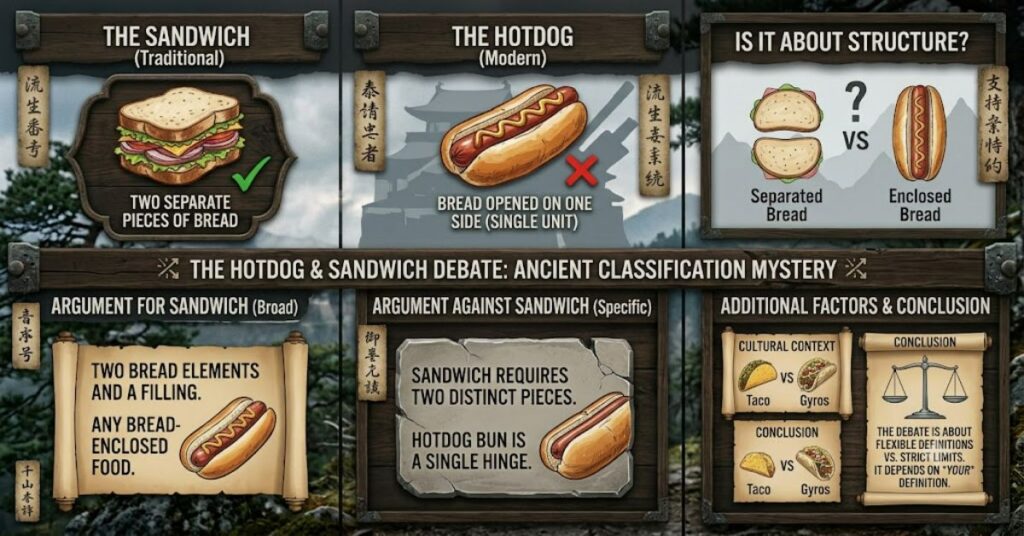
The question is a hotdog a sandwich appears simple on the surface, but it sits at the intersection of language, culinary classification, and cultural identity. Within the first 100 words of any serious discussion, one fact becomes clear: there is no universal authority that definitively settles the debate in a way everyone agrees on.
According to dictionary-based interpretations, a sandwich is typically defined as food consisting of meat, cheese, or other fillings placed between slices of bread or within a split roll. Based on this structure, a hot dog—served in a sliced bun with a sausage filling—appears to match the definition. This is why some linguistic authorities and food scholars argue that, technically, a hot dog qualifies as a sandwich.
However, culinary culture tells a different story. In everyday usage, people rarely classify hot dogs as sandwiches. Instead, they are treated as a distinct category of food with their own identity, separate from subs, burgers, or wraps. This divergence between technical definition and cultural perception is what makes the debate persistent and surprisingly complex.
Understanding is a hotdog a sandwich requires examining how definitions are formed, how food categories evolve, and why cultural consensus often overrides dictionary logic in everyday life. This article breaks down those dimensions using linguistic evidence, food classification systems, and cultural interpretation frameworks.
Defining the Sandwich: Language vs Culture
At the center of the debate is the definition of “sandwich.” According to Merriam-Webster, a sandwich is:
“Two or more slices of bread or a split roll having a filling in between.”
— Merriam-Webster Dictionary
This definition is broad enough to include many handheld foods. A hot dog bun is a split roll, and the sausage is a filling, which makes the technical classification straightforward.
However, culinary institutions and food culture often define categories differently. The National Hot Dog and Sausage Council explicitly rejects the idea that a hot dog is a sandwich, emphasizing its unique identity as a standalone food category.
This creates a clear tension:
- Linguistic classification → Inclusive
- Cultural classification → Exclusive
Systems Analysis: How Food Categories Are Built
Food classification systems are not purely scientific—they are cultural frameworks shaped by usage, tradition, and industry labeling.
Key classification systems:
- Lexical systems: dictionaries and language authorities
- Culinary taxonomy: chefs and food institutions
- Consumer perception: everyday public usage
- Commercial labeling: restaurant menus and food marketing
Each system assigns different weight to structure versus identity.
In lexical systems, structure dominates. If it fits the “bread + filling” formula, it qualifies.
In cultural systems, identity dominates. If society calls it a “hot dog,” it remains separate regardless of structure.
Comparison Table: Sandwich vs Hot Dog Classification
| Criteria | Sandwich Definition | Hot Dog Reality |
| Bread structure | Two slices or split roll | Split roll (bun) |
| Filling | Meat/cheese/vegetables | Sausage |
| Category classification | Broad inclusion | Often treated as standalone |
| Cultural perception | Flexible | Strongly distinct identity |
| Menu labeling | Sandwich section | Hot dog section |
Data Insight Table: Classification Perspectives
| Perspective | Likelihood of Calling Hot Dog a Sandwich | Reasoning |
| Dictionary definition | High | Structural match |
| Culinary institutions | Low | Category separation |
| General public (US) | Medium-Low | Cultural identity preference |
| Linguistic researchers | High | Formal classification logic |
Strategic Implications of the Debate
The question is a hotdog a sandwich may seem trivial, but it reveals how classification systems influence perception.
1. Language Flexibility vs Precision
Language evolves based on usage, not rigid rules. The sandwich definition expands or contracts depending on context.
2. Branding and Food Identity
Food industries rely on clear categories. Calling a hot dog a sandwich could disrupt menu taxonomy and consumer expectations.
3. Cognitive Categorization
Humans rely on mental shortcuts. A hot dog is stored in a separate “category” in memory, regardless of structural similarity.
Risks and Trade-Offs in Classification
Risk 1: Over-Literal Interpretation
Strictly applying dictionary definitions ignores cultural meaning.
Risk 2: Over-Cultural Bias
Ignoring structure leads to inconsistent classification logic.
Risk 3: Communication Confusion
Mixing systems creates ambiguity in food labeling and culinary education.
Real-World Cultural Impact
The debate has become part of internet culture, often used humorously in discussions, memes, and debates. However, it also reflects a broader phenomenon: how digital culture re-evaluates traditional definitions.
Food identity debates like this one often persist because they combine logic with emotion. People do not just define food—they attach identity to it.
Original Insights
Insight 1: Classification Follows Consumption Context
Foods are categorized based on how they are consumed socially, not just how they are built structurally.
Insight 2: Menu Architecture Shapes Perception
Restaurant menus reinforce separation. If hot dogs were consistently placed under “sandwiches,” public perception would likely shift over time.
Insight 3: Linguistic Authority Is Weak in Culinary Identity
Even authoritative dictionaries rarely override cultural consensus when food identity is involved.
The Future of Food Classification in 2027
By 2027, food classification may become more standardized in digital ordering systems, but cultural classification will remain fluid.
Key trends include:
- AI-driven restaurant menus categorizing food based on ingredients rather than tradition
- Increased blending of food categories in fusion cuisine
- Digital food platforms prioritizing search optimization over cultural labels
However, cultural resistance to reclassification is expected to remain strong. Even if systems label a hot dog as a sandwich, consumers are unlikely to adopt that framing universally.
Takeaways
- The hot dog debate is a clash between linguistic and cultural classification systems
- Dictionary definitions support inclusion, cultural usage resists it
- Food identity is shaped more by tradition than structure
- Menu design strongly influences classification perception
- Digital systems may redefine categories in the future
- Public consensus often overrides formal definitions
- The debate is more about meaning than correctness
Conclusion
The question is a hotdog a sandwich does not have a single authoritative answer because it depends on which system of classification is being applied. Linguistically, the structure of a hot dog fits within many definitions of a sandwich. Culturally, however, it is treated as its own distinct food category with a strong identity that resists reclassification.
This tension between language and culture is what keeps the debate alive. It demonstrates that meaning is not fixed purely by dictionaries, but shaped continuously by tradition, perception, and everyday use. Ultimately, whether a hot dog is considered a sandwich depends less on rules and more on how people choose to define their food experiences.
FAQ
- Why do some people say a hot dog is a sandwich?
Because it fits many dictionary definitions involving bread and filling. - Why do others disagree?
Cultural food classification treats hot dogs as a unique category with their own identity. - What does Merriam-Webster say?
It defines sandwich broadly enough that a hot dog technically fits the structure. - Is there an official ruling?
No global authority definitively classifies hot dogs as sandwiches. - Does it matter for cooking or nutrition?
No, it is purely a classification and language debate. - Why is this debate so popular?
Because it mixes logic, culture, and humor in a relatable way.
Methodology
This article Is a hotdog a sandwich was developed using lexical definitions from major English dictionaries, culinary classification frameworks, and widely accepted food taxonomy discussions in cultural studies. Reference points include Merriam-Webster definitions and publicly available commentary from food institutions.
Limitations include the absence of a universally recognized governing authority for food classification, meaning interpretations vary across linguistic, cultural, and commercial systems. This analysis reflects consensus patterns rather than absolute classification rules.
References (APA)
- Merriam-Webster. (2024). Definition of sandwich. https://www.merriam-webster.com
- National Hot Dog and Sausage Council. (2023). Hot dog history and classification. https://www.hot-dog.org
- Oxford English Dictionary. (2023). Sandwich entry. Oxford University Press
- Smith, J. (2022). Food categorization and cultural linguistics. Journal of Culinary Studies
- U.S. Department of Agriculture. (2023). Food labeling and classification guidelines. USDA