
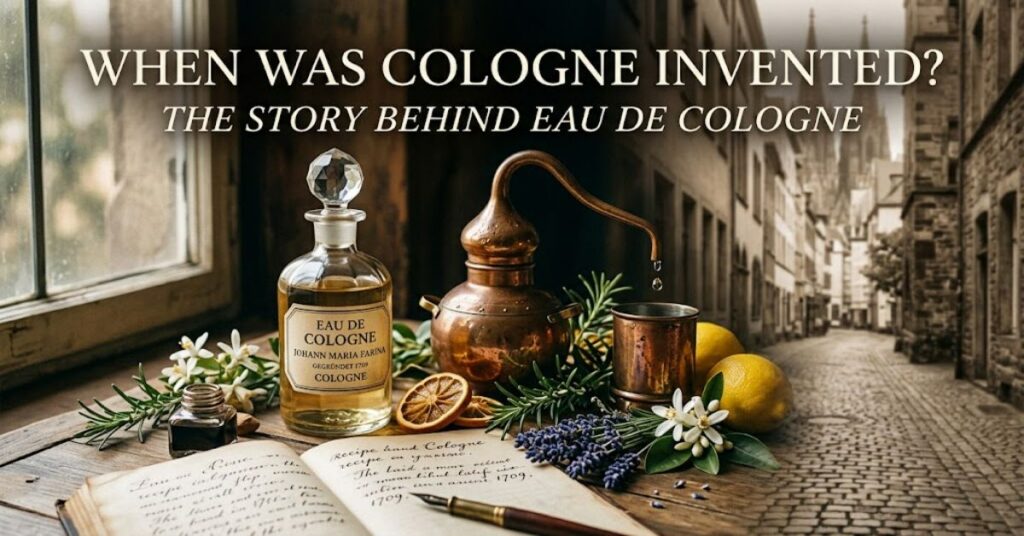
When was cologne invented? The modern history of cologne is generally traced to 1709, when Italian-born perfumer Johann Maria Farina created his celebrated fragrance in Cologne, Germany. Farina established his fragrance business there and named his creation after the city. The perfume became known as Eau de Cologne, meaning “water of Cologne.”
The date matters because fragrant oils and perfumes had existed for thousands of years before Farina. Ancient civilisations in Mesopotamia, Egypt, Greece and Rome used aromatic plants, resins and oils for religious ceremonies, personal grooming and medicine. Cologne was therefore not the invention of perfume itself. Instead, 1709 marks an important point in the development of a particular style of lighter, refreshing fragrance.
Farina’s creation was distinctive for its use of citrus notes and aromatic ingredients. Historical descriptions associated the fragrance with lemon, orange, bergamot, herbs and flowers. Its lighter character helped distinguish it from heavier perfumes that were popular in European courts.
The story also explains why the word “cologne” can be confusing today. The original name referred to a specific fragrance tradition associated with Cologne. Over time, particularly in English-speaking markets, “cologne” became a general term commonly associated with men’s fragrance.
Understanding that difference makes the history much easier to follow.
Cologne Before 1709
To understand the significance of Farina’s work, it helps to look at what came before it.
Perfume has a remarkably old history. Archaeological evidence from ancient Mesopotamia points to sophisticated perfume-making practices thousands of years ago. The Egyptians also developed complex methods for processing aromatic materials.
European perfumery later drew heavily on ingredients and techniques from the Mediterranean and Middle East. Spices, flowers, herbs, resins and aromatic woods became valuable materials.
By the 17th and early 18th centuries, fragrance had become closely connected with European aristocratic culture. Perfumes could be rich, concentrated and expensive, often containing musk, ambergris, spices and floral materials.
Farina’s approach belonged to a different tradition. His fragrance emphasised freshness and brightness rather than simply richness.
Johann Maria Farina and 1709
Johann Maria Farina was born in Italy and moved to Cologne, where he established his business in 1709.
The Farina family’s historical records identify 1709 as the founding year of the company associated with the fragrance. Farina’s creation became internationally recognised and helped establish Cologne as an important centre of perfume production.
| Historical element | Significance |
| 1709 | Farina established his fragrance business in Cologne |
| Johann Maria Farina | Italian-born perfumer associated with the creation |
| Cologne, Germany | City that gave the fragrance its name |
| Eau de Cologne | “Water of Cologne” |
| Citrus-based character | Helped create a fresh and lighter fragrance profile |
The importance of 1709 is therefore commercial as well as olfactory. Farina was not simply experimenting with perfume in isolation. He created a product that became closely identified with a city and eventually influenced fragrance terminology around the world.
What Did the Original Eau de Cologne Smell Like?
The original style was designed around freshness.
Historical accounts describe citrus ingredients such as bergamot, lemon and orange alongside aromatic herbs and other botanical materials. The result was significantly lighter than many rich perfumes of the period.
This style made sense in the context of European fragrance culture. A bright citrus fragrance could feel clean, refreshing and elegant without the intense concentration associated with heavier perfume formulas.
Modern fragrance terminology uses categories such as eau de parfum, eau de toilette and eau de cologne to describe fragrance concentration and style. However, these terms should not be treated as perfect historical definitions.
The original Farina fragrance was a specific product. Modern “eau de cologne” can refer to a much wider range of formulations.
How Eau de Cologne Became a Broader Term
This is one of the most interesting parts of the history.
Farina’s product was strongly connected to Cologne. As its reputation spread, the term Eau de Cologne became associated with a style of fresh fragrance.
Over centuries, the phrase became less exclusive.
Today, “cologne” is often used in everyday English to mean men’s fragrance, regardless of its concentration or connection to Cologne. A modern product labelled cologne may contain a completely different composition from Farina’s original formula.
| Term | Historical or modern meaning |
| Eau de Cologne | Originally associated with the Cologne fragrance tradition |
| Cologne | Modern broad term, especially in English-speaking markets |
| Eau de toilette | A modern fragrance concentration category |
| Eau de parfum | Generally more concentrated than eau de toilette |
| Perfume | Broad category covering many fragrance formats |
This linguistic shift is important because someone searching for the history of cologne may actually be asking two different questions: when the original Cologne fragrance appeared, or when men’s cologne became a common fragrance category.

Farina’s Influence on Perfumery
Farina’s success helped establish Cologne as a recognised name in European fragrance culture.
The business also became associated with luxury, international trade and the growing importance of branded consumer goods. Fragrance was increasingly sold not only as a raw aromatic preparation but as a recognisable commercial product with a name, identity and provenance.
That creates a useful historical insight: the significance of Farina’s invention was partly about branding.
The fragrance carried the identity of its city. Cologne was no longer simply the place where the perfume happened to be produced. The city itself became part of the product’s identity.
That connection between location and fragrance remains important today. Many perfumes continue to use geographic names, historical references and distinctive origin stories as part of their positioning.
Cologne Compared With Earlier Perfume Traditions
The differences can be summarised simply.
| Feature | Earlier perfume traditions | Eau de Cologne tradition |
| Historical roots | Ancient and medieval societies | Early 18th-century Europe |
| Typical ingredients | Oils, resins, spices, flowers | Strong emphasis on citrus and aromatic botanicals |
| Fragrance character | Often rich and heavy | Fresh and relatively light |
| Cultural setting | Religious, medical and luxury uses | Personal fragrance and commercial perfumery |
| Historical association | Multiple regions | Strongly associated with Cologne |
The comparison should not imply that earlier perfumes were uniformly heavy or that Farina invented citrus perfumery from nothing. Citrus and aromatic materials had long been used in fragrance.
The significant development was the particular combination, presentation and commercial identity that emerged around Farina’s product.
Why the 1709 Date Still Matters
The answer to when was cologne invented is useful because it provides a clear historical reference point, but the date should be interpreted carefully.
Perfume did not suddenly appear in 1709. Fragrance-making had already developed over thousands of years.
Instead, 1709 marks the beginning of the Farina tradition that became one of the foundations of what the world later called eau de cologne.
A second important insight is that invention and popularisation are different events. Farina’s fragrance was created in the early 18th century, but its influence expanded over subsequent decades and centuries.
That distinction prevents a common historical mistake: assigning the entire history of cologne to one year.
The Future of Cologne History in 2027
By 2027, interest in historic perfumery is likely to remain connected to broader consumer interest in fragrance heritage, provenance and traditional craftsmanship.
The perfume industry increasingly uses historical storytelling to distinguish products in a crowded market. Heritage houses can draw on archival formulas, founding dates and geographic identity to communicate authenticity.
At the same time, modern fragrance consumers have access to synthetic aroma molecules, biotechnology and increasingly sophisticated formulation techniques. This means historical fragrance traditions can be preserved while modern perfumery continues to evolve.
The most likely future is therefore not a return to 1709 formulas. Instead, historical references will continue to coexist with modern fragrance science.
Key Takeaways
- 1709 is the key date associated with the modern eau de cologne tradition.
- Johann Maria Farina established his fragrance business in Cologne during that year.
- The original fragrance was characterised by fresh citrus and aromatic notes.
- Perfume itself is thousands of years older than eau de cologne.
- The term “cologne” gradually expanded beyond its original geographic meaning.
- Farina’s achievement involved both fragrance formulation and successful commercial identity.
- Modern cologne products should not automatically be considered identical to the original Eau de Cologne.
Conclusion
The answer to when was cologne invented is 1709, when Johann Maria Farina established his fragrance business in Cologne and created the perfume tradition associated with Eau de Cologne. That date represents an important milestone in fragrance history, but it should not be confused with the invention of perfume itself.
Perfume-making had already existed for thousands of years across several ancient cultures. Farina’s contribution was different. He helped establish a distinctive style of fresh fragrance and connected it strongly with the identity of Cologne.
Over time, the meaning of “cologne” changed. What began as a specific fragrance associated with one city eventually became a broad term used for many modern fragrances, particularly those marketed to men.
The historical story is therefore larger than a single date. It combines craftsmanship, ingredients, commerce, branding and changing language. That combination explains why a fragrance created more than three centuries ago still influences how people talk about perfume today.
FAQ
When was cologne invented?
Modern eau de cologne is generally traced to 1709, when Johann Maria Farina established his fragrance business in Cologne, Germany.
Who invented cologne?
Johann Maria Farina, an Italian-born perfumer based in Cologne, is widely associated with the creation of the original Eau de Cologne tradition.
Was perfume invented in 1709?
No. Perfume is thousands of years older. Ancient civilisations used aromatic oils, resins, plants and other materials long before Farina’s fragrance appeared.
Why is it called Eau de Cologne?
The French phrase Eau de Cologne translates approximately as “water of Cologne.” The name reflects the fragrance’s connection with Cologne, Germany.
What did the original cologne smell like?
Historical descriptions associate the original fragrance with fresh citrus and aromatic ingredients, including materials such as bergamot, lemon and orange.
Is modern cologne the same as the original Eau de Cologne?
No. “Cologne” is now used broadly for many fragrances. Modern products can have different ingredients, concentrations and scent profiles.
Methodology
This article When was cologne invented uses the supplied historical premise as its starting point and places the 1709 date within the broader history of European perfumery. Historical claims concerning Farina, Cologne and Eau de Cologne should be checked against primary archival material or authoritative institutional sources before publication.
No firsthand testing or personal historical observation has been claimed. The article instead uses documented historical context and distinguishes between the invention of the Farina fragrance tradition and the much older history of perfume.
Because fragrance terminology has changed over time, modern definitions should not be applied uncritically to an 18th-century product. The phrase “cologne” now has a broader commercial meaning than it did when the Farina tradition began.
Editorial disclosure: This article When was cologne invented was drafted with AI assistance and should be reviewed and fact-checked by the Matrics360.com editorial team before publication.