
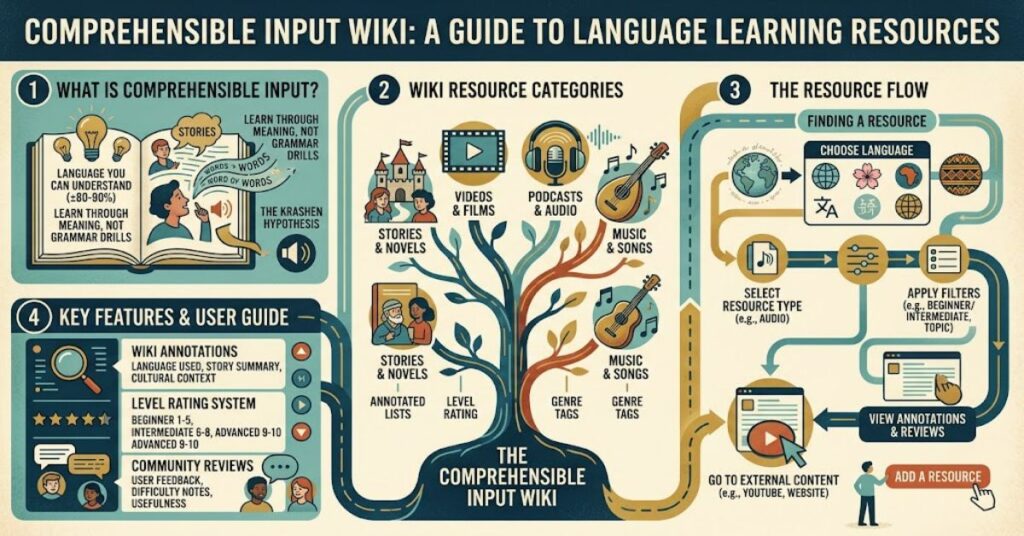
The Comprehensible Input Wiki is a community-maintained archive designed to help language learners find materials that fit the principles of comprehensible input. Rather than functioning as a conventional language course, it acts more like a directory, bringing together resources such as videos, podcasts, easier native content, children’s material, and other input-focused resources.
The idea behind comprehensible input is closely associated with Stephen Krashen’s Comprehension Hypothesis. In simple terms, learners need to understand meaningful language messages in order for acquisition to occur. The wiki applies this principle in a practical way by helping learners locate material they can understand without requiring every word to be translated or formally explained.
The resource is particularly useful because finding suitable input is one of the biggest practical problems with immersion-based learning. A beginner can easily encounter native content that is far too difficult, while an advanced learner can waste time with material that provides little linguistic challenge.
The wiki attempts to narrow that gap by organising resources according to language and learner accessibility. Community discussions also show that users contribute new resources and sections, making the directory an evolving project rather than a fixed textbook.
What Is the Comprehensible Input Wiki?
The Comprehensible Input Wiki is essentially a searchable reference point for people interested in learning languages through understandable exposure.
Its resources can include:
- Learner-focused YouTube channels
- Podcasts and audio programmes
- Graded listening materials
- Easier native-language content
- Children’s content
- Reading resources
- Materials organised by language and approximate level
The distinction between this type of directory and a traditional language-learning platform is important. A course normally provides a planned sequence of lessons. A wiki provides choices.
That flexibility can be valuable for independent learners who prefer to build their own immersion routine.
Community reports indicate that the project covers a wide range of languages, although resource availability is not equal across them. Popular languages naturally tend to have larger collections than less commonly studied languages.
How Comprehensible Input Works
Comprehensible input is based on the idea that language becomes easier to acquire when learners can understand the message even if some individual words or grammatical structures are unfamiliar.
Context is critical.
A learner watching a video about cooking may not know every verb, but visual demonstrations can reveal what is happening. Repetition can reinforce vocabulary. Facial expressions, gestures, images, and familiar situations can provide additional meaning.
This creates an important difference between exposure and comprehensible exposure.
Simply hearing a foreign language does not guarantee understanding. If a learner watches a programme where almost every sentence is incomprehensible, the experience may provide exposure without offering the same benefits as material that can actually be followed.
A recent pilot study published in the Journal of Applied Linguistics and TESOL reported lower comprehension, listening, and reading performance during incomprehensible-input conditions among its small sample of intermediate learners. The researchers also reported greater cognitive effort associated with incomprehensible material. The study was preliminary and involved only two learners, so it should not be treated as universal proof.
The Role of the Wiki in Language Learning
The strongest feature of the Comprehensible Input Wiki is not that it teaches grammar or vocabulary directly. Its strength is resource discovery.
| Traditional resource search | Wiki-based discovery |
| Search the web manually | Browse organised language resources |
| Often difficult to judge level | Resources may be grouped by difficulty |
| Requires many separate searches | Multiple sources can be found in one place |
| Often focused on courses | Supports broader immersion |
| Learner chooses individual resources | Community helps identify useful materials |
This difference matters for learners who want to spend more time consuming language and less time searching for it.
A learner studying Spanish, Japanese, Mandarin, German, or another widely represented language may find enough options to build a varied routine.
Choosing the Right Level
One of the most important practical decisions is selecting material that is neither completely effortless nor overwhelmingly difficult.
| Input level | Likely experience | Practical use |
| Very easy | Almost everything is understood | Confidence and consolidation |
| Comfortable | Most meaning is clear | Regular learning input |
| Slightly challenging | Some new language appears in context | Potential growth area |
| Difficult | Frequent comprehension gaps | Use selectively |
| Extremely difficult | Meaning is largely lost | Poor choice for primary input |
The concept often associated with Krashen’s work is i+1, meaning language slightly beyond the learner’s current competence. However, learners should not treat i+1 as a precise mathematical measurement. There is no universal test that can identify exactly one unit of linguistic difficulty above a learner’s current level.
That is one of the wiki’s practical limitations: resource labels can guide learners, but personal comprehension still matters.
What Makes the Wiki Useful?
Three features make the resource particularly valuable.
1. It reduces search friction
The internet contains enormous amounts of language content, but quantity can become a problem. A learner may spend an hour searching for beginner-level material without actually learning anything.
A curated directory reduces that initial discovery burden.
2. It encourages variety
Language learners can become dependent on one teacher, one podcast, or one course. A resource directory makes it easier to find different voices, subjects, accents, and formats.

That variety can make sustained immersion more interesting.
3. It supports less conventional learning paths
Not every learner wants a textbook-first approach. Some prefer listening heavily before speaking, while others combine immersion with grammar study and conversation practice.
The wiki provides resources rather than forcing one rigid schedule.
Limitations and Risks
The Comprehensible Input Wiki should not be treated as proof that every listed resource is effective.
Because it is community-driven, entries can change. Some resources may disappear, change quality, introduce paid tiers, or stop producing new material.
There is also a broader theoretical limitation. Comprehensible input is influential, but second-language acquisition research does not support reducing language learning to input alone. Research has examined interaction, output, attention, feedback, and other factors.
A recent critical review argues that contemporary language learning should consider richer interactions between learners and their environments rather than treating simplified input as a complete explanation of acquisition.
That does not make comprehensible input useless. It means learners should avoid turning a useful principle into an exclusive doctrine.
How to Use the Wiki Effectively
A practical workflow can be simple:
- Choose one target language.
- Start with beginner or low-level resources.
- Select content you can follow without translating every sentence.
- Listen or read consistently.
- Increase difficulty gradually.
- Add different speakers and subjects.
- Introduce conversation and output when appropriate.
- Review progress based on actual comprehension rather than labels alone.
The key is consistency.
A learner who spends 20 minutes with understandable material every day may develop a more sustainable routine than someone who chooses extremely difficult content and abandons the process after a week.
The Future of Comprehensible Input Wiki in 2027
By 2027, community-maintained language directories are likely to face both opportunities and challenges.
AI-generated language content could dramatically increase the amount of graded material available to learners. Systems can potentially adjust vocabulary, speaking speed, topic difficulty, and repetition to individual needs.
However, more content does not automatically mean better content.
A major challenge will be quality control. Community directories may increasingly need ways to distinguish active resources from abandoned ones and human-created materials from low-quality automated content.
Another likely development is more precise filtering. Learners may expect resources to be organised by CEFR level, speaking speed, accent, topic, transcript availability, and estimated comprehension difficulty.
The infrastructure is already moving in that direction across the wider language-learning market, but the exact future of any individual wiki remains uncertain.
Key Takeaways
- The Comprehensible Input Wiki is primarily a resource directory, not a structured language course.
- Its central value is helping learners discover understandable target-language content.
- Resource selection should be based on actual comprehension, not labels alone.
- Community contributions make the directory useful but also create quality-control limitations.
- Comprehensible input is an important learning principle, but it should not automatically replace interaction, output, or other learning activities.
- Beginners should start with highly contextual material and increase difficulty gradually.
Conclusion
The Comprehensible Input Wiki fills a practical gap in modern language learning. Learners often know that immersion can help, yet struggle to find material that matches their current ability. A community-maintained directory provides a simple solution by collecting and organising resources in one place.
Its greatest strength is therefore convenience rather than instruction. It helps learners find videos, podcasts, reading material, and other forms of understandable language without requiring them to discover every resource independently.
At the same time, the wiki should be viewed as a starting point rather than a complete learning system. Community listings can change, resource quality varies, and comprehensible input is only one part of the wider second-language acquisition discussion.
Used thoughtfully, however, the directory can make immersion more accessible. The most effective approach is to use it to build a steady stream of understandable content while adapting difficulty, adding variety, and combining input with other activities as a learner’s needs develop.
FAQ
What is the Comprehensible Input Wiki?
It is a community-maintained directory that collects language-learning resources designed around comprehensible input, including videos, podcasts, reading materials, and easier native content.
Is the Comprehensible Input Wiki free?
The wiki itself functions as a resource directory. However, individual resources listed within it may be free, paid, or available through different access models.
Is the Comprehensible Input Wiki good for beginners?
Yes, provided beginners select genuinely accessible material. Visual support, slow speech, repetition, familiar subjects, and learner-focused content can make early input easier to understand.
What is comprehensible input in language learning?
Comprehensible input is language that learners can understand for meaning even when they do not know every word or grammatical structure.
Does comprehensible input mean you should never study grammar?
No. Learners can combine comprehensible input with grammar study, vocabulary review, conversation, writing, and other methods. The best balance depends on the learner’s goals and preferences.
Is the wiki a language course?
No. It is better understood as a directory or discovery tool. It helps learners find resources but does not necessarily provide a single sequential curriculum.
Methodology
This article was developed from the supplied description of the Comprehensible Input Wiki and cross-checked against publicly available descriptions of the wiki, community discussions, and recent research concerning comprehensible and incomprehensible input.
The analysis does not claim firsthand testing of the wiki or personal experience with individual resources. Community reports were used to understand how the directory is structured and perceived, while academic sources were used to provide context for the underlying learning theory.
The main limitation is that a community-driven resource directory can change rapidly. Individual entries, availability, quality, and categorisation may differ over time. Claims about language acquisition should also be interpreted in light of the broader second-language acquisition literature rather than attributed exclusively to one methodology.
References
Krashen, S. D. (1982). Principles and practice in second language acquisition. Pergamon Press.
Loschky, L. (2008). Comprehensible input and second language acquisition: What is the relationship? Studies in Second Language Acquisition, 30(2), 169–192.
Tariq, N., & Malghani, L. R. (2026). Examining the differential effects of comprehensible and incomprehensible input on second language acquisition: A pilot crossover study. Journal of Applied Linguistics and TESOL.
Comprehensible Input Wiki. (2025–2026). Comprehensible Input Wiki. Community-maintained language-learning resource archive.