
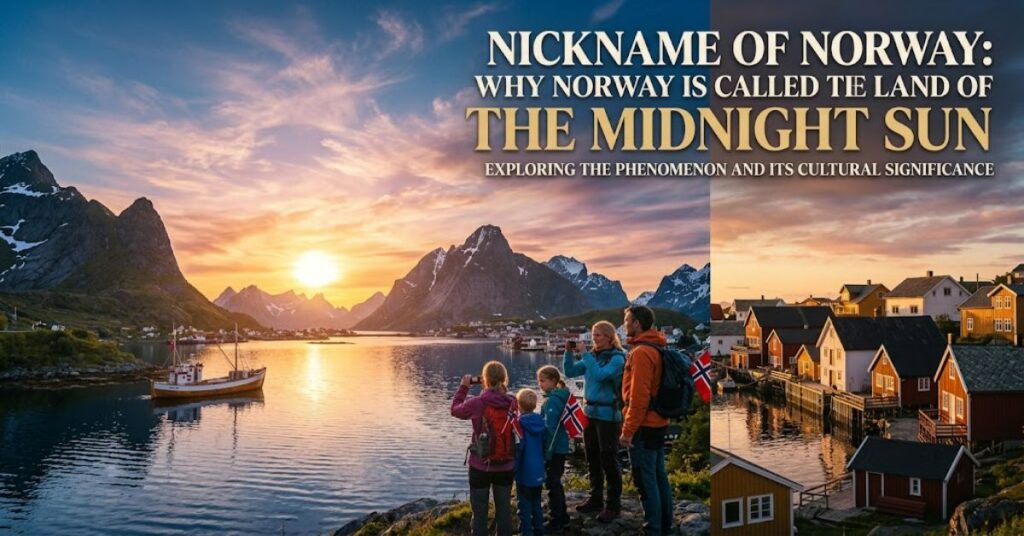
The most famous nickname of Norway is “The Land of the Midnight Sun.” This name comes from a remarkable natural phenomenon found in the northern part of the country. During summer, areas located above the Arctic Circle can experience periods when the sun does not set below the horizon, meaning daylight can continue through midnight and into the following morning.
Norway’s long north-to-south geography makes the phenomenon especially interesting. The farther north a traveller goes, the longer the period of continuous summer daylight becomes. Locations such as Tromsø experience the midnight sun for several weeks, while Svalbard has an even longer period of uninterrupted daylight.
The nickname is not simply a tourism slogan. It reflects Norway’s position on Earth and the effect of the planet’s tilted axis. It also has an important connection to northern Norwegian culture, outdoor activities and tourism.
During these bright summer months, visitors can hike, fish, photograph landscapes, kayak and explore coastal areas late at night without needing artificial light. The experience can feel unusual for travellers accustomed to a clear separation between daytime and night.
Understanding why Norway has this nickname requires a closer look at its geography, seasonal changes and the science behind the midnight sun.
Why Is Norway Called the Land of the Midnight Sun?
Norway is called the Land of the Midnight Sun because parts of the country experience sunlight at midnight during the northern summer.
The phenomenon is possible because Earth is tilted on its axis. During summer in the Northern Hemisphere, the North Pole is tilted towards the Sun. As Earth rotates, areas close to and beyond the Arctic Circle can remain exposed to sunlight throughout the entire rotation.
The Arctic Circle is located at approximately 66.5 degrees north latitude. Above this line, the possibility of continuous daylight occurs during part of the year.
Norway stretches far into the Arctic region, making it one of the most accessible countries for experiencing the midnight sun.
However, it is important to understand that not every part of Norway experiences the true midnight sun. Southern cities can have extremely long summer evenings, but the sun still goes below the horizon. Continuous daylight is mainly associated with the country’s northern territories.
How Does the Midnight Sun Work?
The midnight sun is directly connected to Earth’s axial tilt and its yearly journey around the Sun.
| Factor | Effect |
| Earth’s axial tilt | Tilts the Northern Hemisphere towards the Sun during summer |
| High latitude | Makes prolonged daylight possible |
| Arctic Circle | Marks the approximate southern boundary of the midnight sun |
| Location farther north | Generally produces a longer period of continuous daylight |
| Winter season | Produces the opposite phenomenon, known as polar night |
During the northern summer, the Sun appears to travel around the sky without disappearing completely below the horizon in Arctic regions.
At midnight, it may sit very low above the northern horizon. A few hours later, instead of becoming completely dark, the Sun rises higher again.
This creates a strange but beautiful visual experience. The landscape may look as though it is experiencing sunset and sunrise at almost the same time.
The same principle produces the opposite effect during winter. In northern Norway, the Sun can remain below the horizon for an extended period, creating the polar night.
Where Can You Experience the Midnight Sun?
Northern Norway provides some of the world’s most accessible places for experiencing continuous summer daylight.
Tromsø
Tromsø is one of the country’s most popular Arctic destinations. Its location well above the Arctic Circle gives visitors several weeks of midnight sun during summer.
The city is also surrounded by mountains, islands and fjords, making it a practical base for outdoor activities.
Visitors can combine the unusual daylight with hiking, boat trips, photography and sightseeing. The city’s infrastructure also makes the phenomenon relatively easy to experience without travelling deep into remote wilderness.
Lofoten
The Lofoten Islands offer a more dramatic natural setting.
Sharp mountains, fishing villages, beaches and narrow waterways create a striking landscape beneath the low Arctic sun. The midnight light can give the mountains a warm glow while the surrounding sea reflects the changing colours.
Lofoten is particularly attractive to photographers because the Sun remains relatively low in the sky, producing long shadows and soft evening light.
North Cape
The North Cape is one of the northernmost points accessible to travellers in mainland Norway.
Its extreme northern position means visitors can experience a lengthy period of midnight sun. The dramatic cliffs overlooking the Arctic Ocean make it one of the country’s most recognisable locations for watching the phenomenon.
Svalbard
Svalbard has an even more extreme relationship with seasonal daylight.
The Arctic archipelago experiences midnight sun for several months. Its remote environment, glaciers, mountains and polar landscapes provide a very different experience from mainland Norway.
Because of its location and Arctic conditions, travelling around Svalbard requires more preparation than visiting cities such as Tromsø.
Midnight Sun Periods by Location
The duration varies according to latitude.
| Location | Approximate Midnight Sun Period |
| Arctic Circle | Around mid-June to early July |
| Lofoten | Late May to mid-July |
| Tromsø | Late May to late July |
| North Cape | Mid-May to late July |
| Svalbard | Late April to late August |
These dates are approximate. Weather, mountains and local geography can influence how clearly the Sun is visible.
The overall pattern is straightforward: the farther north you travel, the longer the period of continuous daylight becomes.
What Does the Midnight Sun Feel Like?
For first-time visitors, the biggest surprise may be how difficult it is to judge the time of day.
At 11 p.m., the landscape can still appear bright. At midnight, the sky may have warm golden tones. Even at 1 or 2 a.m., outdoor activities can remain possible without artificial lighting.
This changes the way travellers experience time.
A person could finish dinner late at night and immediately go hiking. A photographer can begin a landscape session after midnight. Anglers can fish during hours that would normally be completely dark.
The phenomenon can also affect sleep. People who are used to darkness at night may find the constant daylight distracting. Accommodation with blackout curtains can therefore be particularly useful.
For residents, however, the midnight sun is part of the normal seasonal rhythm rather than a permanent tourist attraction.
The Cultural Meaning of Norway’s Nickname
The nickname connects Norway’s natural environment with its cultural identity.
Northern communities have adapted to major changes in daylight throughout the year. Summer brings exceptionally long days, while winter brings much darker conditions.
This seasonal contrast influences outdoor life, tourism and local routines.
The midnight sun has also become an important part of Norway’s international tourism image. It represents the country’s Arctic geography and gives visitors an experience that is difficult to reproduce elsewhere.
For travellers, however, it is useful to remember that northern Norway is not simply a place of endless sunshine. Weather can remain cloudy, rainy or cool even when the Sun technically remains above the horizon.
The midnight sun describes the position of the Sun, not a guarantee of clear skies.
Benefits and Challenges of the Midnight Sun
The unusual daylight creates several advantages for visitors.
Benefits:
- Longer opportunities for outdoor activities
- Excellent conditions for landscape photography
- More flexible sightseeing schedules
- Unique Arctic travel experiences
- Extended opportunities for hiking and boating
There are also practical challenges.
Challenges:
- Difficulty sleeping in constant daylight
- Cool temperatures despite visible sunshine
- Sudden changes in Arctic weather
- Limited visibility when clouds cover the sky
- Need for proper sleep and eye protection
One of the most common misunderstandings is that continuous daylight means continuous warmth. Northern Norway can remain cool, particularly around coastal areas.
Travellers should therefore pack for changing conditions rather than relying on the presence of sunlight.
Three Things Travellers Often Get Wrong
The Whole Country Does Not Experience the Midnight Sun
Norway’s nickname can create the impression that the entire country has 24-hour summer daylight.
That is not correct.
The phenomenon is concentrated in the northern part of the country. Southern Norway has long summer evenings, but the Sun still disappears below the horizon.
Midnight Sun Does Not Mean the Sun Stays High
The Sun does not remain directly overhead throughout the night.
It can move very close to the horizon around midnight, creating beautiful golden and orange light before rising again.
This low position is one reason the phenomenon is particularly attractive for photography.
Summer Daylight Has a Winter Opposite
The same geography that produces the midnight sun also creates the polar night.
During the darkest part of winter, northern areas can experience long periods without direct sunlight.
This creates a remarkable seasonal contrast: endless summer daylight followed by extended winter darkness.
The Future of the Nickname of Norway in 2027
The Land of the Midnight Sun is likely to remain an important part of Norway’s tourism identity in 2027.
Northern Norway has increasingly been promoted around nature-based experiences, outdoor recreation, Arctic landscapes and seasonal phenomena. The midnight sun fits naturally into this approach because visitors can experience it through hiking, photography, kayaking, fishing and other activities.
The biggest opportunity is likely to be responsible tourism rather than simply attracting larger numbers of visitors.
Northern environments can be fragile, and remote communities have limited infrastructure compared with major European cities. Sustainable travel, careful visitor management and respect for local communities will remain important.
The nickname itself is unlikely to lose its appeal. Its strength comes from something that cannot easily be manufactured: a real astronomical phenomenon shaped by Norway’s geography.
Key Takeaways
- Norway is widely known as the Land of the Midnight Sun.
- The phenomenon occurs mainly north of the Arctic Circle.
- Tromsø and Lofoten are popular mainland destinations.
- The North Cape offers an especially far-north experience.
- Svalbard experiences one of Norway’s longest periods of continuous daylight.
- Earth’s axial tilt is responsible for the phenomenon.
- The polar night creates the opposite seasonal effect.
Conclusion
The nickname The Land of the Midnight Sun captures one of Norway’s most remarkable natural characteristics. It is based on a genuine geographical and astronomical phenomenon rather than simply being a promotional phrase.
In northern parts of the country, summer brings periods when the Sun remains above the horizon throughout the night. The experience becomes increasingly pronounced as travellers move farther north, with destinations such as Tromsø, Lofoten, the North Cape and Svalbard offering memorable opportunities to witness it.
The nickname also represents something deeper about Norway’s identity. Seasonal changes in daylight have shaped life, tourism and outdoor culture across the country’s northern regions.
For anyone searching for the nickname of Norway, the answer is therefore straightforward: Norway is widely known as the Land of the Midnight Sun, a name inspired by the extraordinary summer daylight found across its northern territories.
FAQ
What is the nickname of Norway?
The most famous nickname associated with Norway is “The Land of the Midnight Sun.” It refers to the continuous summer daylight experienced in northern areas of the country.
Why is Norway called the Land of the Midnight Sun?
Norway has this nickname because areas north of the Arctic Circle can experience periods when the Sun remains above the horizon at midnight during summer.
Does all of Norway experience the midnight sun?
No. The true midnight sun occurs mainly in northern Norway. Southern areas experience long summer days but do not have continuous daylight in the same way.
Where can you see the midnight sun in Norway?
Popular locations include Tromsø, Lofoten, the North Cape and Svalbard. Each location has a different period of continuous daylight depending on its latitude.
What is the opposite of the midnight sun?
The opposite phenomenon is called the polar night. It occurs during winter when the Sun remains below the horizon for an extended period in far northern regions.
When is the best time to experience the midnight sun?
The best period depends on the destination. Generally, late spring and summer provide the best opportunities, with northern locations experiencing longer periods of continuous daylight.
Methodology
This article Nickname of Norway is based on established geographical and astronomical information about Norway’s midnight sun. The explanation of Earth’s axial tilt, the Arctic Circle and seasonal daylight follows standard scientific understanding.
Destination information was assessed using publicly available tourism information concerning Northern Norway and its principal midnight-sun destinations. Dates for the phenomenon are approximate because visibility can vary according to location, weather and local terrain.
No firsthand testing or personal travel experience is claimed. The article also avoids presenting the nickname as an official governmental title. “The Land of the Midnight Sun” is best understood as a widely used descriptive nickname connected with Norway’s northern geography.
Editorial Disclosure: This article was drafted with AI assistance and should be reviewed and fact-checked by a human editor before publication.