
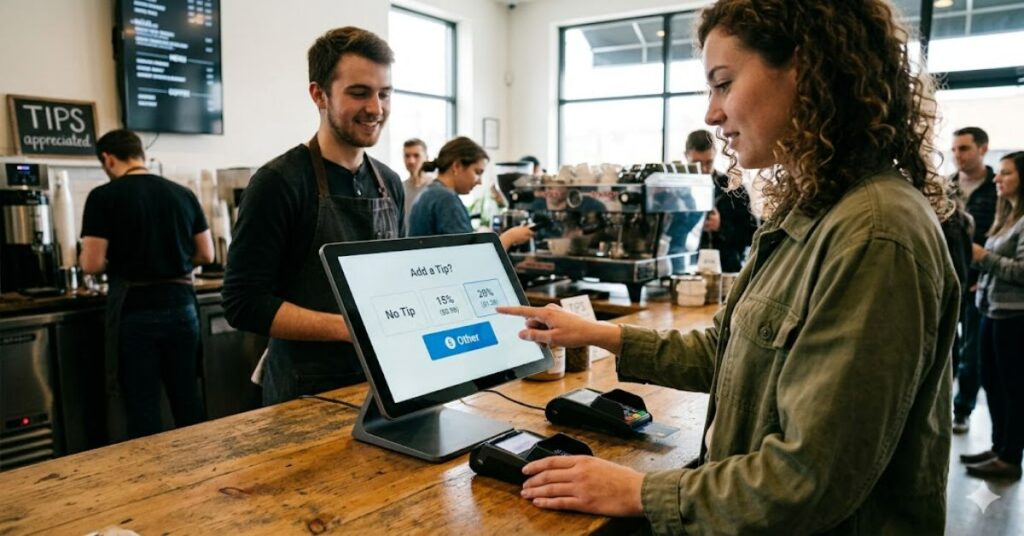
A tip screen is the digital interface displayed on a payment terminal, point-of-sale (POS) tablet, kiosk, or mobile payment device that asks customers whether they would like to leave a gratuity before completing a transaction. Over the last decade, tip screens have largely replaced traditional tip jars as cash usage has declined and digital payments have become the preferred payment method across many industries.
Today, customers encounter tipping prompts almost everywhere. Coffee shops, restaurants, food trucks, salons, ride-sharing services, delivery apps, and even self-service kiosks frequently display suggested gratuity amounts before payment is finalized.
The rapid growth of digital tipping has sparked debate among consumers, business owners, economists, and service workers. Supporters argue that tip screens provide a convenient way to reward workers and compensate for declining cash usage. Critics contend that aggressive tipping prompts create social pressure and contribute to what many describe as “tip fatigue.”
Understanding how tip screens work requires looking beyond the checkout screen itself. They represent a broader shift in payment technology, consumer psychology, labor economics, and business strategy. As payment systems become increasingly digital, the humble tip screen has evolved into a powerful influence on customer behavior and service industry income.
This article examines the technology behind tip screens, their advantages and disadvantages, their impact on businesses and consumers, and what their future may look like in the years ahead.
What Is a Tip Screen?
A tip screen appears during the payment process and asks customers whether they would like to add a gratuity.
Most systems present several options:
- Percentage-based tips (15%, 20%, 25%)
- Fixed-dollar amounts
- Custom tip amounts
- No tip option
The interface is typically integrated into a POS platform such as:
- Square
- Toast
- Clover
- Lightspeed
- Shopify POS
The objective is simple: make tipping easier in a world where fewer customers carry cash.
From Tip Jar to Digital Interface
Historically, workers relied on physical tip jars and cash gratuities.
As electronic payments became dominant, businesses faced a challenge. Customers who wanted to tip often had no convenient way to do so.
The tip screen emerged as a technological solution.
How Tip Screens Work
Digital tipping systems are integrated directly into payment workflows.
Standard Checkout Process
| Step | Customer Action |
| 1 | Purchase is entered into POS system |
| 2 | Total appears on payment terminal |
| 3 | Tip screen displays gratuity options |
| 4 | Customer selects amount or skips |
| 5 | Payment is processed |
| 6 | Receipt is generated |
The process typically adds only a few seconds to checkout.
Behind-the-Scenes Technology
Modern tipping systems rely on:
- POS software
- Payment gateways
- Merchant accounts
- Digital receipt systems
- Payroll integration
In many businesses, tips can be automatically tracked and distributed through payroll systems.
Why Businesses Use Tip Screens
Businesses adopt digital tipping systems for several reasons.
Increased Employee Earnings
The most obvious benefit is additional income for workers.
Many employees report receiving more tips after businesses implement digital tipping options because customers no longer need cash.
Simplified Operations
Digital tipping offers:
- Automated tracking
- Easier reporting
- Reduced cash handling
- Payroll integration
Higher Customer Convenience
Consumers increasingly expect card and mobile payment options.
A tip screen allows customers to complete the entire transaction without needing cash.
Comparison Table: Traditional Tip Jar vs Tip Screen
| Factor | Traditional Tip Jar | Digital Tip Screen |
| Convenience | Requires cash | Works with cards and mobile payments |
| Tracking | Manual | Automated |
| Reporting | Difficult | Integrated |
| Visibility | Physical | Digital |
| Suggested Amounts | None | Yes |
| Analytics | Limited | Extensive |
| Remote Payments | Not possible | Supported |
The Psychology Behind Digital Tipping
One reason tip screens generate debate is their influence on customer behavior.
Behavioral economics suggests that people often respond differently when choices are presented visually and publicly.
Suggested Percentages Matter
Research consistently shows that default options influence decision-making.
When a customer sees:
- 18%
- 22%
- 25%
Many choose one of those options rather than entering a custom amount.
Social Visibility
A tip jar provides privacy.
A tip screen often appears directly in front of employees.
This visibility can influence customer choices, even when no pressure is intended.
The Convenience Effect
Adding a gratuity requires only a tap.
Reducing friction often increases participation rates.
Benefits of Tip Screens
For Employees
Workers gain:
- Increased tipping opportunities
- Reduced dependence on cash
- More consistent income tracking
For Businesses
Businesses benefit from:
- Improved employee satisfaction
- Simplified tip management
- Better reporting capabilities
For Customers
Customers enjoy:
- Convenience
- Flexible payment methods
- Faster checkout experiences
Common Criticisms of Tip Screens
Despite their popularity, tip screens remain controversial.
Tip Fatigue
Consumers increasingly encounter tipping prompts in situations where tipping was historically uncommon.
Examples include:
- Retail counters
- Self-service kiosks
- Convenience stores
This expansion has contributed to growing frustration among some consumers.
Perceived Pressure
Many customers report feeling uncomfortable selecting “No Tip” when employees can observe the transaction.
Rising Suggested Percentages
Historically, tipping expectations ranged between 10% and 15%.
Today, many systems default to 18%, 20%, or higher.
Some customers view this as excessive.
Three Underreported Insights About Tip Screens
Insight 1: The Interface Design Often Matters More Than the Percentage
Small design choices influence outcomes significantly.
Button size, color contrast, placement, and wording can affect tipping behavior more than percentage levels themselves.
Insight 2: Businesses Face a Brand Risk
Aggressive tipping prompts can damage customer relationships.
Some consumers associate excessive tipping requests with poor business practices rather than employee compensation.
Insight 3: Transparency Improves Trust
Businesses that clearly explain where tips go often experience less customer resistance.
Transparency reduces uncertainty and increases perceived fairness.
Real-World Examples
Coffee Shops
Independent cafés commonly use tablet-based payment systems that display tip prompts immediately after order entry.
Food Delivery Apps
Digital tipping has become a core feature of app-based delivery services.
Customers can often tip:
- Before delivery
- During delivery
- After delivery
Salons and Personal Services
Many service providers now receive gratuities through integrated POS systems rather than cash payments.
Industry Impact
Tip screens have changed how businesses approach compensation.
Labor Economics
Service workers increasingly depend on digital tipping channels.
In some sectors, gratuities represent a substantial portion of total earnings.
Customer Expectations
Consumers now expect digital payment flexibility, including digital gratuity options.
Technology Adoption
POS providers continue investing in:
- Better tipping interfaces
- Analytics dashboards
- Payroll integration
- Customer behavior tracking
Industry Insight Table
| Trend | Current Impact | Business Significance |
| Cashless Payments | High | Expands digital tipping |
| Mobile Wallet Adoption | High | Increases tip screen usage |
| Self-Service Checkout | Growing | Creates new tipping questions |
| Consumer Pushback | Moderate | Influences design decisions |
| Labor Cost Pressure | High | Encourages gratuity collection |
| Payment Automation | Growing | Improves reporting accuracy |
The Future of Tip Screen in 2027
The future of the tip screen will likely be shaped by consumer expectations and payment innovation.
Several developments appear likely by 2027:
Greater Personalization
Payment systems may adjust suggested tip amounts based on:
- Transaction type
- Industry norms
- Customer preferences
Increased Transparency
Businesses may provide more information about:
- Tip distribution
- Employee compensation
- Service charges
Regulatory Attention
Governments may examine:
- Disclosure requirements
- Consumer transparency standards
- Fee structures
AI-Powered Checkout Experiences
Artificial intelligence may help businesses optimize checkout flows while balancing customer satisfaction and employee earnings.
However, businesses will need to avoid creating experiences that feel manipulative or coercive.
Key Takeaways
- Tip screens emerged as cash payments declined.
- Digital tipping has become standard across many service industries.
- Businesses benefit from automation and simplified reporting.
- Employees often earn more when digital tipping options are available.
- Consumers appreciate convenience but may experience tipping fatigue.
- Interface design strongly influences tipping behavior.
- Transparency will likely become a major competitive advantage.
Conclusion
The tip screen has become one of the most recognizable features of modern commerce. What began as a practical solution to declining cash usage has evolved into an important component of customer experience, employee compensation, and payment technology strategy.
For businesses, digital tipping provides operational efficiencies and additional earning opportunities for workers. For consumers, it offers convenience and flexibility. Yet the same technology also raises important questions about social pressure, transparency, and the expanding boundaries of tipping culture.
The ongoing debate is not really about screens. It is about expectations. As payment technology continues to evolve, businesses will need to balance profitability, employee welfare, and customer trust. The organizations that achieve that balance are likely to see the greatest long-term success.
FAQ
What is a tip screen?
A tip screen is a digital checkout interface that asks customers whether they want to leave a gratuity before completing a payment.
Why are tip screens becoming more common?
They have grown alongside card payments, mobile wallets, and cashless transactions, replacing traditional tip jars in many businesses.
Are businesses required to include tip screens?
No. Businesses choose whether to enable tipping features through their POS systems.
Can customers skip a tip screen?
Yes. Most systems provide a no-tip option, although its visibility may vary by platform.
Do tip screens increase employee earnings?
Many businesses report higher gratuity collection after implementing digital tipping options because customers no longer need cash to leave a tip.
Why do some consumers dislike tipping screens?
Common concerns include tipping fatigue, social pressure, and increasing suggested tip percentages.
Methodology
This article was created using publicly available information regarding payment technology, point-of-sale systems, consumer behavior research, and digital commerce trends. Industry practices were analyzed through documentation from major POS providers and payment technology platforms.
Limitations include regional differences in tipping culture, evolving payment regulations, and varying business practices across industries.
Editorial Disclosure: This article was drafted with AI assistance and reviewed and verified by the editorial team at Matrics360.com. All data, references, and claims should be independently validated before publication.
References
Square. (2024). Guide to tipping and gratuity management.
Toast. (2024). Restaurant tipping trends and digital payments.
National Restaurant Association. (2024). State of the restaurant industry report.
Federal Reserve Bank of San Francisco. (2024). Consumer payment choice studies.
PYMNTS. (2024). Digital payments and consumer behavior research.