
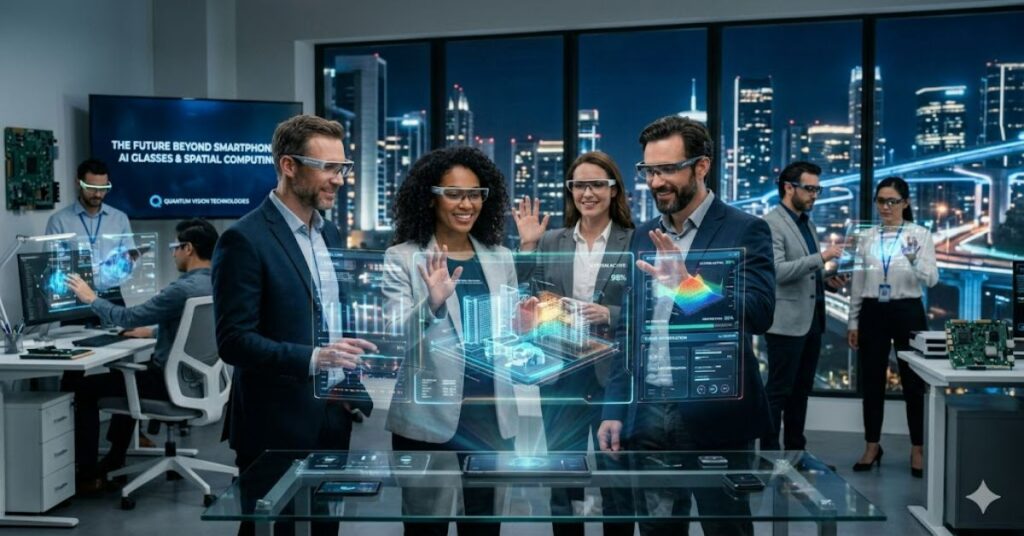
The phrase tech giants envision future beyond smartphones is no longer a speculative headline. It has become a strategic reality shaping billions of dollars in research and development spending across the technology industry.
For nearly two decades, smartphones have been the center of personal computing. They transformed communication, entertainment, navigation, commerce, and productivity. Yet the world’s largest technology companies increasingly believe the smartphone represents an intermediate stage rather than the final form of personal computing.
The emerging vision centers on AI-driven ecosystems, augmented reality (AR) glasses, and spatial computing platforms that eliminate the need to constantly pull a device from a pocket. Instead of opening apps and typing commands, users would interact naturally through voice, gestures, eye tracking, and context-aware artificial intelligence.
Meta’s Orion AR glasses, Google’s Android XR platform, and Apple’s Vision Pro initiative all point toward a common destination: ambient computing that blends digital information directly into the physical world. Apple’s CEO Tim Cook has described Vision Pro as the beginning of a new era of “spatial computing,” while Google and Meta are building AI-powered smart glasses capable of providing navigation, translation, messaging, and contextual assistance.
The question is no longer whether companies are pursuing this future. The question is whether consumers are ready for it.
Why Technology Companies Want to Move Beyond Smartphones
The smartphone remains one of the most successful consumer products ever created. Yet it comes with limitations that technology firms increasingly view as barriers.
The Friction Problem
Current mobile computing relies heavily on intent-based interactions:
- Unlock device
- Open application
- Search for information
- Complete action
- Return to home screen
This process repeats hundreds of times daily.
Technology companies are attempting to remove these steps through ambient computing. Instead of requesting information from a device, information appears when needed.
For example:
- Navigation directions appear directly in view.
- Translation occurs during conversations.
- Calendar reminders emerge contextually.
- AI assistants understand surroundings in real time.
Google’s Android XR smart glasses demonstrate this approach by combining cameras, microphones, and Gemini AI to provide contextual assistance, real-time translation, messaging, and navigation.
The Attention Economy Shift
Another motivation involves user engagement.
Smartphones demand focused attention. Smart glasses and spatial interfaces aim to integrate technology into everyday life without requiring constant screen interaction.
This creates opportunities for:
- New advertising models
- Enhanced commerce experiences
- Continuous AI assistance
- Context-aware productivity tools
The Major Players Building the Post-Smartphone Era
Meta’s Bet on AR Glasses
Meta has perhaps been the most aggressive company pursuing a future beyond smartphones.
In 2024, Meta unveiled Orion, an advanced augmented reality glasses prototype designed to overlay digital content directly onto the physical world. The company describes Orion as a glimpse into future computing where digital information exists seamlessly alongside real environments.
Mark Zuckerberg has repeatedly argued that smart glasses will eventually become the primary computing device for consumers.
Meta’s strategy includes:
- Ray-Ban smart glasses
- Orion AR prototypes
- AI assistants integrated into wearables
- Neural wristband research
- Reality Labs investments
Apple’s Spatial Computing Vision
Apple is taking a different approach.
Instead of launching directly into lightweight glasses, Apple introduced Vision Pro as a spatial computing platform.
The company describes Vision Pro as its first spatial computer, allowing users to interact using eyes, hands, and voice while blending digital content with physical environments.
Apple’s long-term roadmap appears focused on:
- Spatial interfaces
- Mixed reality environments
- AI-powered visual intelligence
- Future wearable form factors
Recent visionOS developments continue expanding spatial interaction capabilities.
Google’s AI-Centric Strategy
Google sees AI as the foundation of post-smartphone computing.
Its Android XR ecosystem combines:
- Gemini AI
- Smart glasses
- Real-time translation
- Visual understanding
- Contextual assistance
At Google I/O demonstrations, Android XR glasses showcased the ability to understand surroundings and provide assistance without requiring direct smartphone interaction.
Comparison Table: Leading Post-Smartphone Platforms
| Company | Platform | Primary Focus | Interaction Model |
| Meta | Orion AR Glasses | Augmented Reality | Voice, gestures, AI |
| Apple | Vision Pro | Spatial Computing | Eyes, hands, voice |
| Android XR | AI Smart Glasses | Contextual AI assistance | |
| Microsoft | Mixed Reality Research | Enterprise Spatial Computing | Gesture and spatial interaction |
| Qualcomm | XR Chipsets | Wearable Computing Infrastructure | Hardware enablement |
The Technology Behind Spatial Computing
Spatial computing represents a major shift in human-computer interaction.
According to academic research, spatial computing combines AI, cloud infrastructure, sensors, XR technologies, and edge computing to merge digital and physical environments.
Core Technologies
Artificial Intelligence
AI acts as the operating layer.
Without AI:
- Glasses are displays.
With AI:
- Glasses become assistants.
Computer Vision
Computer vision allows devices to understand:
- Objects
- People
- Locations
- Context
Edge Computing
Low-latency processing is essential.
Spatial interfaces require near-instant responses to avoid user discomfort and maintain immersion.
Industry Insight Table
| Challenge | Current Status | Impact on Adoption |
| Battery Life | Major limitation | High |
| Display Quality | Improving rapidly | Medium |
| Privacy Concerns | Significant | High |
| Social Acceptance | Uncertain | High |
| Cost | Premium pricing | High |
| AI Accuracy | Improving | Medium |
| Regulatory Oversight | Emerging | Medium |
Three Underreported Challenges
Many discussions focus on technological breakthroughs while ignoring practical obstacles.
1. Privacy Could Become the Largest Barrier
Smart glasses continuously collect environmental data.
Recent reporting revealed concerns surrounding facial recognition capabilities being explored within wearable ecosystems, raising regulatory and privacy questions.
Unlike smartphones, wearable devices can observe continuously.
This creates:
- Surveillance concerns
- Consent issues
- Data governance challenges
2. Battery Physics Remain Difficult
Academic research on wearable imaging systems highlights significant engineering constraints involving size, weight, image quality, and power consumption.
Consumers expect:
- All-day battery life
- Lightweight designs
- Powerful AI processing
Achieving all three simultaneously remains difficult.
3. Social Acceptance Is Uncertain
The success of smartphones depended partly on social acceptance.
Smart glasses face different challenges:
- Constant camera visibility
- Wearability concerns
- Fashion considerations
- Workplace restrictions
Technology alone will not determine adoption.
Real-World Evidence Supporting the Shift
Several developments suggest the transition has already begun.
Case Study: Apple Vision Pro
Vision Pro introduced spatial interfaces that replace touchscreens with eye tracking, hand gestures, and voice commands. Apple describes this as an entirely new computing paradigm.
Case Study: Android XR Demonstrations
Google’s demonstrations showcased live translation, navigation overlays, and AI assistance delivered directly through wearable displays.
Research Example: Always-On AI Agents
A recent academic project called VisionClaw demonstrated always-on wearable AI agents operating through smart glasses. Researchers found reduced interaction overhead and faster task completion compared with traditional device-based workflows.
Market Implications
If tech giants envision future beyond smartphones successfully becomes reality, several industries will experience disruption.
Smartphone Manufacturers
Manufacturers may see:
- Slower upgrade cycles
- Reduced device centrality
- New accessory ecosystems
Software Developers
Developers will need to rethink:
- User interfaces
- Spatial experiences
- Voice-first workflows
- Contextual interactions
Advertising Industry
Advertising could become increasingly contextual.
Digital overlays may create entirely new inventory opportunities within physical environments.
The Future of Tech Giants Envision Future Beyond Smartphones in 2027
By 2027, the industry is unlikely to have fully replaced smartphones.
However, several trends appear increasingly plausible.
Likely Developments
- AI assistants become primary interfaces.
- Smart glasses gain broader consumer adoption.
- Spatial computing expands beyond niche users.
- Real-time translation becomes commonplace.
- Wearable AI ecosystems mature significantly.
Constraints That Will Remain
- Battery limitations
- Privacy regulations
- High costs
- Social acceptance challenges
Governments and regulators are also expected to scrutinize wearable surveillance technologies more closely as adoption grows. Recent privacy debates surrounding facial recognition features demonstrate the complexity of future regulation.
The most realistic 2027 scenario is coexistence rather than replacement. Smartphones may become secondary devices while AI-powered wearables handle everyday interactions.

Key Takeaways
- Smart glasses and spatial computing represent the strongest candidates to succeed smartphones.
- Meta, Apple, and Google are pursuing different strategies toward a similar goal.
- AI is the critical technology enabling ambient computing.
- Privacy concerns may become the largest adoption barrier.
- Battery technology remains a major engineering challenge.
- The transition will likely be gradual rather than sudden.
- By 2027, smartphones are expected to coexist with emerging wearable platforms.
Conclusion
The idea that tech giants envision future beyond smartphones is no longer a distant prediction. It is an active industry strategy supported by substantial investments, new hardware platforms, and rapid advances in artificial intelligence.
Meta is betting on AR glasses. Apple is building spatial computing environments. Google is integrating AI directly into wearable devices. Although their approaches differ, all three companies share a common objective: reducing reliance on handheld screens and moving computing into the user’s environment.
Yet history suggests technological superiority alone does not guarantee adoption. Success will depend on solving battery constraints, addressing privacy concerns, achieving acceptable pricing, and convincing consumers to embrace wearable computing as naturally as they embraced smartphones.
The smartphone’s dominance is unlikely to disappear overnight. But for the first time since the iPhone era began, a credible successor is emerging.
FAQ
Will smart glasses replace smartphones completely?
Probably not in the near term. Most analysts expect coexistence, with smartphones remaining important while smart glasses handle more everyday interactions.
Why are tech companies investing in AR glasses?
AR glasses offer hands-free access to information, contextual AI assistance, and new ways of interacting with digital content.
What is spatial computing?
Spatial computing blends digital content with physical environments, allowing users to interact through eyes, voice, gestures, and movement rather than traditional screens.
What are the biggest obstacles to adoption?
Battery life, privacy concerns, cost, display quality, and social acceptance remain major challenges.
Is Apple Vision Pro part of the post-smartphone movement?
Yes. Apple positions Vision Pro as a spatial computer designed to introduce new forms of interaction beyond traditional mobile devices.
How does AI fit into smart glasses?
AI provides contextual understanding, voice interaction, translation, navigation assistance, and task automation, making wearable devices more useful without manual app navigation.
Methodology
This analysis was developed using publicly available company announcements, technology demonstrations, academic research papers, industry reporting, and product documentation from Apple, Google, Meta, and independent researchers. Sources were selected based on relevance, authority, and recency. Forward-looking observations were grounded in existing product roadmaps and demonstrated technologies rather than speculative claims.
Limitations include the rapidly changing nature of wearable technology markets and uncertainty regarding future consumer adoption patterns. Counterarguments, including privacy concerns, social acceptance barriers, and technical constraints, were incorporated to maintain balance.
Editorial Disclosure: This article was drafted with AI assistance and should undergo human editorial review before publication. All citations, data points, and claims should be independently verified by the editorial team at Matrics360.com.
References
Apple. (2023). Introducing Apple Vision Pro: Apple’s first spatial computer. Apple Newsroom.
Cao, H. (2024). Unveiling the Era of Spatial Computing. arXiv.
Goesele, M., et al. (2025). Imaging for All-Day Wearable Smart Glasses. arXiv.
Liu, X., Lee, D., Gonzalez, E. J., Gonzalez-Franco, M., & Suzuki, R. (2026). VisionClaw: Always-On AI Agents through Smart Glasses. arXiv.
MacRumors. (2024). Meta Unveils Orion Augmented Reality Glasses.
MacRumors. (2025). Google Shows Off Android XR Smart Glasses With In-Lens Display.
TechRadar. (2026). Google I/O 2026: Gemini Spark, Samsung XR Glasses, and More.
The Verge. (2026). Apple Announces visionOS 27 with Siri AI.