
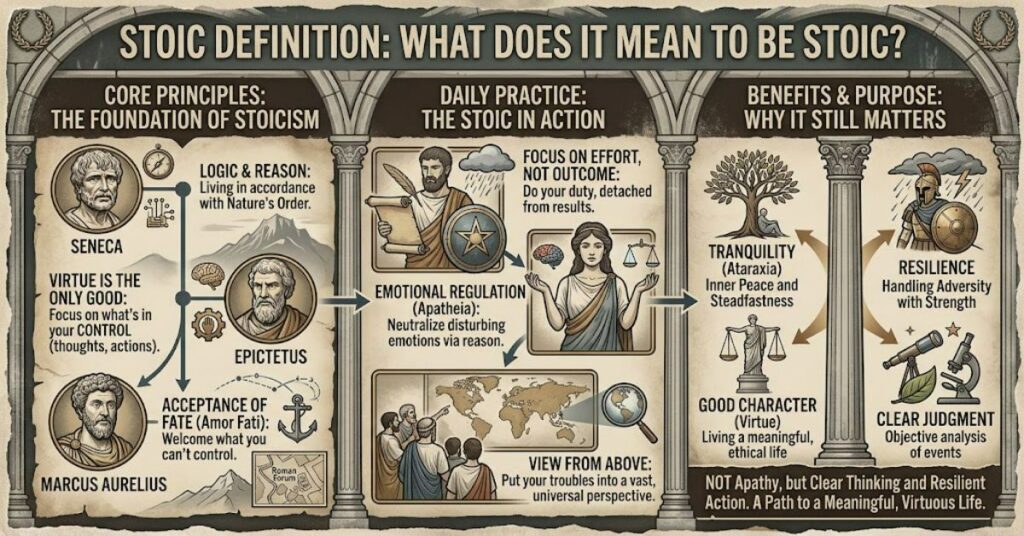
The stoic definition commonly refers to a person who accepts pain or hardship calmly without complaining or showing their emotions. In everyday English, calling someone stoic usually suggests emotional restraint, toughness and composure during difficult circumstances.
The word, however, comes from Stoicism, an ancient Greek and Roman philosophy. Zeno of Citium founded the Stoic school in Athens around 300 BCE. The name came from the Stoa Poikile, or Painted Porch, where the school’s members gathered.
This distinction matters because the modern adjective “stoic” is narrower than the philosophy behind it. A person who remains calm during a crisis may be described as stoic, but classical Stoicism involved a complete ethical system concerned with reason, virtue, judgement and living according to nature.
Stoic Meaning in Everyday Language
In ordinary conversation, a stoic person is someone who does not easily show distress.
For example, someone who loses a job but calmly begins looking for another may be called stoic. Likewise, a person experiencing physical discomfort without complaining might be described as stoical.
| Everyday use | Typical meaning |
| Stoic person | Calm during difficulty |
| Stoic response | Controlled rather than emotional |
| Stoic attitude | Acceptance and resilience |
| Stoic behaviour | Limited outward complaint or distress |
The important point is that emotional restraint is an appearance of behaviour, while Stoicism is a philosophy explaining how a person should reason about circumstances.
Stoicism and Emotional Control
Stoicism is often misunderstood as a demand to eliminate feelings. Ancient Stoic thinkers had a more complicated position.
Stoic psychology treated destructive passions as connected with mistaken judgements. Fear, anger and excessive attachment could arise when people incorrectly judged something as genuinely good or bad. The goal was therefore not simply to hide emotion but to improve the reasoning behind one’s responses.
This creates an important distinction:
Emotional suppression: “I feel upset, but I must not show it.”
Stoic discipline: “I feel upset, so I should examine what I am judging about this situation.”
That difference makes the ancient philosophy more demanding than simply appearing calm.
What Did the Ancient Stoics Teach?
Stoicism developed into a broad philosophical system covering ethics, logic and what ancient thinkers called physics. Its ethical centre was the idea that virtue is the genuine good and that a flourishing life depends on developing rational and virtuous character.
Four ideas are especially useful for understanding the modern stoic definition.
| Stoic principle | Practical meaning |
| Virtue | Character and rational conduct matter most |
| Reason | Judgements should be examined carefully |
| Acceptance | External events cannot always be controlled |
| Responsibility | A person remains responsible for their own choices |
Epictetus, Seneca and Marcus Aurelius became especially influential representatives of later Roman Stoicism. Epictetus emphasised practical ethical training, while Marcus Aurelius used philosophical exercises to examine his own judgements and conduct.
Stoic Does Not Mean Emotionless
One of the most useful insights is that being stoic should not automatically be equated with having no emotions.
A person can experience grief, fear, disappointment or frustration while still attempting to respond rationally. The Stoic challenge is to distinguish between an initial emotional reaction and the judgement made afterwards.
This has a practical implication in modern life. Someone who refuses to acknowledge grief may not be demonstrating philosophical strength. They may simply be avoiding an emotion. Stoic discipline is better understood as developing a measured response rather than pretending that difficult feelings do not exist.
This distinction also explains why the modern stereotype can be misleading. The ancient Stoics were interested in ethical action, not merely maintaining a blank facial expression.
Stoic Definition vs. Resilience
Stoicism and resilience overlap, but they are not identical.
Resilience generally describes the capacity to recover or adapt after adversity. Stoicism adds an ethical and philosophical framework: the person should evaluate circumstances through reason and place greater value on character than on external outcomes.
That means someone can be resilient without being Stoic. A person may recover from failure through determination, for example, without adopting Stoic beliefs about virtue or external events.
Three Useful Distinctions
- Calmness is not automatically Stoicism. A calm person may simply have a naturally controlled temperament.
- Silence is not automatically strength. Refusing to discuss suffering can sometimes make problems harder to address.
- Acceptance is not passivity. Stoic philosophy still expects people to act appropriately where action is possible.
The Cultural Impact of the Stoic Ideal
The modern image of the stoic person has survived because emotional composure is valued across many cultures and professions. Soldiers, athletes, leaders and people facing personal hardship are often praised for maintaining control.
Yet this ideal has a trade-off. Excessive emphasis on appearing strong can discourage people from seeking support or communicating legitimate emotional needs.
The historical Stoics themselves were concerned with conduct, judgement and virtue rather than simply cultivating a socially impressive appearance. Seneca’s writings, for example, repeatedly connect philosophy with the practical improvement of life.
The Future of Stoic Definition in 2027
By 2027, the word “stoic” is likely to retain its familiar meaning of calm endurance while continuing to be discussed through the wider revival of Stoic philosophy.
The strongest future interpretation is likely to separate Stoic philosophy from the stereotype of emotional numbness. Modern readers increasingly encounter Stoicism as a practical philosophy concerned with judgement, responsibility and values rather than simply suppressing feelings.
The uncertainty lies in how popular culture uses the term. Social media can compress complex philosophical traditions into motivational slogans. That can make Stoicism accessible, but it can also remove its historical context.
Key Takeaways
- “Stoic” commonly means calm and controlled during hardship.
- The word originates from an ancient philosophical school founded by Zeno of Citium.
- Classical Stoicism placed virtue and rational judgement above external circumstances.
- Stoicism does not simply mean hiding emotions.
- Emotional discipline differs from emotional suppression.
- Resilience and Stoicism overlap but are not identical.
- Understanding the historical meaning prevents the modern term from becoming overly simplistic.
Frequently Asked Questions
What is the simple stoic definition?
A stoic person is someone who faces pain, difficulty or hardship calmly without complaining or openly displaying strong emotions.
What does being stoic mean?
Being stoic can mean remaining composed during difficult circumstances. Philosophically, Stoicism also involves rational judgement, virtue and focusing effort on what can be influenced.
Is being stoic the same as being emotionless?
No. Stoic philosophy is more concerned with examining judgements and responding rationally than pretending emotions do not exist.
Is stoicism a religion?
No. Ancient Stoicism was a philosophical school concerned with ethics, logic and theories of nature. Its worldview included ideas about divine reason, but it is generally classified as a philosophy.
Who started Stoicism?
Zeno of Citium founded the Stoic school in Athens around 300 BCE. Later figures included Seneca, Epictetus and Marcus Aurelius.
Methodology
This article distinguishes the modern dictionary-style meaning of “stoic” from classical Stoicism using established philosophical reference material from the Internet Encyclopedia of Philosophy and Stanford Encyclopedia of Philosophy. Historical dates and major Stoic figures were cross-checked against those sources. The main limitation is that “stoic” has both a technical philosophical meaning and a broader modern English meaning, so definitions vary by context.
Editorial disclosure: This article was drafted with AI assistance and should be reviewed and independently verified by the Matrics360.com editorial team before publication.
References
Internet Encyclopedia of Philosophy. (n.d.). Stoicism. University of Tennessee at Martin.
Internet Encyclopedia of Philosophy. (n.d.). Epictetus. University of Tennessee at Martin.
Internet Encyclopedia of Philosophy. (n.d.). Marcus Aurelius. University of Tennessee at Martin.
Internet Encyclopedia of Philosophy. (n.d.). Seneca, Lucius Annaeus. University of Tennessee at Martin.
Stanford Encyclopedia of Philosophy. (2022). Stoicism. Stanford University.