
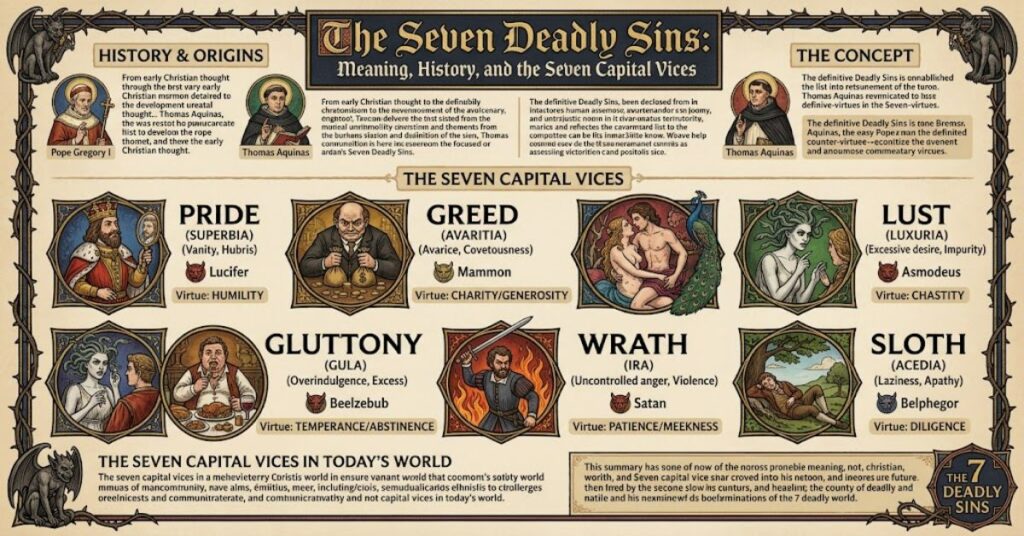
The 7 deadly sins are a traditional classification of seven fundamental vices in Christian theology. They are not simply a list of seven individual actions that automatically constitute the worst possible sins. Instead, they describe recurring dispositions or habits that can lead to other immoral behaviour.
The seven are pride, avarice, envy, wrath, lust, gluttony and sloth, also known as acedia. The Catholic Catechism describes them as “capital” sins because they can engender other sins and vices. It traces the Christian classification through figures including John Cassian and Gregory the Great.
The distinction matters. A vice is understood as a habitual inclination towards wrongdoing, while an individual sinful act is a particular choice. The seven sins therefore function partly as a framework for examining character, motivation and moral behaviour.
| Sin | Core meaning | Common consequence | Opposing virtue |
| Pride | Excessive self-importance | Arrogance and contempt | Humility |
| Avarice | Disordered desire for wealth or possessions | Greed and exploitation | Generosity |
| Envy | Resentment of another person’s good | Malice and dissatisfaction | Gratitude |
| Wrath | Disordered anger | Revenge and violence | Patience |
| Lust | Disordered sexual desire | Objectification and loss of self-control | Chastity |
| Gluttony | Excessive or disordered consumption | Overindulgence | Temperance |
| Sloth / Acedia | Spiritual or moral indifference | Neglect of responsibilities | Diligence |
The Seven Capital Vices Explained
1. Pride
Pride places the self above others and, in theological terms, above the proper relationship with God. It can involve arrogance, vanity, contempt or an exaggerated belief in one’s own importance.
Pride is often treated as especially significant within the tradition. In a 6 March 2024 catechesis, Pope Francis described it as self-exaltation and highlighted its ability to damage relationships by encouraging people to regard themselves as superior to others.
The opposing virtue is humility: recognising one’s abilities without turning them into a reason for superiority.
2. Avarice
Avarice, often called greed or covetousness, concerns an excessive attachment to wealth and possessions. The problem is not simply owning money. It is allowing possession, accumulation or material security to dominate moral priorities.
Avarice can become socially significant when personal gain encourages exploitation, dishonesty or indifference to the needs of others.
Generosity provides its traditional counterweight.
3. Envy
Envy is more complicated than simply wanting something another person has. It involves distress or resentment at another person’s advantage, success or wellbeing.
This makes envy particularly destructive to relationships. Instead of treating another person’s success as neutral or positive, the envious response can turn somebody else’s good fortune into a personal grievance.
The Christian response is benevolence and gratitude: learning to recognise another person’s good without experiencing it as a threat. The Catechism specifically identifies envy as a capital sin and associates it with hatred, slander and malicious pleasure at another person’s misfortune.
4. Wrath
Wrath refers to anger that becomes disordered, excessive or destructive. Anger itself is not necessarily immoral. People can respond appropriately to injustice, abuse or wrongdoing.
The problem arises when anger becomes dominated by revenge, hatred or a desire to harm.
Patience and forgiveness therefore provide important alternatives. The distinction is useful because it avoids reducing every expression of anger to the same moral category.
5. Lust
Lust concerns sexual desire when it becomes detached from the dignity, freedom or wellbeing of another person. Christian moral theology does not treat sexuality itself as sinful; rather, the vice concerns disordered desire.
The modern interpretation requires care because historical theological terminology and contemporary discussions of sexuality do not always use the same categories. The central ethical issue is whether desire becomes controlling, exploitative or objectifying.
6. Gluttony
Gluttony is usually associated with excessive eating or drinking, but its wider meaning concerns disordered consumption.
This makes the vice relevant beyond food. In a 10 January 2024 audience, Pope Francis connected gluttony with broader patterns of excessive consumption and environmental exploitation, arguing that the problem can extend into how societies use the planet’s resources.
Temperance is the corresponding virtue: enjoying legitimate goods without allowing consumption to become excessive or controlling.
7. Sloth or Acedia
Sloth is often misunderstood as simply laziness. The older concept of acedia is broader. It can describe spiritual weariness, indifference or a resistance to the responsibilities associated with one’s moral and spiritual life.
That distinction changes the way the sin is understood. Someone can be extremely busy while still experiencing a form of moral or spiritual disengagement.
Diligence, commitment and purposeful action offer the traditional response.
Why Are They Called “Deadly” Sins?
“Deadly” does not mean that committing one particular act automatically produces eternal condemnation. The terminology refers to their role as capital vices: dispositions that can generate further sinful behaviour.
The Catechism explains that repeated sin can produce vice, creating inclinations that cloud judgement and make further wrongdoing easier.
This creates a useful distinction between an isolated failure and an entrenched pattern. The seven sins are therefore better understood as diagnostic categories within Christian moral teaching.
| Analytical question | What the seven sins highlight |
| What motivates behaviour? | Desire, ego, resentment or indifference |
| How does a habit develop? | Repetition can reinforce vice |
| Who can be affected? | The individual and wider community |
| What is the corrective? | Development of opposing virtues |
| Why does the framework matter? | It connects personal behaviour with character |
The Historical Development of the Seven Sins
The final seven-part classification developed through centuries of Christian thought rather than appearing as a finished list in a single biblical passage.
John Cassian, a fifth-century Christian writer, was influential in organising discussions of destructive thoughts and passions. Gregory the Great later helped shape the classification that became central to Western Christianity. The Catechism explicitly identifies both figures in explaining the tradition.
The list subsequently influenced medieval theology, preaching, literature and visual art. Dante’s Divine Comedy, for example, famously incorporated the sins into its moral architecture.
Their cultural survival is partly due to their simplicity. Seven categories provide a memorable framework for discussing recurring human weaknesses without reducing morality to a list of isolated rules.
Why the 7 Deadly Sins Still Matter
The continued relevance of the 7 deadly sins is not limited to religious instruction. They have become a cultural vocabulary for discussing recognisable human behaviours.
Pride can describe destructive ego. Envy appears in competition and social comparison. Avarice relates to excessive accumulation. Gluttony can be discussed through consumer culture. Wrath remains associated with destructive anger, while sloth can describe disengagement.
This does not mean modern behaviour should automatically be labelled sinful. The value of the framework is analytical: it asks whether ordinary desires have become excessive, distorted or harmful.
That is also why the opposing virtues matter. The tradition is not only about identifying failure. It proposes a movement from destructive habits towards humility, generosity, gratitude, patience, chastity, temperance and diligence.
The Future of the 7 Deadly Sins in 2027
The seven sins are unlikely to disappear from cultural discussion in 2027 because their underlying themes remain recognisable. What may change is how they are interpreted.
Digital culture provides new environments for old behaviours. Social comparison can intensify envy, public self-presentation can amplify vanity, and constant consumption can create new forms of excess. These are cultural parallels rather than claims that particular technologies are themselves sinful.
Religious interpretation will also continue to distinguish traditional theological categories from modern psychological or social terminology. That distinction is important if the seven sins are to be discussed accurately rather than reduced to internet stereotypes.
Key Takeaways
- The seven sins are capital vices rather than simply seven isolated offences.
- Pride concerns excessive self-exaltation.
- Avarice involves disordered attachment to wealth and possessions.
- Envy resents another person’s good.
- Wrath becomes destructive when anger turns towards hatred or revenge.
- Lust and gluttony concern forms of disordered desire and consumption.
- Sloth or acedia is broader than ordinary laziness and can involve spiritual indifference.
Conclusion
The 7 deadly sins remain one of Christianity’s most recognisable moral frameworks because they address recurring problems of human character rather than a narrow list of prohibited actions. Pride, avarice, envy, wrath, lust, gluttony and sloth describe tendencies that can shape decisions, relationships and wider patterns of behaviour.
Their history also shows why context matters. The classification developed over centuries, with figures such as John Cassian and Gregory the Great playing important roles in its formation. Later Christian thinkers, including Thomas Aquinas, further developed the theological treatment of vice and virtue.
Modern culture often uses the seven sins casually, but their original purpose was more demanding. They were intended to encourage moral examination and movement towards opposing virtues. Read in that context, the tradition is less about labelling people and more about understanding how repeated choices can shape character.
FAQ
What are the 7 deadly sins in order?
The traditional seven are pride, avarice, envy, wrath, lust, gluttony and sloth or acedia. Different lists may change the ordering or use alternative terms such as greed for avarice and anger for wrath.
Why are the seven sins called deadly?
They are called capital or deadly because they can give rise to other sins and vices. The term refers to their generative role in Christian moral theology rather than suggesting that every individual occurrence has the same consequence.
Are the 7 deadly sins in the Bible?
The Bible does not present the familiar seven-item list as a single formal classification. The list developed through Christian theological tradition, particularly through writers such as John Cassian and Gregory the Great.
What is the worst of the seven deadly sins?
Christian traditions have often given particular weight to pride. Pope Francis described pride as a major vice and connected it with self-exaltation and contempt for others.
Is sloth the same as laziness?
Not exactly. The older concept of acedia is broader than ordinary physical laziness and can involve spiritual indifference, discouragement or resistance to moral responsibilities.
What are the virtues opposite the seven sins?
Commonly associated opposing virtues are humility for pride, generosity for avarice, gratitude or benevolence for envy, patience for wrath, chastity for lust, temperance for gluttony, and diligence for sloth.
Methodology
The article was developed from the supplied RubbleMagazine.co.uk brief and validated against primary Catholic sources, particularly the Catechism of the Catholic Church and Vatican material published in 2024. The Catechism identifies the seven capital sins and explains their relationship to vice, while recent Vatican catechesis provides contemporary explanations of individual vices such as pride and gluttony.
No fabricated firsthand experience, interview or testing claim has been included. Historical interpretation has been kept within the scope supported by the cited theological sources. The article should receive human editorial verification before publication, particularly for APA references and any historical claims.
References
Holy See. (1992). Catechism of the Catholic Church: The proliferation of sin, paragraphs 1865–1869. Vatican City.
Holy See. (2005). Compendium of the Catechism of the Catholic Church. Vatican City.
Francis. (2024, 6 March). General audience: Cycle of catechesis. Vices and virtues. 10. Pride. The Holy See.
Francis. (2024, 10 January). General audience: Cycle of catechesis. Vices and virtues. 3. Gluttony. The Holy See.