
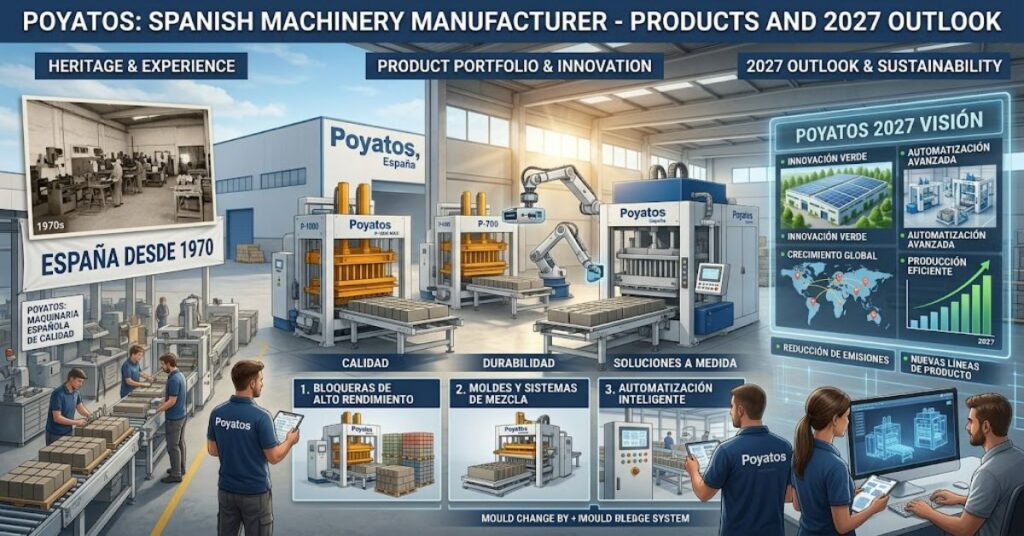
Poyatos primarily refers to Poyatos, the Spanish machinery manufacturer specialising in equipment for producing concrete blocks, pavers, kerbstones and other precast-concrete products. The company says it has manufactured this equipment in Granada since 1975 and has installed more than 1,000 plants across more than 80 countries.
The name can also refer to Poyatos, a small municipality in the province of Cuenca in Castilla-La Mancha. Spain’s national administration lists its local council at Plaza Mayor 1, while the regional tourism authority describes it as a historic rural settlement in the Serranía de Cuenca.
For industrial and business searches, however, the machinery company is the more commercially significant interpretation. Poyatos has built its position around vertical manufacturing: designing, assembling and testing machinery at its Granada facility rather than functioning simply as an equipment reseller.
That distinction matters when evaluating the company. A concrete block machine is not an isolated piece of capital equipment. Its performance affects batching, mould changes, curing, pallet handling, labour requirements, maintenance and ultimately the cost per manufactured unit.
Poyatos therefore operates closer to a production-systems supplier than a conventional machine vendor.
Poyatos Company History and Manufacturing Base
Poyatos traces its origins to 1975, when the business began manufacturing concrete block machinery in Granada. According to the company’s published history, it expanded internationally in 1988, initially serving Latin American and North African markets. By 2001, its production facilities had expanded to around 30,000 square metres.
A further technology investment was reported in 2022, when the company added larger CNC machinery and a robotic welding system. This is significant because manufacturing precision affects the mechanical tolerances, repeatability and long-term serviceability of heavy industrial machinery.
| Poyatos milestone | Significance |
| 1975 | Manufacturing begins in Granada |
| 1988 | International exports expand into Latin America and North Africa |
| 2001 | Manufacturing footprint reaches approximately 30,000 m² |
| 2022 | CNC and robotic welding capabilities expanded |
| 2026 | Company presents a portfolio serving 80+ countries |
The company’s stated manufacturing model is an important part of its proposition. It says its machines are designed, manufactured, assembled and tested at its Granada plant.
That approach can reduce coordination between separate engineering and assembly suppliers. It can also make customisation easier when a plant requires unusual pallet dimensions, mould configurations or production targets.
The trade-off is that a vertically integrated manufacturer remains responsible for a broader range of engineering, service and supply-chain risks. Customers should therefore assess not only machine specifications but also spare-parts availability, commissioning support and the manufacturer’s ability to service equipment in their region.
Poyatos Machinery Range
Poyatos divides its machinery into different production levels rather than presenting a single universal machine.
The Prima and Syncro occupy the entry-level and mid-range segment. The company’s published specifications indicate approximately 800–1,200 blocks per hour for Prima and 1,200–1,800 blocks per hour for Syncro when producing 20 cm blocks, although actual output depends on product configuration and operating conditions.
Higher-capacity machines include Universal, Novabloc and Megabloc. Published company data gives indicative production figures ranging from around 1,600 pieces per hour on the Prima for a specified paver configuration to more than 6,000 pieces per hour on Megabloc under particular production assumptions.
These figures should not be interpreted as guaranteed factory output. Poyatos states that cycle times and hourly production can vary according to product type, aggregate quality, staffing and other production factors.
| Machine | Positioning | Indicative capability |
| Prima | Entry level | Lower-volume production and simpler plants |
| Syncro | Entry/mid range | Higher output with greater automation |
| Universal | High production | Industrial-scale block manufacturing |
| Novabloc | High production | Higher-throughput automated production |
| Megabloc | Industrial | Large-scale, high-capacity plants |
This is one of the most important practical points for prospective buyers: machine capacity should be assessed against the entire production system, not the machine’s headline cycle time alone.
A machine capable of producing thousands of units per hour is of limited commercial value if batching, curing, pallet handling or downstream logistics cannot support the same throughput.
How Poyatos Technology Works
Concrete block production is fundamentally a controlled compaction process. Cement, aggregates and water are prepared into a concrete mixture, transferred to the forming machine and compacted inside moulds through pressure and vibration.
Poyatos highlights servo-vibration technology as part of its machinery approach. The purpose is to control vibration and compaction more precisely, helping manufacturers achieve consistent product quality while managing energy consumption. The company’s published material claims potential energy savings of up to 25% per block, although such a figure should be treated as a manufacturer-specific claim rather than an independently established industry benchmark.
The equipment can also use interchangeable moulds. This gives a plant the ability to manufacture different concrete products without purchasing an entirely separate forming machine.
That flexibility has a strategic implication. A manufacturer can respond to changing demand for hollow blocks, solid blocks, pavers, kerbstones or decorative products by changing production tooling rather than rebuilding the entire factory.
The limitation is operational complexity. More product formats mean more mould management, quality-control requirements, changeover planning and inventory decisions.
Why Lifecycle Support Matters
Industrial machinery is purchased for years rather than months, so after-sales support can be almost as important as the initial specification.
Poyatos says it provides spare parts, remote technical assistance and on-site engineering support across its international customer base. It also states that machines can be supported throughout their operating life.
For a block manufacturer, this has direct financial consequences. A production stoppage can affect delivery commitments, labour utilisation and downstream equipment. The economic value of rapid troubleshooting therefore rises with plant utilisation.
A useful purchasing assessment should examine:
- Spare-parts availability: Critical components should have realistic replacement lead times.
- Remote diagnostics: Software-enabled support can reduce unnecessary engineer travel.
- Operator training: Poor setup can undermine otherwise capable equipment.
- Local technical coverage: Geographic proximity matters during major failures.
- Mould support: Tooling is central to product flexibility and quality.
This is an area where headline machine capacity can become misleading. A slightly slower machine with strong local support may produce better annual economics than a faster machine that suffers longer downtime.
Poyatos and the European Regulatory Shift
The regulatory environment is another factor prospective buyers should consider.
The EU’s revised Construction Products Regulation became applicable in substantial part on 8 January 2026. It introduces a stronger framework for environmental product information and will eventually support digital product passports for relevant construction products.
Machinery regulation is also changing. Regulation (EU) 2023/1230 replaces the Machinery Directive and becomes mandatory on 20 January 2027. The European Commission highlights changes involving digital documentation, safety-related software and cybersecurity requirements for relevant machinery.
For manufacturers such as Poyatos, this creates a practical requirement to keep machinery documentation, conformity processes and safety systems aligned with the new framework.
For buyers, it creates a different question: what will the machine’s compliance profile look like throughout its expected operating life?
That is an increasingly important procurement consideration for equipment containing programmable controls, connected diagnostic functions and safety-related software.
The Future of Poyatos in 2027
Poyatos enters 2027 with several structural advantages: a long manufacturing history, an established export footprint and a broad machinery portfolio.
The most important opportunity is likely to be further automation. Concrete-product manufacturers face pressure to control labour costs, maintain consistent product quality and improve plant utilisation. Automated batching, forming, curing and palletising can address several of these issues simultaneously.
Energy efficiency is another important area. Servo-controlled machinery and improved process control can potentially reduce energy consumption, but manufacturers should evaluate savings using measured plant data rather than promotional headline figures.
The regulatory transition will also matter. From 20 January 2027, the EU Machinery Regulation becomes mandatory, bringing updated requirements around machinery safety and digital aspects.
A further shift is emerging in construction-product information. The revised EU Construction Products Regulation introduces environmental characteristics and a longer-term move towards digital product information.
Poyatos’ future competitiveness will therefore depend not only on producing faster machines. It will depend on combining mechanical reliability with software, documentation, energy performance, serviceability and regulatory readiness.
Key Insights
- Production capacity is system-dependent: A block machine cannot achieve its theoretical output if batching, curing or palletising becomes the bottleneck.
- Vertical manufacturing has strategic value: Designing and testing equipment within one manufacturing organisation can simplify quality control and custom engineering.
- Tooling creates commercial flexibility: Interchangeable moulds allow manufacturers to diversify their product range without necessarily purchasing additional forming machines.
- After-sales support affects total cost: Downtime and parts availability can materially change the economics of a machine over its working life.
- 2027 is a compliance milestone: The EU Machinery Regulation becomes mandatory on 20 January 2027, making regulatory preparation relevant to machinery buyers and manufacturers.
- Environmental data is becoming more important: The revised Construction Products Regulation points towards greater disclosure of environmental characteristics and digital product information.
Conclusion
Poyatos represents a long-established Spanish approach to industrial machinery: specialised engineering, in-house manufacturing and an international focus. Founded in Granada in 1975, the company has developed from a domestic machinery producer into a supplier of concrete block and precast-production systems used across multiple markets.
Its strongest proposition is not simply the output of an individual machine. The broader value lies in combining forming equipment with batching, finishing, automation, technical support and production flexibility.
That distinction is increasingly important as manufacturers face higher expectations around efficiency, product consistency, labour utilisation and regulatory compliance. The transition to the EU Machinery Regulation in 2027 adds another layer to the purchasing decision.

For prospective customers, the sensible approach is therefore to evaluate Poyatos on total plant performance rather than headline capacity alone. Production targets, local materials, energy consumption, mould requirements, maintenance arrangements, support infrastructure and compliance should all form part of the same investment calculation.
Frequently Asked Questions
What does Poyatos manufacture?
Poyatos manufactures machinery and production systems for concrete blocks, pavers, kerbstones and other precast-concrete products. Its portfolio includes forming machines, batching equipment, finishing systems and complete production-line solutions.
Where is Poyatos based?
Poyatos is based in Albolote, Granada, Spain. The company states that its machines are designed, manufactured, assembled and tested at its Granada production facility.
How long has Poyatos been making concrete block machines?
Poyatos states that it began manufacturing concrete block machinery in Granada in 1975. Its published history records international expansion from 1988 onwards.
Which Poyatos machine is best for a small plant?
The Prima is positioned as an entry-level machine, while Syncro provides a step up in production and automation. The appropriate choice depends on production volume, product type, available infrastructure and investment budget.
Is Poyatos only a machinery manufacturer?
No. Its current offering also includes concrete batching systems, finishing equipment and complete plant solutions. This allows customers to source multiple stages of production from one supplier.
What changes for machinery manufacturers in 2027?
The EU Machinery Regulation (EU) 2023/1230 becomes mandatory on 20 January 2027, replacing the Machinery Directive. It updates requirements covering areas including machinery safety, digital documentation and certain software-related risks.
Methodology
This article was prepared using publicly available company information from Poyatos, Spanish government and tourism sources, and current European Commission and EUR-Lex regulatory material. Company-specific production capacities and claims have been treated as manufacturer-published specifications rather than independently tested performance figures. Regulatory statements were checked against current European Commission and EUR-Lex material.
No firsthand testing of Poyatos machinery was conducted for this article, so no invented testing results, personal observations or fabricated practitioner quotations have been included. The main limitation is that independent operating-cost, reliability and energy-performance datasets for individual Poyatos machines are not publicly comprehensive. Buyers should therefore validate site-specific performance through technical documentation, demonstrations and reference installations.
Editorial disclosure: This article was drafted with AI assistance and should be reviewed by a human editor before publication. All data, citations and named claims should be independently confirmed against the original sources.
References
European Commission. (2026). CE marking and Declaration of Performance and conformity (DoPC). European Commission.
European Commission. (2026). Construction Products Regulation 2024 revision. European Commission.
European Commission. (2026). Machinery. Directorate-General for Internal Market, Industry, Entrepreneurship and SMEs.
European Union. (2023). Regulation (EU) 2023/1230 on machinery and repealing Directive 2006/42/EC. Official Journal of the European Union.
Poyatos. (2026). About Poyatos: Concrete block machine manufacturer since 1975. Poyatos Export S.A.
Poyatos. (2026). Concrete block machines and equipment. Poyatos Export S.A.
Poyatos. (2026). Concrete block production solutions. Poyatos Export S.A.
Turismo Castilla-La Mancha. (2026). Poyatos, Cuenca. Junta de Comunidades de Castilla-La Mancha.