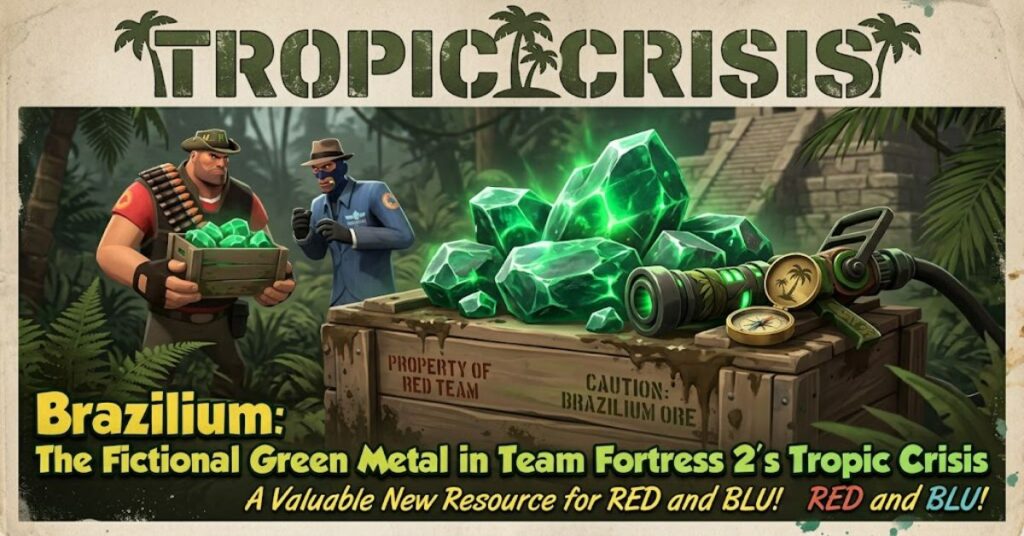
Brazilium is a fictional radioactive green metal associated with the Team Fortress 2 community-created Tropic Crisis custom update project. Within that setting, it functions as a South American counterpart to Australium, the famous gold-coloured material that plays a major role in TF2’s extended fictional universe.
The distinction between official and community-created lore matters. Team Fortress 2 was released by Valve in 2007, while much of its deeper mythology was expanded through comics, promotional material and later updates. Australium became one of the most recognisable fictional resources in that universe because it is connected to Australia’s technological development, powerful machinery and the Mann family’s long-running conflicts.
Brazilium takes that basic storytelling idea in a different regional direction. Instead of reproducing Australium exactly, the concept gives the Tropic Crisis setting a distinctive resource associated with South America. Its green appearance also creates an immediate visual contrast with Australium’s metallic gold appearance.
This makes Brazilium interesting for two reasons. First, it demonstrates how community creators can extend the visual language of an established game universe. Second, it shows how a fictional material can become more than a decorative object: it can help establish geography, technology, conflict and identity within a custom setting.
What Is Brazilium?
Brazilium is not a real chemical element. It is a fictional radioactive and highly energetic green metal created for the Tropic Crisis community project.
Its fictional properties position it as an extraordinary resource rather than an ordinary mineral. The concept is therefore closer to TF2’s deliberately exaggerated approach to science than to real-world nuclear chemistry.
The name itself follows a familiar naming pattern. “Brazilium” evokes Brazil and resembles the naming conventions used for real chemical elements and fictional materials. This immediately communicates its intended geographic association.
| Feature | Brazilium | Australium |
| Status | Community-created fiction | Official TF2 fictional material |
| Colour | Green | Gold/yellow |
| Regional association | South America | Australia |
| Energy concept | Highly energetic and radioactive | Powerful fictional substance |
| Narrative function | Regional world-building | Technology, wealth and power |
| Origin | Tropic Crisis project | Valve’s TF2 universe |
Brazilium and the Australium Connection
Understanding Australium helps explain why Brazilium works as a concept.
Australium is presented in Team Fortress 2 lore as an exceptionally valuable material discovered in Australia. Valve’s comics connect it with Australia’s technological advancement and with inventions such as teleportation and cloaking technology. The material is also associated with life-extending machines and the broader mythology surrounding the Mann family.
The official TF2 material describes Australium as extremely valuable and difficult to obtain. Its fictional importance therefore extends far beyond its appearance.
Brazilium follows the same broad storytelling structure while changing the regional identity and visual language.
That difference is important. A direct copy of Australium would add little to a custom universe. A distinct material allows creators to build new environments, technologies and conflicts around a recognisable TF2-style premise.
Why the Green Colour Matters
Colour is an important part of visual storytelling in games.
Australium’s gold appearance communicates wealth, rarity and prestige. Brazilium’s green appearance creates a different impression. Green can suggest energy, radiation, industrial power, chemical instability or something unfamiliar.
For a fictional radioactive metal, that makes the colour especially useful.
The visual contrast also helps players distinguish two fictional resources without needing extensive explanation. If a story contains gold Australium and glowing green Brazilium, the audience can immediately understand that they represent different materials.
This is one of the strongest design advantages of the concept: the material can communicate information visually before the player reads any lore.
Brazilium as Community World-Building
The Tropic Crisis connection places Brazilium within a broader tradition of TF2 fan development.
Team Fortress 2 has supported an enormous community ecosystem involving custom maps, game modes, cosmetics, stories and total or partial custom projects. Community creators frequently borrow the game’s exaggerated humour, industrial aesthetics and fictional history while developing their own interpretations.
Brazilium demonstrates how a single fictional substance can support that process.
| World-building element | Potential role of Brazilium |
| Geography | Establishes a South American resource zone |
| Technology | Provides a fictional energy source |
| Conflict | Creates a reason for competing factions |
| Visual design | Adds a strong green material identity |
| Lore | Gives the setting a unique historical resource |
| Gameplay atmosphere | Supports unusual machinery and environments |
These are analytical implications of the concept rather than claims about undocumented gameplay mechanics.
How It Differs From Official TF2 Lore
The most important limitation is its status.
Australium belongs to Valve’s established TF2 fictional universe. Brazilium, by contrast, belongs to a community-created project. It should therefore not be described as an official TF2 element unless Valve itself establishes such a connection.
This distinction is particularly important for readers researching the term because search results can mix official TF2 information with fan-created material.
A useful way to understand Brazilium is as expanded community lore inspired by official TF2 storytelling principles.
That framing preserves the creative value of the concept without confusing fan production with Valve canon.
Three Key Insights About Brazilium
1. It is a regional storytelling device.
The concept does more than introduce a fictional metal. It gives a South American setting a resource comparable in narrative importance to Australia’s Australium.
2. Its colour supports its fictional function.
The green appearance separates Brazilium from Australium while reinforcing associations with energy and radioactivity.
3. Its biggest value is world-building.
Even without treating Brazilium as official canon, the concept shows how community creators can develop new stories using familiar TF2 themes.
The Future of Brazilium in 2027
By 2027, the most realistic future for Brazilium is continued use within community-created TF2 projects, custom maps and fan discussions rather than official incorporation into Valve’s canon.
Valve’s Team Fortress 2 has maintained a long-running community culture, but there is no verified basis for claiming that Brazilium will become official lore. Any such prediction would be speculation.
Its future therefore depends primarily on community interest. If Tropic Crisis or related projects continue to receive attention, Brazilium can function as a recognisable piece of that setting’s identity.
The broader lesson is more durable: community-created game lore can develop its own internal mythology even when it remains separate from official canon.
Key Takeaways
- Brazilium is a fictional radioactive green metal connected with the Tropic Crisis community project.
- It is designed as a South American counterpart to Australium.
- Brazilium is not a real chemical element.
- Its green visual identity distinguishes it from Australium’s gold appearance.
- Its primary narrative value comes from world-building.
- It should be separated clearly from official Valve canon.
- Its continued relevance depends on community-created content and player interest.
Frequently Asked Questions
What is Brazilium in Team Fortress 2?
Brazilium is a fictional green radioactive metal associated with the community-created Tropic Crisis project. It is inspired by the concept of Australium but represents a distinct South American fictional resource.
Is Brazilium an official TF2 element?
No. Brazilium should be treated as community-created fiction associated with Tropic Crisis rather than an official element established by Valve.
Is Brazilium real?
No. There is no recognised chemical element called Brazilium. The name refers to a fictional material created for a game-related community project.
Why is Brazilium green?
The green colour provides a strong visual identity and fits its fictional description as a radioactive, highly energetic substance. It also distinguishes the material from gold-coloured Australium.
Is Brazilium related to Australium?
Yes, conceptually. Brazilium is presented as a South American counterpart to Australium, but the two belong to different levels of TF2-related world-building.
What is Tropic Crisis?
Tropic Crisis is a community-created custom update project connected with the Team Fortress 2 mapping and fan-development community. Brazilium is one of the fictional concepts associated with that setting.
Methodology
This article treats Brazilium as fictional community-created game lore rather than a real scientific substance. The description supplied for the Tropic Crisis project was used as the basis for Brazilium’s identity, while established TF2 reference material was used to verify the background of Australium and its place in the wider fictional universe.
No firsthand testing, laboratory analysis or personal gameplay benchmark was conducted, so none is presented as firsthand experience. The main limitation is that community-created projects can change over time and may have less extensive documentation than official Valve material.
The comparison with Australium is therefore intended as a documented lore comparison and an analytical interpretation of the material’s world-building role.
Conclusion
Brazilium is a strong example of how fan-created game lore can expand an established fictional universe without simply reproducing its original ideas. As a fictional radioactive green metal connected with the Tropic Crisis project, it gives a South American setting its own distinctive resource and visual identity.
Its relationship with Australium provides an easy entry point for Team Fortress 2 fans, but Brazilium should not be confused with official Valve canon. Australium has an established role in TF2’s comics and fictional history, while Brazilium belongs to community-created world-building.
The concept works because it combines geography, colour and exaggerated science into a simple fictional idea. Whether it becomes more widely recognised depends on the continued development of Tropic Crisis and the wider TF2 community. For now, Brazilium remains an intriguing piece of fan-created lore that illustrates the creative possibilities of custom game projects.
References
Valve Corporation. (2007). Team Fortress 2. Valve Corporation.
Valve Corporation. (2009–2024). Team Fortress comics. Valve Corporation.
Team Fortress Wiki. (n.d.). Australium. Team Fortress Wiki.
Tropic Crisis Project. (n.d.). Tropic Crisis custom update project. Community-created Team Fortress 2 project.