
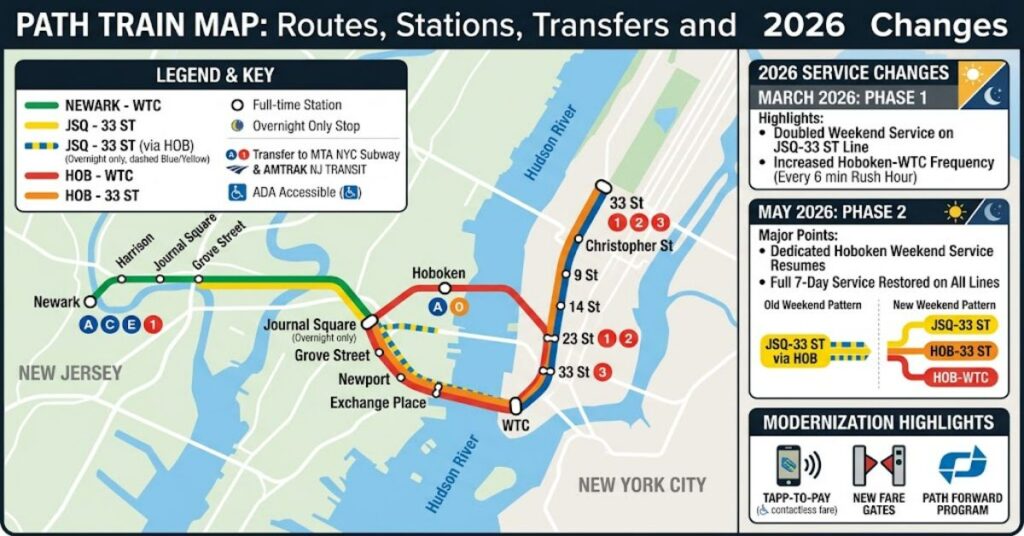
A path train map helps passengers understand one of the most important rail connections between New York and New Jersey. Operated by the Port Authority of New York and New Jersey, PATH connects Manhattan with Newark, Harrison, Jersey City and Hoboken.
Although the network is relatively compact, its route patterns can be confusing for new riders. PATH is not simply one line running from one end to another. Different services connect destinations such as Newark, Journal Square, Hoboken, World Trade Center and 33rd Street.
For travellers, reading the map correctly can make a major difference. The right train can provide a direct journey, while choosing the wrong service may require an unnecessary transfer.
The system has also continued to evolve. Infrastructure improvements, updated service patterns and new payment technology are changing how passengers use PATH. The Port Authority has been investing in rail infrastructure, including new rolling stock, signalling improvements and station upgrades.
PATH also has considerable historical importance. Its predecessor, the Hudson & Manhattan Railroad, began electric passenger operations in 1908. The system eventually became part of the Port Authority’s regional transportation network.
Understanding both the physical network and its operating patterns is therefore useful for commuters, tourists and anyone travelling between New York and New Jersey.
PATH Train Map: Main Stations and Routes
PATH currently serves 13 stations. Seven are located in New Jersey and six are in Manhattan.
| Area | Major PATH stations |
| New Jersey | Newark, Harrison, Journal Square, Grove Street, Exchange Place, Newport, Hoboken |
| Manhattan | World Trade Center, Christopher Street, 9th Street, 14th Street, 23rd Street, 33rd Street |
The four main service patterns are:
| Route | Major connection |
| Newark–World Trade Center | Newark to Lower Manhattan |
| Journal Square–33rd Street | Jersey City to Midtown Manhattan |
| Hoboken–World Trade Center | Hoboken to Lower Manhattan |
| Hoboken–33rd Street | Hoboken to Midtown Manhattan |
Knowing these corridors is often more useful than memorising every station.
Key Stations to Know
Newark
Newark is the western end of the Newark–World Trade Center service. It is also an important transportation centre for passengers connecting with other regional rail services.
Harrison
Harrison is located between Newark and Jersey City. Its station has become particularly important as the surrounding area has developed into a major residential and commercial district.
Journal Square
Journal Square is one of the most important stations on the PATH network. It provides an important connection between services travelling toward Newark, Lower Manhattan and Midtown.
Grove Street
Grove Street serves central Jersey City and is useful for passengers travelling between local neighbourhoods and Manhattan.
Exchange Place
Exchange Place provides convenient access to Lower Manhattan and the Jersey City waterfront. It is one of the most strategically located PATH stations for commuters working in the financial district.
Hoboken
Hoboken is both a PATH destination and a broader transportation hub. Passengers can use it as a connection point between PATH and other regional transportation services.
World Trade Center
World Trade Center is the major Lower Manhattan terminal. Its location makes it particularly useful for passengers travelling to the Financial District and surrounding areas.
33rd Street
The 33rd Street station is the principal PATH destination in Midtown Manhattan and provides convenient access to the Herald Square and Midtown areas.
Why Transfers Matter
One of the most important lessons when using the PATH map is that a direct route is not always obvious.
A passenger travelling from Newark toward Midtown, for example, may need to consider whether to remain on a Newark service or transfer at Journal Square depending on the current service pattern.
Likewise, passengers travelling from Hoboken should pay attention to whether their train is heading toward World Trade Center or 33rd Street.
| Passenger goal | Useful PATH corridor |
| Newark to Lower Manhattan | Newark–World Trade Center |
| Jersey City to Midtown | Journal Square–33rd Street |
| Hoboken to Lower Manhattan | Hoboken–World Trade Center |
| Hoboken to Midtown | Hoboken–33rd Street |
The map is therefore best understood as a decision-making tool rather than simply a geographical diagram.
2026 Changes Passengers Should Know
PATH has been undergoing substantial infrastructure investment. Improvements have included modern signalling technology, new railcars and station infrastructure designed to support reliability and capacity.
Weekend service has also received particular attention. Changes to weekend operations mean passengers should not automatically assume that a weekday route pattern will operate in exactly the same way on Saturday or Sunday.
Payment technology is another important development. PATH has been moving toward contactless TAPP payment, allowing passengers to use compatible contactless bank cards and smart devices at PATH turnstiles.
According to the Port Authority’s published information, SmartLink Cards and MetroCards are scheduled to stop being accepted at PATH beginning September 1, 2026.
This is a practical change rather than merely a technological one. Regular riders who have relied on older fare media need to understand the new payment system before travelling.
What a Static Map Cannot Show
Even the best PATH map has limitations.
A static diagram cannot show temporary construction, equipment outages, service disruptions or unexpected changes to train frequency. It also cannot guarantee that every route will operate identically throughout the day.
Accessibility is another consideration. Elevator availability can affect how easily passengers with mobility requirements can enter or leave particular stations.
The best approach is to use the map for understanding the network and current service information for the actual journey.
The Future of the PATH Train Map in 2027
The PATH network is expected to remain an important part of regional transportation in 2027.
Future improvements are likely to focus on capacity, reliability, modern infrastructure and service frequency. The Port Authority’s broader capital programme includes significant investment in transportation infrastructure across the New York and New Jersey region.
The biggest constraint is that infrastructure improvements can themselves create temporary disruptions. Construction, signalling work and station upgrades may require altered schedules or weekend service changes.
For passengers, the likely result is gradual improvement rather than a completely redesigned network. The basic structure of PATH is well established, but the experience of using it can continue to improve as modern infrastructure replaces older systems.
Key Takeaways
- Network: PATH has 13 stations across New York and New Jersey.
- Main destinations: Newark, Jersey City, Hoboken, Lower Manhattan and Midtown.
- Important transfer: Journal Square is a major interchange between routes.
- Lower Manhattan: World Trade Center is the primary PATH destination.
- Midtown: 33rd Street is the main Manhattan terminal for Midtown services.
- 2026 payment change: Contactless TAPP payment is becoming increasingly important.
- Planning: Always check current service information alongside the map.
Frequently Asked Questions
What is a PATH train map?
It is a visual guide to the PATH rail system, showing stations and the main services connecting New Jersey with Manhattan.
How many PATH stations are there?
PATH currently has 13 stations, with seven in New Jersey and six in Manhattan.
Does PATH connect Newark with Manhattan?
Yes. Newark is connected with Lower Manhattan through the Newark–World Trade Center service.
Can PATH take you from Hoboken to New York City?
Yes. PATH provides services from Hoboken toward both Lower Manhattan and Midtown, depending on the operating pattern.
Is PATH the same as the New York City subway?
No. PATH is operated by the Port Authority of New York and New Jersey. However, passengers can connect between PATH and the wider New York subway network at several locations.
What payment system is replacing older PATH fare media?
TAPP is the contactless payment system being adopted for PATH. Passengers can use compatible contactless cards and devices.
Methodology
This article PATH Train Map is based on publicly available information about the PATH system, including official transportation information, historical records and published details concerning its stations, routes, infrastructure and payment changes.
No personal journey, station inspection or independent timing test was conducted for this article. Therefore, no simulated personal observations or invented performance measurements have been presented as firsthand experience.
Service conditions can change because of construction, maintenance and operational requirements. Passengers should verify current service information before travelling.
Editorial disclosure: This article was drafted with AI assistance and should be reviewed and fact-checked by the Matrics360.com editorial team before publication.
Conclusion
The PATH system may appear complicated at first, but its structure becomes much easier to understand when the main corridors are separated. Newark, Journal Square, Hoboken, World Trade Center and 33rd Street are the most important destinations to recognise when reading the network.
The most useful habit is to identify your starting station, determine whether you are travelling toward Lower Manhattan or Midtown, and then check whether your service requires a transfer.
The network is also changing. Infrastructure investment, revised weekend services and the move toward contactless payment are important developments for passengers in 2026 and beyond.
For commuters and visitors alike, a good understanding of the PATH map can reduce unnecessary transfers and make journeys between New York and New Jersey much more predictable.