
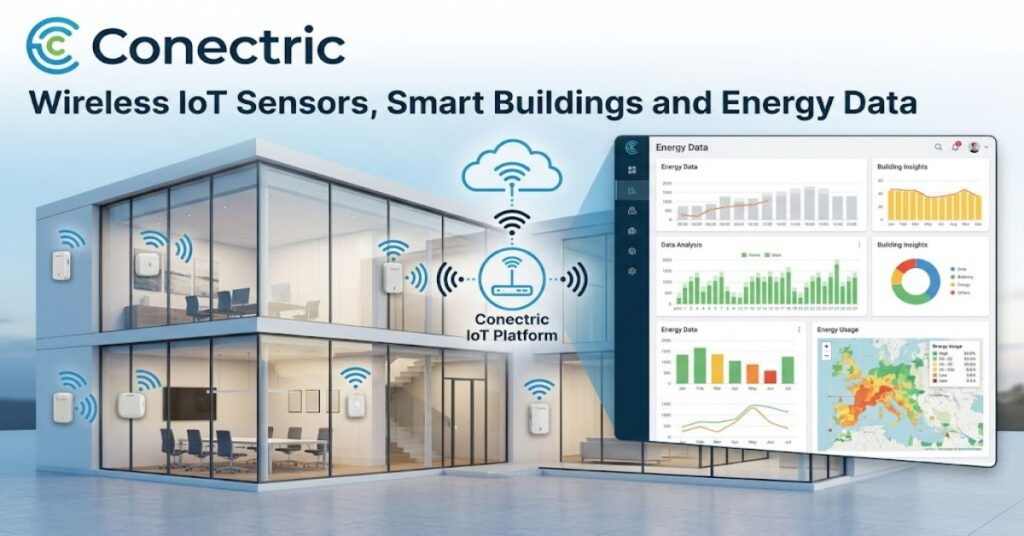
Conectric was a technology company associated with wireless Internet of Things (IoT) systems for buildings, energy management and utility data. Its documented product ecosystem included wireless sensors, a USB gateway, mesh-networking technology and software tools capable of transferring sensor information into applications.
The company’s LinkedIn profile described Conectric Networks as a San Diego-based business founded in 2015 and focused on wireless communications for real-time sensor and energy data. Its listed specialties included building automation, sensors and controls, demand response, energy management, wireless networks and utility submetering.
The central idea behind Conectric was straightforward: buildings generate enormous quantities of physical data, but that data becomes useful only when it can be collected reliably and connected to software. Temperature, humidity, occupancy, door status, equipment readings and energy consumption can reveal how a building is operating.
Conectric’s approach used distributed wireless devices to gather these measurements and mesh networking to move information towards gateways. This was particularly relevant to existing buildings where installing new cables can be disruptive or expensive.
Its technology therefore sits at the intersection of IoT hardware, building automation and energy intelligence. Public technical documentation and patent records provide useful evidence of how the system was designed and where it was intended to operate.
How the Conectric Technology Stack Worked
The system was built around several connected components rather than a single product.
| Component | Function | Practical value |
| Wireless sensors | Capture physical conditions | Provides granular building data |
| Mesh network | Transfers sensor messages | Extends wireless coverage |
| USB gateway | Connects sensors to software | Bridges physical and digital systems |
| Software tools | Decode and process information | Enables applications and analytics |
| RS-485 integration | Connects compatible equipment | Extends monitoring beyond basic sensors |
Documented technical material described motion, door-switch and temperature/humidity sensors. The gateway could receive messages from the wireless network and expose sensor information to software through a Node.js library.
This architecture created an important separation between data collection and application development. Developers could use sensor readings in dashboards, alerts, databases or other services rather than being locked into a single visualisation.
Why Wireless Mesh Networking Matters
Traditional building automation often depends heavily on wired infrastructure. Wiring remains highly reliable, but retrofitting an occupied hotel, office or commercial property can involve installation costs, access restrictions and operational disruption.
A mesh network offers another model. Individual sensors can communicate across a network where devices help move information towards a gateway. Additional routers can extend coverage, according to Conectric’s documented technical material.
That does not make wireless automatically superior. Radio interference, network density, gateway positioning, battery life and cybersecurity all become engineering considerations.
The strategic advantage is flexibility. A property manager can potentially deploy additional sensing points without treating every new measurement as a major cabling project.
Energy Management and Utility Submetering
Energy management was one of the more important applications associated with Conectric. Submetering allows consumption to be measured at a more granular level than a property’s primary utility meter.
The U.S. General Services Administration explains that submeters can measure electricity, water, natural gas, heating or cooling for specific areas, systems, equipment or tenants. That granularity can help identify inefficiencies and improve cost allocation.
Conectric’s technology was designed to contribute to this wider information layer. Its company profile listed utility submetering, demand response, grid balancing and energy intelligence among its specialties.
This distinction is important: sensors do not automatically create energy savings. Savings occur when collected information leads to better operational decisions, such as identifying waste, adjusting equipment schedules or responding to demand conditions.
Documented Evidence and Real-World Applications
There are several verifiable signals showing that Conectric’s work went beyond a conceptual IoT product.
A 2023 U.S. patent assigned to Conectric LLC describes wireless sensor networks involving multiple sensors installed in buildings, including hotels, to help predict and control energy needs.
Independent technical documentation from former Conectric engineering work also described practical implementations using its sensors and gateway. Demonstrations showed temperature and humidity information being collected and displayed through software platforms such as Elasticsearch and Grafana.
These documented examples provide stronger evidence than simply relying on a corporate description. They show that the architecture could operate across the complete chain: physical sensor, wireless network, gateway, software and visualisation.
Key Technical Insights
| Insight | Evidence | Implication |
| Distributed sensing | Multiple wireless sensor types were documented | Buildings can be monitored at room or equipment level |
| Gateway architecture | USB gateway connected sensors with software | Physical devices can feed conventional applications |
| Mesh expansion | Additional routers could extend network coverage | Larger installations can use multiple network points |
| Open software integration | Node.js tooling was documented | Developers could build custom applications |
| Energy focus | Patents and company materials reference energy management | The system targeted operational efficiency, not sensing alone |
Risks and Trade-Offs
The first limitation is network reliability. Wireless systems depend on radio conditions, device placement and network architecture. Large buildings with dense walls, machinery or interference may require careful site planning.
The second issue is power management. Battery-powered sensors reduce wiring requirements but introduce maintenance considerations. A network with hundreds or thousands of devices needs a disciplined battery monitoring strategy.
Cybersecurity is another concern. Once building sensors become connected systems, security extends beyond the sensor itself to gateways, software, credentials and data transmission.
The third insight is economic: granular data has value only when the organisation has a workflow for acting on it. Installing sensors without connecting measurements to maintenance, energy or operational decisions can produce more data without producing meaningful savings.
The Future of Conectric in 2027
By 2027, the broader technology category represented by Conectric is likely to remain relevant as commercial buildings seek more detailed operational data. The strongest opportunities are likely to involve retrofits, energy monitoring, occupancy intelligence and integration with existing building-management systems.
However, future adoption will depend on interoperability, cybersecurity and lifecycle economics rather than sensor deployment alone. Standards-based integration and stronger device-security practices will increasingly influence purchasing decisions.
Conectric’s historical technology provides an example of an early architecture built around distributed sensing and software integration. Whether the company itself remains commercially active should not be assumed without current corporate confirmation.
Key Takeaways
- Wireless sensing can reduce the installation burden associated with building data collection.
- Mesh networking is useful when sensors must cover distributed physical spaces.
- Gateways remain important because they connect constrained IoT devices with software environments.
- Energy data becomes valuable when connected to operational decisions.
- Submetering can provide more detailed consumption information than whole-building utility meters.
- Wireless deployments still require careful planning for security, batteries and radio coverage.
Conclusion
Conectric represents an important model of how IoT technology can connect physical buildings with software-based energy intelligence. Its documented sensors, gateways and mesh-networking systems addressed a practical challenge: collecting detailed information from existing environments without depending entirely on new wired infrastructure.
The technology’s significance is broader than the company itself. Modern smart-building systems continue to depend on the same basic architecture of sensors, communications, gateways, analytics and controls. What has changed is the scale, interoperability and security expectations surrounding these systems.
The strongest lesson from Conectric’s approach is that sensing is only the first step. Useful smart-building technology must turn measurements into operational information and, where appropriate, actions. That remains central to energy management, submetering and building automation as the industry moves toward increasingly connected infrastructure.
Frequently Asked Questions
What is Conectric?
Conectric was a technology company associated with wireless IoT sensors, mesh networking, gateways and software for building automation and energy-management applications.
What did Conectric sensors measure?
Documented sensor products included motion, door-switch and temperature/humidity sensing. The wider platform also supported energy and equipment-related data collection.
How did the Conectric mesh network work?
Sensors communicated wirelessly through a mesh architecture. Gateways received the information and connected the sensor network with software applications.
Was Conectric used for smart buildings?
Yes. Publicly documented company information, technical demonstrations and patent records connect its technology with building automation, energy management and commercial-building applications.
What is Conectric utility submetering?
The term refers to using connected sensing and metering infrastructure to collect more detailed information about utility consumption, such as electricity used by particular areas, systems or equipment.
Is Conectric still operating in 2027?
Current public evidence is insufficient to make a definitive claim about its present commercial status. Historical technology and patent records are well documented, but current operations should be independently confirmed.
Methodology
This article was prepared using publicly available corporate information, documented technical material, U.S. patent records and government guidance on building submetering. Particular weight was given to primary or technically specific evidence rather than general promotional descriptions.
The analysis also considered documented Conectric sensor and gateway demonstrations, including temperature/humidity, motion and door-switch applications. The principal limitation is that current commercial status and present-day product availability cannot be established confidently from the historical technical record alone.
No firsthand testing was conducted for this article, so no original performance measurements or invented testing claims have been presented. Readers evaluating a current deployment should independently verify product availability, support arrangements, security specifications and compatibility.
References
Conectric Networks. (n.d.). Company profile and technology specialties. LinkedIn.
General Services Administration. (n.d.). Submetering. U.S. General Services Administration.
Google Patents. (2023). US11605973B2: Systems and methods for a wireless sensor network. U.S. Patent and Trademark Office records.
Prickett, S. (2017). Announcing Conectric’s USB IoT Gateway & Sensor Product.
Prickett, S. (2017). Visualizing room climate data with Conectric’s IoT sensors, Elasticsearch & Grafana.
The App Solutions. (2023). Conectric: IoT sensors, business intelligence and energy management.