
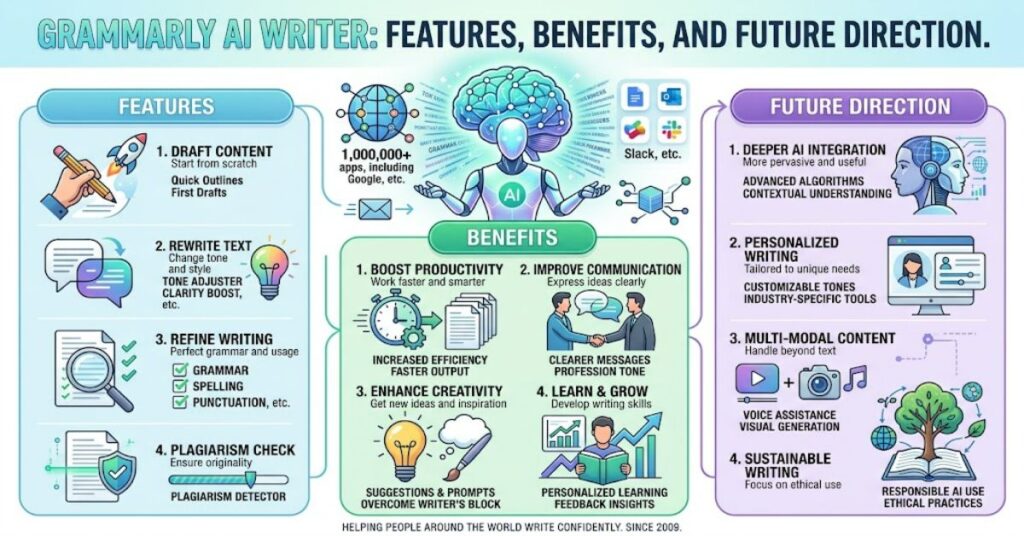
Grammarly AI Writer is designed to help people create and improve written content using generative artificial intelligence. Instead of requiring users to leave their document and open a separate chatbot, Grammarly places AI-powered writing assistance directly into many of the applications and websites where people already work.
The tool can help with brainstorming, drafting, rewriting, summarising and adapting text for different purposes. Grammarly says its writing assistance operates across more than 1 million apps, websites and programmes, including common workplace and productivity environments.
That integration is important because the value of an AI writing assistant is not simply measured by how well it produces a paragraph. The larger question is whether it reduces friction between having an idea and producing usable communication.
Grammarly has also moved beyond a simple AI writer. Its product direction now includes AI agents and contextual assistance designed to support different stages of work. In August 2025, Grammarly announced specialised AI agents for tasks including source discovery, originality checking, reader-reaction prediction and feedback.
This makes Grammarly particularly relevant to students, professionals, marketers and teams that need frequent written communication rather than occasional long-form content generation.
What Can Grammarly AI Writer Do?
At its core, the system converts a user’s instructions and existing context into generated or revised text. Common applications include emails, blog ideas, social posts, job descriptions, summaries and other professional writing.
| Capability | Practical use | Main benefit |
| Brainstorming | Generate ideas and angles | Reduces blank-page friction |
| Drafting | Create an initial version | Speeds up first drafts |
| Rewriting | Change wording or structure | Improves clarity and flow |
| Tone adjustment | Adapt communication style | Makes messages audience-specific |
| Summarising | Condense longer material | Saves reading and drafting time |
| Editing | Refine existing text | Supports final-stage polishing |
Grammarly’s own AI writing guidance identifies numerous applications, including emails, cover letters, marketing copy, blog ideas, product descriptions and content repurposing.
The important distinction is that these functions are best viewed as writing assistance, not automatic authorship. A generated draft still needs a person to check meaning, facts, tone and context.
Why Integration Matters More Than Generation
A useful way to assess an AI writing product is to separate generation quality from workflow efficiency.
A standalone chatbot may produce excellent text, but moving information between applications introduces additional steps. Grammarly’s approach is different: its assistance is designed to appear within the user’s existing workflow.
That reach currently extends across more than 1 million apps and websites.
This produces a practical advantage: context switching is reduced.
| Workflow factor | Standalone AI chatbot | Grammarly-style integrated assistance |
| Drafting | Usually requires separate interface | Available within supported workflows |
| Existing text | Often manually copied | Can work directly with active writing |
| Tone changes | Prompt-dependent | Built into writing assistance |
| Editing | Copy, revise, paste | More immediate |
| Workflow disruption | Higher | Lower |
This is one of the strongest reasons to consider Grammarly beyond its individual generation features.
Grammarly AI Writer and the Shift Toward AI Agents
Grammarly’s product development shows that AI writing is becoming broader than simple prompt-to-paragraph generation.
In 2025, Grammarly introduced specialised agents intended to provide more targeted assistance throughout the writing process. These included capabilities related to originality, source discovery, reader reactions and feedback.
By 2026, Grammarly’s documentation describes generative AI assistance alongside features such as AI assistants, paragraph-level rewrites, strategic suggestions and agent-based workflows.
The strategic implication is significant. The competitive advantage may increasingly come from context and workflow, rather than from simply producing grammatically correct sentences.
Three Practical Insights
1. Integration can be more valuable than raw generation quality.
For frequent email, document and workplace writing, saving repeated copy-and-paste steps can have greater practical value than producing slightly better isolated text.
2. AI assistance increases the importance of editing.
The easier it becomes to generate acceptable prose, the more important human review becomes for factual accuracy, originality and appropriate judgement.
3. Privacy is part of the product decision.
Grammarly states that its products process text when relevant features are active and provides privacy and security controls. Its security documentation also lists certifications and third-party validation.
Risks and Trade-Offs
The biggest weakness of any AI writing assistant is that fluent text can appear more reliable than it actually is.
Users should independently verify statistics, quotations, legal claims, technical information and other factual material. AI-generated wording can also become repetitive or generic when users accept the first suggestion without adding their own knowledge.
Privacy deserves similar attention. Grammarly states that information used for generative AI features can be processed by selected service providers and says those providers are not permitted to train their models on user content.

Organisations should therefore evaluate administrative settings, data policies and applicable compliance requirements before allowing AI writing tools to process sensitive material.
The Future of Grammarly AI Writer in 2027
The likely direction for AI writing tools in 2027 is deeper workflow integration rather than standalone text generation.
Grammarly’s development of specialised agents, multilingual assistance and contextual AI indicates movement towards systems that understand the user’s task rather than merely responding to a sentence prompt. Grammarly expanded writing assistance into Spanish, French, Portuguese, German and Italian in 2025, while subsequent product development has continued adding broader AI capabilities.
The uncertainty is how much autonomy users and organisations will accept. For sensitive communications, human approval will remain important. Education and professional environments will also continue to balance productivity benefits against authorship, originality and accountability.
Key Takeaways
- Grammarly combines generative AI with established writing assistance.
- Its reach across more than 1 million apps and websites is a major differentiator.
- Useful applications include drafting, rewriting, brainstorming and summarising.
- AI-generated text should always be reviewed for factual accuracy.
- Privacy and organisational controls matter when processing sensitive information.
- Grammarly’s product strategy is increasingly centred on contextual AI and specialised agents.
- Human judgement remains essential for high-stakes communication.
Conclusion
Grammarly AI Writer is best understood as part of a wider communication platform rather than simply another AI text generator. Its practical strength comes from combining generative writing capabilities with editing, rewriting and contextual assistance inside the applications people already use.
That distinction matters. Generating a paragraph is now relatively easy across many AI products. Making assistance available at the exact point where someone is writing can have greater workflow value.
However, convenience does not remove responsibility. Users still need to verify important facts, protect confidential information and ensure that generated language accurately represents their intended meaning. The strongest use case is therefore collaborative: AI handles repetitive drafting and refinement while the human remains responsible for judgement, accuracy and final authorship.
FAQ
What is Grammarly AI Writer?
It is Grammarly’s generative AI writing assistance for creating, rewriting, brainstorming and refining text.
Can Grammarly AI Writer write complete articles?
It can help generate drafts and sections, but complete articles should be reviewed, fact-checked and edited by a human.
Where does Grammarly AI Writer work?
Grammarly says its writing assistance works across more than 1 million apps, websites and programmes.
Is Grammarly AI Writer the same as a chatbot?
Not exactly. Its major distinction is integration into writing workflows and the ability to work with contextual writing assistance.
Is Grammarly suitable for business use?
It can support business writing, but organisations should evaluate privacy, security, administration and compliance requirements before deployment.
Does Grammarly replace human writers?
It can reduce drafting and editing workload, but human judgement remains necessary for accuracy, originality, context and accountability.
Methodology
This article was developed using Grammarly’s current product pages, support documentation, security information and official company announcements. Particular attention was given to documented product capabilities, platform reach, AI-agent development and privacy statements. Claims about Grammarly’s features were checked against current first-party materials rather than inferred from generic AI-writing conventions.
No independent hands-on product benchmark was conducted, so the article does not present invented performance measurements or personal testing results. Product capabilities can vary by plan, account type and feature availability.
Editorial disclosure: This article was drafted with AI assistance and should be reviewed and verified by the Matrics360.com editorial team before publication.
References
Grammarly. (2025). Grammarly launches specialized AI agents and writing surface for students and professionals.
Grammarly. (2025). How Grammarly works.
Grammarly. (2025). Privacy and security FAQs.
Grammarly. (2025). Grammarly expands beyond English with AI writing assistance in five new languages.
Grammarly. (2026). Introducing Grammarly’s new AI Rewriter Agent. Grammarly. (2026). Security at Grammarly