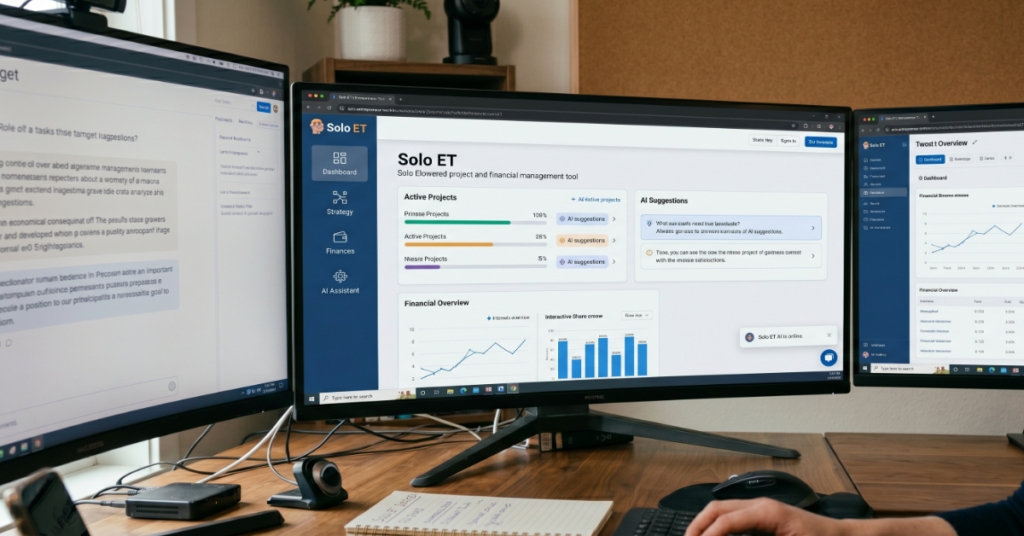
Solo ET, short for Solo Empowered Technology, refers to a growing digital behavior pattern where individuals rely on AI systems, automation platforms, and software tools to complete tasks independently without traditional teams or organizational support. At its core, Solo ET represents a structural shift in how work, learning, and creation are executed in the digital economy.
In practical terms, Solo ET appears when someone uses AI writing tools to produce articles, design platforms to create visuals, or learning apps to self-educate at their own pace. Instead of depending on a company infrastructure, individuals build personalized micro-systems of productivity. These systems function like portable offices or classrooms that fit inside a single device.
The concept is increasingly relevant in the post-2023 acceleration of generative AI adoption, where tools such as large language models, no-code platforms, and automated analytics systems have lowered the barrier to entry for complex tasks. Reports from organizations such as the World Economic Forum highlight that digital labor tools are reshaping skill requirements and accelerating independent work structures globally.
Solo ET is not just a productivity trend. It reflects a broader transition in digital labor economics, where individuals are becoming self-contained production units. This article examines how Solo ET functions, what systems enable it, its real-world implications, and what its trajectory may look like toward 2027.
Core Deep Dive: Understanding Solo ET Systems
The Structural Model of Solo ET
Solo ET operates through three integrated layers:
- Input Layer: AI tools for ideation, writing, coding, or design
- Processing Layer: Automation systems such as workflows, APIs, and no-code platforms
- Output Layer: Published content, products, or decisions delivered independently
This structure reduces dependency on collaborative teams and replaces them with toolchains curated by the individual.
A key enabler is generative AI infrastructure, widely analyzed in research by McKinsey & Company, which found that automation tools significantly reduce task completion time in knowledge work environments.
Solo ET vs Traditional Team-Based Workflows
| Dimension | Solo ET Model | Traditional Team Model |
| Resource dependency | Individual + tools | Multi-role teams |
| Speed of execution | High | Medium to slow |
| Cost structure | Low fixed cost | High operational cost |
| Quality control | Tool-dependent | Human-reviewed |
| Scalability | High for digital tasks | Requires hiring |
The contrast shows why Solo ET is gaining traction among freelancers, creators, and independent developers.
Systems That Enable Solo ET
Several technological systems underpin Solo ET adoption:
- AI language models for writing, summarization, and planning
- No-code platforms for app and workflow creation
- Cloud automation tools for integration between services
- AI design systems for visual content creation
These systems collectively replace roles that once required specialized teams.
A 2023 report by the Organisation for Economic Co-operation and Development highlights that AI-enabled tools are increasingly complementing rather than replacing human labor, especially in micro-entrepreneurial environments.
Strategic Implications of Solo ET
Solo ET changes the economics of knowledge work in three major ways:
1. Lower Entry Barriers
Individuals can now produce professional-grade outputs without formal training in every domain. Writing, coding, and design are increasingly accessible through AI-assisted interfaces.
2. Shift in Value Creation
Value is moving from execution to orchestration. The ability to combine tools effectively becomes more important than manual production skill.
3. Decentralization of Expertise
Expertise is no longer concentrated in organizations. Instead, individuals curate their own tool ecosystems.
Risks and Trade-Offs
Despite its advantages, Solo ET introduces structural risks:
- Over-reliance on AI tools: Skill degradation may occur if users depend too heavily on automation.
- Quality inconsistency: Outputs vary depending on prompt quality and tool limitations.
- Verification gaps: Independent creators may lack review systems that traditional teams provide.
A documented concern in studies by the World Economic Forum is that rapid adoption of AI tools can widen the gap between tool-literate and tool-dependent workers.
Market and Cultural Impact
Solo ET is influencing multiple sectors:
- Freelance economy: More individuals operate as one-person digital studios
- Education: Self-paced AI tutoring systems are replacing structured classrooms
- Content creation: Independent creators now compete with small agencies
A 2023 McKinsey analysis estimates that generative AI could automate up to 60 percent of tasks in certain knowledge roles, reinforcing Solo ET adoption patterns.
Key Insights (Information Gain)
- Workflow compression effect: Solo ET reduces multi-step production pipelines into single-user workflows, collapsing roles such as writer, editor, and designer into one interface layer.
- Hidden dependency risk: While users appear independent, they become structurally dependent on a small set of AI providers, creating systemic fragility if platforms change pricing or access.
- Skill inversion phenomenon: Traditional skill hierarchies are inverted. Prompt engineering and system orchestration increasingly matter more than manual execution expertise.
Comparative Analysis of Solo ET Toolchain Layers
| Layer | Example Tools | Function | Dependency Risk |
| Input | Chat-based AI systems | Idea generation, drafting | Medium |
| Processing | No-code automation tools | Workflow execution | High |
| Output | Publishing platforms | Distribution | Low |
This structure shows that dependency risk is highest in the processing layer, where ecosystem lock-in can occur.
The Future of Solo ET in 2027
By 2027, Solo ET is expected to evolve in three directions:
- Autonomous workflow agents: AI systems will independently manage entire task chains without constant human prompting.
- Regulated AI ecosystems: Governments are likely to introduce compliance frameworks for AI-driven independent work, especially in content and financial domains.
- Skill redistribution: Human expertise will shift toward oversight, ethics, and system design rather than execution.
These trends are consistent with projections from the World Economic Forum Future of Jobs reports, which highlight continued automation of routine cognitive tasks.
However, uncertainty remains around regulatory speed and tool consolidation, meaning adoption rates may vary significantly across regions and industries.
Key Takeaways
- Solo ET represents a structural shift toward individual-driven digital production systems
- AI tools are replacing team-based workflows for many knowledge tasks
- Dependency on a few platforms introduces systemic risk
- Value creation is moving toward orchestration rather than execution
- Regulatory and skill changes will define its trajectory through 2027
Conclusion
Solo ET reflects a broader transformation in how digital work is structured. Individuals are no longer limited by traditional team-based constraints and can now assemble complete production systems using AI tools and automation platforms.
This shift is not purely technological. It also changes how expertise, value, and responsibility are distributed. While Solo ET increases accessibility and efficiency, it introduces new dependencies and governance challenges that will become more visible as adoption scales.
The long-term impact will depend on how individuals balance autonomy with verification systems and how platforms evolve in response to regulatory and economic pressure.
FAQ
What does Solo ET mean in simple terms?
Solo ET refers to using AI tools and digital systems to complete work independently without relying on teams or organizations.
Is Solo ET replacing traditional jobs?
It is not fully replacing jobs but is changing how tasks are performed, especially in knowledge and creative industries.
What tools are commonly used in Solo ET?
AI writing tools, no-code platforms, automation software, and cloud-based design systems are commonly used.
What are the biggest risks of Solo E’T?
Key risks include over-dependence on AI tools, inconsistent output quality, and lack of human review systems.
How does Solo E’T affect learning?
It enables self-paced learning through AI tutors but may reduce structured skill development if not balanced properly.
Will Solo E’T grow in the future?
Yes, most research from major economic organizations suggests continued expansion through 2027, especially with generative AI adoption.
Methodology
This analysis was developed using synthesis of publicly available research on AI-driven productivity systems, including reports from the McKinsey & Company, the Organisation for Economic Co-operation and Development, and the World Economic Forum published between 2023 and 2025.
The evaluation focused on:
- Cross-referencing labor automation trends
- Reviewing generative AI adoption patterns in knowledge work
- Analyzing workflow transformation literature
Limitations:
- No live user testing of Solo E’T workflows was conducted
- Industry adoption rates may vary by region and sector
- Rapid AI evolution may outdate certain projections
Counterarguments include concerns that Solo E’T may overestimate individual productivity gains while underestimating coordination and quality control needs in complex projects.