
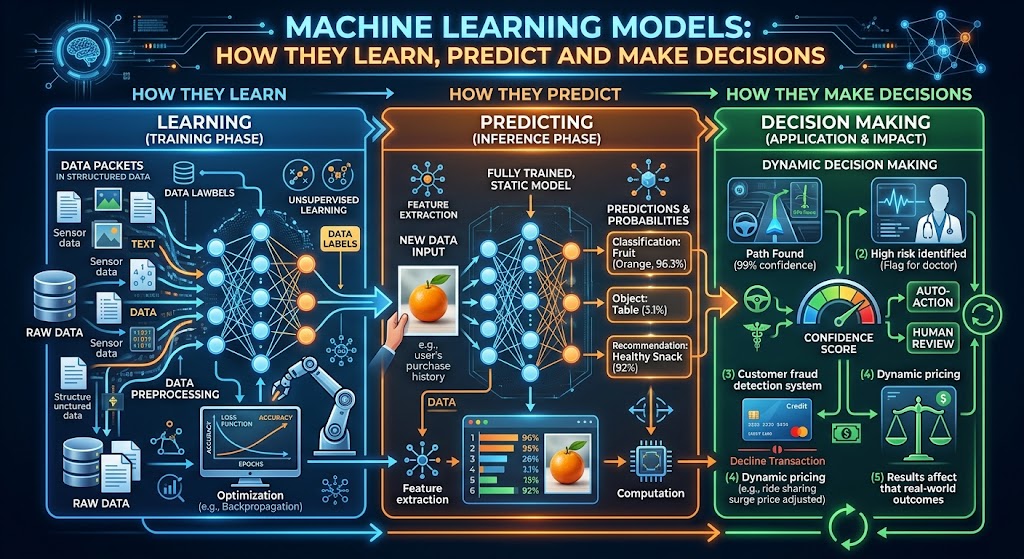
Machine learning models are computer programmes trained on data to recognise patterns, make predictions or take actions without being explicitly programmed for every individual rule. They are now used across search, banking, healthcare, retail, manufacturing, cybersecurity and countless digital services.
At their simplest, these models learn a relationship between inputs and outputs. A model might examine previous house prices and property characteristics to estimate the value of another property. It might analyse transactions to identify unusual activity or classify an email as spam.
The term covers a wide range of techniques rather than one specific type of software. Linear regression, decision trees, support vector machines, neural networks and large language models all belong to the broader machine learning family, but they solve problems in very different ways.
Understanding those differences matters because there is no universally “best” model. A simpler algorithm may outperform a complex neural network when the dataset is small, the variables are well understood or transparency is important.
How Machine Learning Models Work
Most machine learning development begins with data. The data is prepared, relevant variables are identified and the model is trained to find patterns.
In supervised learning, the training data contains known outcomes. A model could receive thousands of labelled examples showing whether a transaction was fraudulent or legitimate. During training, it adjusts its internal parameters to reduce prediction errors.
Unsupervised learning works differently. Instead of receiving predefined answers, the model searches for structures within data. Clustering is a common example, where customers might be grouped according to purchasing behaviour.
Reinforcement learning introduces another approach. An agent learns by interacting with an environment and receiving rewards or penalties based on its actions.
| Learning approach | Typical task | Example |
| Supervised learning | Prediction or classification | Fraud detection |
| Unsupervised learning | Pattern discovery | Customer segmentation |
| Reinforcement learning | Sequential decisions | Game-playing systems |
| Deep learning | Complex pattern recognition | Image or speech analysis |
Main Types of Machine Learning Models
Linear Models
Linear regression and logistic regression are among the most straightforward approaches. They are useful when relationships between variables can be represented effectively through linear combinations.
Their relative simplicity can be an advantage. They are often easier to interpret, train and maintain than highly complex models.
Decision Trees
Decision trees make predictions through a sequence of questions or conditions. For example, a model assessing loan applications might consider income, credit history and existing debt.
They are relatively easy to understand, although individual trees can become overly complex and prone to overfitting.
Random Forests
Random forests combine many decision trees and aggregate their predictions. This ensemble approach can improve robustness compared with relying on one tree.
They work well for many structured-data problems and can handle nonlinear relationships without requiring the same architecture used by deep neural networks.
Neural Networks
Neural networks contain interconnected computational units arranged in layers. They can learn highly complex relationships and are particularly important in computer vision, speech recognition and natural-language processing.
Deep learning refers broadly to neural-network systems with multiple layers. Their power comes with trade-offs: training can require substantial computing resources, large datasets and careful model evaluation.
Large Language Models
Large language models are specialised neural networks trained on enormous collections of text and other data. They can generate, classify, summarise and transform language.
Their capabilities have expanded the practical role of machine learning, but their outputs still require evaluation. A fluent response is not automatically a factual or reliable one.
What Makes a Model Effective?
Model quality is not simply a matter of achieving the highest accuracy score.
| Factor | Why it matters |
| Data quality | Poor or incomplete data can produce unreliable predictions |
| Accuracy | Measures how often predictions are correct |
| Precision and recall | Important when different error types have different consequences |
| Generalisation | Shows whether the model performs well on unseen data |
| Interpretability | Helps users understand why predictions were produced |
| Latency | Matters when decisions must happen quickly |
| Cost | Training and running complex models can require significant resources |
| Fairness | Poorly designed systems can reproduce or amplify data bias |
A model that performs brilliantly in testing but poorly after deployment is not necessarily successful. This makes validation and monitoring essential.
The Importance of Training Data
The quality of training data often places a practical ceiling on model performance.
If historical data contains missing values, systematic errors or biased sampling, the model can learn those weaknesses. Increasing model complexity does not automatically solve the problem.
There is also a distinction between training performance and generalisation. A model can memorise patterns in its training dataset instead of learning relationships that apply to new examples. This problem is known as overfitting.
Techniques such as train-test splits, cross-validation, regularisation and careful feature selection can help identify or reduce this risk.
Risks and Real-World Trade-Offs
Machine learning introduces several risks beyond technical accuracy.
Bias can emerge when training data does not adequately represent the population affected by a system. Privacy is another concern when sensitive information is used during development or inference.
Interpretability can also become difficult. A highly complex model may produce strong predictions without offering an explanation that ordinary users can easily understand.
There is a further operational risk: models can become less accurate as real-world conditions change. This is sometimes described as data drift or concept drift.
For businesses, deploying a model should therefore be treated as an ongoing process rather than a one-time software installation.
Three Practical Insights
First, the simplest suitable model is often worth testing before a complex one. A transparent model can be easier to audit and cheaper to operate.
Second, data preparation can matter as much as model selection. Changing the algorithm may produce only limited gains if the underlying dataset is inconsistent or poorly labelled.
Third, deployment changes the problem. A model evaluated in a controlled environment still needs monitoring once people, markets and behaviours begin interacting with it.
These points help explain why successful machine learning is as much about engineering, governance and evaluation as it is about algorithms.
The Future of Machine Learning Models in 2027
By 2027, machine learning is likely to become increasingly integrated into ordinary software rather than appearing only as a separate AI feature.
The strongest development is likely to be greater use of specialised models alongside general-purpose systems. Smaller models can be attractive where organisations need lower latency, reduced infrastructure costs or greater control over data.
Model efficiency is also likely to remain important. Improvements in hardware, quantisation, distillation and other optimisation techniques can reduce the resources required to run capable systems.
Regulation will shape deployment as well. The EU AI Act is establishing a risk-based framework for artificial intelligence, while organisations elsewhere are developing their own governance requirements.
The direction is therefore not simply towards larger models. It is towards systems that can be evaluated, monitored, secured and deployed efficiently.
Key Takeaways
- Model selection should follow the problem rather than current technology trends.
- Training data can determine performance as strongly as algorithm choice.
- Complex models can introduce interpretability, cost and governance challenges.
- Evaluation should include unseen data and realistic deployment conditions.
- Monitoring is necessary because real-world data can change after deployment.
- Responsible machine learning requires attention to privacy, bias, security and accountability.
Conclusion
Machine learning models provide a flexible way for computers to learn patterns from data and use those patterns to produce predictions or decisions. Their applications range from straightforward statistical forecasting to highly complex systems capable of processing images, speech and language.
The central challenge is not simply creating a model that performs well on a benchmark. A useful system must work with appropriate data, generalise beyond its training examples, operate within practical cost constraints and remain reliable after deployment.
For organisations adopting machine learning, model selection should therefore be only one part of the process. Data governance, testing, monitoring, security and human oversight are equally important.
As machine learning becomes more deeply embedded in everyday technology, understanding these foundations will matter not only to engineers but also to business leaders, policymakers and ordinary users.
FAQ
What are machine learning models?
They are computer programmes trained using data to recognise patterns and make predictions, classifications or decisions without requiring every rule to be explicitly programmed.
What are the main types of machine learning models?
Common categories include linear models, decision trees, ensemble methods, support vector machines, neural networks and deep-learning systems.
What is the difference between AI and machine learning models?
Artificial intelligence is the broader field of creating systems capable of performing tasks associated with intelligence. Machine learning is one major approach used to build such systems.
Which machine learning model is best?
There is no universal best model. The appropriate choice depends on the data, objective, required accuracy, interpretability, computing resources and deployment environment.
Why is training data important?
Models learn from training data. Incomplete, inaccurate or biased datasets can lead to poor predictions and unreliable outcomes.
Can machine learning models make mistakes?
Yes. Models can produce incorrect predictions because of limited training data, unusual inputs, bias, changing conditions or weaknesses in their underlying design.
Methodology
This article was developed from established definitions and guidance concerning machine learning, model evaluation and responsible AI. The discussion focuses on commonly used learning approaches and practical considerations rather than presenting a benchmark comparison of individual algorithms.
No independent model training, performance testing or proprietary dataset analysis was conducted for this article. Claims concerning specific systems should therefore be independently verified before publication.
The article also avoids presenting any particular machine learning architecture as universally superior because model performance depends heavily on the problem, dataset and deployment environment.
References
European Union. (2024). Regulation (EU) 2024/1689 laying down harmonised rules on artificial intelligence.
Google. (2023). Machine Learning Crash Course.
National Institute of Standards and Technology. (2023). Artificial Intelligence Risk Management Framework (AI RMF 1.0).
Russell, S., & Norvig, P. (2021). Artificial Intelligence: A Modern Approach (4th ed.). Pearson.
World Economic Forum. (2025). The Future of Jobs Report 2025.