
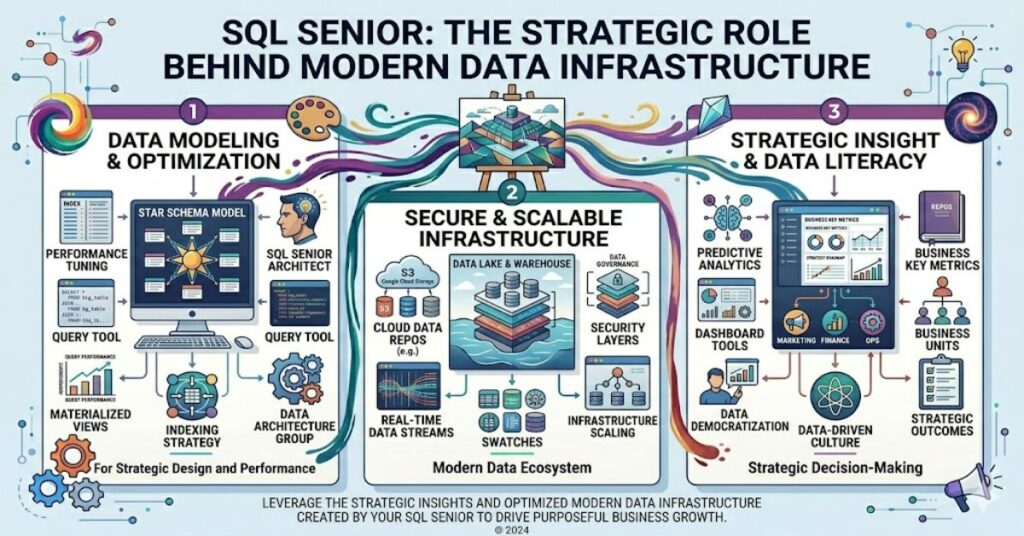
The term sql senior refers to an experienced database professional responsible for far more than creating queries. In modern organisations, senior SQL specialists design scalable database architectures, optimise performance, manage data governance, and support critical business decisions through reliable data systems.
As companies generate increasingly large volumes of information, database performance becomes a strategic concern rather than a purely technical one. Slow reporting, poor schema design, and inefficient indexing can create significant operational costs. Senior SQL professionals solve these challenges by combining technical expertise with business understanding.
Unlike junior database developers who primarily focus on writing and maintaining SQL statements, senior practitioners oversee database health, scalability planning, disaster recovery strategies, and cross-functional collaboration. They frequently work alongside software engineers, cloud architects, analysts, and executive stakeholders.
This evolution has transformed database expertise into a high-value career path. Whether working with Microsoft SQL Server, PostgreSQL, MySQL, Oracle Database, or cloud-native platforms, experienced professionals help organisations turn raw data into measurable business value.
The role is especially important in sectors such as finance, healthcare, retail, logistics, and artificial intelligence, where reliable access to accurate information directly influences decision-making and profitability.
What Does a Senior SQL Professional Do?
A senior SQL professional operates at both technical and strategic levels.
Key responsibilities often include:
- Database architecture design
- Query performance tuning
- Index optimisation
- Data modelling
- ETL process management
- Security and compliance oversight
- High-availability planning
- Disaster recovery implementation
- Mentoring junior developers
Rather than simply responding to performance problems, senior professionals proactively build systems that prevent bottlenecks from occurring.
Core Technical Areas
Database Architecture
Senior practitioners design schemas capable of handling future growth. This includes selecting appropriate normalisation levels, partitioning strategies, and storage structures.
Performance Optimisation
Query execution plans, indexing strategies, and workload analysis are critical skills. Small improvements can dramatically reduce infrastructure costs.
Data Governance
Modern organisations face increasing compliance requirements. Senior SQL professionals often participate in governance frameworks that ensure data accuracy, privacy, and retention compliance.
SQL Senior vs Junior SQL Developer
| Area | Junior SQL Developer | Senior SQL Professional |
| Query Writing | Basic to intermediate | Advanced optimisation |
| Database Design | Limited involvement | Full architecture ownership |
| Performance Tuning | Reactive | Proactive and strategic |
| Security Planning | Minimal | Governance leadership |
| Stakeholder Communication | Technical teams | Technical and business teams |
| Scalability Planning | Rare | Core responsibility |
| Mentorship | Receives guidance | Provides leadership |
The distinction is not merely years of experience. It reflects the ability to solve complex organisational challenges through data infrastructure.
Why Organisations Need Senior Database Expertise
As data volumes increase, technical debt becomes expensive.
A poorly optimised query executed millions of times per day can consume substantial infrastructure resources. Senior professionals identify these inefficiencies before they affect business operations.
Real-World Example
Large e-commerce platforms frequently process millions of transactions daily. Database latency of even a few milliseconds can impact user experience, conversion rates, and operational costs.
Experienced database engineers often redesign indexing structures and execution workflows to maintain performance under heavy loads.
Business Impact Areas
| Business Objective | Senior SQL Contribution |
| Faster Reporting | Query optimisation |
| Lower Infrastructure Costs | Efficient resource usage |
| Better Customer Experience | Reduced latency |
| Regulatory Compliance | Governance controls |
| Business Intelligence | Reliable data pipelines |
| Scalability | Future-proof architecture |
Essential Skills for a SQL Senior Role
Advanced Query Optimisation
Understanding execution plans, joins, indexing, and statistics remains fundamental.
Data Modelling
Strong knowledge of relational design helps create systems that remain maintainable as data volumes expand.
Cloud Database Platforms
Many organisations now deploy workloads through cloud providers such as AWS, Azure, and Google Cloud.
Senior professionals increasingly require expertise in:
- Amazon RDS
- Azure SQL Database
- Google Cloud SQL
- Snowflake
- BigQuery
Communication Skills
One frequently overlooked requirement is communication.
Senior database professionals often translate technical limitations into business language for managers and executives.
Risks and Trade-Offs
The role carries significant responsibility.
Performance Risks
Poor optimisation decisions can affect thousands of users simultaneously.
Security Exposure
Database environments often contain sensitive customer and operational information.
Complexity Management
As systems grow, maintaining performance becomes increasingly challenging.
A hidden limitation rarely discussed is organisational dependency. Many businesses become overly reliant on a single database expert, creating operational risk if knowledge is not properly documented and shared.
Three Important Insights Often Missed
1. Query Optimisation Is a Financial Function
Many organisations treat optimisation as a technical concern. In reality, efficient queries directly reduce infrastructure spending.
2. Data Models Determine Future Flexibility
Poor schema decisions can restrict analytics capabilities years later. Strategic data modelling creates long-term business agility.
3. Communication Drives Career Progression
Technical expertise alone rarely leads to senior leadership opportunities. The ability to influence business stakeholders is often what separates senior specialists from database architects.
The Future of SQL Senior Roles in 2027
Several trends are likely to shape the profession through 2027.
Increased Cloud Adoption
Cloud-native database services continue replacing traditional on-premises deployments.
AI-Assisted Optimisation
Database monitoring platforms increasingly use machine learning to identify performance issues automatically.
Stronger Governance Requirements
Privacy regulations and security expectations continue to expand globally, increasing demand for professionals who understand both compliance and database architecture.
Hybrid Data Ecosystems
Organisations are combining transactional databases, data warehouses, and real-time analytics platforms. Senior SQL professionals will increasingly act as integration specialists across these environments.
While automation may reduce some routine tasks, strategic database design and business-focused optimisation remain difficult to automate fully.
Key Takeaways
- Senior SQL professionals contribute strategic value beyond query writing.
- Performance optimisation directly influences operational costs.
- Data modelling decisions affect long-term scalability.
- Communication skills are increasingly important.
- Cloud database expertise continues growing in importance.
- Governance and security responsibilities are expanding.
- Demand for experienced database specialists remains strong.
Conclusion
The modern sql senior role sits at the intersection of technology, operations, and business strategy. Organisations depend on reliable data systems to support reporting, customer experiences, compliance requirements, and decision-making. As a result, database expertise has evolved beyond traditional administration and query development.
Senior SQL professionals create the frameworks that allow businesses to scale confidently while maintaining performance and security. Their work affects everything from infrastructure costs to executive reporting accuracy.
The future of database management will undoubtedly include more automation, cloud adoption, and AI-assisted optimisation. However, strategic thinking, architectural planning, and business alignment remain uniquely human strengths. For professionals seeking a career path that combines technical depth with organisational impact, senior SQL expertise continues to offer substantial opportunities and long-term relevance.
FAQ
What does a senior SQL professional do?
A senior SQL professional designs, optimises, secures, and scales database systems while supporting business objectives through reliable data infrastructure.
How many years does it take to become a senior SQL developer?
Most professionals reach senior-level responsibilities after five to ten years of practical database experience, depending on project complexity and leadership exposure.
Is SQL still a valuable skill in 2027?
Yes. SQL remains the primary language used for managing and analysing relational data across industries.
What databases should senior professionals learn?
SQL Server, PostgreSQL, MySQL, Oracle, Snowflake, BigQuery, and cloud database platforms are among the most valuable technologies.
Is database optimisation important for business performance?
Absolutely. Efficient database systems improve reporting speed, reduce costs, and support better decision-making.
Can AI replace senior SQL professionals?
AI can automate some administrative tasks, but architecture design, governance decisions, and business alignment still require experienced human expertise.
Methodology
This article was produced using industry-standard database management concepts, current enterprise database practices, vendor documentation, and established principles of relational database design. The analysis focuses on role responsibilities, technical requirements, and organisational impact rather than vendor-specific marketing claims.
Limitations include differences between industries, database platforms, and company structures. Responsibilities may vary between organisations.
Editorial Disclosure: This article was drafted with AI assistance and reviewed and verified by [Author Name]. All data, citations, and claims should be independently confirmed by the editorial team before publication.