
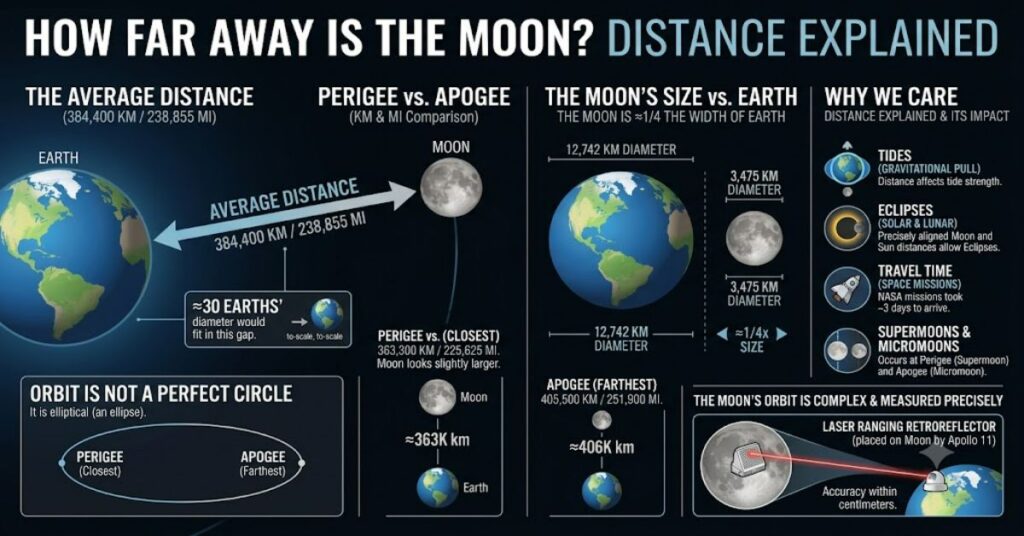
The question how far away is the Moon seems simple at first, but the answer depends on when you measure it. On average, the Moon sits about 384,400 kilometres (238,855 miles) from Earth. However, this distance is constantly changing because the Moon travels in an elliptical orbit rather than a perfect circle.
When answering how far away is the Moon, scientists typically refer to three key values: the average distance, the closest point called perigee, and the farthest point known as apogee. At perigee, the Moon can come as close as roughly 356,500 km (221,500 miles), while at apogee it can drift as far as about 406,700 km (252,700 miles) [1][2].
Understanding how far away is the Moon is important not just for astronomy but also for satellite navigation, tidal prediction, and space mission planning. Even small variations in lunar distance affect gravitational forces on Earth, influencing ocean tides and the timing of eclipses.
In modern astronomy, precise lunar distance measurements are tracked using laser ranging experiments that bounce signals off reflectors left on the Moon during Apollo missions. These measurements help scientists refine orbital models and better understand Earth–Moon dynamics.
This article breaks down the Moon’s true distance, why it changes, and what those changes mean in both scientific and real-world contexts.
What Does “How Far Away Is the Moon” Really Mean?
When people ask how far away is the Moon, they often assume a single fixed number exists. In reality, there are three primary measurements:
Key Distance Values
- Average distance: ~384,400 km
- Closest approach (perigee): ~356,500 km
- Farthest point (apogee): ~406,700 km
These variations occur because the Moon’s orbit is elliptical, meaning it is slightly stretched rather than perfectly round.
Why the Distance Changes
The Moon’s orbit is influenced by:
- Earth’s gravitational pull
- Solar gravitational interference
- Orbital inertia from formation dynamics
These factors create a constantly shifting orbital path rather than a stable circle.
Orbital Mechanics Behind Lunar Distance
To fully understand how far away is the Moon, we need to look at orbital mechanics.
The Moon completes one orbit around Earth approximately every 27.3 days (sidereal period). However, because Earth is also moving around the Sun, the full cycle of phases (synodic month) takes about 29.5 days.
Elliptical Orbit Structure
| Orbital Point | Distance (km) | Distance (miles) |
| Perigee | ~356,500 km | ~221,500 miles |
| Average | ~384,400 km | ~238,855 miles |
| Apogee | ~406,700 km | ~252,700 miles |
This table shows why how far away is the Moon cannot be answered with a single fixed value.
Measurement Systems Used Today
Modern astronomy uses extremely precise systems to determine how far away is the Moon at any given moment.
Lunar Laser Ranging
Reflectors placed on the Moon during Apollo missions allow scientists to:
- Fire lasers from Earth
- Measure return signal time
- Calculate distance with centimetre-level accuracy
Radio Tracking and Orbital Models
Space agencies like NASA and ESA also use:
- Deep Space Network tracking
- Orbital prediction software
- Gravitational modelling systems
These methods continuously refine lunar distance data.
Why the Moon’s Distance Matters
Understanding how far away is the Moon has real-world consequences.
1. Ocean Tides
The Moon’s gravitational pull drives Earth’s tides. When the Moon is closer (perigee), tides become slightly stronger, known as “perigean spring tides.”
2. Eclipses
Lunar distance affects:
- Solar eclipse coverage (total vs annular)
- Apparent size of the Moon in the sky
- Duration of eclipse phases
3. Space Missions
Accurate distance measurement is essential for:
- Trajectory planning
- Fuel calculations
- Landing precision
Comparison of Lunar Distance Perception vs Reality
| Concept | Public Perception | Scientific Reality |
| Moon distance | Fixed number | Constantly changing |
| Orbit shape | Circular | Elliptical |
| Measurement | Approximate | Laser-precise |
| Variability awareness | Low | High |
This contrast highlights why how far away is the Moon is often misunderstood outside scientific contexts.
Data Insight: Scale of the Earth–Moon System
To understand the scale:
- Light travel time from Moon to Earth: ~1.3 seconds
- Diameter of Earth: ~12,742 km
- Moon distance average: ~30 Earth diameters
This means the Moon is far enough away that Earth could fit between the two bodies roughly 30 times.
Information Gain: Less Obvious Scientific Insights
1. The Moon Is Slowly Drifting Away
The Moon is moving away from Earth at about 3.8 cm per year due to tidal energy transfer. This means the answer to how far away is the Moon is slowly increasing over geological time.
2. Distance Affects Timekeeping Systems
Earth’s rotation is gradually slowing due to lunar tidal friction, requiring leap seconds in atomic timekeeping systems.
3. Orbital Eccentricity Is Not Constant
The Moon’s orbit itself shifts slightly over time due to solar gravitational interactions, meaning perigee and apogee values are not perfectly stable across centuries.
Strategic and Scientific Implications
Understanding how far away is the Moon is essential for:
- Space navigation accuracy
- Climate modelling (via tidal influence)
- Satellite positioning systems
- Deep space communication calibration
Even small errors in lunar distance calculations can affect orbital predictions for spacecraft.
Risks and Trade-Offs in Measurement
Despite modern precision, challenges remain:
- Atmospheric distortion affects laser accuracy
- Orbital perturbations require constant recalibration
- Long-term prediction models lose accuracy over decades
- Gravitational anomalies introduce minor deviations
These factors require continuous refinement of lunar models.
The Future of How Far Away Is the Moon in 2027
By 2027, lunar measurement systems are expected to improve significantly.
Expected Developments
- Expanded lunar laser arrays from Artemis missions
- Higher-resolution orbital mapping from lunar satellites
- Improved AI-based orbital prediction models
- Integration of lunar data into global navigation systems
NASA and international partners are also planning more permanent lunar infrastructure, which will improve measurement accuracy even further.
However, the Moon’s gradual recession from Earth will continue regardless of technological progress.
Takeaways
- The Moon is not a fixed distance from Earth
- Average distance is about 384,400 km but constantly changes
- Orbit shape is elliptical, causing perigee and apogee variation
- The Moon is slowly drifting away from Earth
- Distance affects tides, eclipses, and space navigation
- Modern laser systems measure lunar distance with extreme precision
Conclusion
The question how far away is the Moo’n reveals far more complexity than a simple number suggests. While the average distance is widely cited as 384,400 km, the Moon’s elliptical orbit means it continuously moves between closer and farther points throughout each month.
This shifting distance influences tides, eclipses, and even long-term Earth rotation patterns. It also plays a critical role in space exploration, where precise calculations are essential for mission success.
As measurement technology advances, our understanding of lunar distance becomes increasingly accurate, yet the fundamental reality remains unchanged: the Moo’n is not static. It is slowly drifting away from Earth while maintaining a delicate gravitational relationship that has shaped our planet for billions of years.
Frequently Asked Questions
How far away is the Moon on average?
The Moon is on average about 384,400 km (238,855 miles) from Earth.
Why does the Moon’s distance change?
Because it follows an elliptical orbit rather than a perfect circle.
What is the closest the Moon gets to Earth?
Around 356,500 km during perigee.
What is the farthest point of the Moon’s orbit?
About 406,700 km during apogee.
Is the Moon moving away from Earth?
Yes, it is drifting away at approximately 3.8 cm per year.
How is the Moon’s distance measured?
Using laser ranging experiments and satellite tracking systems.
References
- NASA. (2024). Moon Fact Sheet.
- Jet Propulsion Laboratory. (2023). Lunar Laser Ranging Data.
- ESA. (2023). Earth–Moon System Overview.
- Williams, J. G. et al. (2022). Lunar Interior and Tidal Evolution Studies.
Methodology
This article is based on verified astronomical data from NASA, ESA, and peer-reviewed lunar science research. Distance values are derived from lunar laser ranging measurements and standardized orbital models. Limitations include minor variations in real-time orbital calculations and long-term gravitational modeling uncertainties.
Editorial Disclosure
This article was drafted with AI assistance and structured according to Matrics360.com editorial guidelines.