
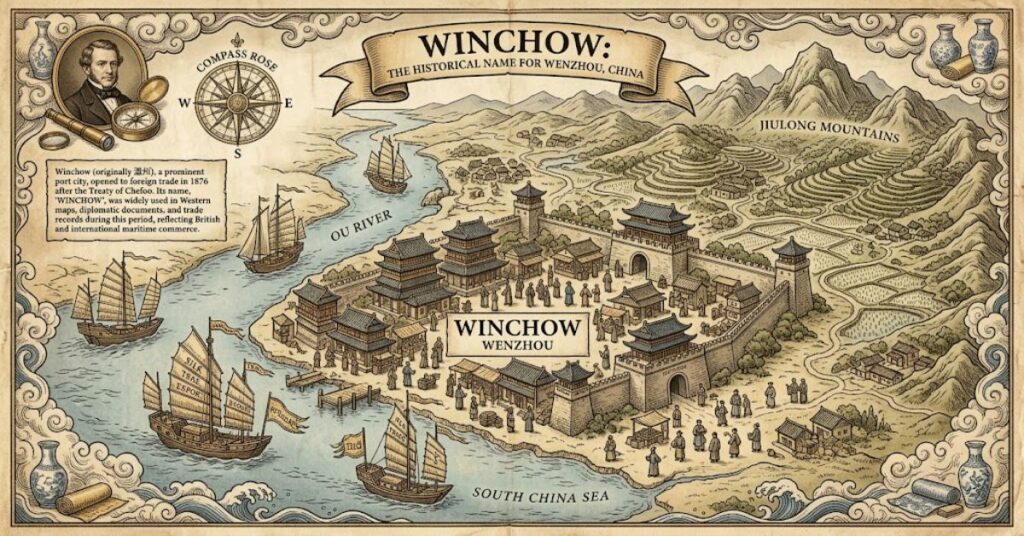
If you have encountered the word winchow in an old map, historical book, shipping record or genealogy, it may initially look like the name of a separate Chinese city. In most historical contexts, however, the intended place is Wenzhou, a coastal city in southeastern Zhejiang Province.
The modern Mandarin spelling is Wenzhou, written 温州 in simplified Chinese and 溫州 in traditional Chinese. Older Western sources used several different romanisations, including Wenchow and Wen-chou. The Library of Congress’s conventional place-name material pairs Wen-chou with the modern Pinyin form Wenzhou, while historical references identify Wenchow as an older spelling.
The spelling matters because Chinese place names were not always represented in Latin letters using one universal system. Before Hanyu Pinyin became dominant internationally from the late twentieth century, foreign governments, publishers, postal authorities, missionaries and mapmakers used several systems.
Wenzhou is particularly interesting because its history stretches back more than two millennia, while its modern economy has developed into one of Zhejiang’s significant private-enterprise centres. Official Zhejiang material describes it as a historic coastal city, and 2025 economic data show that its regional GDP passed the one-trillion-yuan threshold.
Understanding winchow, therefore, is not simply a matter of correcting an old spelling. It provides a useful route into the history of Chinese romanisation, the development of Wenzhou and the challenge of interpreting historical geographical records.
What Does Winchow Mean?
Winchow is best treated as a historical spelling associated with Wenzhou, not as the standard modern English name of a separate city.
The most established historical form is Wenchow, which was used as postal romanisation. Another important form is Wen-chou, associated with Wade–Giles romanisation. Modern Hanyu Pinyin gives Wenzhou.
| Form | Romanisation context | Modern equivalent |
| Wenzhou | Hanyu Pinyin | Current standard |
| Wenchow | Postal romanisation | Wenzhou |
| Wen-chou | Wade–Giles | Wenzhou |
| Wen-Chou | Variant historical styling | Wenzhou |
This explains why a historical source may appear to describe a place that does not exist on a modern map. The geography has not necessarily changed; the spelling has.
For researchers, the distinction is important. Searching only for the modern spelling can cause older newspapers, maps and books to be missed.
Why Wenchow Became Wenzhou
The history of Chinese romanisation is central to understanding the change.
Different systems attempted to represent Chinese sounds using the Latin alphabet. Wade–Giles became particularly influential in English-language scholarship, producing forms such as Wen-chou. Postal romanisation created another set of spellings, including Wenchow.
Pinyin eventually became the dominant standard for Mandarin romanisation. The Library of Congress’s place-name resources demonstrate the conversion directly: Wen-chou is given as Wenzhou, while reference material identifies Wenchow as the older postal form.
The result is a layered historical record. A document written decades ago may use a spelling that looks unfamiliar today but was perfectly conventional at the time.
A Practical Historical Research Rule
When an old source uses Winchow, Wenchow or Wen-chou, researchers should avoid assuming that each spelling represents a different location.
Instead, compare:
- The surrounding province or region.
- Nearby rivers, ports and counties.
- The date of the document.
- The romanisation system used elsewhere in the same source.
- Chinese characters where available.
This approach can prevent false location matches in historical research.
Wenzhou’s Historical Background
Wenzhou has a much longer history than its modern English name suggests. Official Zhejiang material traces the region’s cultural history back more than 2,200 years to the Kingdom of Dong’ou. The city later became associated with the name Wenzhou during the Tang dynasty period.
The name Wenzhou is commonly explained through its climate. Official descriptions state that the city derived its present name from its relatively mild climate.
The location also shaped its development. Wenzhou sits in southeastern Zhejiang on the coast, with the Ou River running through the region. Its combination of mountains, waterways, islands and access to the East China Sea influenced both settlement and trade.
The city later developed into a foreign trade port during the Southern Song period. That maritime connection became one of the foundations for Wenzhou’s later commercial identity.
Winchow, Wenchow and Modern Wenzhou Compared
| Name | Status | Where it is most likely encountered |
| Winchow | Uncommon historical/search variant | Older or inconsistent English references |
| Wenchow | Historical postal romanisation | Maps, records and older English texts |
| Wen-chou | Wade–Giles form | Older academic and historical sources |
| Wenzhou | Modern Pinyin | Current maps, government sources and international usage |
The important point is that these forms should generally be investigated as potential references to the same city rather than immediately treated as separate places.

Wenzhou Today
Modern Wenzhou is considerably more than a historical footnote.
The city administers four districts, three county-level cities and five counties. Official 2025 data put the permanent population at approximately 9.90 million at the end of the year. Its 2025 GDP reached 1,021.39 billion yuan, representing 6.1% year-on-year growth.
| Indicator | 2025 figure |
| GDP | ¥1,021.39 billion |
| GDP growth | 6.1% |
| Permanent population | 9.902 million |
| Urbanisation rate | 76.7% |
| Above-scale industrial enterprises | 9,372 |
| Goods imports and exports | ¥311.65 billion |
| Exports | ¥276.19 billion |
The figures illustrate a useful information gain that older descriptions of Wenzhou can easily miss: a place found in historical sources under Wenchow is now a large, economically significant urban region.
The city’s economic structure is also notable. In 2025, private enterprises and individual businesses accounted for 97.6% of registered market entities. Private enterprises generated 90.7% of the added value of above-scale industry, according to the city’s statistical bulletin.
Why the Old Name Still Matters
Historical names have practical value beyond nostalgia.
Archives: Old business records may identify Wenzhou as Wenchow.
Maps: Historical maps can use postal romanisation rather than Pinyin.
Genealogy: Family documents may contain place names that differ from modern spellings.
Shipping records: Older maritime material can preserve foreign-language forms for ports.
Academic research: Searching multiple romanisations can reveal sources that a modern-name search misses.
This is one of the clearest practical lessons from the term. Historical spelling is metadata. It can determine whether a document is discovered at all.
The Future of Winchow in 2027
Winchow itself is unlikely to return as the standard English name for Wenzhou. Modern international mapping, government communication and digital databases overwhelmingly favour Pinyin.
Its historical value, however, should remain. Digitisation projects are making older newspapers, maps and archival documents increasingly searchable. That increases the importance of recognising historical variants rather than automatically treating them as errors.
Wenzhou’s own development is also likely to keep generating new references to the city. Its 2025 economic performance pushed GDP beyond one trillion yuan, while official plans emphasise manufacturing, digital industries, transport infrastructure, technology and international trade.
The result is an unusual overlap: Winchow belongs mainly to historical research, while Wenzhou belongs to the contemporary economic and geographic vocabulary.
Key Insights
- Winchow should be investigated as a historical spelling rather than assumed to be a separate city.
- Wenchow is the better-established postal romanisation associated with modern Wenzhou.
- Wen-chou reflects Wade–Giles conventions.
- Pinyin explains why Wenzhou is now the dominant international spelling.
- Historical spelling can materially affect archival and genealogy searches.
- Wenzhou’s modern economy is substantially larger than its historical-name context suggests.
- The city passed the one-trillion-yuan GDP threshold in 2025.
Conclusion
Winchow is best understood as part of the complex naming history surrounding modern Wenzhou in Zhejiang, China. Older Western sources used several romanisation systems, producing forms such as Wenchow and Wen-chou before Pinyin became the dominant standard.
For anyone researching historical documents, the distinction is more than a spelling curiosity. Different forms can determine whether a map, newspaper article, shipping record or family document appears in a search.
Modern Wenzhou is a major coastal city with deep historical roots and a substantial contemporary economy. Its 2025 GDP exceeded one trillion yuan, while its population approached 10 million and its private sector remained a central part of economic activity.
The simplest way to interpret Winchow is therefore to treat it as a historical clue. When it appears in an older source, look for Wenchow, Wen-chou and Wenzhou as related forms, then use the document’s date and surrounding geographical details to confirm the identification.
FAQ
What is Winchow?
Winchow is an uncommon historical spelling associated with Wenzhou, a coastal city in Zhejiang, China. The better-documented older postal form is Wenchow.
Is Winchow the same as Wenzhou?
In historical geographical contexts, Winchow may refer to Wenzhou, but Wenchow is the established postal romanisation. Historical spellings should be checked against the source’s date and context.
What was Wenchow called before Wenzhou?
Wenchow was a postal romanisation of the same Chinese place name. Wen-chou was another form associated with Wade–Giles romanisation.
Why was Wenzhou called Wenchow?
Wenchow resulted from an older romanisation convention used for Chinese place names before Hanyu Pinyin became the dominant international system.
Where is Wenzhou located?
Wenzhou is in southeastern Zhejiang Province on China’s coast. It has extensive coastal and maritime geography and borders Fujian Province to the south.
Is Wenzhou an important Chinese city today?
Yes. Official 2025 statistics report GDP of ¥1,021.39 billion and a permanent population of approximately 9.90 million.
Methodology
This article was researched by comparing current official Wenzhou and Zhejiang government information with established reference material on Chinese place-name romanisation. The Library of Congress place-name material was used to validate the relationship between Wen-chou and Wenzhou, while historical reference material was used to establish Wenchow as an older postal form.
Current demographic and economic figures were taken from the 2025 Wenzhou statistical bulletin and current Zhejiang government reporting.
A limitation is that “Winchow” itself is much less consistently documented than Wenchow. It should therefore be treated cautiously and checked against the original source whenever it appears in historical research.
No firsthand field reporting or personal travel testing was conducted. The real-world authority signals used here are documented historical records and official statistical data rather than invented firsthand observations.
AI Disclosure: This article was drafted with AI assistance and should be independently reviewed by the RubbleMagazine.co.uk editorial team before publication. Named claims, statistics and references should be checked against their original sources during final editorial review.
References
Library of Congress. (2000). Conventional place names: China. Library of Congress.
Wenzhou Municipal Bureau of Statistics & National Bureau of Statistics Wenzhou Survey Team. (2026, 4 June). 2025 Wenzhou statistical bulletin of national economic and social development.
Zhejiang Provincial Government. (2025, 27 March). Overview of Wenzhou. Zhejiang Government.
Zhejiang Provincial Government. (2026, 21 January). Wenzhou passes trillion-yuan GDP milestone. Zhejiang Government.
Wenzhou Municipal People’s Government. (2026, 9 February). Report on implementation of Wenzhou’s 2025 national economic and social development plan and draft 2026 plan.