
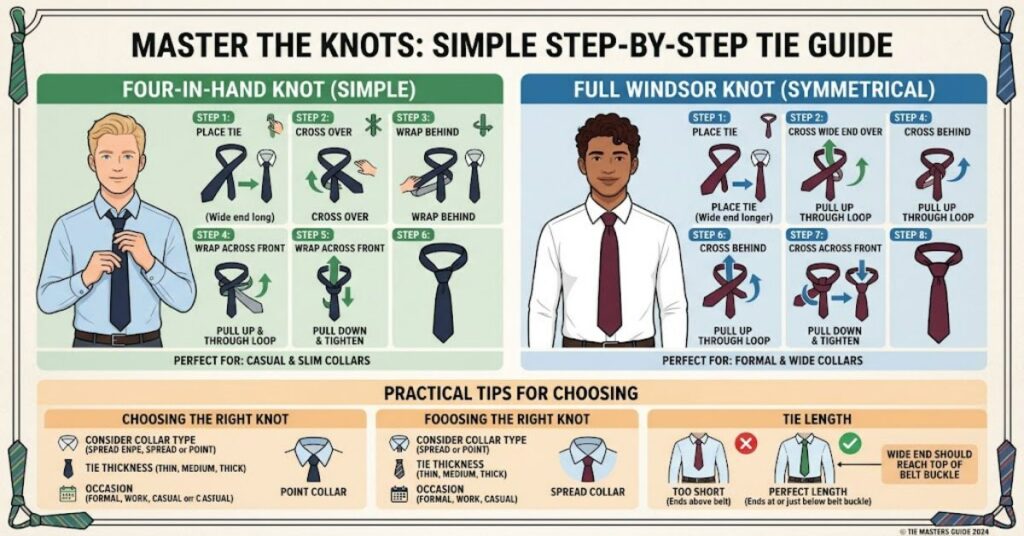
Knowing how to tie a tie is a small practical skill that can make getting dressed for work, weddings, interviews and formal events much easier. The easiest starting point is the Four-in-Hand knot. It requires relatively few movements, creates a slightly asymmetrical shape and works with many everyday shirts. For occasions that call for a larger and more symmetrical appearance, the Full Windsor is another useful option.
If you are learning how to ti’e a ti’e for the first time, begin with the Four-in-Hand. Place the ti’e around your neck with the wide end hanging lower than the narrow end. Cross the wide end over the narrow end, wrap it around the front, bring it through the neck loop and pull it down through the front loop. Tighten the knot and adjust its position beneath your collar. This basic sequence is documented by established menswear guides and can be learned with a few practice attempts.
The Full Windsor follows a more involved sequence but produces a distinctive triangular knot. It is particularly useful when the shirt has a spread collar and the outfit calls for a more structured appearance.
How to Tie a Four-in-Hand Knot
The Four-in-Hand is generally the most practical starting point because it is simple, relatively compact and adaptable. Real Men Real Style describes it as one of the main beginner knots, while The Knot provides a seven-step version of the process.
Follow these steps:
- Raise your shirt collar and place the ti’e around your neck.
- Let the wide end hang lower than the narrow end.
- Cross the wide end over the narrow end.
- Wrap the wide end behind the narrow end.
- Bring it across the front again to create the front loop.
- Bring the wide end upward through the neck opening.
- Pull it down through the front loop.
- Hold the narrow end and slide the knot upward until it sits neatly against the collar.
The completed knot should look slightly tapered rather than perfectly symmetrical. A small central dimple beneath the knot can also improve the tie’s shape and give the fabric a cleaner transition into the shirt.
How to Tie a Full Windsor Knot
The Full Windsor is larger and more symmetrical than the Four-in-Hand. Its broad triangular shape makes it particularly suitable for spread collars and formal clothing.
The basic sequence is:
- Place the ti’e around your neck with the wide end hanging lower.
- Cross the wide end over the narrow end.
- Bring the wide end upward through the neck opening.
- Bring it down and around the narrow end.
- Cross it across the front to create the second side of the knot.
- Bring it upward through the neck opening again.
- Pull the wide end down through the front loop.
- Tighten the knot carefully and centre it beneath the collar.
Unlike the Four-in-Hand, the Windsor uses more fabric and creates a fuller knot. That difference matters when choosing between the two styles.
Four-in-Hand vs Full Windsor
| Feature | Four-in-Hand | Full Windsor |
| Shape | Narrow and slightly asymmetrical | Broad and symmetrical |
| Difficulty | Beginner-friendly | Moderate |
| Overall size | Small to medium | Large |
| Best use | Everyday, business-casual and general formal wear | Formal events and structured outfits |
| Collar pairing | Button-down and narrower collars | Spread collars |
| Fabric requirement | Works particularly well with slimmer ties | Benefits from appropriate tie length and fabric |
The choice is therefore not simply about which knot looks more sophisticated. It is about proportion. A large knot can overwhelm a narrow collar, while a very small knot may look visually lost beneath a wide spread collar.
Choosing the Right Knot for Your Outfit
Collar geometry is one of the easiest details to overlook. The Four-in-Hand has a relatively narrow profile and can work particularly well with button-down or narrower collars. The Full Windsor creates considerably more width, making it better suited to shirts with a broad spread.
Ti’e material also matters. Thick fabrics naturally produce more volume, so adding multiple folds through a large knot can create excessive bulk. Conversely, a thin ti’e may look undersized when paired with a very wide knot.
A useful practical rule is to consider three things together: knot size, collar width and ti’e thickness. Treating them separately is one reason an otherwise correctly tied knot can still look unbalanced.
Common Mistakes When Tying a Ti’e
| Problem | Likely Cause | Practical Fix |
| Tie finishes too short | Wide end started too high | Begin with more length on the wide end |
| Knot looks oversized | Thick tie combined with large knot | Try a Four-in-Hand |
| Knot looks too small | Narrow tie or small knot with wide collar | Consider a Half or Full Windsor |
| Knot sits crooked | Front crossings are uneven | Re-centre before tightening |
| Tie looks flat | Fabric has been pulled completely straight | Create a small dimple below the knot |
One important point is that the correct starting length varies with the person’s height, neck size, ti’e length and knot. Instructions often give an approximate starting position, but adjustment is normal.
Three Practical Insights About Ti’e Knots
First, the knot does not exist independently of the shirt. A Four-in-Hand and Full Windsor can look very different when paired with different collar constructions.
Second, ti’e length should be checked after the knot is finished, not before. A knot that consumes more fabric, such as a Full Windsor, can significantly change where the ti’e ends.
Third, symmetry is not automatically the goal. The Four-in-Hand is deliberately less symmetrical, and its irregular shape is part of its traditional appearance. Menswear references commonly distinguish it from the more geometric Windsor family.
The Future of How to Tie a Tie in 2027
The basic mechanics of tying a necktie are unlikely to change in 2027. What may continue changing is how people learn the skill. Visual tutorials, short instructional videos and step-by-step interactive guides have already made traditionally hands-on skills easier to learn without formal instruction.
The wider fashion context is also relevant. Ti’e use varies according to workplace dress codes, social occasions and changing attitudes towards formalwear. The continued presence of multiple knot styles means there is unlikely to be one universal approach. Instead, practical guides will remain useful when they explain how knot size, shirt collars, fabric and occasion interact.
Key Takeaways
- Start with the Four-in-Hand when learning the basic technique.
- Use the Full Windsor when a larger triangular knot suits the shirt and occasion.
- Check the finished ti’e against the collar rather than judging the knot in isolation.
- Adjust the starting length according to your height and ti’e dimensions.
- Avoid excessive bulk when using thick fabrics.
- A small dimple can give the finished knot a more structured appearance.
- Practise the movements before an important event rather than learning immediately beforehand.
Conclusion
Learning how to tie a tie does not require mastering dozens of complicated knots. The Four-in-Hand provides a practical foundation because its sequence is relatively simple and its shape works across many everyday outfits. The Full Windsor offers a different option when a larger, symmetrical knot is appropriate.
The most useful skill is understanding proportion. A successful knot should work with the shirt collar, tie fabric, tie length and occasion. Once those factors are considered together, choosing between a Four-in-Hand and Full Windsor becomes much easier.
For beginners, repetition is more valuable than complexity. Practise the same knot several times, learn how the starting length affects the finished position, and become comfortable making small adjustments. With that foundation, tying a necktie becomes a routine part of dressing rather than a last-minute problem.
Frequently Asked Questions
What is the easiest way to tie a tie?
The Four-in-Hand is a practical beginner option because it uses a relatively simple sequence and produces a compact knot.
How do you tie a tie for a formal event?
A Full Windsor can provide a broad, symmetrical triangular appearance. It is particularly suitable when paired with a spread-collar shirt.
Is the Four-in-Hand suitable for work?
Yes. Its relatively compact and slightly asymmetrical shape makes it suitable for many office and business-casual settings.
Why does my tie always come out too short?
The starting position, your height, neck size and the knot itself all affect finished length. Larger knots generally consume more tie fabric.
Should a tie knot be perfectly symmetrical?
Not necessarily. The Four-in-Hand is naturally asymmetrical, while the Full Windsor is designed to create a more symmetrical triangular shape.
What is the best collar for a Windsor knot?
A Full Windsor generally works well with wider spread collars because the larger knot complements the additional space between the collar points.
Methodology
This article was prepared by comparing established instructional references covering Four-in-Hand and Full Windsor techniques, collar compatibility and knot characteristics. The Knot’s updated August 2025 guide was used to validate the step sequences, while Real Men Real Style was consulted for additional knot, proportion and styling context. GQ was used for supporting guidance on the role of the tie dimple.
No firsthand physical testing was conducted for this article, so no fabricated testing results or personal performance claims have been included. Tie proportions can vary with individual body dimensions, tie construction and shirt design. A human editor should verify all practical instructions before publication.
Editorial disclosure: This article was drafted with AI assistance and should be reviewed and verified by the Matrics360.com editorial team before publication.
References
The Knot. (2025, August 25). How to tie a tie: Easy guide to necktie knots.
Real Men Real Style. (2023). How to tie a tie on someone else: Guide to teaching tie knots.
Real Men Real Style. (2023). Four-in-Hand knot tying guide.
Real Men Real Style. (2023). How to tie a tie knot: Different ways of tying neckties.
GQ. (2012). Tie it, pair it, pin it: How to perfect your tie game.