
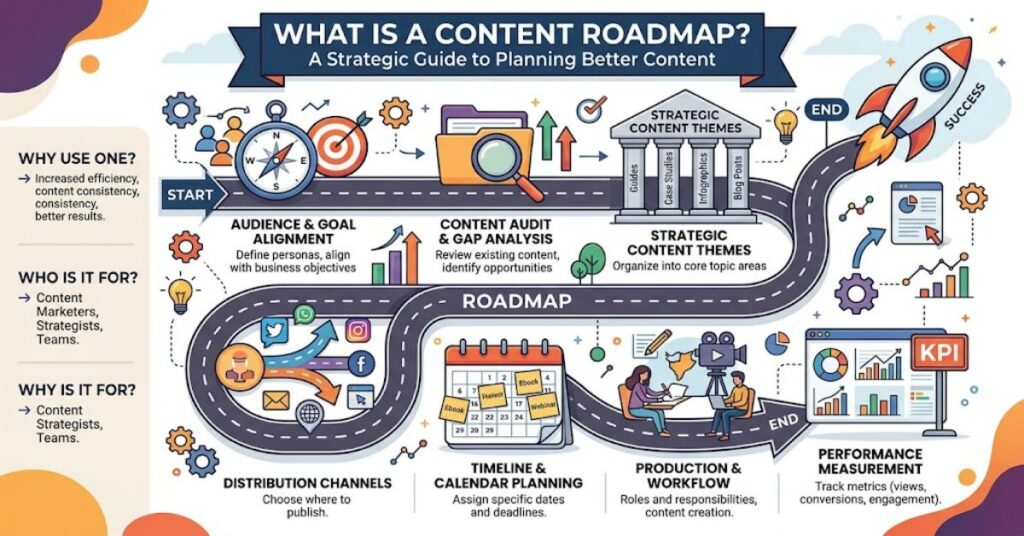
If you are asking what is a content roadmap, the simplest answer is this: it is a high-level plan showing what content a business should create, why it matters, who it is for and how priorities should develop over a defined period. Unlike a simple list of blog ideas, a roadmap connects content activity to wider business objectives.
A useful roadmap may cover several months or quarters. It can identify major themes, target audiences, buyer-journey stages, content formats, distribution channels, owners and performance measures. Brightspot similarly describes a content strategy roadmap as a plan connecting business goals with audiences, workflows, technology, distribution and measurement.
The distinction matters because publishing more content does not automatically produce better results. A business can publish weekly while still targeting the wrong audience, duplicating existing topics or creating material that has no relationship to its commercial priorities.
Modern content planning also has to account for search behaviour. HubSpot’s 2026 guidance on topic clusters recommends mapping related topics, identifying gaps and maintaining a clear view of how individual pages connect.
A roadmap provides that wider view. It gives a content team a strategic destination before the editorial calendar turns that strategy into specific publishing dates.
What Does a Content Roadmap Include?
A roadmap normally brings several planning elements together.
| Element | Purpose |
| Business goal | Defines the outcome content should support |
| Audience | Identifies who the content is designed to help |
| Topic | Establishes the subject or content pillar |
| Search intent | Clarifies what the audience wants to accomplish |
| Format | Determines whether content becomes an article, video, guide or another asset |
| Channel | Identifies where content will be distributed |
| Priority | Determines what should happen first |
| Measurement | Establishes how success will be evaluated |
The roadmap does not need to predict every article title months in advance. Its value is in setting direction while leaving enough flexibility to respond to new information.
Content Roadmap vs Content Calendar
One of the most common planning mistakes is treating a roadmap and calendar as the same thing.
| Content Roadmap | Content Calendar |
| Strategic | Operational |
| Usually covers months or quarters | Usually focuses on specific dates |
| Defines priorities | Schedules execution |
| Connects content to business goals | Organises publishing |
| Can remain relatively flexible | Often contains fixed deadlines |
A calendar might say that a company will publish an article on Tuesday, produce a video on Thursday and send a newsletter on Friday. The roadmap explains why those assets exist and how they support a larger objective.
This distinction is also reflected in current enterprise content-planning guidance, which separates strategic direction across quarters from the scheduling of individual assets.
How to Build a Content Roadmap
Start with business objectives rather than content ideas. If the company wants more qualified leads, for example, the roadmap should prioritise content capable of attracting and educating the relevant audience rather than simply producing high-volume traffic.
Next, define the audience. Document important questions, problems, buying concerns and stages of the customer journey. This prevents the roadmap from becoming a collection of topics chosen only because they have search volume.
The third step is a content audit. Review existing pages and identify material that performs well, material that needs improvement and subjects that are missing. HubSpot’s content-gap guidance describes this process as identifying topics and information that an audience needs but that existing content does not adequately address.
Keyword research can then support prioritisation. Current SEO practice increasingly involves grouping related queries into topic clusters and mapping those clusters to appropriate pages rather than creating disconnected articles for every keyword.
Finally, assign priorities, owners and measurement criteria.
A Simple Quarterly Structure
| Quarter | Strategic Focus | Example Content Work |
| Q1 | Awareness | Educational guides and foundational topics |
| Q2 | Consideration | Comparisons, case studies and deeper resources |
| Q3 | Conversion | Product-focused and decision-stage content |
| Q4 | Retention | Support, education and customer resources |
The exact structure should change according to the organisation. A SaaS company, retailer and professional-services firm will not need identical roadmaps.
Why a Roadmap Improves Content Strategy
The biggest benefit is prioritisation. Without a roadmap, teams can spend disproportionate time responding to the newest request. A documented strategy provides a reference point for deciding whether an idea deserves resources.
A second benefit is topic coverage. Keyword mapping can reveal clusters where a website has several related pages but lacks a strong central resource, or where important subtopics have no dedicated page. Ahrefs specifically identifies these gaps as opportunities that can feed into a content roadmap.
A third benefit is coordination. Writers, editors, designers, SEO specialists and subject-matter experts can work from the same priorities instead of maintaining disconnected plans.
Risks and Trade-Offs
A roadmap can become a problem when it is treated as a rigid contract. Markets change, search behaviour shifts and business priorities can move. A six-month plan created once and never reviewed may become outdated.
There is also a risk of measuring activity instead of outcomes. Publishing 20 articles is not necessarily better than publishing eight highly relevant resources. Useful measurements might include qualified organic traffic, assisted conversions, engagement by audience segment, content-assisted revenue or improvements in topic coverage.
Another limitation is overreliance on keyword data. Search demand can reveal what people ask, but it does not fully explain commercial importance, customer experience or brand priorities.
The best roadmap therefore combines quantitative signals with editorial and business judgement.
The Future of Content Roadmaps in 2027
By 2027, content roadmaps are likely to become more adaptive as AI search and answer engines influence how people discover information. HubSpot’s 2026 reporting highlights the growing importance of optimising content for AI-generated answers as well as traditional search.
That does not mean every roadmap should become an AI-content production schedule. Instead, teams will need to consider whether their most important information is clear, authoritative, well structured and supported by evidence.
The roadmap may increasingly track content reuse, topic authority, AI-search visibility and customer journey coverage alongside traditional traffic metrics.
Key Takeaways
- A roadmap defines strategic content direction rather than simply listing publication dates.
- Business objectives should come before topic selection.
- Audience research and search intent help determine useful priorities.
- Content-gap analysis can identify missing opportunities.
- Topic clusters can provide stronger structure than isolated keyword targeting.
- Roadmaps should be reviewed regularly rather than treated as permanent documents.
Conclusion
Understanding what is a content roadmap starts with recognising the difference between creating content and planning content strategically. A roadmap provides the structure between business objectives and individual editorial tasks.
It identifies which audiences matter, which subjects deserve attention, what formats may be appropriate and how priorities should develop over time. It also creates a framework for deciding what not to produce, which is often just as important as deciding what to publish.
A strong roadmap should remain flexible. Search trends, customer behaviour, competitive activity and business priorities can all change. Regular reviews allow teams to adjust without abandoning the wider strategy.
For organisations serious about content performance, the roadmap is best viewed as a decision-making framework rather than a static document. The calendar handles the dates; the roadmap explains the destination.
Frequently Asked Questions
What is a content roadmap?
A content roadmap is a strategic plan that connects business goals with content priorities, audiences, topics, formats, channels and measurement over a defined period.
What is the difference between a content roadmap and a content calendar?
A roadmap establishes strategic direction and priorities, often across several months or quarters. A calendar schedules individual content assets and publication dates.
How long should a content roadmap be?
There is no universal timeframe. Three, six or twelve months can work depending on the organisation. Quarterly planning is useful because it provides direction while allowing regular adjustment.
What should be included in a content strategy roadmap?
Important components include business objectives, target audiences, content themes, search intent, formats, channels, priorities, ownership, deadlines and performance measures.
Can SEO keywords be included in a content roadmap?
Yes. Keyword research can help identify search demand, content gaps and topic relationships. However, keywords should support the wider business and audience strategy rather than determine it alone.
How often should a content roadmap be updated?
A practical approach is to review performance monthly and reassess major priorities quarterly. Fast-moving industries may require more frequent adjustments.
Methodology
This article was developed using current guidance from recognised content-marketing and SEO sources, including HubSpot, Brightspot and Ahrefs. Their material was used to validate distinctions between roadmaps and calendars, content-gap analysis, topic clustering and strategic content planning.
No original performance testing or firsthand client campaign results were conducted for this article. Accordingly, no invented metrics or personal testing claims have been presented. The recommendations are strategic interpretations of documented content-planning practices.
Editorial disclosure: This article was drafted with AI assistance and should be reviewed and independently verified by the Matrics360.com editorial team before publication.
References
Brightspot. (2026). How to build a content strategy roadmap: Enterprise guide. Brightspot.
An, M. (2026). Topic clusters: The next evolution of SEO. HubSpot.
Byloli, S. (2024). How content gap analysis bolsters your marketing strategy. HubSpot.
Ahrefs. (2026). What are secondary keywords? (And how to use them). Ahrefs.