
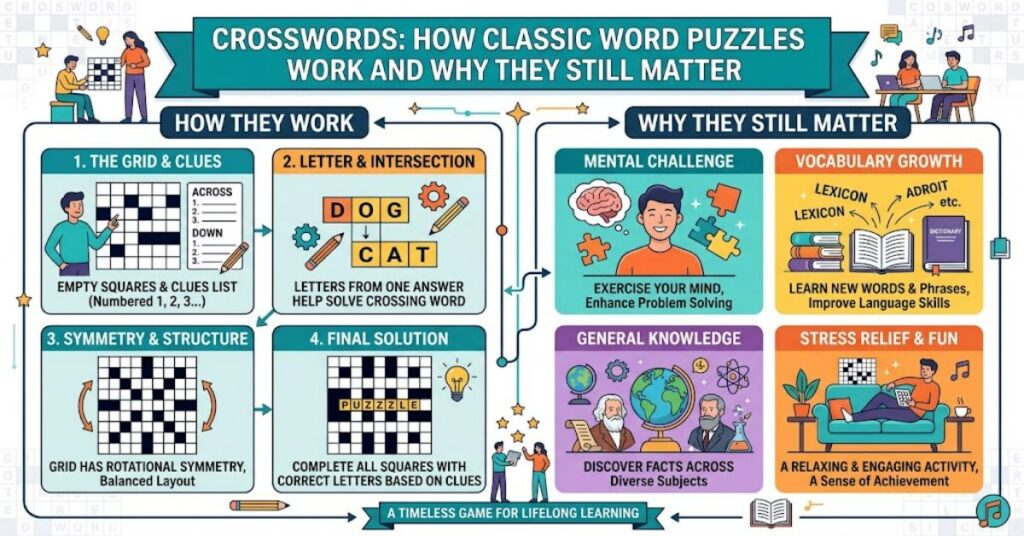
Crosswords are classic word puzzle games built around a grid of white and black squares. Players enter words and phrases according to numbered clues, with the intersecting answers providing additional letters that help solve uncertain entries.
The basic idea is simple, but the solving process combines several mental tasks. A player may need to recall vocabulary, recognise a synonym, interpret a clue’s wording, identify a grammatical pattern and use crossing letters to test possible answers. That combination explains why a puzzle can feel difficult even when every individual clue appears straightforward.
The modern crossword originated in the United States. Arthur Wynne published his first “Word-Cross” puzzle in the New York World on December 21, 1913. The original design was diamond-shaped rather than the familiar rectangular grid, but its central principle was already recognisable: answers had to intersect within a structured arrangement.
More than a century later, the format remains adaptable. Newspaper puzzles, specialist publications, websites and mobile applications use the same fundamental mechanism while experimenting with themes, clue styles, difficulty and presentation.
How Crossword Puzzles Work
A conventional puzzle contains three core components:
| Component | Purpose |
| Grid | Defines where answers can be placed |
| Clues | Provide definitions, wordplay or other prompts |
| Crossings | Supply letters that confirm or eliminate answers |
The grid creates the puzzle’s constraint system. An answer cannot simply be correct in isolation; it must also agree with the letters created by intersecting entries.
This is why solving often becomes easier after several answers are completed. A difficult clue may become obvious once two or three crossing letters are available.
| Puzzle feature | What it tests |
| Direct clue | Vocabulary and recall |
| Synonym clue | Semantic flexibility |
| Wordplay | Interpretation and lateral reasoning |
| Crossing letters | Pattern recognition |
| Theme answers | Association and broader knowledge |
From 1913 to the Digital Era
The crossword became a major cultural phenomenon during the 1920s. In 1924, Simon & Schuster published an early crossword collection, initially printing 3,600 copies. Demand was strong enough for subsequent printings, and the puzzle soon became part of popular American culture.
The New York Times eventually introduced its crossword on February 15, 1942, with a daily version following in September 1950. The newspaper’s puzzle helped establish a model in which difficulty could vary across the week and clues could rely increasingly on humour, wordplay and cultural knowledge.
Digital publishing changed the solving experience again. Instead of requiring a newspaper and pencil, players can now enter answers on computers and mobile devices. The underlying logic has changed far less than the delivery method.
One important insight follows from this history: the durability of the format comes partly from its constraints. The grid gives players immediate feedback. Every correct answer potentially creates information for another clue.
Cognitive Benefits: What the Evidence Says
Crosswords are often promoted as “brain training”, but the evidence requires careful interpretation.
A small intervention study involving 37 older adults found that participants assigned to daily crossword solving for four weeks improved on measures of verbal fluency compared with a control group.
More recent research has examined crossword training among people with mild cognitive impairment. A 78-week randomised clinical trial involving 107 participants compared computerised crossword training with computer games and reported better results for the crossword group on its primary cognitive outcome.
That does not establish that solving puzzles prevents dementia or guarantees long-term cognitive protection. Research findings vary according to the population, intervention design and outcome being measured. A separate study of intellectual activities also found that crossword solving did not show the same moderating effect on memory as activities such as reading and writing.
The sensible conclusion is narrower: crossword solving is a structured mental activity that may support particular cognitive skills, but it should not be treated as a medical treatment.
What Makes a Crossword Difficult?
Difficulty is not determined simply by the number of squares.
A smaller puzzle can be challenging if its clues depend on obscure vocabulary, cultural references or unusual wordplay. Conversely, a larger grid can be approachable when clues are direct and crossings provide generous support.
Three factors are especially important:
- Vocabulary range: Unfamiliar words increase recall demands.
- Clue ambiguity: A clue with several plausible interpretations requires more reasoning.
- Grid dependency: Difficult entries become easier when surrounding answers provide letters.
This creates an unusual feedback loop. A solver’s success depends partly on what they already know and partly on their ability to use the structure of the puzzle to compensate for what they do not know.
Risks and Limitations
The principal limitation is overclaiming what puzzles can accomplish.
Completing a crossword demonstrates successful performance within a particular cognitive environment. It does not automatically prove improved general intelligence, memory or decision-making outside that environment.
There is also a practical accessibility issue. Some puzzles rely heavily on cultural references, abbreviations, idioms or specialist knowledge. That can make difficulty reflect background knowledge as much as reasoning ability.
Modern constructors have increasingly considered representation and clue fairness, but expectations differ between puzzle communities. What feels clever to one audience may feel obscure or inaccessible to another.
The Future of Crosswords in 2027
By 2027, the crossword is likely to remain recognisable while becoming increasingly digital and interactive. Online platforms can provide instant checking, hints, saved progress, accessibility features and alternative input methods without changing the fundamental grid-and-clue structure.
Artificial intelligence may also influence construction and solving. However, human editorial judgement remains important because a technically valid grid is not necessarily an enjoyable puzzle. Clue fairness, humour, cultural context and answer quality require decisions that go beyond simply finding words that intersect.
The most sustainable future is therefore unlikely to be about replacing human constructors entirely. It is more likely to involve technology supporting construction, testing, accessibility and distribution while editors retain responsibility for the final puzzle experience.
Key Insights
- The crossword’s strength comes from the interaction between clues and grid constraints.
- Crossing letters allow partial knowledge to become a solving advantage.
- Historical popularity has survived major changes in publishing technology.
- Research supports cautious claims about specific cognitive outcomes, not sweeping medical promises.
- Digital tools have changed delivery more dramatically than the underlying puzzle mechanics.
- Cultural knowledge can influence difficulty as strongly as pure vocabulary.
- Human editorial judgement remains important even when software assists construction.
Conclusion
Crosswords have survived for more than a century because their central mechanism remains remarkably effective. A clue produces a question, the grid limits possible answers and intersecting words provide evidence. Each solved entry can therefore help unlock another.
The format has also demonstrated unusual adaptability. It moved from newspapers to books, then to websites and mobile applications without losing its identity. Research offers some evidence that regular crossword activity can support particular cognitive outcomes, although those findings should not be exaggerated into claims about preventing dementia or preserving overall brain health.
Their lasting appeal may ultimately be simpler. Crosswords offer a compact challenge with immediate feedback and a satisfying sense of progress. Whether solved with pencil on paper or through a digital interface, the basic pleasure remains the same: turning uncertainty into a completed pattern.
FAQ
What are crosswords?
Crosswords are grid-based word puzzles in which players enter answers according to numbered clues. The answers intersect, allowing letters from one solution to help determine another.
How do crossword puzzles work?
A solver reads clues, proposes answers and enters them into a grid. Correct crossing letters provide additional information and help eliminate incorrect possibilities.
Are crosswords good for the brain?
Research suggests they may support certain cognitive and verbal skills, but evidence does not justify claiming that crosswords alone prevent dementia or guarantee long-term cognitive health.
Who invented the crossword puzzle?
Arthur Wynne is generally credited with creating the first modern crossword, published in the New York World on December 21, 1913.
Why are some crossword puzzles harder than others?
Difficulty depends on vocabulary, clue ambiguity, cultural references, wordplay and the amount of useful crossing information available.
Are digital crosswords different from newspaper puzzles?
The interface is different, but the fundamental mechanism is usually the same: clues, entries, crossings and a constrained grid.
Methodology
This article combines historical documentation with published research on crossword solving and cognition. Historical claims were checked against Smithsonian reporting on Arthur Wynne and the development of crossword culture, while cognitive claims were compared with peer-reviewed research indexed by PubMed.
No original crossword-solving experiment or clinical testing was conducted for this article. Accordingly, no personal testing results or invented firsthand observations are presented. The main limitation is that cognitive research differs in participant characteristics, intervention length and measured outcomes.
AI Editorial Disclosure: This article was drafted with AI assistance and requires human editorial review before publication. All statistics, citations, historical claims and named sources should be independently verified by the Postcard.fm editorial team.
References
Daugherty, G. (2013, December 16). What’s a 9-letter word for a 100-year-old puzzle? Smithsonian Magazine.
Amlen, D. (2019, December). How the crossword became an American pastime. Smithsonian Magazine.
Makhdoom, A., et al. (2014). Daily crosswords improve verbal fluency: A brief intervention study. International Journal of Geriatric Psychiatry.
Nash, S., et al. (2023). Computerized games versus crosswords training in mild cognitive impairment. NEJM Evidence.
Editorial Quality Note
The required internal-link component has not been populated with unverified URLs. Any Postcard.fm links should be added only after a human editor confirms that the destination pages are live, relevant and published on the site.