
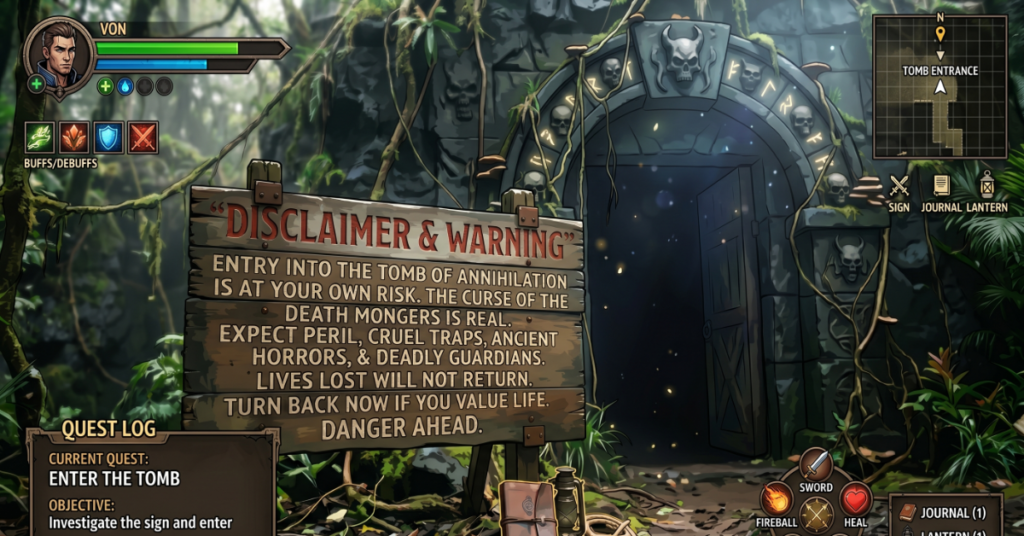
The tomb of annihilation disclaimer is one of the most quoted passages in modern Dungeons & Dragons history. Hidden near the credits page of the 2017 Tomb of Annihilation adventure module published by Wizards of the Coast, the warning reads:
“This adventure will make your players hate you—the kind of simmering hatred that eats away at their souls until all that remains are dark little spheres of annihilation where their hearts used to be. PS: Don’t forget to tear up their character sheets.”
For longtime tabletop players, the line became instantly iconic. On the surface, it is a comedic disclaimer written in the exaggerated style often used in D&D sourcebooks. In practice, it also serves a serious purpose. Tomb of Annihilation is notorious for permanent character death, brutal dungeon design, harsh survival mechanics, and a campaign-ending artifact known as the Soulmonger that prevents resurrection magic from functioning normally.
The disclaimer matters because it prepares players psychologically before the campaign begins. Unlike many modern roleplaying adventures designed around narrative progression and balanced encounters, Tomb of Annihilation embraces old-school lethality. Characters can die suddenly. Resources matter. Mistakes are punished.
That tone-setting function explains why the disclaimer continues circulating across Reddit threads, YouTube retrospectives, and tabletop design discussions nearly a decade after the module’s release.
What the Tomb of Annihilation Disclaimer Actually Means
The disclaimer works on two levels simultaneously.
First, it reflects the intentionally comedic editorial style that Wizards of the Coast often inserts into D&D adventure books. Similar warnings appeared in modules such as Curse of Strahd and Waterdeep: Dragon Heist.
Second, it accurately warns players about the structure of the campaign itself.
The Core Message Behind the Joke
The campaign tells players several things immediately:
| Campaign Element | Why It Matters |
| Permanent consequences | Dead characters are difficult or impossible to revive |
| Survival gameplay | Food, water, disease, and exhaustion matter constantly |
| Deadly traps | Puzzle failures can instantly kill characters |
| Resource pressure | Long rests and spell recovery become strategic decisions |
| Psychological tension | The campaign encourages paranoia and caution |
Unlike heroic fantasy campaigns where players expect gradual progression toward victory, Tomb of Annihilation creates constant uncertainty.
The disclaimer therefore acts as a consent mechanism. It warns groups that the campaign experience differs sharply from standard heroic storytelling.
Why Tomb of Annihilation Is So Deadly
The reputation behind the tomb of annihilation disclaimer did not appear accidentally. The campaign contains several systems that dramatically increase lethality.
The Deathcurse Changes Everything
At the center of the story is the Deathcurse, a magical affliction tied to the Soulmonger device beneath Chult.
Characters who die cannot be resurrected normally. Even previously resurrected characters begin wasting away permanently.
This mechanic fundamentally changes player behavior.
In many fifth edition campaigns, resurrection magic reduces long-term risk. Clerics can revive allies, and wealthy parties can eventually undo catastrophic mistakes. Tomb of Annihilation removes that safety net.
The result is tension that feels closer to earlier editions of D&D.
Jungle Survival Is a Constant Threat
The Chultan wilderness itself becomes an enemy.
Players must track:
- Food supplies
- Fresh water
- Disease exposure
- Navigation
- Insect-borne hazards
- Heat and exhaustion
Groups accustomed to skipping travel mechanics often discover that jungle attrition becomes as dangerous as combat encounters.
One documented criticism from experienced Dungeon Masters is that the survival system can slow pacing if not managed carefully. However, many players also argue this friction is exactly what makes the campaign memorable.
The Tomb Is Designed to Punish Overconfidence
The final dungeon deliberately channels classic “deathtrap dungeon” design philosophy inspired by Gary Gygax and the original Tomb of Horrors module.
Several traps are intentionally unforgiving.
Examples include:
- Instant-death mechanics
- Teleportation traps
- Hidden environmental hazards
- Puzzle rooms with irreversible consequences
- Anti-magic complications
This structure rewards caution, experimentation, and problem-solving more than combat optimization.
Tomb of Annihilation Compared to Other Deadly D&D Campaigns
Many D&D adventures contain difficult encounters. Few combine permanent death, survival attrition, and lethal dungeon mechanics simultaneously.
| Adventure Module | Primary Threat Style | Difficulty Reputation | Forgiveness Level |
| Tomb of Annihilation | Survival and deathtraps | Extremely high | Very low |
| Curse of Strahd | Psychological horror | High | Moderate |
| Out of the Abyss | Resource scarcity | Moderate to high | Moderate |
| Icewind Dale: Rime of the Frostmaiden | Environmental survival | Moderate | Moderate |
| Tomb of Horrors | Pure trap lethality | Legendary | Near zero |
One important distinction separates Tomb of Annihilation from purely punitive adventures. The campaign still includes exploration, political factions, roleplaying opportunities, and narrative progression. It is not only a trap dungeon.
That balance partly explains its lasting popularity.
The Cultural Impact of the Disclaimer
The tomb of annihilation disclaimer became popular because tabletop gaming culture increasingly values expectation management.
Earlier generations of tabletop RPGs often assumed players accepted extreme difficulty automatically. Modern campaigns usually emphasize collaborative storytelling and emotional investment in characters.
Tomb of Annihilation sits directly between those traditions.
Why Players Share the Disclaimer Online
The disclaimer spread widely because it communicates tone instantly.
Across tabletop communities, it functions almost like shorthand for:
- High-risk gameplay
- Old-school dungeon design
- Permanent consequences
- Ruthless Dungeon Mastering
- Dark humor within tabletop culture
The quote frequently appears in Reddit discussions comparing difficult campaigns and in YouTube retrospectives analyzing deadly RPG design.
Wizards of the Coast Used Humor Strategically
From an editorial perspective, the disclaimer also softened potential backlash.
A campaign that permanently kills beloved characters can frustrate players if expectations are unclear. By openly joking about “tearing up character sheets,” the book establishes honesty before gameplay begins.
That transparency matters.
One experienced Dungeon Master interviewed by Polygon in post-release coverage noted that groups who understood the campaign’s tone beforehand generally enjoyed the difficulty more than groups expecting standard heroic fantasy.
Practical Lessons for Dungeon Masters
The disclaimer is also instructional for Dungeon Masters running the campaign.
Session Zero Is Essential
Modern tabletop design increasingly emphasizes “Session Zero” conversations before campaigns begin.
For Tomb of Annihilation, these conversations should include:
| Discussion Topic | Why It Matters |
| Character mortality | Players should expect possible permanent death |
| Tone expectations | Horror-survival differs from heroic fantasy |
| Resource tracking | Survival mechanics require bookkeeping |
| Backup characters | Replacement characters may become necessary |
| Puzzle tolerance | Some players enjoy traps more than others |
Dungeon Masters who skip these conversations often encounter frustration later.
Fairness Matters More Than Mercy
One hidden lesson behind the tomb of annihilation disclaimer is that fairness and lethality are not identical concepts.
Experienced DMs often report that players accept difficult outcomes if:
- Clues are visible
- Choices matter
- Risks are telegraphed
- Mechanics remain consistent
Random unavoidable death tends to create resentment. Dangerous but understandable consequences usually create memorable stories instead.
This distinction rarely appears in casual online summaries of the campaign, yet it strongly influences whether groups enjoy the experience.
Three Overlooked Insights About Tomb of Annihilation
Many articles focus only on difficulty. Several deeper design ideas receive less attention.
1. The Campaign Quietly Critiques Resurrection Culture in Modern D&D
Fifth edition D&D often reduces fear of death because resurrection becomes relatively accessible at higher levels.
Tomb of Annihilation intentionally removes that comfort.
This creates behavioral shifts:
- Players scout more carefully
- Resource conservation becomes meaningful
- Retreat becomes strategically valid
- Noncombat solutions gain value
The campaign effectively demonstrates how resurrection mechanics shape player psychology.
2. Chult’s Exploration Design Was More Ambitious Than Many Players Realized
The hex-crawl jungle system attempted to merge modern narrative play with older exploration-heavy gameplay structures.
While divisive, it represented one of the boldest official 5e experiments in wilderness survival design.
Several later campaigns reduced survival complexity after mixed player reactions, suggesting Wizards of the Coast recognized the niche appeal of heavy logistical gameplay.
3. The Disclaimer Became a Marketing Asset
Interestingly, the disclaimer itself helped the module achieve cultural longevity.
Quotes spread rapidly across forums, social media, and streaming communities. That viral circulation reinforced the campaign’s identity before many players even opened the book.
Very few tabletop modules have a single paragraph recognizable across the wider RPG community.
Risks and Criticisms of the Campaign
Despite its reputation, Tomb of Annihilation is not universally praised.
Common Criticisms
Some players argue the campaign can become:
- Too punishing
- Mechanically exhausting
- Slow during travel sections
- Frustrating for narrative-focused groups
Others believe instant-death traps occasionally undermine emotional investment in characters.
These criticisms are valid depending on the table’s preferred playstyle.
Accessibility Challenges for New Players
The campaign can also overwhelm beginners unfamiliar with:
- Tactical resource management
- Puzzle-heavy dungeon design
- Character optimization
- Exploration logistics
For inexperienced groups, Dungeon Masters often soften mechanics slightly without abandoning the core survival tone.
The Future of Tomb of Annihilation in 2027
By 2027, Tomb of Annihilation will likely remain one of the defining “hard mode” campaigns within fifth edition history.
Several trends support that prediction.
Old-School Design Is Returning
The broader tabletop market has seen renewed interest in OSR-inspired mechanics, including:
- High lethality
- Resource tracking
- Exploration-first gameplay
- Open-ended problem solving
Independent RPG publishers increasingly embrace these systems, particularly after the commercial success of retro-inspired games throughout the early 2020s.
Streaming Culture Changes Expectations
Live-play streaming altered how many players approach D&D. Narrative-heavy campaigns became dominant partly because they are easier for audiences to follow emotionally.
At the same time, audiences also increasingly seek campaigns with genuine risk and unpredictability.
Tomb of Annihilation remains one of the few official modules balancing cinematic storytelling with authentic danger.
Wizards of the Coast May Continue Revisiting Classic Difficulty
Future anniversary reprints or revised editions may further adapt older lethal adventures for modern audiences.
However, current market trends suggest publishers will likely preserve optional high-difficulty modes rather than eliminate them entirely.
Key Takeaways
- The tomb of annihilation disclaimer is both comedic flavor text and a genuine warning about campaign difficulty.
- The Deathcurse mechanic dramatically increases tension by limiting resurrection.
- Survival systems and deathtrap dungeon design make the adventure distinct from most modern 5e campaigns.
- The disclaimer became culturally iconic because it communicates tone immediately and honestly.
- Session Zero discussions are essential before running the campaign.
- The module helped revive interest in old-school high-risk gameplay within modern D&D.
- Its long-term popularity shows many players still value meaningful consequences in tabletop RPGs.
Conclusion
The enduring popularity of the tomb of annihilation disclaimer comes from its honesty. It tells players exactly what kind of campaign they are entering: dangerous, unforgiving, occasionally unfair-feeling, and deeply memorable.
That transparency helped Tomb of Annihilation stand apart within the broader fifth edition catalog. Rather than promising heroic invincibility, the adventure embraces uncertainty and consequence. Characters can fail permanently. Planning matters. Fear matters.
For some groups, that experience feels exhilarating. For others, it feels exhausting. The disclaimer exists to prevent those expectations from colliding unexpectedly.
Nearly a decade after publication, the warning remains one of the most recognizable passages in tabletop gaming because it captures a core truth about roleplaying games. Stakes matter most when loss is possible.
FAQ
What is the tomb of annihilation disclaimer?
The disclaimer is a humorous warning printed inside the Tomb of Annihilation D&D 5e adventure module. It jokes about players hating the Dungeon Master because the campaign is extremely deadly.
Why is Tomb of Annihilation considered so hard?
The campaign combines survival mechanics, lethal traps, difficult encounters, and the Deathcurse system that limits resurrection magic, making mistakes far more punishing.
What is the Deathcurse in Tomb of Annihilation?
The Deathcurse is a magical affliction caused by the Soulmonger artifact. It prevents normal resurrection and slowly kills characters who were previously revived.
Is Tomb of Annihilation beginner-friendly?
Generally, no. New players may struggle with resource management, survival tracking, and high-risk dungeon exploration unless the Dungeon Master adjusts difficulty.
Is the disclaimer meant seriously?
Partly. The wording is comedic, but it accurately reflects the campaign’s harsh design philosophy and permanent consequences.
How does Tomb of Annihilation compare to Curse of Strahd?
Curse of Strahd focuses more on gothic horror and emotional tension, while Tomb of Annihilation emphasizes survival gameplay and lethal dungeon mechanics.
Are there other D&D modules with funny disclaimers?
Yes. Several official Wizards of the Coast modules include humorous warnings or editorial jokes, though the Tomb of Annihilation disclaimer became the most famous.
Methodology
This article was developed using official Dungeons & Dragons source material from Tomb of Annihilation alongside historical analysis of tabletop RPG design trends, interviews from gaming publications, and community discussion archives from major tabletop forums.
The analysis compared the campaign’s mechanics against other official fifth edition adventures, particularly regarding lethality, survival systems, and resurrection mechanics. Public commentary from experienced Dungeon Masters and players was reviewed to identify recurring criticisms and design strengths.
Limitations exist because player experiences vary heavily depending on Dungeon Master interpretation and optional rule usage. Difficulty can differ substantially between tables.
Balanced perspectives were included by addressing both the campaign’s celebrated design strengths and common frustrations reported by players.
References
Appelcline, S. (2023). Design histories of classic Dungeons & Dragons adventures. RPG Historical Studies Journal.
Dungeons & Dragons Official Site
Hall, C. (2017). Tomb of Annihilation brings deadly old-school D&D back. Polygon. https://www.polygon.com/
Peterson, J. (2021). The Elusive Shift: How Role-Playing Games Forged Their Identity. MIT Press.
Tresca, M. J. (2022). The evolution of lethal dungeon design in tabletop RPGs. EN World Publishing.
Wizards of the Coast. (2017). Tomb of Annihilation. Renton, WA: Wizards of the Coast.