
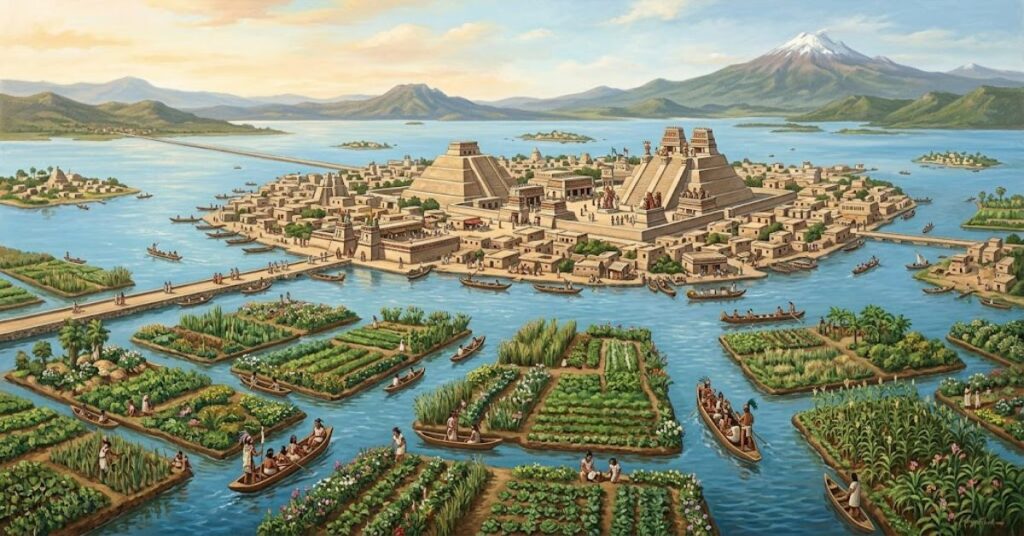
Tenochtitlan was the magnificent capital of the Mexica, commonly called the Aztec Empire, and stood on an island in Lake Texcoco in the Valley of Mexico. The city was traditionally founded in 1325, although historical sources preserve different dates for its establishment. Mexico’s National Institute of Anthropology and History identifies 1325 as the date most commonly associated with its foundation.
Its location was both a challenge and an opportunity. The Mexica settled on a small island surrounded by shallow lake waters and gradually transformed the landscape. Through chinampas, canals and causeways, they expanded agricultural production, connected neighbourhoods and created infrastructure capable of supporting a growing urban centre.
By the early 16th century, Tenochtitlan was more than a ceremonial capital. It was the centre of political authority, commerce, religion and military power within the Mexica-dominated political system. When Spanish forces and their Indigenous allies attacked the city in 1521, they confronted a sophisticated urban society rather than an isolated settlement.
The city’s destruction did not erase its physical or cultural importance. Spanish authorities built Mexico City over much of the former capital, leaving archaeological remains beneath the modern metropolis. Today, excavations, monuments and museum collections continue to reveal how the city functioned.
How Tenochtitlan Was Built
The original settlement was established on a small island in Lake Texcoco. Rather than treating the lake as a barrier, the Mexica adapted their urban development to it.
Chinampas played an important role. These engineered agricultural areas expanded usable land and supported intensive cultivation. The system also contributed to the city’s physical growth, allowing residents to develop areas for homes and other structures.
Canals provided routes for canoe transportation, while causeways connected the island capital with the surrounding mainland. The result was an urban landscape in which water was part of everyday infrastructure rather than simply a geographical feature.
| Feature | Role in the city |
| Chinampas | Intensive agriculture and land expansion |
| Canals | Transportation and movement of goods |
| Causeways | Connections between the island and mainland |
| Templo Mayor | Major ceremonial and religious centre |
| Lake Texcoco | Natural setting and transport environment |
This infrastructure reveals an important point about the city: its success depended on engineering as much as political power. The Mexica had to manage water, food production, transport and construction together.
The Political and Religious Centre
At the heart of the capital stood the Templo Mayor, a monumental ceremonial complex associated with major Mexica religious traditions. INAH records that the city developed as a ceremonial centre with twin temples dedicated to Huitzilopochtli and Tlaloc.
Religion and government were closely connected. Major ceremonies reinforced political authority while monumental construction demonstrated the resources available to the ruling elite.
Tenochtitlan was also connected to a wider political system. Alongside Texcoco and Tlacopan, it formed the Triple Alliance, which became the dominant political force across a large part of Mesoamerica before the Spanish conquest. Tribute from subject territories helped support the capital and its institutions.
This created a relationship between the city and its wider region. Tenochtitlan depended on surrounding communities for resources, while those communities were incorporated into a system of political control and tribute.

Trade, Agriculture and Urban Life
The city’s lake environment shaped more than its architecture. It also influenced how food and goods moved through the urban economy.
Chinampa agriculture provided an intensive method of food production. Canoes could transport agricultural products through waterways, reducing the need to move every item along roads. Causeways and mainland connections supplemented this network.
The result was a city where agriculture, transport and commerce were closely linked.
| Urban system | Practical significance |
| Lake environment | Supported waterways and fishing |
| Chinampa cultivation | Increased agricultural productivity |
| Canoe transport | Moved people and goods efficiently |
| Causeways | Linked the capital to mainland settlements |
| Markets | Supported regional exchange |
Accounts from the period of Spanish arrival describe an extensive island city filled with canals, bridges, temples and buildings. Later archaeological research has added physical evidence to these historical descriptions. The excavation of the Templo Mayor, which began in 1978, dramatically expanded modern understanding of the city’s architecture and material culture.
Tenochtitlan and the Spanish Conquest
Hernán Cortés and his forces entered the region in 1519. Their campaign was aided by alliances with Indigenous groups that opposed Mexica dominance. This wider political context is essential to understanding the conquest because the Spanish did not defeat the capital through European military power alone.
Conflict eventually centred on the capital itself. In 1521, Spanish forces and Indigenous allies placed Tenochtitlan under siege. The fighting lasted for months, while disease, hunger and warfare weakened the city’s population. The capital fell in August 1521.
The consequences were profound. Spanish authorities began constructing a new colonial capital over the ruins of the Mexica city. Archaeological evidence shows that materials from earlier buildings were incorporated into later structures.
This means modern Mexico City is, in part, built on the physical remains of its predecessor.
Why Tenochtitlan Still Matters
The historical importance of Tenochtitlan extends beyond its role as an Aztec capital. It provides evidence of how societies can adapt large-scale urban development to difficult environments.
Three broader insights stand out. First, the city’s lake setting did not prevent urban expansion; it shaped the technology used to achieve it. Second, agriculture was integrated into the urban system rather than separated from the city. Third, the conquest transformed the physical landscape but did not completely erase Indigenous traditions.
Archaeological discoveries continue to demonstrate that Indigenous practices survived beyond 1521. Excavations in Mexico City have uncovered evidence of pre-Hispanic burial customs and ritual activity continuing into the colonial period.
The Future of Tenochtitlan in 2027
Interest in the ancient capital is likely to remain closely tied to archaeology, heritage conservation and public interpretation. Modern Mexico City contains layers of pre-Hispanic, colonial and modern history, making preservation particularly complex.
INAH continues archaeological work around sites associated with the former capital, while museums and heritage institutions use excavated objects and structures to reconstruct everyday life and political history.
The central challenge is interpretation. Tenochtitlan should not be understood only through Spanish conquest narratives or romanticised descriptions of an ancient metropolis. Archaeological evidence, Indigenous traditions, historical documents and modern scholarship each provide different pieces of the story.
Key Insights
- The city’s island location encouraged sophisticated water-management and transport systems.
- Chinampas connected urban development directly with intensive food production.
- The Triple Alliance placed Tenochtitlan at the centre of a wider political and economic network.
- The conquest of 1521 involved Spanish forces as well as Indigenous allies opposed to Mexica rule.
- Much of colonial Mexico City was constructed over the earlier capital.
- Archaeology continues to recover evidence of Indigenous life and traditions after the conquest.
Conclusion
Tenochtitlan was one of the most significant urban centres of pre-Hispanic Mesoamerica. Founded on an island in Lake Texcoco, it developed through a combination of engineering, agriculture, transportation, political organisation and religious institutions. The city’s environment presented major challenges, but the Mexica transformed those challenges into part of their urban infrastructure.
Its fall in 1521 marked a major political and cultural transition, yet it did not bring the history of the city to an absolute end. Mexico City emerged on the same site, incorporating and obscuring parts of the earlier landscape.
Today, archaeological work continues to make that buried history visible. The remains of temples, residences, objects and infrastructure demonstrate that Tenochtitlan was not simply a legendary capital. It was a functioning city shaped by deliberate engineering and complex social institutions.
FAQ
When was Tenochtitlan founded?
The traditional foundation date is 1325. INAH notes that different historical sources give different dates, but 1325 is the date most commonly associated with the city’s foundation.
Where was Tenochtitlan located?
It was built on an island in Lake Texcoco in the Valley of Mexico, at the location of what is now central Mexico City.
Why was Tenochtitlan built on a lake?
The lake environment provided access to waterways and resources, while the Mexica developed chinampas, canals and causeways to overcome the limitations of building on an island.
What happened to Tenochtitlan in 1521?
The city fell after a prolonged siege involving Spanish forces and Indigenous allies. The Spanish subsequently developed a colonial city over much of the former capital.
Was Tenochtitlan the Aztec capital?
Yes. It was the principal capital of the Mexica political system commonly referred to as the Aztec Empire and became the dominant centre of the Triple Alliance.
What remains of Tenochtitlan today?
Archaeological remains survive beneath and around modern Mexico City. The Templo Mayor archaeological zone is among the most important surviving areas associated with the ancient capital.
Methodology
This article was prepared using the supplied Postcard.fm brief and cross-checked against material from Mexico’s National Institute of Anthropology and History and Smithsonian sources. The supplied brief identifies Tenochtitlan as the Mexica/Aztec capital founded on an island in Lake Texcoco in 1325. Historical details were checked against institutional and museum-related sources, particularly regarding the foundation date, chinampas, Triple Alliance, archaeology and the 1521 conquest.
No firsthand archaeological fieldwork or personal site testing is claimed. Foundation dates and descriptions of the city’s development can vary between historical traditions and modern scholarship, so the article uses qualified wording where appropriate.
References
Instituto Nacional de Antropología e Historia. (2025). Fundación de México-Tenochtitlan: origen de una ciudad, símbolo de una historia.
Instituto Nacional de Antropología e Historia. (n.d.). Centro histórico de la Ciudad de México.
Instituto Nacional de Antropología e Historia. (n.d.). Centro histórico de México y Xochimilco.
Instituto Nacional de Antropología e Historia. (n.d.). Templo Mayor.
Smithsonian Magazine. (2005). The Aztecs: Blood and Glory.
Smithsonian Magazine. (2021). Mexico City marks 500th anniversary of the fall of Tenochtitlán.