
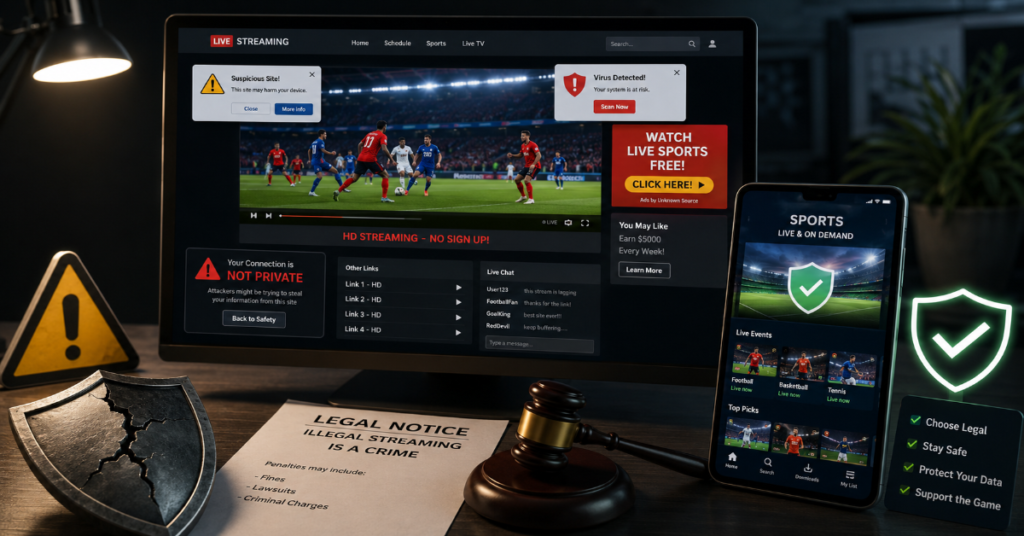
Roja Directa remains one of the most searched names connected to free live sports streams, especially football. The reason is simple: fans want fast access to matches without juggling regional broadcasters, blackout rules, expensive packages and confusing rights windows. But the name now sits inside a much larger legal and cybersecurity story.
The original appeal was not hard to understand. A fan could search a match, find a streaming link and watch without studying broadcast contracts. That convenience helped the brand spread across football forums and search engines for years. The problem is that live sports rights are not casual web content. They are expensive, territory-based commercial assets owned by leagues, clubs, broadcasters and production companies.
Recent legal actions show how seriously rightsholders now treat this ecosystem. In December 2024, Spanish media reports said Roja Directa-related operators were ordered to pay €31.6 million to Mediapro over illegal LaLiga match piracy from the 2014 to 2015 season, following earlier Spanish Supreme Court findings against Puerto 80 Projects and its administrator.
This article explains what the platform name means in 2026, why it is risky, how legal enforcement has changed and what practical choices sports fans have now.
What roja directa Actually Means Today
The phrase roja directa originally became associated with sports stream indexing rather than a single polished streaming service. Its strength was aggregation. Users went there because they expected links to football, basketball, tennis, boxing and other live events. That distinction matters because many legal disputes around sports piracy involve not only hosting video but also organizing, linking or facilitating access to unauthorized live broadcasts.
Today, the name is more complicated. Many users who search it may not land on the original operation. They may find clones, copycat domains, parked pages, ad-heavy mirrors or sites using the reputation of the old brand to attract traffic. That creates three separate risks:
| Risk Area | What It Means | Why It Matters |
| Legal exposure | Accessing or distributing unauthorized streams may violate copyright rules depending on jurisdiction | Enforcement has expanded from site operators toward resellers, platforms and in some cases users |
| Device safety | Clone sites often rely on pop-ups, redirects, fake play buttons and push notification traps | A sports stream search can become a malware or phishing funnel |
| Reliability | Links often vanish during matches or switch domains | Fans lose time, privacy and viewing quality |
The important point is that the search term no longer maps cleanly to one stable destination. That uncertainty is the first warning sign.
Why Fans Still Search for It
Unauthorized sports-streaming demand is not just about avoiding payment. It is also about friction.
A football fan may need one subscription for domestic league matches, another for European competitions, another for cup matches and a different broadcaster when travelling. Some services restrict live games by territory. Others do not carry every match. In lower-income markets, official monthly packages can be expensive relative to local wages.
That creates a market gap. Unofficial services exploit it by promising three things: all matches, instant access and no contract. The emotional pitch is powerful because live sport is perishable. A match missed at 8 p.m. cannot be fully replaced by highlights at midnight.
The business reality is harsher. Live sports rights fund leagues, production crews, commentary teams, distribution partners and club revenue. When large unauthorized networks scale, they do not merely “share” content. They compete with licensed broadcasters while avoiding the costs of rights acquisition.
This explains why enforcement has become more aggressive across Europe, the United States and Latin America.
Legal Context: From Link Sites to Live Blocking
Sports piracy enforcement has changed in three major ways.
First, courts and regulators now recognize that live content requires speed. A takedown after a match ends has little commercial value. The European Commission’s 2023 Recommendation on combating online piracy of sports and other live events explicitly focused on fast action against unauthorized live retransmission while maintaining safeguards for fundamental rights. (Digital Strategy EU)
Second, enforcement has become more coordinated. Europol reported a major operation against illegal streaming providers linked to sports, movies and TV content, identifying more than 560 resellers, over 100 suspects and 11 arrests. The network allegedly distributed more than 2,500 TV channels to over 22 million users. (AP News)
Third, rightsholders are investing in real-time detection. LaLiga said in April 2026 that it reduced piracy of its streams in Spain by 60 percent during the 2024 to 2025 season through legal, educational, institutional and technological measures. (Página web oficial de LALIGA | LALIGA)
That shift matters for readers. The modern enforcement target is not only a single pirate website. It is the whole chain: domains, hosting providers, payment processors, social promotion, IPTV resellers, search visibility and sometimes end-user access data.
Structured Insight Table: What Changed Since the Early Streaming Era
| Period | Typical Piracy Model | Enforcement Pattern | Reader Risk |
| Early 2010s | Link directories and forum sharing | Domain seizures and civil litigation | Unstable access, basic malware risk |
| Late 2010s | Mirror sites, IPTV boxes and social sharing | Site blocking, broadcaster lawsuits and payment disruption | Higher clone-site risk |
| 2023 to 2026 | Real-time live piracy networks and paid IPTV resellers | Dynamic blocking, cross-border operations and AI detection | Legal uncertainty, phishing, data exposure and service shutdowns |
| 2027 outlook | More automated piracy detection and faster takedowns | Wider cooperation between leagues, platforms, CDNs and regulators | Fewer stable illegal streams, more deceptive clone pages |
Safety Risks Most Readers Underestimate
The common mistake is treating unauthorized sports streams as a simple content choice. The larger risk is the surrounding web environment.
Many clone pages rely on deceptive interface patterns. A “play” button may trigger a pop-up. A fake CAPTCHA may request notification permissions. A “HD player update” may push an unsafe download. Some pages rotate ad networks during high-traffic matches, making the risk inconsistent from one visit to the next.
There is also account risk. Some piracy-adjacent pages ask users to create free accounts, verify cards or install browser extensions. That is a red flag. No legitimate sports broadcast should require a random extension from an unknown domain to play a match.
For Matrics360 readers who follow broader platform safety topics, this pattern is similar to other grey-area media sites where the content experience may seem convenient but the domain ecosystem creates the real danger. Matrics360 has covered similar safety issues in guides on user-generated media platforms and manga-reading sites, including Soundgasm, Kaliscan and readmymanga com. (Matrics360)
Comparison Table: Risky Sports Streams vs Safer Viewing Options
| Option | Cost Profile | Legal Safety | Reliability | Best For |
| Unofficial link sites | Usually free | High risk | Unstable | Not recommended |
| Illegal IPTV resellers | Low monthly cost | High risk | Can disappear suddenly | Not recommended |
| Official broadcaster apps | Paid | Strong | Usually stable | League fans and regular viewers |
| League-owned platforms | Paid or freemium | Strong | Strong where available | Fans of one league or sport |
| Free official highlights | Free | Strong | High after match | Casual fans |
| Sports bars or public venues | Variable | Strong when licensed | Good for major games | Social viewing |
| Radio commentary and live text | Free or low cost | Strong | Very reliable | Fans with limited bandwidth |
Practical Implications for Sports Fans
The safest strategy is to plan around rights, not around search results.
For major football leagues, start with the official league website to identify licensed broadcasters in your country. For tournaments, check the competition’s official broadcast page. For clubs, check whether they offer match passes, audio commentary, academy matches, women’s team coverage or delayed full-match replays.
The second strategy is to separate live necessity from content interest. Not every match needs a live video subscription. Some fans can combine one official live package with free highlights, legal radio commentary, live blogs and post-match tactical analysis. That reduces cost without moving into risky streaming.
The third strategy is to avoid installing anything from a streaming page. No unknown APKs. No browser extensions. No “video codec” downloads. No push notifications. No payment card entry on unfamiliar domains.
The fourth strategy is to be careful with VPN assumptions. A VPN can improve privacy on public Wi-Fi and may help users access services while travelling, but it does not make unauthorized streaming legal. In 2025, reports around LaLiga blocking efforts also showed how aggressive anti-piracy measures can create collateral damage, including disruption to legitimate sites when IP-level blocking is used too broadly.
Strategic Implications for Broadcasters and Leagues
The roja directa story also exposes a weakness in the legal sports market: fragmentation creates piracy demand.
When fans cannot easily identify where a match is available, piracy sites win the first click. When official packages are expensive or split across too many services, piracy becomes a pricing protest. When regional restrictions confuse travellers, unofficial links feel simpler.
Rightsholders should not interpret every piracy search as pure unwillingness to pay. Some of it is failed product design.
The best anti-piracy strategy is not only enforcement. It is a better legal path:
| Fan Pain Point | Legal Market Fix |
| Too many subscriptions | Flexible match passes or club-specific bundles |
| Geo-confusion | Clear country-by-country rights pages |
| Expensive full packages | Lower-cost audio, highlights and single-game options |
| Poor discovery | Search-optimized official broadcast pages |
| Late takedowns | Real-time content fingerprinting and faster platform response |
This is where the 2027 market will likely move. Enforcement will get faster, but legitimate access also has to become easier.
The Future of roja directa in 2027
The future of roja directa in 2027 is unlikely to be a return to the old open-link era. The direction of travel is toward faster blocking, automated detection and broader cooperation between leagues, regulators, infrastructure providers and platforms.
The European Commission began assessing the impact of its 2023 live-piracy recommendation in 2025, focusing on how well stakeholders were responding to unauthorized retransmissions of sports and other live events. (Digital Strategy EU) The EUIPO has also supported monitoring work around live-event piracy and online copyright infringement. (EUIPO)
At the same time, enforcement will face limits. Overbroad blocking can harm legitimate services. Smaller sites may reappear under new domains. IPTV sellers can move through encrypted messaging apps, private groups and reseller chains. The technical contest will continue.
By 2027, the most likely outcome is a split market. Casual users will have fewer stable illegal options because public domains will be blocked faster. More determined users may move toward private IPTV groups, which increases scam risk. Legal services will still need to solve pricing and availability gaps if they want to convert frustrated fans.
Key Takeaways
• The name still attracts attention because sports broadcasting remains fragmented and expensive for many fans.
• Legal pressure has intensified, especially around live football, IPTV networks and repeat infringers.
• Clone domains are often more dangerous than users expect because they monetize traffic through redirects, fake buttons and risky ads.
• Official options are not always cheap, but they are safer, more stable and less likely to expose users to scams.
• Broadcasters should treat piracy demand as product feedback as well as a legal problem.
• The 2027 environment will likely bring faster takedowns, more AI-based detection and continued debate over blocking safeguards.
Conclusion
roja directa is no longer just a nostalgic search term for football fans. It is a case study in how live sports piracy evolved from link-sharing culture into a high-stakes enforcement issue involving courts, leagues, broadcasters, infrastructure companies and regulators.
The platform’s popularity revealed a real consumer frustration: fans want simple, affordable access to live sport. But the legal and safety risks around unauthorized streams have become harder to ignore. Court judgments, cross-border enforcement and real-time blocking systems now make the old model less stable and more dangerous for users.
The smarter path is not to chase mirror domains. It is to identify legal rights holders, combine paid and free official options and avoid any page that asks for downloads, extensions, suspicious permissions or card verification. For fans, convenience should not come at the cost of privacy, device safety or legal exposure.
FAQ
What is roja directa?
It is a name historically associated with online sports-stream link aggregation, especially football. Today, many search results using the name may lead to clones, mirrors or unrelated pages rather than one stable original service.
Is roja directa legal?
Unauthorized live sports streaming can violate copyright law depending on the country, the stream source and the user’s role. Operators, resellers and distributors face the highest risk, but users should not assume viewing is risk-free.
Why do so many fans still search for it?
Fans search for it because live sports access is often fragmented across broadcasters, apps, regions and subscriptions. Unofficial sites promise simplicity, but that convenience comes with legal, privacy and cybersecurity risks.
Can a VPN make sports piracy legal?
No. A VPN can protect privacy in some situations, but it does not turn unauthorized streaming into licensed viewing. It may also violate the terms of some streaming services if used to bypass regional restrictions.
What are safer alternatives?
Safer choices include official broadcaster apps, league platforms, club channels, licensed highlights, radio commentary, live text coverage and public venues with legal sports subscriptions.
Why do pirate sports sites disappear so often?
They face domain seizures, blocking orders, hosting pressure, payment disruption and legal complaints. Many also rebrand frequently to avoid enforcement or exploit traffic from old search demand.
Methodology
This article was prepared using the Matrics360 production requirements supplied in the uploaded brief, including the required structure, metadata, FAQ, visual strategy and trust-focused methodology.
The analysis used current reporting and institutional sources on sports-streaming piracy, including European Commission materials, EUIPO piracy-monitoring context, AP reporting on Europol anti-piracy operations, LaLiga’s 2026 anti-piracy update and Spanish reporting on the Mediapro damages ruling. The article does not claim direct testing of any active unauthorized streaming domain. That limitation is intentional because visiting clone domains can expose devices to unsafe scripts, redirects and deceptive prompts.
References
Associated Press. (2024). Europol dismantles network of illegal streaming of sports and other pirated content. AP News. (AP News)
European Commission. (2023). Recommendation on combating online piracy of sports and other live events. European Commission Digital Strategy. (Digital Strategy EU)
European Commission. (2025). Commission launches a call for evidence in view of the assessment of the recommendation on combatting online piracy of sports and other live events. European Commission Digital Strategy. (Digital Strategy EU)
European Union Intellectual Property Office. (2025). Findings of the monitoring exercise: Recommendation on combating live event piracy. EUIPO. (EUIPO)
LaLiga. (2026). Fastly and LALIGA team up on joint innovation to combat piracy. LaLiga. (Página web oficial de LALIGA | LALIGA)
El País. (2024). Roja Directa tendrá que pagar 31,6 millones de euros a Mediapro por piratear partidos de fútbol. El País. (El País)
Telecompaper. (2024). Mediapro awarded over EUR 31 mln for illegal Roja Directa streaming. Telecompaper. (Telecompaper)