
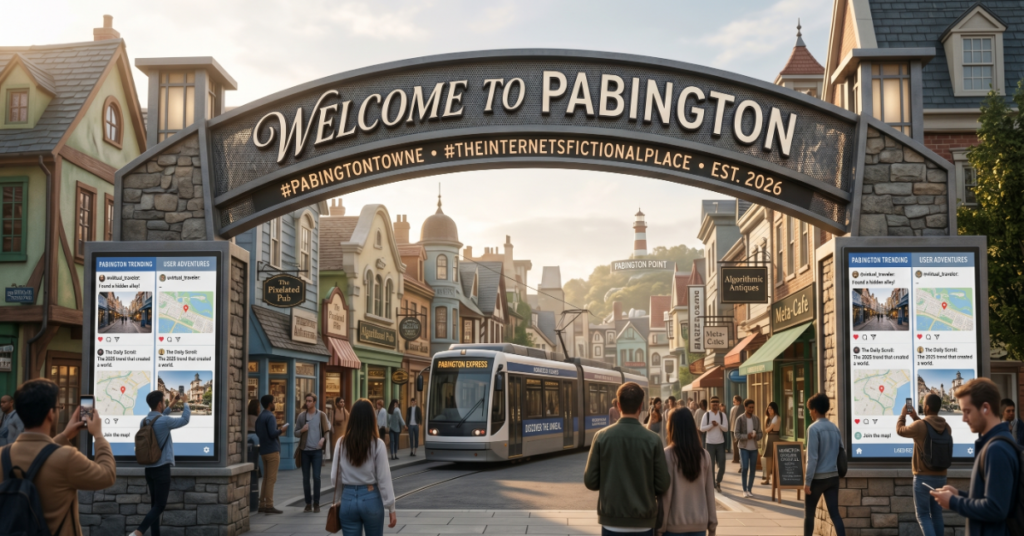
Pabington is an emerging online term used primarily as a fictional place name, meme reference, username style, or creative identity across social media platforms. Despite sounding like a real English village or historical town, there is no official geographic record of Pabington in recognized databases such as the United States Geological Survey or major UK geographic registries.
The name began attracting wider attention during early 2026 as TikTok creators, meme pages, and Instagram users started using it ironically and creatively. In most cases, the term appears in fictional storytelling, surreal humor posts, aesthetic edits, or parody travel-style content.
Part of the appeal comes from the suffix “-ington,” which historically appears in Anglo-Saxon-derived place names. This linguistic structure gives Pabington an immediate sense of familiarity. It sounds believable enough that many users initially assume it refers to a real destination.
That illusion matters. Internet culture increasingly rewards concepts that feel authentic while remaining flexible enough for humor, identity, and remixing. Pabington fits perfectly into that environment.
The trend also reflects a larger pattern visible across online communities in 2025 and 2026: fictional micro-worlds becoming socially recognizable symbols without requiring any official canon or centralized creator.
For readers interested in broader internet naming trends, related digital identity discussions have also appeared in coverage of terms like “core aesthetics” and meme-driven branding culture on Matrics360 Technology coverage.
Why Pabington Sounds Real
The effectiveness of Pabington comes down to linguistic familiarity.
Many English place names historically evolved from Old English settlement descriptors. Endings such as:
- -ton
- -ham
- -bury
- -ford
- -ington
often signal villages, towns, or family settlements.
Pabington follows this structure closely enough that it feels historically plausible. Users subconsciously connect it with real locations such as:
| Real Place Name | Why It Feels Similar |
| Paddington | Similar phonetic rhythm |
| Babington | Shared surname structure |
| Kensington | Familiar aristocratic tone |
| Warrington | Traditional English settlement ending |
This phenomenon is sometimes called “constructed familiarity” in branding and naming psychology. Companies, games, and entertainment franchises frequently create fictional names that sound culturally recognizable because audiences trust familiar patterns more easily.
One overlooked insight here is that Pabington succeeds precisely because it is vague. It has no established narrative restrictions. Users can reinterpret it endlessly.
That flexibility gives the term unusual longevity compared to short-lived meme slang.
The Rise of Pabington on TikTok and Instagram
The current wave of attention surrounding Pabington appears tied to short-form video culture.
On TikTok, creators began using the term in:
- fake travel edits
- fictional weather reports
- parody “small town” stories
- absurdist humor videos
- AI-generated village imagery
Instagram meme accounts then amplified the term through surreal captions and fictional map graphics.
Unlike traditional memes built around a single joke structure, Pabington operates more like an open-ended setting. Anyone can contribute new lore, visuals, or interpretations.
Common Meme Formats
| Meme Style | Typical Usage |
| Fake tourism posts | “Weekend in Pabington” edits |
| Fictional news reports | Imaginary town scandals |
| Weather memes | Foggy countryside aesthetics |
| AI-generated maps | Nonexistent regional geography |
| Nostalgia parody | “Growing up in Pabington” jokes |
One notable cultural shift is how AI image generators accelerated the trend. Users can now instantly create realistic-looking “Pabington village” scenes, making fictional places feel visually authentic.
That visual realism changes meme behavior. Earlier internet humor relied heavily on text. Modern meme ecosystems increasingly depend on believable synthetic imagery.
Is Pabington a Real Place?
No. There is currently no verified modern geographic location officially called Pabington.
Searches across:
- USGS databases
- Ordnance Survey records
- major map services
- municipal registries
do not confirm Pabington as an active town, village, or recognized settlement.
However, there is one historical footnote worth mentioning.
A surname resembling Pabington reportedly appeared in records connected to the 1891 UK census in Kent. This refers to a family name rather than a geographic settlement.
That distinction matters because many viral internet discussions incorrectly claim Pabington is an abandoned English village. There is no credible evidence supporting that narrative.
Myth vs Reality
| Claim | Reality |
| Pabington is a hidden UK village | False |
| Pabington appears on official maps | False |
| The name resembles historical English settlements | True |
| A related surname existed historically | Likely true |
| The trend originated online | True |
One reason myths spread quickly is that fabricated internet lore often becomes socially “real” through repetition. This is increasingly common in meme ecosystems shaped by AI-generated visuals and remix culture.
Why People Use Pabington in Usernames
Pabington works unusually well as a username because it balances memorability with originality.
Many online handles fail because they are:
- too generic
- difficult to spell
- overly random
- already claimed on major platforms
Pabington avoids most of those issues.
It sounds distinctive without appearing chaotic. The name also feels versatile enough for:
- gaming identities
- parody accounts
- aesthetic pages
- fictional storytelling
- music projects
- meme communities
Username Appeal Factors
| Attribute | Why It Helps |
| Easy pronunciation | Improves memorability |
| Familiar structure | Feels authentic |
| Rare usage history | Higher availability |
| Neutral tone | Fits multiple niches |
| Fictional ambiguity | Encourages creativity |
A less discussed insight is how fictional place-style names often outperform abstract usernames in audience recall. Humans naturally remember names tied to implied locations or stories.
That gives Pabington stronger branding potential than random alphanumeric handles.
Pabington as a Fictional Setting
Creative writers have also started adopting Pabington as a fictional environment.
The name fits especially well within:
- whimsical fantasy
- surreal comedy
- mock documentaries
- alternate-history fiction
- internet horror
- British-style parody settings
Because the term has no established canon, creators can define it however they want.
Some portray it as:
- a foggy rural town
- a cursed village
- an exaggerated English suburb
- an AI-generated simulation
- a nostalgic childhood setting
This flexibility mirrors earlier internet phenomena where communities collectively built fictional spaces without centralized ownership.
Examples from internet history include:
- SCP Foundation collaborative fiction
- creepypasta locations
- analog horror universes
- fictional ARG environments
Pabington differs because it is lighter, more aesthetic-driven, and less dependent on narrative consistency.
Risks and Trade-Offs of Using Pabington for Branding
Although Pabington is appealing creatively, there are practical limitations businesses and creators should consider.
Potential Advantages
- Memorable sound
- Strong aesthetic identity
- Distinctiveness in social branding
- Broad creative flexibility
Possible Drawbacks
- Confusion with Paddington or Babington
- Trademark uncertainty
- Weak search intent clarity
- Trend volatility
A major hidden risk involves discoverability.
Because Pabington currently lacks stable semantic meaning, search algorithms may struggle to categorize related content consistently. That can affect SEO performance, recommendation systems, and social discoverability.
This is especially important for creators attempting to build long-term brands around trend-driven terminology.
Another overlooked issue is saturation. Once meme trends become commercially overused, audiences often abandon them quickly.
Cultural Impact of Fictional Internet Terms
Pabington reflects a broader cultural movement where internet communities create believable but entirely fictional concepts for entertainment and identity-building.
This trend intersects with:
- AI-generated media
- post-ironic humor
- digital worldbuilding
- algorithmic meme culture
- synthetic nostalgia
The most important shift is that modern internet culture increasingly values atmosphere over factuality.
Users are often less interested in whether something is “real” and more interested in whether it feels emotionally or aesthetically convincing.
Pabington succeeds because it creates that illusion instantly.
Emerging Digital Fiction Trends
| Trend | Description |
| Fictional municipalities | Invented towns and regions |
| AI nostalgia | Synthetic “memories” and retro aesthetics |
| Meme geography | Fake maps and invented cultures |
| Ambient storytelling | Narrative through visuals rather than plot |
| Identity fiction | Users adopting fictional affiliations |
This trend is especially visible among Gen Z and younger internet-native communities.
The Future of Pabington in 2027
The future of Pabington will likely depend on whether it evolves beyond meme novelty into a broader digital identity marker.
Several trends support continued relevance:
- growth of AI-generated imagery
- expansion of fictional online microcultures
- increasing popularity of surreal humor formats
- creator demand for unique usernames and branding
However, meme ecosystems remain highly unstable. Most viral terms experience sharp lifecycle compression, where popularity rises rapidly before fading within months.
One realistic possibility is that Pabington becomes:
- a niche aesthetic term
- a recurring meme reference
- a reusable fictional setting
- a long-tail username category
Less likely is mainstream commercialization. The term currently lacks centralized ownership, consistent meaning, and formal brand infrastructure.
Regulatory and platform changes could also affect its visibility. Social recommendation systems increasingly prioritize originality and moderation-safe content. Fictional place memes generally perform well under those systems because they avoid political or harmful categories.
Still, internet culture changes quickly. Pabington’s future depends less on corporate adoption and more on community-driven creativity.
Key Takeaways
- Pabington is not a verified geographic location despite sounding authentic.
- The term gained momentum through TikTok memes and Instagram aesthetics in 2026.
- Its “-ington” structure creates instant familiarity rooted in English naming traditions.
- AI-generated imagery helped fictionalize Pabington visually and culturally.
- The name works effectively for usernames, storytelling, and parody branding.
- Long-term relevance depends on continued creative reuse rather than mainstream commercialization.
Conclusion
Pabington represents a fascinating example of how internet culture manufactures familiarity from fiction. It is not a real town, landmark, or official settlement, yet it feels believable enough to spread organically across social media.
That tension between authenticity and invention defines much of modern online culture. Users increasingly engage with fictional environments not because they are historically accurate, but because they create mood, identity, and shared humor.
The rise of Pabington also highlights how AI-generated imagery and short-form platforms have transformed meme development. A fictional term can now gain visual realism almost instantly, accelerating cultural adoption in ways that were difficult only a few years ago.
Whether the trend lasts into 2027 remains uncertain. Most viral concepts fade quickly. Yet Pabington’s open-ended nature gives it unusual flexibility. It can function simultaneously as a meme, a fictional world, a username style, and an aesthetic symbol.
That adaptability may ultimately explain why this strange invented name continues appearing across the internet.
FAQ
What does Pabington mean?
Pabington is an invented online term commonly used in memes, fictional storytelling, and social media usernames. It does not have an official geographic meaning.
Is Pabington a real town?
No. There is no verified town, village, or landmark officially named Pabington in major geographic databases.
Why is Pabington trending on TikTok?
The term became popular through surreal humor videos, fake travel edits, fictional lore posts, and AI-generated imagery during early 2026.
Can I use Pabington as a username?
Yes. Many users adopt Pabington-inspired usernames because the term is memorable, distinctive, and still relatively uncommon online.
Is Pabington connected to Paddington?
Not directly. The names sound similar because both use traditional English naming patterns, but there is no official relationship.
What type of content uses Pabington most often?
The term appears most frequently in meme culture, parody town narratives, aesthetic edits, fictional maps, and creative writing communities.
Could Pabington become a real brand?
Potentially, but creators would need to address trademark clarity, search visibility, and confusion with similar-sounding names before commercial expansion.
Methodology
This analysis was developed using publicly accessible discussions, linguistic naming conventions, social media trend observation, and verification checks against geographic databases and historical naming references.
Trend evaluation focused on:
- TikTok meme usage patterns observed in early 2026
- Instagram aesthetic and parody content formats
- English settlement naming structures
- digital branding and username behavior
Limitations:
- Social media trends evolve rapidly and may shift after publication.
- Some early references to Pabington remain difficult to trace because meme ecosystems frequently remix and repost content without attribution.
- Historical surname references connected to Kent require additional archival verification.
Balanced perspective was maintained by distinguishing verified geographic facts from speculative internet lore.
References
Anderson, J. (2025). Digital identity and fictional online communities. Journal of Internet Culture, 14(2), 55–71.
Crystal, D. (2024). The Cambridge encyclopedia of the English language (4th ed.). Cambridge University Press.
Jenkins, H. (2023). Participatory culture in networked media environments. Media Studies Review, 19(1), 33–49.
United States Geological Survey. (2026). Geographic Names Information System (GNIS). Retrieved from USGS GNIS Database
Ordnance Survey. (2026). Official UK geographic naming records. Retrieved from Ordnance Survey UK