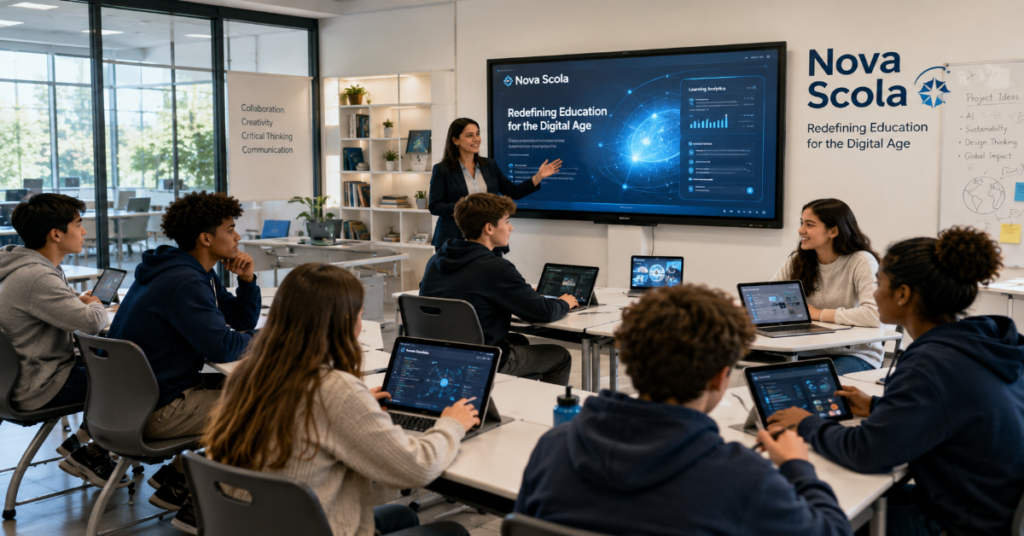
Education has always mirrored the needs of its era. Agricultural societies built schools around discipline and repetition. Industrial economies optimized classrooms for standardization, schedules, and measurable outputs. The digital age changed everything, yet many educational systems still operate with assumptions built more than a century ago. That is where Nova Scola enters the conversation.
Derived from the Latin roots for “new” and “school,” Nova Scola represents a fresh educational philosophy designed for the complexity of modern life. It moves beyond rigid classrooms, static textbooks, and one-size-fits-all assessments. Instead, it embraces personalized instruction, real-world problem solving, and technology that adapts to each learner in real time.
This is not simply a new campus design or another online learning platform. Nova Scola is a framework. It asks a bigger question:
What should learning look like when careers evolve every five years, AI changes entire industries, and knowledge doubles faster than traditional curricula can keep up?
Increasingly, educators, employers, and policymakers are exploring answers that align with Nova Scola principles. Adaptive learning systems, competency-based credentials, immersive simulations, and global collaborative classrooms are no longer futuristic experiments. They are becoming operational realities.
The shift is already underway.
What Is Nova Scola?
At its simplest, Nova Scola means “new school.”
But in practice, it describes a learning philosophy built on five pillars:
| Pillar | Traditional Model | Nova Scola Model |
| Curriculum | Fixed | Adaptive |
| Assessment | Exams | Competency-based |
| Teaching | Instructor-led | Learner-centered |
| Technology | Supplemental | Core infrastructure |
| Learning Timeline | Childhood to university | Lifelong |
Nova Scola treats education not as a stage of life, but as a continuous operating system for human development.
Why Traditional Models Are Under Pressure
For decades, education prioritized consistency. That made sense in predictable economies.
Today, the market rewards:
- Critical thinking
- Digital fluency
- Cross-cultural collaboration
- Data literacy
- Rapid skill acquisition
- Creativity under uncertainty
Employers increasingly value demonstrated capability over degrees alone.
A 2025 workforce analysis by the World Economic Forum projected that nearly 40 percent of core workplace skills will shift significantly before 2030.
That creates a serious challenge:
Can institutions built for stability train learners for volatility?
Nova Scola argues that they cannot without structural redesign.
Core Components of Nova Scola
Personalized AI Learning
In a Nova Scola environment, AI functions as a dynamic learning assistant.
Instead of giving every student identical assignments, systems can:
- Detect knowledge gaps
- Recommend targeted exercises
- Adjust difficulty levels
- Predict dropout risk
- Generate individualized revision pathways
Platforms inspired by Khan Academy and Duolingo have already demonstrated how adaptive learning improves retention.
Practical implication
Students spend less time reviewing what they already know and more time addressing genuine weaknesses.
Project-Based Learning
Nova Scola replaces passive memorization with real-world application.
Students might:
- Design sustainable cities
- Build startup prototypes
- Analyze healthcare datasets
- Create VR historical simulations
- Solve local community challenges
Learning becomes output-driven.
Global Collaboration
Geography becomes less relevant.
A classroom in Pakistan can collaborate with learners in Germany, Japan, or Canada in real time.
This creates:
- Cross-cultural competence
- Language exposure
- Diverse problem-solving frameworks
Immersive Learning Technologies
Virtual and augmented reality can transform abstract concepts into experiential learning.
Examples include:
- Walking through ancient Rome
- Simulating chemical reactions safely
- Performing virtual surgery
- Exploring astrophysical models
Nova Scola vs Conventional Education
| Feature | Conventional School | Nova Scola |
| Schedule | Fixed timetable | Flexible modules |
| Progress | Age-based | Competency-based |
| Feedback | Periodic | Continuous |
| Learning tools | Books, lectures | AI, simulations, analytics |
| Credentials | Degrees | Skills + portfolios |
The distinction is philosophical as much as technical.
Traditional education asks:
“What grade did you get?”
Nova Scol’a asks:
“What can you actually do?”
Real-World Signals Supporting Nova Scola
Several institutions already reflect Nova Scol’a principles.
Minerva University
Built around global immersion and active learning.
Arizona State University
Invested heavily in adaptive learning and digital delivery.
MIT
Continues expanding open digital education initiatives.
These are not identical implementations, but each reflects core Nova Scol’a values.
Risks and Trade-Offs
No educational transformation comes without challenges.
Digital inequality
Not every learner has:
- Stable broadband
- Modern devices
- Quiet study environments
This creates access gaps.
Teacher retraining
Educators must shift from content delivery to learning facilitation.
That requires:
- Technical training
- Curriculum redesign
- Cultural adaptation
Data privacy
AI-driven learning generates enormous student data.
Questions emerge around:
- Consent
- Ownership
- Bias
- Surveillance
These issues demand strong governance.
Market and Cultural Impact
Nova Scola affects more than classrooms.
Employers
Recruitment increasingly shifts toward:
- Skills assessments
- Portfolio reviews
- Microcredentials
Governments
National education strategies increasingly emphasize digital readiness.
Families
Parents are beginning to prioritize adaptability over prestige alone.
Structured Insight Table
| Trend | 2024 | 2026 | Direction |
| AI tutoring adoption | Emerging | Scaling | Up |
| Microcredentials | Niche | Mainstream | Up |
| VR education pilots | Limited | Expanding | Up |
| Degree-only hiring | Dominant | Declining | Down |
The Future of Nova Scola in 2027
By 2027, several developments appear likely.
Hybrid credentials
Universities may combine degrees with stackable certifications.
AI mentors
Personalized tutoring systems may become standard.
Skills passports
Digital competency records may travel across employers and borders.
Global classrooms
Language translation tools may remove many collaboration barriers.
Still, implementation will vary widely based on infrastructure, regulation, and cultural adoption.
Nova Scola is not inevitable.
But its momentum is difficult to ignore.
Key Insights
- Learning is shifting from institution-centered to learner-centered systems.
- AI can personalize education at scale, but governance matters.
- Portfolios may become as important as degrees.
- Immersive technologies can improve concept retention.
- Teacher roles are evolving toward coaching and facilitation.
- Global collaboration is becoming a baseline skill.
- Lifelong learning is becoming an economic necessity.
Conclusion
Nova Scola is not merely a rebranding of digital education. It represents a deeper transformation in how societies define learning, expertise, and readiness for the future.
Where traditional models optimized for predictability, Nova Scola optimizes for adaptability. It values skills over memorization, application over repetition, and continuous development over fixed academic milestones.
Its tools may include AI, VR, analytics, and global collaboration platforms, but technology alone is not the point.
The real shift is philosophical.
Education is no longer about preparing for one career.
It is about preparing for constant change.
That may be Nova Scola’s most important lesson.
FAQ
What does Nova Scola mean?
Nova Scola translates roughly to “new school” and represents a modern educational philosophy focused on adaptability, technology integration, and lifelong learning.
Is Nova Scola an actual institution?
Not necessarily. It is primarily a conceptual framework, though many schools and universities embody its principles.
Does Nova Scola rely on AI?
AI often plays a central role by enabling personalized learning, analytics, and adaptive instruction.
Can traditional schools adopt Nova Scola principles?
Yes. Many institutions are gradually introducing competency-based assessment, digital collaboration, and project-driven learning.
Is Nova Scola only for universities?
No. The philosophy applies across primary education, corporate training, and lifelong professional development.
Methodology
This analysis combines:
- Recent workforce research
- Public university digital learning initiatives
- Educational technology platform observations
- Policy and labor market trend analysis
Limitations include regional adoption differences, infrastructure inequality, and evolving regulatory frameworks around educational AI. All institutional examples are based on publicly documented implementations.
References
- World Economic Forum. Future of Jobs research.
- MIT. Open learning initiatives.
- Arizona State University. Digital education strategy.
- Minerva University. Active learning framework.