
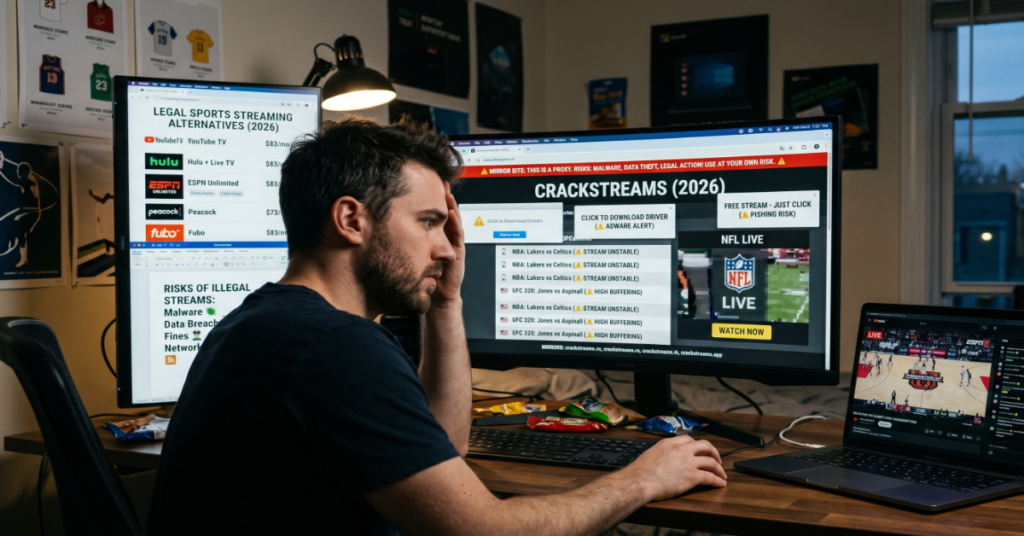
The search term “crackedstreams” usually refers to CrackStreams, one of the most recognizable unofficial live sports streaming aggregators online. The platform became widely known during the late 2010s and early 2020s by offering links to major sporting events including UFC pay-per-views, NFL games, NBA broadcasts, boxing matches, and MLB coverage without official licensing agreements.
Unlike legitimate streaming providers, CrackStreams does not maintain a stable domain for long periods. The site frequently moves between extensions such as .io, .me, .cx, and others after copyright complaints, hosting suspensions, or ISP blocks. That instability has created an ecosystem filled with mirror sites, copycat domains, malicious redirects, and fake “relaunch” pages that often confuse users.
The appeal is easy to understand. Official sports broadcasting has become increasingly fragmented. Fans may need separate subscriptions for regional sports networks, national broadcasters, premium pay-per-view events, and streaming-exclusive games. CrackStreams emerged as an informal workaround to those rising costs.
Still, there are serious trade-offs. Cybersecurity researchers, browser vendors, and digital rights groups have repeatedly warned about the dangers tied to unauthorized streaming ecosystems. Aggressive advertising scripts, credential harvesting attempts, cryptojacking code, and malware redirects are all common within the broader shadow-streaming market.
This article examines how CrackStreams operates, why its domains constantly change, the practical risks users face, and how legitimate sports streaming services are reshaping the market in 2026.
What CrackStreams Actually Is
CrackStreams is not a licensed broadcaster. It functions more like a link aggregation and redistribution network that points users toward unauthorized live sports feeds.
The site became especially popular during major UFC events and NFL playoffs because users could access streams without expensive cable packages or pay-per-view purchases. Over time, searches for “crackedstreams” became almost synonymous with free sports streaming.
Sports Commonly Found on CrackStreams
| Sport | Typical Coverage | Reliability During Peak Events |
| NFL | Regular season and playoffs | Moderate to unstable |
| NBA | National and local broadcasts | Usually stable early, weaker during playoffs |
| UFC/MMA | PPV events and prelims | High traffic causes frequent crashes |
| MLB | Daily regular season games | Variable |
| Boxing | Championship fights | Often overloaded |
| NHL | Select games | Less comprehensive |
One notable shift since 2023 is the increased use of decentralized hosting infrastructure and disposable mirror domains. This has made shutdowns harder but has also increased fake clone activity.
Why CrackStreams Domains Keep Changing
The constant domain switching is directly tied to copyright enforcement.
Sports leagues including the National Football League, National Basketball Association, and Ultimate Fighting Championship aggressively pursue unauthorized broadcasters through DMCA notices, court orders, hosting complaints, and domain seizures.
When one domain becomes blocked or suspended, operators often launch another mirror.
Common Reasons Mirrors Disappear
- Domain registrar complaints
- Hosting provider shutdowns
- CDN suspensions
- ISP-level blocking
- Search engine deindexing
- Traffic overload during major events
A hidden problem many users miss is that abandoned domains are frequently purchased by unrelated operators afterward. Some become malware traps rather than sports streaming sites.
That transition period creates a major cybersecurity blind spot.
The Real Security Risks Behind Unofficial Sports Streams
Most discussions about CrackStreams focus only on legality. The larger issue in practice is often device security.
Malvertising Is the Biggest Threat
Cybersecurity firms have repeatedly documented malicious advertising networks operating across unauthorized streaming ecosystems. These ads may trigger:
- Fake software update prompts
- Browser notification hijacks
- Credential phishing pages
- Mobile APK downloads
- Crypto wallet scams
- Fake VPN installations
The danger is rarely the video player itself. The surrounding ad infrastructure creates the real exposure.
Browser Notification Abuse
One increasingly common tactic involves fake “Click Allow to Watch Stream” prompts. Once permission is granted, users may receive persistent scam notifications even after leaving the site.
These campaigns often imitate:
- Antivirus warnings
- Prize alerts
- Banking security notices
- Browser update prompts
VPNs Reduce Exposure but Do Not Eliminate Risk
Many users assume VPNs make unofficial streaming safe. They do not.
A VPN may hide traffic from ISPs and reduce location tracking, but it cannot prevent malicious scripts, phishing attempts, or infected downloads.
This distinction matters because many clone sites market “safe streaming” while simultaneously serving aggressive advertising payloads.
Comparison Table: CrackStreams vs Legal Streaming Services
| Feature | CrackStreams | ESPN+ | DAZN | YouTube TV |
| Licensing | Unauthorized | Official | Official | Official |
| Stream Stability | Inconsistent | High | High | High |
| Malware Risk | Elevated | Low | Low | Low |
| PPV Integration | Unofficial | Supported for select events | Supported in some regions | Limited |
| Replay Access | Rare | Yes | Yes | DVR support |
| Device Support | Browser-heavy | Broad | Broad | Broad |
| Customer Support | None | Official | Official | Official |
Legal services remain expensive for some viewers, but the reliability gap has widened significantly since 2022.
Why Sports Piracy Continues Growing
The persistence of platforms like CrackStreams reflects a broader structural problem in sports media.
Fans increasingly face subscription fragmentation.
A single viewer following NFL football, NBA basketball, UFC events, and regional baseball coverage may need:
- Cable access
- Regional sports subscriptions
- Multiple streaming apps
- Premium PPV purchases
The combined annual cost can exceed several hundred dollars.
Practical Friction Matters
One overlooked factor is convenience.
Some users report that unofficial streams offer simpler access than legitimate broadcasters with blackout restrictions, authentication layers, or regional limitations.
That does not justify piracy legally, but it explains user behavior more accurately than simple “free access” narratives.
Real-World Example: UFC PPV Pricing Pressure
By 2025, major UFC pay-per-view events regularly exceeded combined viewing costs above $80 in some regions when platform subscriptions were included.
That pricing structure continues driving piracy demand during headline fights.
Popular Alternatives Users Search For
Users frequently migrate between sports streaming aggregators when mirrors fail or disappear.
StreamEast
StreamEast gained popularity because of its cleaner interface and relatively stable NFL and NBA feeds.
Its simplified design reduced some of the aggressive pop-up behavior found elsewhere, though legal and security risks remain similar.
BuffStreams
BuffStreams focuses heavily on mainstream American sports along with select combat sports coverage.
The site often appears during playoff seasons when traffic spikes affect competing mirrors.
VIPRow
VIPRow covers a broader mix of sports including tennis, racing, golf, and rugby.
Its wider category support attracts international users, especially during global tournaments.
Hidden Operational Risks Most Users Ignore
Three operational realities receive far less attention than legality discussions.
1. Fake Mirrors Outnumber Real Ones
Search results for “crackedstreams” often contain dozens of cloned domains. Some only exist to collect ad revenue while others actively attempt credential theft.
This creates a trust verification problem that casual users rarely recognize.
2. Live Event Latency Can Spoil Games
Unofficial streams frequently lag behind live broadcasts by 30 to 90 seconds.
For viewers active on social media, score notifications often arrive before major plays appear on screen.
3. Mobile Devices Face Higher Risk
Mobile browsers generally provide weaker visibility into redirect behavior compared to desktop environments.
Some Android-focused clone sites aggressively push APK installations disguised as video players or codec updates.
Structured Insight Table: Operational Weaknesses of Unofficial Sports Streaming
| Operational Issue | User Impact | Long-Term Trend |
| Mirror instability | Frequent downtime | Increasing |
| Malware advertising | Device compromise risk | Increasing |
| ISP blocking | Regional accessibility issues | Expanding |
| CDN enforcement | Stream interruptions | Increasing |
| Event traffic overload | Lag and crashes | Persistent |
| Search engine deindexing | Harder discovery | Increasing |
Legal Reality in 2026
Watching unauthorized streams occupies a legally gray area in some regions and a clearly infringing area in others.
Distribution operators face the greatest enforcement risk. However, governments and rights holders have increased pressure on end-user ecosystems through:
- ISP-level blocking
- Dynamic injunction systems
- Payment processor enforcement
- Search result suppression
- App store removals
Europe Has Accelerated Real-Time Blocking
Several European countries expanded live blocking systems for sports piracy between 2023 and 2025. These systems allow broadcasters to request rapid ISP restrictions during live events.
That has reduced mirror stability significantly during major football and combat sports broadcasts.
The United States Focuses More on Distribution Networks
American enforcement has historically prioritized operators, hosting providers, and commercial piracy networks over casual viewers.
Still, rights holders continue pushing for broader enforcement capabilities.
The Future of CrackStreams in 2027
The future of CrackStreams and similar services depends less on technology and more on economics, enforcement, and media fragmentation.
Several trends are already visible.
Increased Real-Time Anti-Piracy Infrastructure
Sports broadcasters are investing heavily in automated detection systems capable of identifying redistributed streams within minutes.
Cloud-based fingerprinting systems now detect duplicated feeds faster than earlier manual reporting methods.
More Exclusive Streaming Rights
Leagues continue shifting toward exclusive digital partnerships.
That fragmentation may unintentionally sustain piracy demand if legitimate access becomes too expensive or geographically restricted.
AI-Powered Clone Detection
Search engines and cybersecurity firms are improving automated identification of fraudulent mirrors and malicious streaming clones.
This could reduce visibility for fake domains, though enforcement remains inconsistent globally.
Consumer Bundling Could Reduce Piracy Pressure
One realistic countertrend is rebundling.
Some streaming providers are experimenting with combined sports packages designed to reduce subscription fatigue. If pricing becomes simpler and more transparent, unofficial stream demand could decline modestly.
Still, analysts do not expect sports piracy to disappear by 2027. The infrastructure has become too decentralized and adaptive.
Key Takeaways
- CrackStreams remains popular largely because official sports broadcasting is fragmented and expensive.
- Mirror domains create severe trust and cybersecurity problems beyond basic copyright concerns.
- VPN usage reduces privacy exposure but does not eliminate malware or phishing risks.
- Fake clone domains increasingly outnumber stable mirrors.
- Legal streaming platforms now offer stronger mobile performance, cloud DVR systems, and lower latency than unofficial alternatives.
- Anti-piracy enforcement is shifting toward real-time blocking and automated detection systems.
- The long-term future of sports piracy depends heavily on subscription pricing and regional accessibility.
Conclusion
CrackStreams became popular because it addressed a real consumer frustration. Sports broadcasting has fragmented across too many services, too many paywalls, and too many regional restrictions. For many fans, unofficial streams became the simplest way to watch live events without navigating multiple subscriptions.
But simplicity comes with consequences.
The modern “crackedstreams” ecosystem is far more unstable and risky than it appeared several years ago. Mirror churn, malicious advertising, fake clones, and event-day outages now define much of the user experience. In practical terms, the cybersecurity risks may matter more than the copyright questions for many users.
At the same time, legal streaming platforms are improving. Better mobile apps, bundled sports offerings, lower latency delivery, and integrated replay systems have narrowed some of the convenience gap that once made unofficial streams so attractive.
The broader issue remains unresolved though. As long as live sports rights stay fragmented and expensive, unofficial streaming platforms will likely continue adapting rather than disappearing entirely.
FAQ
Is CrackStreams legal?
No. CrackStreams generally distributes or links to copyrighted sports broadcasts without authorization from rights holders.
Why does CrackStreams keep changing domains?
The site frequently changes domains due to copyright complaints, ISP blocks, hosting suspensions, and legal enforcement actions.
Is using crackedstreams dangerous?
It can be. Many mirror sites contain aggressive advertising, phishing attempts, fake updates, and malicious redirects.
Does a VPN make CrackStreams safe?
A VPN improves privacy but does not protect users from malware, phishing pages, or malicious browser scripts.
What sports are usually available on CrackStreams?
NFL, NBA, MLB, UFC, boxing, and select NHL events are commonly streamed through CrackStreams mirrors.
What are legal alternatives to CrackStreams?
Services like ESPN+, DAZN, and YouTube TV provide licensed sports streaming options.
Why do unofficial streams lag behind live broadcasts?
Unofficial streams often pass through multiple rebroadcast layers, creating latency that can exceed a minute during high-traffic events.
Methodology
This analysis was compiled using publicly available reporting from sports media publications, cybersecurity research, anti-piracy enforcement announcements, and streaming industry documentation published between 2023 and 2026. Observations about mirror instability, browser behavior, and event latency were compared across multiple widely discussed unofficial streaming ecosystems.
Known limitations remain. Mirror domains change rapidly, meaning operational conditions can shift within days or even hours. Regional legality also varies significantly depending on jurisdiction.
Balanced consideration was applied throughout the article. While unauthorized streaming creates measurable legal and cybersecurity concerns, consumer frustration around fragmented sports rights and escalating subscription costs is also a documented driver of piracy behavior.
References
Cisco Talos Intelligence Group. (2024). Malvertising trends in unauthorized streaming ecosystems. Cisco.
European Union Intellectual Property Office. (2023). Online copyright infringement in sports broadcasting. EUIPO.
International Broadcaster Coalition Against Piracy. (2025). Annual sports piracy enforcement report. IBCAP.
Khan, I. (2025). Sports streaming fragmentation and subscription fatigue among digital audiences. Journal of Media Economics, 38(2), 91–107.
Motion Picture Association. (2024). Digital piracy and infrastructure trends report. MPA.
Statista. (2025). Sports streaming subscription market worldwide. Statista Research Department.
United States Copyright Office. (2024). Digital copyright enforcement developments. U.S. Government Publishing Office.