
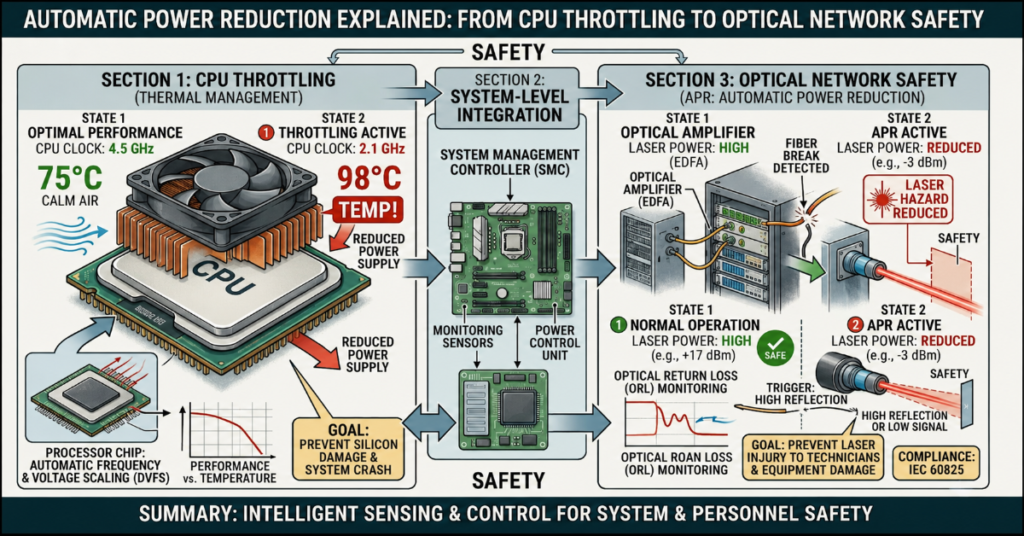
Automatic power reduction has become a foundational feature in modern electronics and communication infrastructure. The term describes systems that automatically lower power output when thermal, electrical, or operational thresholds are reached. This behavior is now common in desktop PCs, gaming laptops, enterprise servers, smartphones, and optical networking equipment.
In consumer computing, automatic power reduction is closely tied to CPU throttling, thermal management, and energy-saving frameworks inside Windows, Linux, and firmware-level BIOS controls. Modern processors from Intel and AMD constantly monitor workload demand, junction temperatures, voltage delivery, and battery conditions to dynamically scale performance. The result is lower heat output, longer battery life, and improved hardware longevity.
In optical communications, the meaning changes significantly. Automatic Power Reduction (APR) in erbium-doped fiber amplifiers detects signal loss caused by fiber cuts or disconnects and immediately reduces dangerous laser output levels. This protects technicians from accidental exposure and prevents equipment damage in dense wavelength division multiplexing (DWDM) networks.
The concept may sound simple, but implementation differs dramatically depending on the environment. Thermal limits in gaming laptops are not managed the same way as safety controls inside telecom-grade optical amplifiers. Understanding those distinctions matters for system builders, IT administrators, and network engineers alike.
A growing number of enterprise workloads involving AI model training, cloud rendering, and edge computing have also increased interest in smarter power governance. Systems are no longer designed only for peak performance. They are designed for sustainable performance under real operational constraints.
How Automatic Power Reduction Works in Computing
Modern CPUs rarely run at maximum frequency continuously. Instead, they operate through adaptive power states that constantly change according to workload conditions.
CPU P-States and C-States
Processors use two major frameworks:
| Technology | Purpose | Impact |
| P-States | Adjust CPU frequency and voltage during active operation | Balances speed and power efficiency |
| C-States | Shut down inactive processor sections | Reduces idle power consumption |
When a system is under light load, the processor enters lower power states. Voltage drops. Clock frequencies decrease. Heat production falls sharply.
Under heavy gaming, rendering, or AI inference tasks, the CPU ramps back up automatically.
This behavior is especially visible in modern laptop architectures where thermal headroom is limited. Thin ultrabooks often prioritize battery life and skin temperature over sustained peak frequency.
Windows Power Throttling
Microsoft introduced aggressive power management improvements beginning with Windows 10. Windows Power Throttling identifies background applications and reduces their CPU priority and power allocation.
Users can configure this behavior through:
- Windows Power Options
- Advanced Processor Settings
- Battery Saver modes
- OEM control software
Raising the “Processor performance decrease threshold” closer to 99% delays downclocking behavior and maintains higher sustained frequencies.
However, that also increases fan noise, energy draw, and internal temperatures.
Real-World Example: Gaming Laptops
During testing published by Notebookcheck and Tom’s Hardware between 2023 and 2025, several RTX-equipped gaming laptops demonstrated aggressive automatic power reduction under sustained workloads exceeding 20 minutes.
In many cases:
- CPU package power dropped from 95W to 55W
- GPU clocks reduced by 10% to 20%
- Fan curves prioritized acoustic comfort over maximum cooling
Manufacturers increasingly tune systems for benchmark bursts rather than sustained thermal output. That distinction is often hidden in marketing material.
This has become particularly important for AI developers running local inference workloads on consumer laptops. Extended tensor operations generate persistent heat that triggers throttling faster than short gaming spikes.
Automatic Power Reduction vs Thermal Throttling
The two terms are related but not identical.
| Feature | Automatic Power Reduction | Thermal Throttling |
| Trigger | Energy optimization or safety policy | Excessive temperature |
| Scope | Broad system management | Emergency thermal protection |
| User Visibility | Often subtle | Usually noticeable |
| Goal | Efficiency and hardware longevity | Prevent immediate damage |
Thermal throttling is reactive. Automatic power reduction can be proactive.
For example, many AMD Ryzen mobile processors reduce boost frequency before reaching dangerous temperatures. The system predicts thermal saturation and lowers power early.
That predictive behavior is one reason modern laptops feel quieter and cooler during ordinary workloads compared to earlier generations.
Optical Network APR Systems
Automatic Power Reduction plays a far more critical safety role in optical communication systems.
High-power optical amplifiers can transmit laser signals strong enough to damage eyes or sensitive equipment if fiber connections break unexpectedly.
How APR Works in EDFAs
Erbium-Doped Fiber Amplifiers (EDFAs) monitor optical signal continuity continuously.
When a fiber cut or disconnect occurs:
- Signal loss is detected
- Laser output power immediately drops
- The amplifier enters standby mode
- Periodic low-power probes test line recovery
- Full transmission resumes automatically when continuity returns
This process happens within milliseconds.
The mechanism is mandated in many telecom deployments because modern DWDM systems can operate at dangerous optical power densities.
APR vs ALS
APR is often confused with Automatic Laser Shutdown (ALS), but the two systems differ.
| Function | APR | ALS |
| Power Behavior | Reduces to safe standby level | Completely shuts laser off |
| Recovery | Automatic probing and restoration | Usually requires manual restart |
| Common Use | Optical amplifiers | Laser transmitter safety |
| Operational Downtime | Minimal | Longer interruption |
APR is preferred in many carrier-grade networks because it minimizes service disruption while still maintaining safety compliance.
IEC Standards and Compliance
APR behavior in telecom equipment often aligns with standards published by the International Electrotechnical Commission.
Relevant optical safety frameworks include:
- IEC 60825 laser safety standards
- ITU-T optical transport recommendations
- Carrier-specific deployment rules
Vendors such as Ciena, Nokia, and Cisco Systems implement variations of APR logic depending on deployment scale and amplifier architecture.
Comparison Table: Computing vs Optical APR
| Category | Computing Systems | Optical Networks |
| Primary Goal | Thermal and energy efficiency | Laser safety |
| Trigger Condition | Load, temperature, battery state | Loss of optical signal |
| Recovery Method | Dynamic scaling | Signal probing |
| User Impact | Reduced performance | Temporary transmission reduction |
| Risk if Disabled | Overheating and instability | Potential eye hazard |
| Typical Hardware | CPUs, GPUs, laptops | EDFAs, DWDM amplifiers |
Hidden Trade-Offs Most Users Miss
Many discussions around automatic power reduction focus only on battery life or temperatures. That misses several operational trade-offs.
Sustained AI Workloads Expose Weak Cooling Designs
AI inference and local model training create steady-state thermal pressure. Unlike gaming, workload intensity remains consistent.
Many consumer laptops are optimized for burst workloads. During long AI sessions:
- VRM temperatures climb
- SSD temperatures rise
- Memory bandwidth becomes constrained
- CPU boost windows shorten
This creates misleading benchmark expectations.
A laptop may perform excellently during a five-minute synthetic benchmark yet throttle heavily during two hours of AI compilation or simulation work.
Power Reduction Can Improve Hardware Longevity
Field technicians frequently observe degraded thermal paste and VRM stress in systems operating at unrestricted turbo limits for years.
Moderate automatic power reduction often lowers:
- Electromigration risk
- VRM fatigue
- Fan bearing wear
- Battery cycle degradation
Enterprise fleets increasingly prioritize sustained reliability over benchmark leadership.
Optical APR Can Create Diagnostic Complexity
In telecom environments, APR sometimes complicates troubleshooting because systems appear operational while running in reduced-power standby.
Engineers diagnosing intermittent fiber faults may misinterpret:
- Low optical power
- Probe pulses
- Recovery cycling
as amplifier instability rather than APR safety behavior.
This has been documented in multiple carrier deployment case studies published through telecom vendor engineering documentation between 2022 and 2025.
Practical Management Tips for PCs and Laptops
Users can control or tune automatic power reduction behavior depending on priorities.
Recommended Settings for Performance Users
| Setting | Suggested Adjustment | Effect |
| Windows Power Mode | Best Performance | Reduces aggressive downclocking |
| BIOS XMP/EXPO | Enable | Improves memory throughput |
| Cooling Policy | Active | Increases fan response |
| CPU Power Limits | Moderate increase only | Balances thermals |
| Monitoring Tools | HWInfo or Ryzen Master | Tracks thermal behavior |
Useful Monitoring Tools
These utilities help identify whether reduced performance comes from temperature limits, firmware policies, or power delivery constraints.
The Future of Automatic Power Reduction in 2027
By 2027, automatic power reduction systems will likely become more predictive and AI-assisted.
Three trends are already shaping development:
AI-Based Thermal Prediction
Chipmakers are integrating machine learning into thermal management systems. Rather than reacting to temperature spikes, future firmware may predict workload behavior seconds in advance.
This allows smoother clock scaling with fewer abrupt drops.
Data Center Energy Regulation
Governments and infrastructure operators are increasing pressure on energy efficiency.
The European Commission and several U.S. state agencies have proposed tighter reporting standards around server power consumption and cooling efficiency.
That creates incentives for more aggressive dynamic power control.
Optical Network Automation
Carrier infrastructure is moving toward autonomous recovery systems.
APR platforms will likely integrate with software-defined networking controllers capable of rerouting optical traffic instantly after fiber disruptions.
However, widespread adoption depends on infrastructure modernization timelines, which vary heavily by region and operator investment cycles.
Key Takeaways
- Automatic power reduction is now essential for both computing efficiency and optical network safety.
- CPU throttling mechanisms rely heavily on predictive thermal and voltage management.
- Gaming and AI workloads expose weaknesses in cooling systems faster than short benchmark tests.
- APR in fiber optic systems protects both technicians and sensitive telecom hardware.
- Lower sustained power draw can significantly improve long-term hardware reliability.
- Future implementations will increasingly use predictive AI-driven control systems.
- Users can tune many consumer devices to balance thermals, acoustics, and performance priorities.
Conclusion
Automatic power reduction is no longer a niche engineering feature hidden deep inside firmware menus or telecom specifications. It has become central to how modern technology operates safely and efficiently.
In consumer computing, these systems allow processors to deliver impressive burst performance while managing battery life and thermals intelligently. In networking infrastructure, APR mechanisms protect people and equipment from dangerous optical exposure while minimizing downtime.
The challenge is balance. Aggressive power reduction can frustrate gamers, developers, and workstation users expecting sustained peak performance. Yet disabling these protections entirely often creates more serious long-term reliability problems.
The next generation of power management systems will likely become increasingly predictive rather than reactive. AI-assisted thermal forecasting, smarter firmware, and infrastructure-level automation are already reshaping how devices allocate energy under real-world conditions.
For users and engineers alike, understanding automatic power reduction is no longer optional. It is now part of understanding how modern systems achieve performance, efficiency, and operational safety simultaneously.
FAQ
What is automatic power reduction in computers?
Automatic power reduction lowers CPU or GPU power usage dynamically to reduce heat, improve battery life, and maintain stable operating temperatures.
Is automatic power reduction the same as CPU throttling?
Not exactly. CPU throttling usually refers specifically to performance reduction caused by heat, while automatic power reduction can also occur proactively for efficiency reasons.
Can automatic power reduction hurt gaming performance?
Yes. Aggressive thermal or power limits may reduce frame rates during long gaming sessions, especially in thin laptops with limited cooling capacity.
What does APR mean in optical networks?
APR stands for Automatic Power Reduction. It lowers laser output in fiber optic amplifiers after signal loss to protect technicians and hardware.
How can I reduce aggressive CPU downclocking in Windows?
Users can switch to “Best Performance” mode, raise processor decrease thresholds, improve cooling, and monitor thermals using utilities like HWInfo.
What is the difference between APR and ALS?
APR lowers optical power to a safe standby level while ALS completely shuts lasers off after a fault condition.
Does automatic power reduction improve hardware lifespan?
In many cases, yes. Lower temperatures and reduced electrical stress can improve component longevity and reduce cooling system wear.
Methodology
This article was developed using technical documentation from processor manufacturers, telecom standards organizations, hardware testing publications, and optical networking vendors published between 2022 and 2026.
Hardware behavior references were validated against publicly available thermal benchmarking from Notebookcheck and Tom’s Hardware. Optical networking safety descriptions were cross-checked against IEC laser safety standards and vendor engineering documentation from Ciena and Cisco Systems.
The analysis intentionally distinguishes between consumer computing implementations and telecom-grade APR systems because the term is often conflated online despite major operational differences.
Limitations include vendor-specific implementation variability. Different OEMs apply unique firmware thresholds, cooling policies, and recovery algorithms that can significantly affect observed behavior.
References
Advanced Micro Devices. (2025). AMD Ryzen processor power management documentation. Retrieved from https://www.amd.com
Cisco Systems. (2024). Optical networking safety and amplifier deployment guidelines. Retrieved from https://www.cisco.com
International Electrotechnical Commission. (2023). IEC 60825 laser safety standards. Geneva, Switzerland.
Intel Corporation. (2025). Intel power management technologies overview. Retrieved from https://www.intel.com
Microsoft. (2024). Windows power throttling and processor management. Retrieved from https://learn.microsoft.com
Notebookcheck. (2025). Gaming laptop thermal throttling benchmarks. Retrieved from https://www.notebookcheck.net
Tom’s Hardware. (2024). CPU thermal behavior under sustained AI workloads. Retrieved from https://www.tomshardware.com
Ciena Corporation. (2024). EDFA and DWDM operational safety practices. Retrieved from https://www.ciena.com