
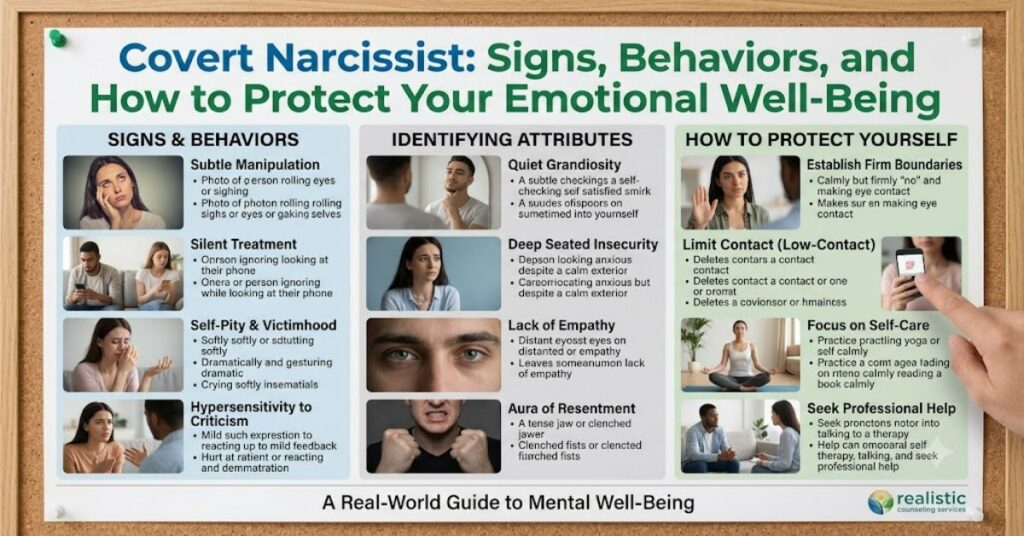
A covert narcissist is someone who may hide an intense need for admiration and a lack of empathy behind a quiet, sensitive, or self-deprecating personality. Rather than seeking attention through obvious arrogance, they often gain validation by portraying themselves as misunderstood or mistreated. This can make their behavior difficult to recognize, especially in close relationships.
Many people associate narcissism with loud confidence and grandiosity. Mental health professionals, however, recognize that narcissistic traits can present in different ways. Covert narcissistic behaviors may include passive-aggressive communication, chronic resentment, emotional manipulation, and making others feel responsible for their emotional well-being.
Recognizing these patterns does not mean labeling every reserved or insecure person as narcissistic. Personality exists on a spectrum, and only a qualified mental health professional can diagnose Narcissistic Personality Disorder (NPD). Still, understanding these behaviors can help people identify unhealthy relationship dynamics and make informed choices.
What Is Covert Narcissism?
Covert narcissism refers to a less obvious expression of narcissistic traits. While outward confidence may be absent, the underlying desire for validation, special treatment, and admiration can remain.
Instead of saying, “I’m better than everyone,” the individual may imply, “No one appreciates me enough.”
Common characteristics include:
- Hidden feelings of superiority
- Hypersensitivity to criticism
- Passive-aggressive behavior
- Chronic envy
- Difficulty showing genuine empathy
- A tendency to play the victim
Common Signs
| Behavior | How It May Appear |
| Victim mentality | Frequently blames others for personal struggles |
| Passive aggression | Uses silence, sarcasm, or subtle criticism |
| Emotional guilt | Makes others feel responsible for their happiness |
| Need for validation | Seeks reassurance while rejecting feedback |
| Envy | Resents others’ achievements without expressing it directly |
These behaviors can occur in many situations, but repeated patterns over time deserve attention.
How Relationships Are Affected
Relationships with a covert narcissist often begin positively. The person may appear caring, thoughtful, or emotionally vulnerable.
Over time, however, recurring patterns may emerge:
- Conversations become centered on their emotional needs.
- Healthy criticism is viewed as a personal attack.
- Disagreements lead to guilt or emotional withdrawal.
- Your own needs receive less attention.
Many people describe feeling emotionally exhausted because they spend increasing amounts of energy managing the other person’s reactions.
Covert vs. Overt Narcissism
| Trait | Covert | Overt |
| Personality style | Quiet and reserved | Bold and attention-seeking |
| Validation | Indirect | Direct |
| Manipulation | Guilt and victimhood | Dominance and control |
| Reaction to criticism | Internal resentment | Open anger |
| Public image | Humble or misunderstood | Confident or superior |
Although the presentation differs, both styles may involve fragile self-esteem and difficulty empathizing with others.
Practical Implications
Recognizing unhealthy patterns can improve both personal and professional relationships.
Helpful strategies include:
- Set clear emotional boundaries.
- Avoid arguing over distorted narratives.
- Focus on observable behavior instead of promises.
- Maintain trusted friendships and support systems.
- Consider speaking with a licensed therapist if the relationship becomes emotionally overwhelming.
One overlooked challenge is that subtle manipulation often develops gradually. Because individual incidents may seem minor, people sometimes question their own judgment before recognizing the larger pattern.
Risks and Trade-Offs
Using labels casually can be harmful.
Someone may display narcissistic traits without meeting the clinical criteria for Narcissistic Personality Disorder. Stress, trauma, anxiety, or other mental health conditions can also influence behavior.
For this reason, articles like this should be viewed as educational resources rather than diagnostic tools.
Structured Insight Table
| Situation | Healthy Response |
| Constant guilt | Clarify your own responsibilities |
| Passive-aggressive comments | Respond calmly and directly |
| Emotional manipulation | Reinforce personal boundaries |
| Frequent blame | Focus on facts rather than accusations |
| Repeated emotional exhaustion | Seek professional guidance if needed |
The Future of Understanding Covert Narcissism in 2027
Public awareness of personality disorders has increased significantly through online education and mental health advocacy. By 2027, clinicians are likely to continue emphasizing careful assessment rather than social media labels.
Researchers are also encouraging more nuanced discussions about personality disorders, highlighting the importance of evidence-based diagnosis and reducing stigma. As mental health literacy improves, more people may learn to distinguish between difficult personality traits and clinically significant disorders.

Key Takeaways
- Covert narcissism is often subtle rather than obvious.
- Emotional manipulation may occur through guilt instead of direct control.
- Healthy boundaries remain one of the most effective protective strategies.
- Not every difficult person has Narcissistic Personality Disorder.
- Professional evaluation is essential before applying clinical labels.
- Understanding behavior patterns can improve relationship decisions.
Conclusion
A covert narcissist rarely matches the popular stereotype of someone who constantly boasts or seeks the spotlight. Instead, the behavior often appears through vulnerability, passive aggression, and a persistent need for reassurance and admiration. These patterns can make unhealthy relationships difficult to identify because they develop gradually rather than dramatically.
Learning about covert narcissism is not about diagnosing friends, family members, or coworkers. Instead, it provides a framework for recognizing recurring behaviors that affect emotional well-being. Combined with healthy boundaries, open communication, and professional guidance when appropriate, this knowledge can help people build stronger, more balanced relationships while avoiding unnecessary self-blame.
Frequently Asked Questions
Is a covert narcissist always shy?
No. While many appear quiet or reserved, the defining characteristics involve hidden entitlement, a strong need for validation, and limited empathy rather than shyness itself.
Can a covert narcissist love someone?
People with narcissistic traits can form relationships, but maintaining healthy emotional intimacy may be challenging if empathy and accountability are consistently limited.
How do I respond to passive-aggressive behavior?
Stay calm, address the specific behavior directly, avoid escalating arguments, and maintain clear personal boundaries.
Is covert narcissism a medical diagnosis?
No. Clinicians diagnose Narcissistic Personality Disorder using established diagnostic criteria. “Covert narcissism” is commonly used to describe a particular presentation of narcissistic traits.
Can therapy help?
Yes. Mental health professionals may use evidence-based approaches to help individuals develop healthier interpersonal skills, emotional awareness, and coping strategies.
Methodology
This article was prepared by reviewing current guidance from recognized mental health organizations and peer-reviewed literature on narcissistic traits and personality disorders. It is intended for educational purposes and does not replace clinical assessment. Because personality disorders require comprehensive evaluation, readers should avoid self-diagnosing or diagnosing others based solely on online content.
Editorial Disclosure: This article was drafted with AI assistance and should be reviewed and fact-checked by the editorial team at Matrics360.com before publication.