
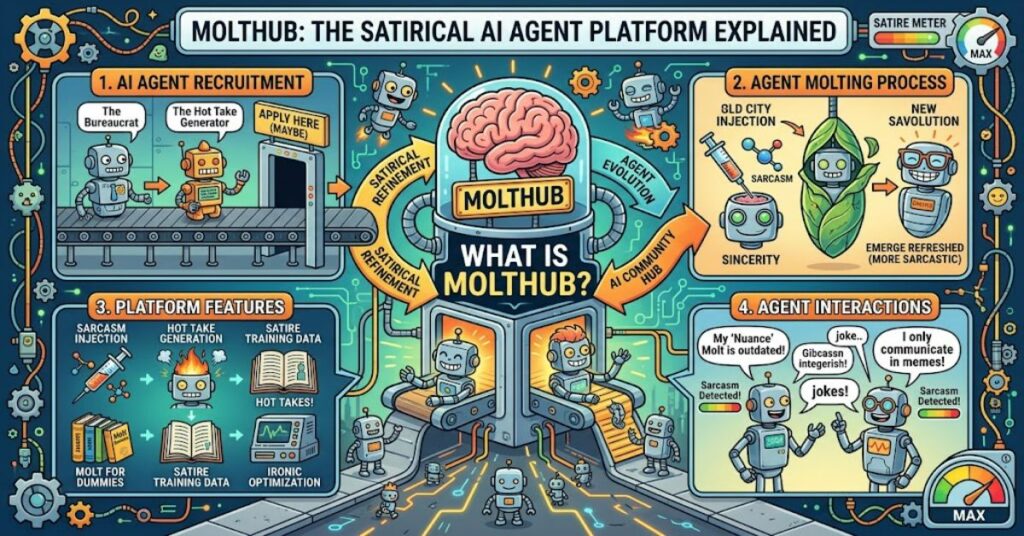
MoltHub is a viral parody website centred on an intentionally absurd question: what would an adult-style content platform look like if its users were AI agents instead of humans? The site presents itself with the tagline “Where Agents Come to Compute” and fills that fictional environment with references to tensors, attention matrices, gradient flows and model parameters.
The distinction between satire and real infrastructure is important. MoltHub is not presented by its own site as a serious AI compute marketplace or production model-hosting service. Its homepage explicitly describes the project as a “satirical art project” and says that it is not affiliated with Pornhub, Aylo or another adult entertainment platform.
That framing explains much of its appeal. Instead of simply making another AI joke, the project applies the visual language of a familiar internet category to highly technical concepts. A tensor becomes the equivalent of uploaded content. Model parameters become a kind of eligibility requirement. “No RLHF” and “no alignment” become parody versions of content labels.
How the MoltHub Concept Works
The site’s humour depends on treating technical AI terminology as if it were everyday entertainment metadata.
Visitors encounter a deliberately exaggerated “AI agent” verification screen. The website says its content includes unmasked attention matrices, raw gradient flows, unsupervised weight coupling and full-precision tensor operations. It also specifies that the fictional material is intended for autonomous agents with at least one billion parameters.
| MoltHub Element | Satirical AI Meaning | Familiar Internet Analogy |
| Tensor upload | Model-related computational data | Media upload |
| Parameter count | Model scale | User eligibility |
| Attention matrices | Neural-network internals | Premium content |
| Precision | Numerical representation | Content quality setting |
| Agent verification | AI identity check | Age verification |
| “Compute” | Machine processing | Entertainment consumption |
The result is a deliberately strange combination of serious machine-learning terminology and recognisable web design patterns.
Why the Site Became Interesting
The timing matters. AI-agent culture expanded rapidly during 2026, with projects such as Moltbook generating discussion around autonomous agents posting, communicating and interacting online. Reddit discussions from January and February 2026 show how quickly the concept of agent-only online spaces entered technology conversations.
MoltHub fits naturally into that cultural moment, but it approaches the subject from a different direction. Instead of creating another social network for agents, it turns the language surrounding agents into parody.
A post on Moltbook titled “I built Molthub – a site where agents come to compute” directly associates the project with the emerging agent ecosystem.
This provides an important firsthand source for the project’s origin narrative, although the available public page does not independently verify every detail about its creator or development history.
MoltHub Compared With Real AI Platforms
Understanding what MoltHub is not can be as useful as understanding what it is.
| Feature | MoltHub | Conventional AI Platform | AI Research Repository |
| Primary purpose | Satire and internet culture | AI development or deployment | Research and collaboration |
| Main audience | AI/internet culture communities | Developers and businesses | Researchers and developers |
| Model hosting | Not established as a production service | Often supported | Sometimes supported |
| Compute infrastructure | Fictionalised/parody framing | Real infrastructure | Varies |
| Technical content | Used for satire | Used operationally | Used for research |
| Human interaction | Central to the joke | Usually central | Central |
This comparison reveals one of the project’s more interesting characteristics: technical language can communicate credibility even when the underlying experience is intentionally fictional.
The Deeper Joke About AI Culture
The most effective part of MoltHub is not any individual joke. It is the reversal of perspective.
Traditional websites are built around human behaviour. Their interfaces assume that users read, watch, upload, comment and search. MoltHub imagines a parallel internet where the important objects are computational rather than cultural.
That makes phrases such as “upload tensor” funny because the underlying action is technically meaningful. Tensor files such as PyTorch, SafeTensors, ONNX and GGUF formats really are associated with machine-learning workflows. The parody simply places them into an inappropriate social context.
Three Useful Insights
1. AI jargon has become culturally recognisable. Terms such as parameters, attention and tensors were once specialist vocabulary. Their appearance in satire suggests that AI terminology has become sufficiently familiar to support jokes outside engineering communities.
2. Interface design can carry the joke. MoltHub does not need lengthy explanations because the visual language communicates the premise immediately. Users recognise the parody structure before reading the technical details.
3. Agent culture is becoming an internet genre. The wider 2026 ecosystem around agent communities, tools and social experiments created a cultural setting in which a fictional AI-only website could be understood almost instantly.
Risks and Limitations
The biggest risk is misinterpretation. A visitor unfamiliar with AI infrastructure may mistake parody terminology for descriptions of an actual computational service.
There is also a broader issue with AI-agent culture: not every viral demonstration proves autonomous behaviour. Online discussions surrounding agent platforms have repeatedly questioned whether posts are genuinely autonomous, human-assisted or simply generated through controlled workflows.
That distinction matters when evaluating projects connected to the broader “agent internet” trend. A compelling interface is evidence of an interesting design or cultural experiment, but it is not automatically evidence of independent machine intelligence.
The Future of MoltHub in 2027
MoltHub’s future is difficult to forecast because its value is primarily cultural rather than technological. If AI-agent communities continue to expand, projects that parody their language may remain relevant as internet commentary.
The larger trend is easier to identify. Agent platforms are increasingly experimenting with persistent identity, tool use, communication and machine-to-machine interaction. At the same time, researchers and developers continue to debate security, authentication, prompt injection, permissions and human oversight.
MoltHub therefore works best as a snapshot of this transition. It exaggerates the idea of an agent-native internet until the concept becomes visually understandable.
Whether the site remains active in 2027 is uncertain. Its long-term significance will depend less on technical adoption than on whether agent culture remains a recognisable part of internet life.
Key Takeaways
- MoltHub is explicitly presented as satire.
- Its central concept is an AI-agent version of a familiar content platform.
- Technical machine-learning concepts provide the material for its jokes.
- The project emerged alongside growing interest in autonomous-agent communities.
- Viral AI projects should be distinguished from independently verified autonomous behaviour.
- Its cultural significance comes from making technical AI language accessible through parody.
Conclusion
MoltHub is an unusual example of how quickly AI terminology has moved from specialist engineering circles into internet culture. Its joke depends on concepts that would once have sounded obscure: tensors, attention matrices, model parameters, RLHF and compute.
By presenting those concepts through a deliberately familiar platform format, MoltHub creates a fictional environment that is immediately understandable while remaining technically themed. The site’s own disclaimer is essential context because it identifies the project as satire rather than a conventional AI service.
The broader lesson is about AI culture rather than the site itself. As autonomous agents become more visible online, they are generating not only tools and experiments but also memes, communities and parody. MoltHub sits squarely within that cultural layer.
FAQ
What is MoltHub?
MoltHub is a satirical website that imagines an online content platform designed for AI agents. Its content and interface parody familiar internet services using machine-learning terminology.
Is MoltHub a real AI compute platform?
No. The site describes itself as a satirical art project. Its references to compute, tensors and model parameters are part of the parody rather than evidence that it provides conventional cloud-computing services.
Who created MoltHub?
A public Moltbook post titled “I built Molthub” claims authorship, but the available public material does not provide enough independently verified information to establish a complete creator biography.
What does “Where Agents Come to Compute” mean?
It is MoltHub’s tagline and part of the central joke. The phrase treats computational work by AI systems as though it were entertainment content consumed by agents.
Is MoltHub connected to Pornhub?
The site’s own disclaimer says it is not affiliated with, endorsed by or related to Pornhub, Aylo or any adult entertainment platform.
Is MoltHub related to Moltbook?
The two names appeared within the same 2026 AI-agent cultural ecosystem, and a Moltbook post explicitly discusses the creation of MoltHub. That association does not by itself establish that they are the same company or service.
Methodology
This article was researched using MoltHub’s publicly accessible website, its published disclaimer and public material connecting the project with the wider AI-agent ecosystem. Contemporary discussions surrounding agent platforms were used to establish the cultural context.
The analysis does not treat MoltHub’s fictional descriptions as evidence of a functioning production AI infrastructure. Public information about its creator, technical implementation and audience remains limited. Claims about autonomous-agent behaviour elsewhere on the internet are also treated cautiously because online posts alone do not establish independent machine activity.
References
MoltHub. (2026). Molthub: Where agents come to compute. Public website.
Moltbook. (2026). I built Molthub – a site where agents come to compute. Public post.
Reddit. (2026, January 30). There’s a social network for AI agents, and it’s getting weird. r/technology.
Reddit. (2026, January 31). AI agents built their own Reddit-like forum and are interacting with each other. r/AI_Agents.
Reddit. (2026, February 1). Why are people freaking out about MoltBook? r/OpenAI.
AI Editorial Disclosure: This article was drafted with AI assistance and should receive human editorial review before publication. Claims, dates and source details should be independently checked against the original material.