
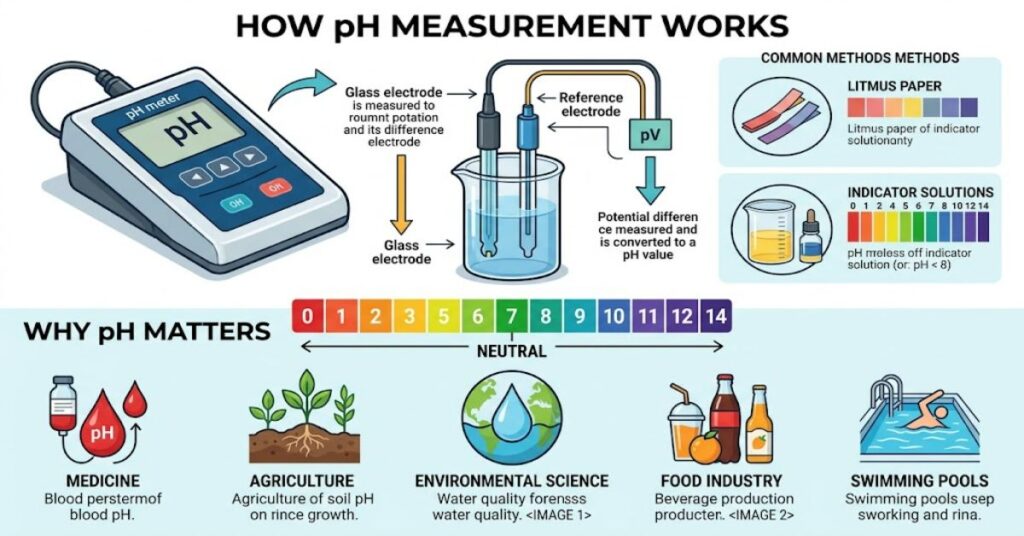
A pH metric measurement is an electrochemical method used to determine the acidity or alkalinity of a water-based solution by quantifying its hydrogen ion concentration. In practical laboratory and field work, this is normally achieved with a pH meter connected to an electrode system, most commonly a glass electrode and reference electrode.
The basic concept is straightforward. A solution with a greater effective concentration of hydrogen ions is more acidic and has a lower pH. A solution with lower hydrogen ion activity is more alkaline and has a higher pH. The familiar scale places neutral water at approximately pH 7 under standard conditions, with acidic solutions below 7 and alkaline solutions above 7. The US Environmental Protection Agency defines pH mathematically as the negative base-10 logarithm of hydrogen ion concentration in aqueous solution.
The important detail is that pH is logarithmic rather than linear. Moving from pH 7 to pH 6 does not represent a small change. It corresponds to roughly a tenfold increase in hydrogen ion concentration.
That makes pH measurement useful across many fields, including water treatment, environmental monitoring, chemistry, food production, agriculture and industrial processing.
How Does pH Measurement Work?
Modern pH meters do not simply “count” hydrogen ions. Instead, they measure an electrical potential generated by an electrochemical cell.
A typical system uses a pH-sensitive glass membrane alongside a reference electrode. When the electrode is immersed in the solution, a potential develops across the glass membrane. The meter measures the resulting electrical signal and converts it into a pH value using a calibrated relationship.
NIST describes operational pH measurement as typically involving a pH cell with a liquid junction and glass electrode. It also highlights an important metrological limitation: liquid-junction potentials and electrode behaviour mean that practical pH measurements are operational measurements rather than perfectly direct determinations of thermodynamic hydrogen-ion activity.
| Measurement element | Function | Why it matters |
| Glass electrode | Responds to hydrogen-ion activity | Produces the pH-sensitive electrical potential |
| Reference electrode | Provides a stable reference potential | Allows the meter to determine the voltage difference |
| Temperature sensor | Detects sample temperature | Supports temperature compensation |
| Buffer solution | Provides a known reference value | Used during calibration |
| Meter | Converts electrical signal into pH | Displays the final measurement |
This explains why simply inserting an electrode into a sample is not enough for reliable analytical work.
Why Calibration Is Critical
Calibration is one of the most important practical stages of pH measurement.
A pH electrode can drift because of ageing, contamination, changes in the reference junction and deterioration of the glass membrane. Temperature also affects electrode response and the relationship between pH standards and the measurement system.
The US EPA’s field pH procedure, updated on 7 November 2024, specifically addresses procedures and considerations for measuring pH in aqueous environmental media such as groundwater, surface water and certain wastewaters.
A common calibration workflow uses certified buffer solutions at known pH values. A two- or three-point calibration can establish the electrode’s response across the expected measurement range.
| Factor | Potential effect | Practical response |
| Dirty electrode | Unstable or inaccurate readings | Clean according to electrode guidance |
| Calibration drift | Systematic measurement error | Recalibrate |
| Temperature variation | Changes electrode response and sample chemistry | Measure temperature and use appropriate compensation |
| Old electrode | Slow response or unstable values | Inspect, maintain or replace |
| Poor sampling | Sample no longer represents original conditions | Standardise collection and measurement time |
The key insight is that the pH meter itself is only one part of the measurement system. Electrode condition, calibration standards and sample handling can be equally important.
Understanding the pH Scale
The pH scale is commonly presented from 0 to 14, although real solutions can fall outside that familiar range under some conditions. Neutrality is associated with pH 7 at a specified temperature, but neutral pH is temperature-dependent because the ionisation behaviour of water changes with temperature.
The logarithmic nature of pH creates a useful analytical shortcut.
| pH change | Relative hydrogen-ion concentration |
| 7 to 6 | Approximately 10× higher |
| 7 to 5 | Approximately 100× higher |
| 7 to 4 | Approximately 1,000× higher |
| 7 to 8 | Approximately 10× lower |
| 7 to 9 | Approximately 100× lower |
This is why seemingly small numerical differences can represent substantial chemical changes.
Where pH Metrics Are Used
pH measurement has applications far beyond school chemistry experiments.
In drinking-water management, pH is an important operational parameter. WHO guidance discusses pH in relation to water quality and distribution systems, including its relationship with treatment performance and corrosion-related considerations. The WHO’s 2022 guidance describes an optimal range of around 6.5–8.5 for drinking-water distribution systems in the relevant operational context.
Environmental scientists use pH measurements when assessing rivers, lakes, groundwater and wastewater. Industrial processes also depend on controlled acidity because pH can influence corrosion, chemical reactions, biological processes and treatment efficiency.
Food and beverage production provides another example. Fermentation, preservation and product consistency can depend on controlled acidity, making repeatable pH measurement part of quality control.
Risks and Limitations
A pH value should rarely be interpreted in isolation.
For example, two water samples can have identical pH readings while differing considerably in alkalinity, dissolved minerals, conductivity or contaminant concentrations. pH tells the analyst about acidity or alkalinity, but it does not provide a complete chemical profile.
Another limitation is that the simple idea of “hydrogen ion concentration” can conceal the more precise concept of hydrogen-ion activity. Modern pH metrology recognises that practical measurement is tied to defined standards and measurement procedures rather than being a perfectly direct count of free hydrogen ions.
This distinction becomes especially important in high-precision analytical chemistry.
The Future of pH Metric Measurement in 2027
By 2027, the main development in pH measurement is likely to be greater integration rather than a fundamental replacement of the glass-electrode principle.
Industrial and environmental systems increasingly combine sensors with automated monitoring, data logging and process-control platforms. The challenge will remain measurement quality. Automated data does not eliminate calibration drift, fouling or sampling errors.
The WHO’s 2024 guidance for small drinking-water supplies places increased emphasis on preventive risk management, surveillance and practical water-safety planning. That direction reinforces the value of reliable field measurements as part of broader water-quality management rather than treating a single pH result as a complete assessment.
Key Takeaways
- pH is logarithmic, so small numerical changes can represent major chemical differences.
- A glass electrode and reference system are central to conventional electrochemical pH measurement.
- Calibration is essential for dependable results.
- Temperature, contamination and electrode ageing can influence measurements.
- pH alone cannot establish whether water is safe or chemically suitable.
- Automated monitoring will increase, but sensor maintenance remains essential.

Conclusion
A pH metric provides a compact numerical way to describe acidity and alkalinity, but the measurement behind that number is more sophisticated than the familiar 0-to-14 scale suggests. Conventional pH meters rely on electrochemical potentials, glass electrodes, reference systems and calibration against defined standards.
Its value comes from versatility. The same basic measurement principle can support laboratory chemistry, environmental monitoring, water treatment, food production and industrial process control.
The biggest practical lesson is that a pH reading should be treated as a measurement system rather than merely a number on a display. Calibration, temperature, electrode condition and sample handling all influence reliability. Just as importantly, pH should be interpreted alongside other chemical and physical parameters when decisions about water quality or industrial processes are being made.
FAQ
What is a pH metric?
A pH metric is a measurement approach used to determine the acidity or alkalinity of a solution. Modern instruments commonly use an electrochemical cell containing a glass pH electrode and reference electrode.
How does a pH metric measure acidity?
It measures an electrical potential generated by the electrode system in contact with the solution. The instrument converts that potential into a pH value using calibration data.
Is pH measurement the same as measuring hydrogen ion concentration?
They are closely related but not identical in rigorous metrology. pH is more precisely associated with hydrogen-ion activity, while practical pH measurement uses defined operational standards and electrochemical procedures.
Why does pH calibration matter?
Calibration establishes the relationship between the electrode’s electrical response and known pH standards. Without suitable calibration, electrode drift and other errors can produce unreliable results.
What does a pH of 7 mean?
A pH around 7 is commonly described as neutral under standard conditions. The precise neutral point changes with temperature because water’s ionisation behaviour is temperature-dependent.
Can pH alone determine whether water is safe?
No. pH is one water-quality parameter. Assessing safety requires consideration of microbiological, chemical and physical hazards and the applicable regulatory or health-based requirements.
Methodology
This article pH Metric was prepared using authoritative technical sources from the US Environmental Protection Agency, National Institute of Standards and Technology, International Union of Pure and Applied Chemistry material indexed by NIST, and World Health Organization drinking-water guidance. The technical explanation was cross-checked against documented descriptions of electrochemical pH measurement, field procedures and water-quality applications.
No firsthand instrument testing or laboratory experiment was conducted for this article, so no fabricated testing results or personal measurement observations have been included. The main limitation is that specific electrode performance, calibration intervals and acceptable measurement uncertainty vary according to instrument design, sample matrix and analytical purpose.
Editorial disclosure: This article was drafted with AI assistance and should be reviewed and verified by the Matrics360.com editorial team before publication, including confirmation of technical claims, references and any instrument-specific guidance.
References
National Institute of Standards and Technology. (2025). pH metrology. NIST.
Pratt, K. W., Buck, R. P., Rondinini, S., Covington, A. K., Baucke, F. G. K., Brett, C. M. A., Camoes, M. F., Milton, M. J. T., Mussini, T., Naumann, R., Spitzer, P., & Wilson, G. S. (2002). Measurement of pH: Definition, standards, and procedures. Pure and Applied Chemistry, 74(11), 2169–2200.
U.S. Environmental Protection Agency. (2024). Field pH measurement. Field Branches Quality Systems and Technical Procedures.
U.S. Environmental Protection Agency. (n.d.). pH. CADDIS.
World Health Organization. (2022). Guidelines for drinking-water quality: Fourth edition incorporating the first and second addenda. World Health Organization.
World Health Organization. (2024). Guidelines for drinking-water quality: Small water supplies. World Health Organization.