
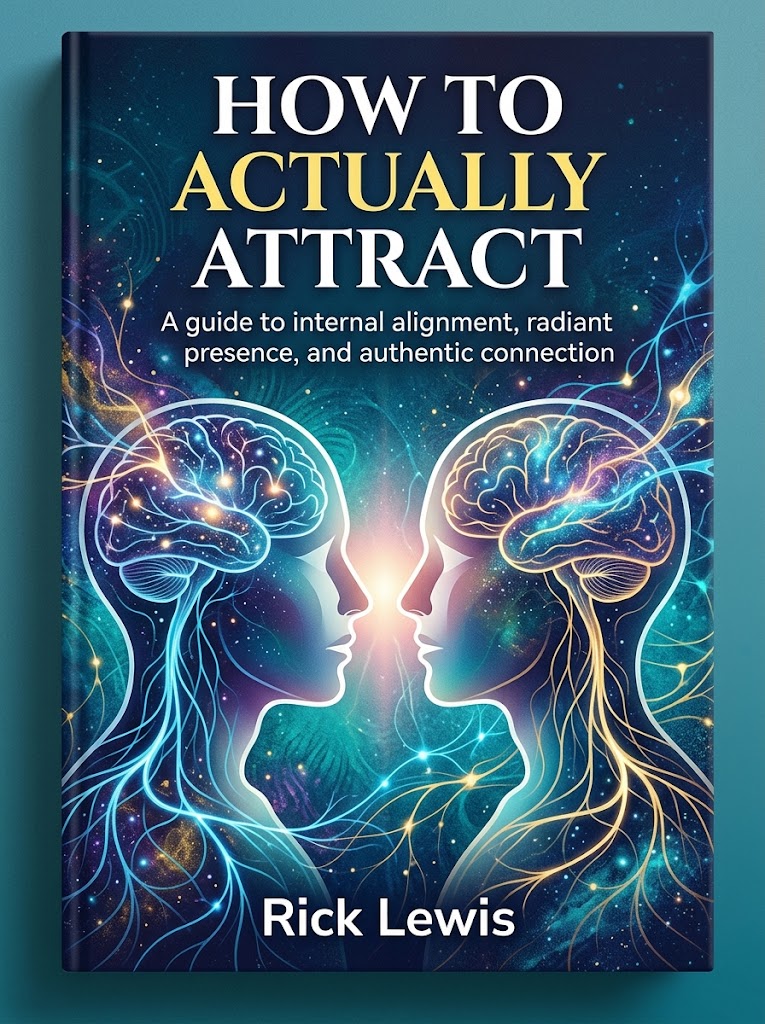
If you are searching for how to actually attract by Rick Lewis, you are likely looking for more than another guide to positive thinking. How to Actually Attract is a self-help book by Rick Lewis that approaches attraction through a combination of mindset, behaviour and internal patterns. Google Books lists the title as a 2025 publication, with an 86-page edition published under Lewis’s name.
The book positions itself against familiar manifestation advice centred on repeating affirmations, visualising an ideal future and simply maintaining positive thoughts. Instead, its published descriptions emphasise identity, perception and the patterns that influence how people act and respond.
That distinction is important. The idea of “attraction” can mean very different things. In a spiritual context, it may refer to manifestation or the Law of Attraction. In a psychological context, attraction can involve confidence, social behaviour, attention, expectations and communication.
Lewis’s approach attempts to connect these ideas into a practical framework. Whether readers accept its broader claims or not, the book is notable for trying to move the discussion away from wishful thinking and towards the relationship between internal state and observable behaviour.
What Is How to Actually Attract About?
At its core, the book asks readers to reconsider why conventional attraction techniques may not produce the results they expect.
The official description says the book explores the connection between thoughts, actions and what people experience in their lives. It also discusses changing limiting beliefs and aligning internal patterns with desired outcomes.
A useful way to understand the framework is as a sequence:
Internal state → perception → behaviour → response → feedback
For example, someone who expects rejection may behave cautiously in social situations. That behaviour can affect how others respond, which can then reinforce the original expectation. Changing the internal pattern could therefore change the behaviour and potentially alter the feedback loop.
This behavioural interpretation is easier to connect with everyday psychology than the idea that thoughts alone magically produce external events.
How Lewis Differs From Traditional Manifestation Advice
Traditional Law of Attraction content often focuses on visualisation, affirmations, positive thinking and maintaining a particular emotional state.
Lewis’s published material takes a different position. The book’s descriptions repeatedly emphasise deeper internal mechanisms rather than simply telling readers to “think positive”.
| Approach | Main emphasis | Practical focus |
| Traditional manifestation | Positive thoughts | Affirmations and visualisation |
| Lewis’s framework | Internal patterns | Awareness and behavioural change |
| Behavioural psychology | Observable behaviour | Habits and responses |
| Goal setting | Desired outcomes | Planning and action |
This does not mean Lewis’s framework replaces psychology or scientifically established behavioural methods. Instead, readers can view it as a self-help model that uses psychological language to explain attraction and personal change.
The Role of Identity and Perception
One of the recurring ideas associated with the book is that identity affects behaviour.
Consider two people applying for the same opportunity. One sees themselves as capable and expects to be taken seriously. The other assumes they are unlikely to succeed. Their preparation may be similar, but their communication, persistence and willingness to pursue opportunities can differ.
The book’s published descriptions similarly emphasise identity, perception and internal patterns as factors that shape how people interact with reality.
This provides one of the more practical ways to interpret the attraction concept. Instead of asking only, “What do I want?”, readers can ask, “What patterns currently influence the way I pursue it?”
Nervous System Regulation and Behaviour
The supplied brief describes the book as incorporating nervous system regulation and behavioural feedback loops.
This is an important distinction because emotional states can influence decision-making and social behaviour. Someone who feels threatened or highly anxious may avoid risks, communicate differently or interpret ambiguous situations negatively.
That does not establish a supernatural attraction mechanism. It does suggest a practical relationship between internal state and behaviour.
The strongest interpretation of this part of the framework is therefore behavioural: changing how someone regulates themselves may change how they act, and changed actions can produce different responses from other people.
What the Book Does Not Prove
A balanced review should separate self-help claims from scientific evidence.
How to Actually Attract presents a particular framework for understanding attraction. Its existence as a published book is verifiable, but that does not mean every claim within a self-help framework has been independently established by scientific research.
This distinction matters because terms such as “energy”, “alignment” and “attraction” can be used metaphorically or scientifically. Readers should not automatically treat them as evidence that thoughts directly control external events.
The most useful approach is to test the ideas against observable behaviour: Does a change in confidence affect communication? Does changing a recurring habit alter decisions? Does becoming more socially engaged create more opportunities?
Those questions can be explored without assuming supernatural causation.
Is How to Actually Attract Worth Reading?
The answer depends on what you want from it.
If you want a conventional Law of Attraction book based mainly on affirmations and visualisation, Lewis’s approach may feel different. Published descriptions explicitly position the book as an alternative to surface-level techniques.
If you are interested in self-reflection, behaviour and the relationship between internal beliefs and external actions, its framework may be more relevant.
The book is also relatively short. Google Books lists the 2025 edition at 86 pages, making it a compact introduction rather than a large academic treatment of psychology.
The Future of How to Actually Attract in 2027
By 2027, interest in manifestation and psychology-based self-help is likely to continue, but readers may increasingly demand clearer distinctions between evidence-based psychology and personal-development philosophy.
That distinction could benefit books such as How to Actually Attract. Concepts such as habits, self-perception and behavioural feedback can be discussed using established psychological research, while broader manifestation claims should remain clearly identified as philosophical or self-help ideas.
The future value of the book will therefore depend partly on how readers interpret its framework: as a literal explanation of reality, or as a practical model for examining patterns that influence behaviour.
Key Takeaways
- How to Actually Attract was published by Rick Lewis in 2025.
- The book challenges simple manifestation techniques such as forced positivity and visualisation.
- Identity and perception are central themes in its published descriptions.
- Behaviour provides a practical bridge between internal beliefs and external outcomes.
- Nervous-system regulation is part of the framework described in the supplied brief.
- The book should be understood as self-help rather than automatically treated as scientific evidence.
Conclusion
How to Actually Attract by Rick Lewis takes a different route through a subject that is often dominated by manifestation language. Rather than focusing exclusively on wishes, affirmations or visualisation, its published descriptions emphasise identity, perception, internal patterns and behaviour.
That makes the book particularly interesting when attraction is interpreted through observable human behaviour. Confidence can affect communication. Expectations can influence decisions. Repeated behaviours can create feedback loops. These ideas provide a practical lens through which readers can examine their own patterns.
At the same time, readers should maintain a clear boundary between useful self-reflection and claims that require scientific evidence. The book offers a particular framework, not proof that thoughts alone control external reality.
For anyone researching the title, that distinction provides the clearest starting point: read Lewis’s ideas as a self-development framework, examine which concepts translate into practical behaviour, and evaluate broader claims critically.
Frequently Asked Questions
What is How to Actually Attract by Rick Lewis?
It is a self-help book focused on attraction, internal patterns, identity, perception and behaviour. Google Books lists an 86-page 2025 edition by Rick Lewis.
Is How to Actually Attract about the Law of Attraction?
It addresses attraction and manifestation but positions itself as an alternative to approaches based mainly on positive thinking, visualisation and affirmations.
What does Rick Lewis say about attraction?
The book’s published descriptions focus on internal patterns, identity, perception and actions rather than simply trying to maintain positive thoughts.
Does the book focus on psychology?
Yes. Its descriptions frame attraction around internal mechanisms and behavioural change, while the supplied brief specifically identifies psychology and nervous-system regulation as key elements.
Is How to Actually Attract scientifically proven?
The book is a self-help publication. Its framework should not automatically be treated as scientifically established. Individual psychological concepts may have research support, but broader manifestation claims require separate evidence.
How long is How to Actually Attract?
Google Books lists an edition at 86 pages.
Methodology
This article was based primarily on the supplied Matrics360 editorial brief and publicly available bibliographic and publisher descriptions of How to Actually Attract. Google Books was used to verify the book’s title, author, publication year and length, while publisher and audiobook descriptions were used to identify the book’s stated themes. No firsthand testing of the book’s methods was conducted, so no invented experience or outcome has been presented as evidence.
References
Lewis, R. (2025). How to actually attract: How attraction really works. Rick Lewis.
Rick Lewis. (2025). How to actually attract. Official book website.
Apple Books. (2026). How to actually attract, Part 1: Master the unseen laws that shape real attraction.