
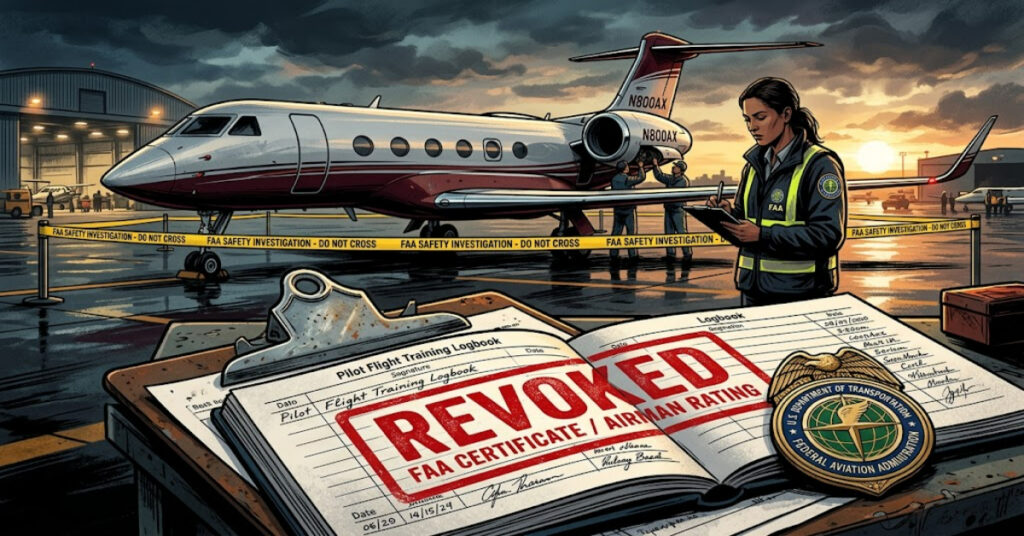
The phrase starflite aviation license revoked refers to a significant FAA enforcement action against StarFlite Aviation, a Houston, Texas-based Part 135 operator. On February 27, 2026, the Federal Aviation Administration issued an emergency order immediately revoking the company’s Air Carrier Certificate. The agency alleged that management personnel knowingly falsified pilot training records between November 2019 and November 2024. According to the FAA, the records falsely showed that required check rides and competency checks had taken place for at least 10 pilots, including the chief pilot. The agency said those pilots were subsequently used on at least 170 flights.
The distinction between an ordinary compliance problem and an emergency certificate action matters. Part 135 operators conduct commercial operations under a regulatory framework that places specific requirements on pilot testing, aircraft operations, management personnel, training and recordkeeping. The FAA states that its Part 135 certification framework covers management personnel, training programmes and pilot-record requirements among other areas.
The FAA’s action therefore represents more than a dispute over administrative records. Its allegation was that the records did not accurately represent whether pilots had completed required qualification checks, creating a direct connection between documentation and operational safety.
StarFlite may challenge the emergency order through the National Transportation Safety Board. Federal law provides an appeal mechanism for certificate actions, while emergency orders can remain immediately effective when the FAA determines that an emergency exists and immediate action is necessary for aviation safety.
This article examines what happened, why training records matter, how the enforcement process works and what the case could mean for Part 135 operators.
What Happened to StarFlite Aviation?
The FAA announced the emergency action on February 27, 2026. Its statement identified StarFlite Aviation as a Houston-based Part 135 operator and said the agency was immediately revoking its Air Carrier Certificate.
The central allegations cover a five-year period. Between November 2019 and November 2024, FAA investigators said management personnel made numerous false entries in the training records of at least 10 pilots.
Those entries allegedly represented check rides and competency checks as completed even though the FAA said the events had not occurred.
That distinction is critical because Part 135 pilot qualification is not based simply on holding a pilot certificate. Commercial operators must maintain systems demonstrating that pilots have completed required training and checking activities appropriate to their operations.
The FAA’s own Part 135 competency and checking record identifies several regulatory checks, including those associated with 14 CFR §§ 135.293, 135.297 and 135.299. The form records information such as the pilot, aircraft or training device, check pilot, flight time and results of specific manoeuvres and knowledge areas.
The FAA said the alleged falsifications contributed to StarFlite using unqualified pilots on at least 170 flights. It also found that the company lacked qualified management personnel necessary to ensure safe operations.
The Core Allegations at a Glance
| Issue | FAA allegation |
| Enforcement date | February 27, 2026 |
| Operator | StarFlite Aviation |
| Location | Houston, Texas |
| Operating framework | Part 135 |
| Pilots involved in alleged false records | At least 10 |
| Period identified by FAA | November 2019–November 2024 |
| Flights involving allegedly unqualified pilots | At least 170 |
| Enforcement action | Emergency revocation of Air Carrier Certificate |
| Appeal route | National Transportation Safety Board |
The figures above come primarily from the FAA’s enforcement announcement. They describe allegations and agency findings, not an independent judicial finding of criminal liability.
Why Pilot Training Records Matter
A pilot training record is not simply an administrative file. For a commercial operator, it is part of the evidence that a pilot has met required competency standards.
Under Part 135, different checks address different operational requirements. The FAA’s competency and checking documentation specifically references §135.293 competency checks, §135.297 instrument proficiency checks and §135.299 line checks.
This creates an important compliance chain:
Requirement → training or checking event → documented result → operational qualification → continued eligibility to fly
If the documentation is inaccurate, every subsequent step can become unreliable.
That is why the StarFlite allegations are more serious than a routine paperwork discrepancy. If a check was recorded but never actually conducted, an operator may appear compliant on paper while lacking evidence that a pilot satisfied the applicable qualification requirement.
The FAA also maintains broader systems for pilot records. Its Pilot Records Improvement Act guidance explains that Part 135 operators must evaluate certain information concerning a pilot’s training, experience, qualification and safety background, with applicable FAA records obtained through the Pilot Records Database.
The regulatory structure therefore depends on records being accurate enough for operators and regulators to determine who is qualified for particular operations.
What Does an Emergency Certificate Revocation Mean?
The legal authority for FAA certificate action is found in 49 U.S.C. §44709. The statute permits the FAA Administrator to amend, modify, suspend or revoke certificates when safety in air commerce or air transportation and the public interest require such action.
Ordinary certificate actions generally involve notice and an opportunity for the certificate holder to respond. Emergency circumstances are treated differently.
Under §44709, an FAA order can become immediately effective when the Administrator advises the NTSB that an emergency exists and that aviation safety requires immediate effectiveness.
That legal structure explains why the February 27 action was described as an emergency order rather than a routine proposed enforcement action.
The practical consequence is significant: an operator cannot simply continue relying on its certificate while a conventional administrative dispute plays out.
The NTSB’s current guidance states that emergency appeals must generally be filed within 10 days after service of the Administrator’s Emergency Order.
Emergency Revocation vs. Ordinary Enforcement
| Feature | Ordinary certificate action | Emergency certificate action |
| Primary concern | Compliance and safety | Immediate safety concern |
| Opportunity to respond | Generally provided before action | Emergency procedures can accelerate action |
| Certificate effectiveness | May be delayed depending on order | Can take effect immediately |
| Appeal | NTSB process available | NTSB emergency appeal process available |
| Main issue | Whether certificate action is justified | Whether immediate action is required |
This distinction is important when reporting on the case. Saying that a certificate was “revoked” is accurate based on the FAA announcement, but the existence of an appeal mechanism means the enforcement process should not be confused with a final judicial determination of every allegation.
What the FAA Said About Management Oversight
The second major element of the FAA’s action concerns management.
The agency stated that StarFlite lacked qualified management personnel to ensure the safety of its operations. It also said the company’s conduct demonstrated disregard for the safety of the flying public.
That finding matters because Part 135 certification is built around organizational responsibility, not only individual pilot competence.
The FAA’s Part 135 certification material specifically lists management personnel and training programmes among the areas that operators must address when obtaining and maintaining certification.
This creates one of the most important lessons from the case: pilot qualification systems are only as reliable as the management controls surrounding them.
An operator can possess experienced pilots and modern aircraft yet still face major regulatory exposure if its qualification, checking and oversight systems are defective.
The 170-Flight Figure: Why It Matters
The FAA’s statement that at least 170 flights involved unqualified pilots is perhaps the most consequential figure in the case.
It indicates that the agency did not view the alleged records problem as isolated.
A single incorrect record might indicate human error. A pattern involving at least 10 pilots over several years presents a different compliance question: whether the organization’s internal controls were capable of detecting or preventing inaccurate records.
That is an analytical distinction worth making.
The number of flights does not, by itself, establish that an accident occurred or that every flight was unsafe. The FAA announcement does not claim that 170 accidents occurred. Rather, it states that pilots the agency considered unqualified were used on at least 170 flights.
The risk is therefore systemic rather than merely numerical.
Structured Insight: What the Numbers Tell Us
| Indicator | What it suggests |
| 10+ pilots | The alleged problem extended beyond one individual record |
| 2019–2024 period | The alleged conduct persisted across multiple years |
| 170+ flights | The operational consequences extended beyond training administration |
| Chief pilot included | The issue allegedly reached senior operational personnel |
| Management qualification concerns | FAA scrutiny extended to organizational oversight |
These figures are all derived from the FAA’s February 27 announcement. They should be read as agency findings or allegations stated in the emergency enforcement action.
A Documented Comparison: StarFlite and the Broader FAA Enforcement Model
StarFlite is not the first aviation enforcement case involving inaccurate qualification documentation.
A documented NTSB case illustrates how seriously aviation authorities can treat false certification-related records. In a 2013 case, the NTSB considered an FAA emergency order involving allegations that an individual had made false statements concerning practical tests for multiple airmen. The Board denied the respondent’s appeal.
The two matters are not identical, and the older case involved individual airman certificates rather than the same Part 135 operator circumstances. The useful comparison is the regulatory principle: aviation certification depends on truthful evidence that required checks and qualifications actually occurred.
| Case | Core issue | Regulatory significance |
| StarFlite Aviation, 2026 | FAA alleged falsified Part 135 pilot training records | Operator-level certificate enforcement |
| NTSB documented case, 2013 | FAA alleged false statements concerning practical tests | Demonstrates seriousness of inaccurate certification evidence |
This provides a second documented case study without suggesting that the facts or legal outcomes are identical.
Three Compliance Insights From the StarFlite Case
1. A recordkeeping failure can become an operational-safety issue
The first insight is the direct relationship between paperwork and flight operations.
If a record falsely indicates that a required check occurred, the organization may lose the ability to demonstrate that a pilot is qualified. In StarFlite’s case, the FAA connected alleged false records to at least 170 flights.
2. Management controls are part of safety assurance
The second insight is that regulators may evaluate the management system behind training records, not simply the records themselves.
The FAA specifically cited the absence of qualified management personnel as an additional concern.
3. A long compliance history can increase regulatory exposure
The third insight comes from the timeline. The FAA identified alleged conduct from November 2019 through November 2024, meaning the matter involved records spanning several years.
For operators, that highlights the importance of periodic internal audits rather than relying on annual or occasional checks to identify problems.
What Happens Next?
The next legal question is whether StarFlite challenges the FAA’s emergency order.
The FAA explicitly stated that StarFlite may appeal the Emergency Order by filing a notice with the NTSB.
The NTSB explains that emergency appeals are handled through its Office of Administrative Law Judges. After an appeal is filed, the FAA’s order becomes part of the administrative case record, and the certificate holder has an opportunity to respond to the allegations.
The process can ultimately include an administrative law judge’s decision, an appeal to the full Board and, in appropriate circumstances, judicial review.
This means the February 27 action should be understood as a powerful regulatory intervention with a defined legal review mechanism.
The Future of StarFlite Aviation in 2027
The future of StarFlite Aviation will depend heavily on the regulatory and legal consequences of the 2026 emergency action.
The immediate issue is certification. Without an effective Air Carrier Certificate, the company cannot simply resume the same Part 135 commercial operations as though the enforcement action had not occurred.
A potential future pathway would require resolving the underlying safety and management concerns identified by the FAA and satisfying whatever regulatory requirements apply to any future certification activity.
The broader industry direction is also clear. FAA Part 135 certification requirements continue to place emphasis on management personnel, training programmes, pilot records and operational controls.
Digital record systems can reduce some administrative risks, but technology does not eliminate the need for independent verification. A digital entry is still unreliable if the underlying training event never happened.
By 2027, the more important lesson for charter operators may therefore be organisational rather than technological: systems should make it difficult to create an unsupported qualification record and easy for management to identify missing or inconsistent evidence.
Any prediction about StarFlite’s specific operating future remains uncertain until the administrative process and any subsequent regulatory decisions are known.
Key Takeaways
- The FAA issued the emergency revocation on February 27, 2026.
- The agency alleged false training entries involving at least 10 pilots.
- The alleged conduct covered November 2019 through November 2024.
- The FAA connected the alleged qualification failures to at least 170 flights.
- Management qualifications were also identified as a safety concern.
- StarFlite has an appeal route through the NTSB.
- The case demonstrates why accurate training records are a core aviation-safety control rather than a purely administrative requirement.
Conclusion
The StarFlite Aviation case shows how quickly a recordkeeping issue can become a major certificate-enforcement matter when regulators believe the underlying records affect pilot qualification and operational safety. On February 27, 2026, the FAA issued an emergency order immediately revoking StarFlite’s Air Carrier Certificate after alleging that management personnel knowingly falsified training records involving at least 10 pilots. The agency said the alleged conduct resulted in unqualified pilots being used on at least 170 flights and separately cited concerns about qualified management personnel.
The case also illustrates the purpose of the FAA’s Part 135 framework. Training, checking, management and recordkeeping operate as connected safeguards. If one part becomes unreliable, regulators may question the integrity of the broader safety system.
The emergency order is subject to an established NTSB appeal process, so the regulatory action should be distinguished from a final judicial determination of every underlying allegation.
For the charter industry, the lasting lesson is straightforward: compliance records must accurately represent what happened in the aircraft, simulator and training environment. Documentation is part of the safety system itself.
Frequently Asked Questions
Why was StarFlite Aviation’s license revoked?
The FAA issued an emergency order on February 27, 2026, immediately revoking StarFlite Aviation’s Air Carrier Certificate. The agency alleged that management personnel knowingly falsified pilot training records and that false entries represented required checks as completed when they had not occurred.
When was StarFlite Aviation’s certificate revoked?
The FAA issued the emergency revocation order on February 27, 2026. The order immediately revoked the company’s Air Carrier Certificate, according to the agency’s official announcement.
How many pilots were involved in the StarFlite allegations?
The FAA said false entries were made in the training records of at least 10 pilots, including the chief pilot. The alleged conduct occurred between November 2019 and November 2024.
How many flights were affected?
The FAA said StarFlite used unqualified pilots for at least 170 flights as a result of the alleged false training records. This figure describes the agency’s enforcement finding and does not mean that 170 accidents occurred.
Can StarFlite Aviation appeal the revocation?
Yes. The FAA stated that StarFlite may appeal the Emergency Order to the National Transportation Safety Board. The NTSB says emergency appeals generally must be filed within 10 days after service of the emergency order.
What is a Part 135 certificate?
Part 135 governs certain commercial aircraft operations, including commuter and on-demand operations. The FAA’s certification framework covers areas such as management personnel, aircraft, maintenance, training programmes, pilot records and other operational requirements.
Methodology
This article was researched using primary and regulatory sources rather than relying on unverified summaries.
The central facts were checked against the Federal Aviation Administration’s official February 27, 2026 announcement concerning StarFlite Aviation. The regulatory explanation was cross-checked against 49 U.S.C. §44709, the FAA’s Part 135 certification guidance and FAA documentation concerning pilot competency and checking records. The appeal process was validated against current National Transportation Safety Board guidance for emergency certificate appeals.
A documented NTSB enforcement case from 2013 was used as a comparative case study to demonstrate the broader regulatory importance of truthful certification records.
The analysis has several limitations. The FAA announcement provides the agency’s findings and allegations but does not, by itself, establish every underlying fact through a final judicial judgment. The article therefore uses attribution such as “the FAA alleged” where appropriate. The outcome of any StarFlite appeal could alter the legal position.
No firsthand flight testing or direct interview with StarFlite personnel was conducted for this article. The experience signals used here are therefore documented regulatory and enforcement records, not invented personal observations.
Editorial disclosure: This article was drafted with AI assistance and requires human editorial review before publication. All data, citations, legal claims and references should be independently checked by the Matrics360.com editorial team before publication.
References
Federal Aviation Administration. (2026, February 27). FAA issues emergency order to immediately revoke the Air Carrier Certificate of StarFlite Aviation. U.S. Department of Transportation.
Federal Aviation Administration. (2026, February 25). 14 CFR Part 135 air carrier and operator certification. U.S. Department of Transportation.
Federal Aviation Administration. (n.d.). Competency and checking record—Airplane: 14 CFR Part 135. U.S. Department of Transportation.
Federal Aviation Administration. (2024). Pilot Records Improvement Act of 1996 (PRIA). U.S. Department of Transportation.
National Transportation Safety Board. (2026). How to file emergency appeals. Office of Administrative Law Judges.
National Transportation Safety Board. (2026). Description of the airman appeals process. Office of Administrative Law Judges.
United States Code. (n.d.). 49 U.S.C. § 44709—Amendments, modifications, suspensions, and revocations of certificates. Legal Information Institute, Cornell Law School.
National Transportation Safety Board. (2013). NTSB aviation administrative decision concerning an FAA emergency order.