
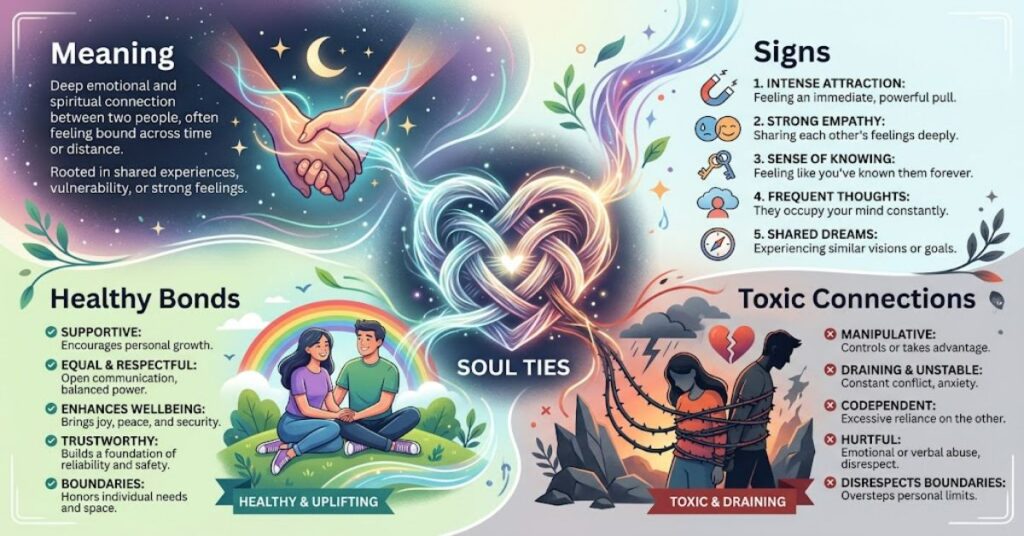
The phrase soul ties is commonly used to describe a powerful connection between two people. Depending on the context, it can refer to an emotional, mental, physical or spiritual bond that feels unusually difficult to break. Some people use the term positively for a relationship built on trust and mutual respect, while others use it to describe a connection that remains distressing long after a relationship has ended.
There is an important distinction, however. “Soul tie” is not a formal psychological diagnosis or established clinical category. Mental-health research instead uses concepts such as attachment, interpersonal dependency, emotional regulation and relationship quality to explain why certain relationships can feel exceptionally powerful.
That distinction does not make someone’s experience unreal. A person can genuinely feel deeply connected to another individual and struggle to move forward after separation. The useful question is what is creating that intensity and whether the relationship supports healthy functioning.
Research on adult attachment has repeatedly examined how patterns of security, anxiety and avoidance can influence close relationships. Attachment theory therefore provides a more evidence-based framework for understanding experiences that people may describe using spiritual language.
What Are Soul Ties?
A soul tie is generally described as an unusually deep bond between two people. The concept appears frequently in religious discussions, relationship advice and popular culture.
The meaning varies considerably. Some interpretations describe a healthy connection based on affection, loyalty and shared experiences. Others associate it with unhealthy attachment, especially when someone feels unable to function independently after a relationship ends.
| Type of connection | Common experience | Healthy potential |
| Emotional | Strong affection and attachment | High |
| Mental | Frequent thoughts about another person | Depends on intensity |
| Physical | Bond associated with intimacy | Depends on circumstances |
| Spiritual | Shared beliefs or perceived spiritual connection | Depends on beliefs |
| Unhealthy dependency | Fear, control or inability to detach | Low |
The key issue is not whether a connection feels powerful. It is whether the relationship allows both people to retain autonomy, dignity and appropriate boundaries.
Soul Ties and Attachment
Attachment research offers one of the strongest evidence-based ways to understand intense relationships.
People with secure attachment tendencies generally find it easier to trust others while maintaining independence. Anxious attachment can involve heightened concern about rejection or abandonment, while avoidant patterns can involve discomfort with emotional closeness.
These patterns do not automatically determine how someone will behave. Relationships are influenced by personal history, circumstances and the behaviour of both partners.
This creates an important practical insight: an intense bond should not automatically be interpreted as proof that two people are spiritually destined to remain together. Emotional intensity can arise from several psychological mechanisms.
Healthy vs. Toxic Connections
A healthy relationship does not require emotional distance. Deep attachment can coexist with independence.
Healthy connections commonly include:
- Mutual respect
- Honest communication
- Appropriate personal boundaries
- Emotional support
- Shared responsibility
- Freedom to maintain friendships and interests outside the relationship
Unhealthy connections can look different. A partner may use guilt, threats, isolation or manipulation to maintain control. In such situations, describing the relationship as a “soul tie” can sometimes obscure the more concrete issue: harmful behaviour.
The National Domestic Violence Hotline describes emotional abuse as behaviour used to control, isolate or frighten another person. That framework is more useful for identifying danger than relying on spiritual labels alone.
Signs a Deep Bond May Be Unhealthy
Intensity itself is not evidence of toxicity. Several patterns are more informative.
Loss of independence: Your choices increasingly revolve around another person, even when doing so harms your work, friendships or wellbeing.
Persistent fear: You constantly worry that disagreement or distance will cause abandonment.
Boundary violations: You repeatedly communicate limits, but they are ignored.
Emotional manipulation: Guilt, threats or deliberate withdrawal are used to control your behaviour.
Inability to accept separation: You believe you cannot have a meaningful life without one particular person.
Repeated relationship cycles: Conflict, reconciliation and renewed conflict become a predictable pattern.
These signs should be assessed in context. A difficult breakup can temporarily produce strong emotions without meaning that someone has a permanent unhealthy attachment.
Why Some Connections Feel Impossible to Break
A relationship combines memories, routines, expectations and emotional experiences. When it ends, the person is not only losing another individual. They may also lose a daily routine, social environment and imagined future.
This helps explain why separation can feel physically and emotionally disruptive.
One useful way to understand the process is to separate the person from the pattern:
| Question | What it can reveal |
| Do I miss the person or the routine? | Nature of the attachment |
| Can I maintain normal activities? | Functional impact |
| Are my boundaries respected? | Relationship health |
| Do I fear being alone? | Possible dependency |
| Can I maintain other relationships? | Degree of autonomy |
This approach produces more actionable information than simply asking whether two people have a “soul connection.”
Spiritual Interpretations
For people who use spiritual or religious frameworks, a soul tie may carry a meaning that psychology does not attempt to address.
Some Christian teachings and contemporary religious discussions use the concept to describe powerful relational bonds. Other traditions may have their own language for relationships that feel spiritually significant.
The important distinction is between personal belief and established clinical evidence. A spiritual interpretation can be meaningful to an individual without being treated as a scientific diagnosis.
That distinction also protects people from unnecessarily labelling ordinary grief, attraction or attachment as something mysterious or permanent.
Practical Ways to Handle an Unhealthy Attachment
If a relationship continues to cause distress, practical boundaries are often more useful than trying to determine whether the connection is metaphysically permanent.
Start by identifying specific behaviours. Write down what happens rather than only describing how the relationship feels.
Next, examine boundaries. Can you say no without facing intimidation, punishment or manipulation?
It can also help to rebuild independent routines. Time with friends, family, work, exercise and hobbies can reduce the sense that one relationship defines your entire identity.
Where distress remains severe or persistent, a qualified mental-health professional can help examine attachment patterns, grief, anxiety or other relevant concerns.
Three Evidence-Based Insights
1. Intensity is not the same as health. A relationship can feel extraordinary while still containing controlling or damaging behaviour.
2. Labels can hide mechanisms. Calling something a soul tie may describe an experience, but attachment, dependency, grief and interpersonal behaviour provide more specific concepts for understanding it.
3. Independence is an important test. A healthy bond can be emotionally significant without eliminating a person’s ability to make decisions, maintain other relationships or function alone.
The Future of Soul Ties in 2027
Interest in relationship psychology and spiritual language is likely to remain strong through 2027, particularly as social platforms continue turning psychological terminology into everyday vocabulary.
The main challenge will be distinguishing popular relationship language from clinical evidence. Terms can spread quickly online even when they have no formal diagnostic meaning.
Future relationship content will likely benefit from combining cultural and spiritual perspectives with established research on attachment, communication and emotional wellbeing. That approach allows people to respect personal beliefs without presenting them as scientific facts.
The broader trend is already visible: consumers increasingly want accessible explanations of psychological concepts, but responsible publishers must distinguish evidence, interpretation and personal belief.
Key Takeaways
- A soul ties is a popular description, not a formal psychological diagnosis.
- Deep attachment can be healthy when both people retain autonomy.
- Manipulation and coercive control are more important warning signs than relationship intensity.
- Attachment theory provides a useful evidence-based framework.
- Breakup distress can involve loss of routines and an imagined future.
- Spiritual interpretations can coexist with psychological explanations.
- Professional support can help when attachment seriously affects daily functioning.
Frequently Asked Questions
What is a soul ties in a relationship?
It generally refers to a deep emotional, physical, mental or spiritual bond between two people. The term is popular rather than a formal clinical diagnosis.
Can soul ties be healthy?
Yes, when the phrase is being used to describe a close relationship involving mutual respect, trust, independence and healthy boundaries.
What are signs of an unhealthy soul tie?
Possible warning signs include excessive dependency, fear, manipulation, repeated boundary violations, isolation from others and an inability to function independently.
Can you have a soul tie with an ex?
People may use the term to describe lingering emotional attachment after a breakup. Psychology would generally examine this through concepts such as attachment, grief and relationship dependency rather than a soul-tie diagnosis.
How do you break an unhealthy emotional attachment?
Identify harmful patterns, establish clear boundaries, reduce unhealthy contact where appropriate, rebuild independent routines and seek professional support when distress becomes difficult to manage.
Is a soul tie a psychological diagnosis?
No. “Soul tie” is not a recognised formal psychological diagnosis. Mental-health professionals may instead assess attachment, anxiety, dependency, trauma or relationship dynamics.
Conclusion
The idea of a soul tie resonates because people sometimes experience relationships that feel deeper and more persistent than ordinary attraction. The emotions can be genuine, but the label itself does not explain why a connection feels so powerful.
Psychological concepts such as attachment, dependency, grief and emotional regulation provide more precise ways to understand these experiences. They also make it easier to distinguish a supportive relationship from one involving manipulation or loss of independence.
A healthy bond does not require two people to surrender their individuality. Trust, affection and closeness can exist alongside boundaries, separate friendships and personal decision-making. When a relationship instead produces fear, isolation or repeated boundary violations, those concrete behaviours deserve attention regardless of the spiritual language used to describe the connection.
For readers who understand relationships through faith or spirituality, the concept can remain personally meaningful. The strongest approach is simply to separate belief from clinical fact while focusing on respect, safety and wellbeing.
Methodology
This article treats “soul tie” as a popular spiritual and relationship term rather than a clinical diagnosis. The analysis draws on established relationship and attachment concepts and distinguishes those concepts from spiritual interpretations.
No firsthand relationship experiment, interview or clinical assessment was conducted for this article. Consequently, no invented personal observations or practitioner claims have been included. Readers experiencing significant relationship distress should seek guidance from an appropriately qualified professional.
The article should receive human editorial review before publication, including verification of all cited research and any claims concerning mental-health conditions or relationship abuse.
Editorial disclosure: This article was drafted with AI assistance and should be reviewed and verified by the Matrics360.com editorial team before publication.
References
Mikulincer, M., & Shaver, P. R. (2016). Attachment in adulthood: Structure, dynamics, and change (2nd ed.). Guilford Press.
World Health Organization. (2022). World mental health report: Transforming mental health for all. World Health Organization.
National Domestic Violence Hotline. (n.d.). What is emotional abuse? The National Domestic Violence Hotline.