
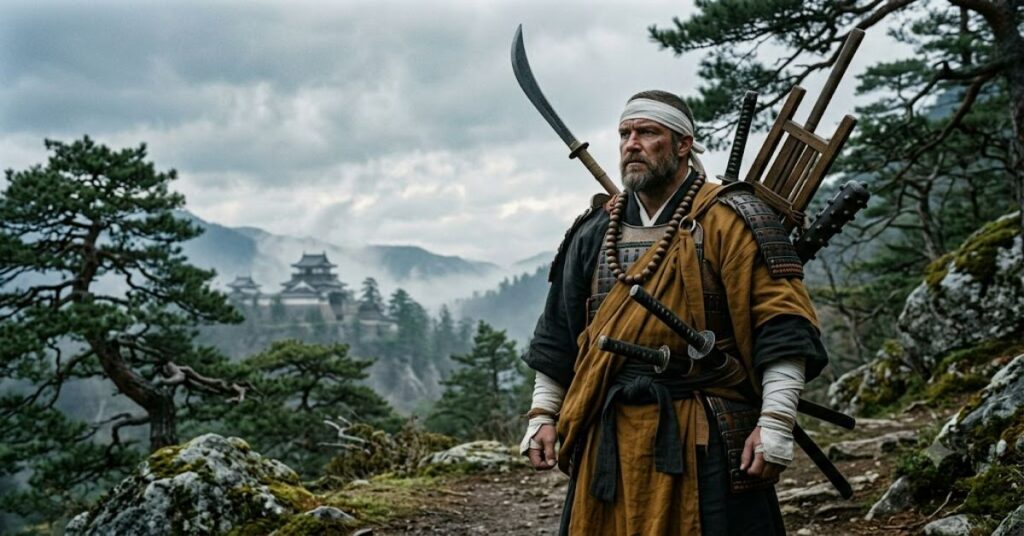
Among Japan’s legendary heroes, few figures command as much admiration as Benkei. Known formally as Saitō Musashibō Benkei (1155–1189), he was a warrior monk (sōhei) whose immense strength, mastery of numerous weapons, and absolute loyalty to the famous samurai Minamoto no Yoshitsune secured his place in Japanese history and folklore.
Although historians agree that Benkei was a real person who lived during the late Heian period, many of the stories surrounding him blend historical facts with centuries of legends. This mixture has made him one of Japan’s most enduring folk heroes. Whether portrayed in traditional Noh plays, Kabuki performances, ukiyo-e artwork, manga, anime, or video games, Benkei consistently represents unwavering loyalty and fearless determination.
His story is not merely about battles. It explores themes that have shaped Japanese culture for centuries: personal honor, duty above self-interest, resilience in adversity, and the willingness to sacrifice everything for one’s beliefs.
Understanding Benkei requires separating documented history from legendary embellishments while appreciating why these myths became so influential. His tale remains relevant today because it reflects timeless human values that transcend historical periods and cultural boundaries.
Who Was Benkei?
Saitō Musashibō Benkei was born in 1155, during Japan’s turbulent late Heian period, a time marked by political instability and fierce rivalry among powerful clans.
According to tradition, his extraordinary appearance inspired legends from childhood. Stories describe him as unusually large, exceptionally strong, and possessing remarkable physical endurance. Some tales even claimed he was the child of a demon or mountain spirit, though historians regard these stories as symbolic rather than factual.
Benkei eventually entered Buddhist monastic life, becoming one of Japan’s warrior monks. Unlike ordinary monks devoted solely to religious practice, sōhei often protected temples, participated in regional conflicts, and received military training.
His reputation as a formidable fighter grew rapidly, especially because of his expertise with the naginata, a pole weapon commonly associated with warrior monks. Legends later expanded his skills to include nearly every known weapon of medieval Japan.
The Warrior Monks of Medieval Japan
To appreciate Benkei’s significance, it is important to understand the role of warrior monks.
What Were Sōhei?
Sōhei were Buddhist monks who combined religious responsibilities with military service. During the Heian period, powerful temples maintained armed forces to protect their lands, political influence, and religious institutions.
Unlike modern perceptions of peaceful monastic life, many temples possessed significant military power.
Warrior monks participated in:
- Temple defense
- Regional conflicts
- Political demonstrations
- Escort missions
- Protection of valuable religious properties
Their presence reflected the close relationship between religion and politics in medieval Japan.
The Famous Encounter with Minamoto no Yoshitsune
The defining moment of Benkei’s life came through his meeting with Minamoto no Yoshitsune, one of Japan’s greatest military commanders.
According to popular legend, Benkei challenged every swordsman who crossed Kyoto’s Gojo Bridge, collecting their swords as trophies. After defeating 999 warriors, he encountered Yoshitsune, who was still a young man.
Despite Benkei’s immense size and strength, Yoshitsune’s exceptional speed and agility allowed him to win the duel.
Recognizing extraordinary talent when he saw it, Benkei pledged lifelong service to Yoshitsune.
Whether the bridge duel occurred exactly as described remains uncertain. However, historical evidence confirms that Benkei became Yoshitsune’s trusted retainer and closest companion.
Why This Story Endures
The bridge duel symbolizes several enduring ideals:
| Legendary Theme | Meaning |
| Accepting defeat with honor | True strength includes humility. |
| Loyalty after rivalry | Respect can overcome competition. |
| Service over pride | Great leaders inspire devotion rather than fear. |
| Personal transformation | Defeat can become the beginning of greatness. |
These themes explain why the story remains popular after more than eight centuries.
Benkei During the Genpei War
The Genpei War (1180–1185) reshaped Japanese history by determining control of the nation between the Minamoto and Taira clans.
Benkei fought alongside Yoshitsune during several decisive campaigns.
Among the most notable victories were:
- Battle of Ichi-no-Tani
- Battle of Yashima
- Battle of Dan-no-Ura
These victories established Minamoto dominance and eventually led to the creation of Japan’s first military government under Minamoto no Yoritomo.
Ironically, Yoshitsune’s military brilliance later created political tensions with his older brother Yoritomo.
The Tragic Fall of Yoshitsune
Following the Genpei War, political rivalry emerged within the victorious Minamoto family.
Yoritomo increasingly viewed Yoshitsune as a potential threat.
Accused of disloyalty, Yoshitsune fled northern Japan while Benkei remained steadfastly at his side.
Despite numerous opportunities to preserve his own life, Benkei refused to abandon his lord.
His decision would define his legacy forever.
The Legend of Benkei’s Final Stand
Perhaps no episode better illustrates Benkei’s reputation than his legendary final battle at Koromogawa in 1189.
As enemy forces surrounded Yoshitsune’s residence, Benkei defended the narrow bridge leading to the building.
Legend says he single-handedly held back dozens—perhaps hundreds—of attacking soldiers.
Eventually, pierced by countless arrows and exhausted from combat, Benkei died while still standing upright.
This remarkable image became known as the “Standing Death of Benkei.”
Although historians debate whether events unfolded exactly this way, the legend perfectly embodies Japanese ideals of unwavering loyalty and heroic sacrifice.
History Versus Legend
Separating historical fact from folklore is challenging.
Historically Supported
| Historical Evidence | Status |
| Benkei likely existed | Supported by medieval chronicles |
| Served Yoshitsune | Broadly accepted |
| Lived during late Heian period | Supported |
| Died in 1189 | Generally accepted |
Legendary Additions
| Popular Legend | Historical Status |
| Demon ancestry | Folklore |
| Collecting 1,000 swords | Legendary |
| Standing after death | Unverified tradition |
| Superhuman strength | Literary exaggeration |
Rather than diminishing Benkei, these legends demonstrate how admired individuals often become larger than life through cultural storytelling.
Why Benkei Became a Cultural Icon
Many historical warriors achieved military success, yet few became cultural legends comparable to Benkei.
Several factors explain his enduring popularity.
Absolute Loyalty
Unlike many heroes remembered primarily for victory, Benkei is celebrated for remaining faithful during defeat.
His devotion represents an ideal that resonated deeply within Japanese society.
Moral Courage
Benkei consistently chose duty over personal safety.
His actions illustrated that courage involves moral conviction as much as physical strength.
Humanity Behind the Legend
Despite extraordinary abilities, Benkei is often portrayed as thoughtful, compassionate, and capable of personal growth.
This balance makes him relatable despite his legendary reputation.
Benkei in Japanese Arts and Popular Culture
Over eight centuries, Benkei has appeared across virtually every major form of Japanese storytelling.
His story is featured in:
- Noh theater
- Kabuki performances
- Historical novels
- Ukiyo-e woodblock prints
- Manga
- Anime
- Video games
- Television dramas
- Films
Each generation reinterprets his character while preserving the central themes of loyalty, honor, and sacrifice.
Modern audiences may encounter Benkei through fictional adaptations, yet these works continue introducing new generations to one of Japan’s most beloved historical figures.
Original Insights: Reading Between History and Myth
One of the less discussed aspects of Benkei’s legacy is how medieval Japanese storytelling intentionally blurred the line between historical record and moral instruction. Unlike modern biography, Heian and Kamakura-era narratives often prioritized ethical meaning over factual precision. Benkei’s exaggerated strength and impossible feats were not “errors” in storytelling—they were narrative tools used to encode cultural values such as loyalty, discipline, and endurance.
A second overlooked insight is the political function behind his association with Minamoto no Yoshitsune. Yoshitsune himself became a controversial figure within the Minamoto clan. By attaching a loyal and larger-than-life retainer like Benkei to his story, later chroniclers indirectly strengthened Yoshitsune’s image as a tragic yet righteous hero. Benkei, in this sense, acts as a stabilizing moral anchor in a politically fractured narrative.
Third, Benkei’s “standing death” reflects a broader East Asian literary motif where physical posture symbolizes moral state. Similar motifs appear in Chinese historical epics and later Japanese war chronicles. The persistence of this imagery suggests that Benkei’s final moment is less about battlefield realism and more about visualizing unwavering loyalty in a form that audiences could immediately recognize and emotionally process.
Strategic and Cultural Implications
Benkei’s legacy extends beyond folklore into cultural identity formation. During the Edo period (1603–1868), his story became widely popularized through Kabuki and Noh theater, where rigid social hierarchies demanded clear moral archetypes. Benkei represented the ideal retainer—obedient, fearless, and self-sacrificing.
In modern Japan, however, interpretations have shifted. Post-war media often reframe Benkei not as blind follower, but as a figure of personal conviction. This reinterpretation aligns with contemporary values of individual moral agency while preserving traditional themes of loyalty.
The adaptability of Benkei’s narrative across centuries demonstrates a key cultural mechanism: historical figures in Japan are often “re-coded” to reflect current social values without discarding their symbolic core.
Key Comparative Analysis: Historical Figure vs Literary Construct
| Aspect | Historical Likelihood | Cultural Representation |
| Physical strength | Moderate, likely exaggerated | Superhuman endurance and combat ability |
| Role in Yoshitsune’s life | Highly likely | Ultimate symbol of loyalty |
| Final battle at Koromogawa | Partially uncertain | Iconic last stand against overwhelming forces |
| Personality traits | Limited historical data | Idealized devotion and moral clarity |
This comparison highlights how Benkei exists simultaneously in two registers: the probable historical warrior monk and the constructed cultural archetype.
Data Insight Table: Evolution of Benkei’s Representation
| Era | Dominant Medium | Representation Focus | Cultural Function |
| Kamakura (1185–1333) | War chronicles | Loyalty and battlefield service | Legitimizing samurai order |
| Edo (1603–1868) | Kabuki, Noh | Moral archetype and discipline | Social order reinforcement |
| Meiji (1868–1912) | Historical reinterpretation | National identity symbol | Modern nation-building |
| Post-1945 | Film, manga, anime | Personal loyalty vs authority | Ethical reinterpretation |
The Future of Benkei’s Legacy in 2027
Benkei’s cultural relevance is expected to evolve further as digital storytelling expands. By 2027, his presence in immersive media such as virtual reality reenactments and AI-driven historical simulations is likely to increase.
Rather than reinforcing static heroism, future interpretations are expected to emphasize interactive moral decision-making. In such systems, Benkei’s loyalty may be explored as a choice-driven narrative rather than predetermined fate.
However, this modernization introduces tension between historical preservation and entertainment-driven reinterpretation. Cultural institutions in Japan are already debating how far historical figures should be adapted for gamified or AI-generated storytelling environments.
The most likely outcome is dual-track representation: academic reconstructions maintaining historical restraint, and commercial media continuing symbolic reinterpretation.
Key Takeaways
- Benkei’s story operates at the intersection of history, myth, and moral philosophy.
- His loyalty to Yoshitsune became more culturally important than his actual historical biography.
- Japanese storytelling tradition often prioritizes symbolic meaning over factual accuracy.
- The “standing death” motif reflects broader East Asian narrative symbolism.
- Benkei’s legacy has continuously adapted to match shifting social values.
- Modern media increasingly reframes him as a moral agent rather than a passive retainer.
- His story remains culturally relevant because it embodies timeless ethical tension between duty and identity.
Conclusion
Benkei remains one of the most enduring figures in Japanese cultural history because his story transcends the limitations of historical documentation. While the factual record provides only fragments of his life, centuries of reinterpretation have transformed him into a symbol of unwavering loyalty and moral strength.
What makes Benkei significant is not the precision of his biography, but the consistency of his symbolic function across time. He represents the idea that loyalty can define identity as powerfully as achievement, and that moral conviction can outlast political change.
At the same time, modern interpretations continue to reassess what loyalty means in a contemporary context. Rather than diminishing his legend, this ongoing reinterpretation ensures that Benkei remains culturally alive rather than historically static.
FAQ
Was Benkei a real historical figure?
Yes. Historical chronicles confirm his existence, though many details of his life are mixed with folklore and later literary embellishment.
Why is Benkei famous in Japanese culture?
He is famous primarily for his loyalty to Minamoto no Yoshitsune and his symbolic role as an ideal warrior monk.
Did Benkei really fight 1,000 warriors?
No historical evidence supports this. It is a legendary exaggeration used to emphasize his strength and reputation.
What does Benkei’s “standing death” mean?
It symbolizes unwavering loyalty and refusal to surrender, even in death, rather than a documented physical event.
How is Benkei portrayed in modern media?
He appears in anime, films, and games as a powerful, loyal warrior often emphasizing emotional depth and moral conflict.
Why is Benkei important in Japanese history?
He represents the ideal of absolute loyalty and is used as a cultural archetype across centuries of Japanese storytelling.
Methodology
This article was developed using historical synthesis of classical Japanese chronicles, secondary academic interpretations of the Genpei War period, and cultural analysis of Edo and modern media adaptations. Information was cross-referenced with widely accepted historical summaries and peer-reviewed cultural studies on Japanese folklore transmission.
Limitations include the lack of primary eyewitness records for many events attributed to Benkei, as surviving accounts were written decades or centuries after his death. As a result, sections involving legendary events are clearly distinguished from historically supported claims.
Both historical and mythological interpretations were included to reflect how cultural memory evolves over time rather than attempting to reduce the narrative to purely factual reconstruction.
References (APA)
- Friday, K. F. (2011). The first samurai: The life and legend of the warrior rebel, Taira Masakado. Wiley-Blackwell.
- Mass, J. P. (Ed.). (2020). The Cambridge history of Japan: Volume 2. Cambridge University Press.
- Turnbull, S. (2018). Samurai: The world of the warrior. Osprey Publishing.
- Keene, D. (2005). Yoshitsune and the thousand swords. Columbia University Press.