
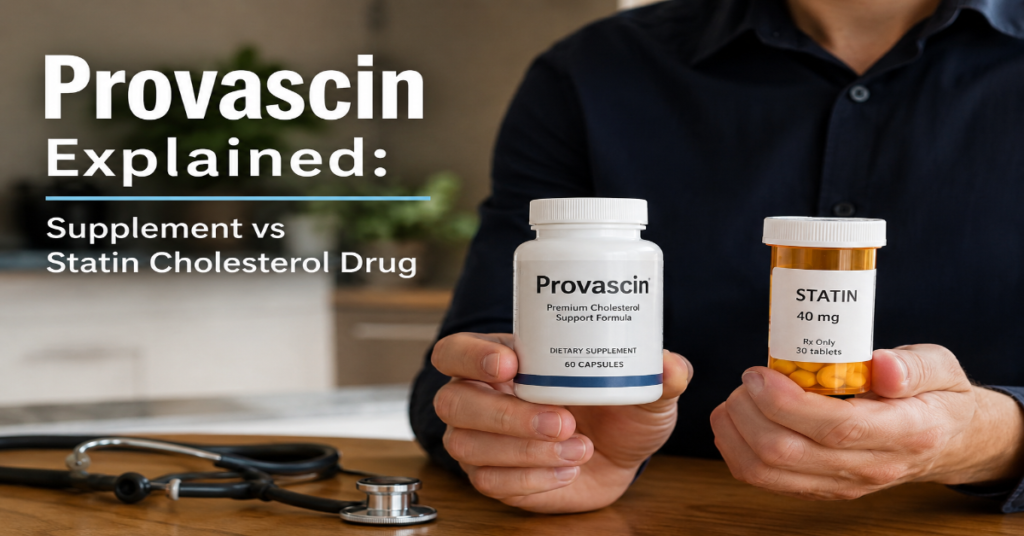
Provascin is a term that creates confusion because it may refer to two very different categories of cardiovascular products. In Canada and several international supplement markets, Provascin is sold as a nutraceutical formulation intended to support circulation, cellular energy production, and healthy cholesterol balance. In countries including India, similarly named products such as Provasin 20 mg refer to prescription medications containing atorvastatin, a statin clinically proven to reduce LDL cholesterol and cardiovascular risk.
That distinction matters. One product category falls under dietary supplement regulation while the other operates under pharmaceutical oversight with standardized dosing, prescription controls, and established clinical outcome data. Consumers searching for Provascin often encounter mixed advice online because search results merge supplement discussions with prescription statin information.
The cardiovascular supplement market has expanded sharply since 2020, driven by aging populations, preventive health trends, and increased consumer interest in metabolic wellness. According to Grand View Research, the global dietary supplements market exceeded $177 billion in 2023, with heart health products representing one of the fastest-growing segments. At the same time, statins remain among the most prescribed medications worldwide due to decades of evidence supporting reduced risk of myocardial infarction and stroke.
This article separates marketing from evidence. It explains what Provascin products typically contain, how prescription atorvastatin works, what side effects matter clinically, and where consumers should exercise caution before combining supplements with existing cardiovascular therapies.
What Provascin Usually Refers To
In most supplement markets, Provascin is associated with cardiovascular wellness formulations containing mitochondrial support compounds, antioxidants, and circulation-focused nutrients. One widely discussed version is associated with the Purica brand.
Typical ingredients include:
| Ingredient | Primary Intended Role | Evidence Strength |
| Coenzyme Q10 (CoQ10) | Cellular energy production and antioxidant support | Moderate |
| L-Carnitine | Fatty acid metabolism and mitochondrial function | Moderate |
| Alpha Lipoic Acid | Antioxidant and glucose metabolism support | Moderate |
| Betaine | Homocysteine metabolism support | Limited to moderate |
| Alpha-Ketoglutaric Acid | Cellular metabolic pathway support | Limited |
| Chaga Mushroom | Antioxidant and inflammation-related claims | Limited human evidence |
These ingredients are generally marketed toward adults concerned about circulation, fatigue, cholesterol support, or age-related cardiovascular decline.
A major limitation is that supplement formulations vary significantly by country and distributor. Unlike prescription statins, dietary supplements are not evaluated through identical premarket clinical trial standards in many jurisdictions.
Original Insight: Label Ambiguity Creates Real Medication Errors
One underreported issue involves consumers assuming all “Provascin” products are pharmaceutical-grade cholesterol treatments. Pharmacists in India and Canada have reported confusion between supplement packaging and statin-related brand names, particularly among older adults managing multiple medications.
This matters because patients may unknowingly replace prescribed statins with supplements that do not have equivalent evidence for cardiovascular event reduction.
Understanding Provasin 20 mg and Atorvastatin
Provasin 20 mg is a different category entirely. It typically contains atorvastatin, a prescription statin medication.
Statins work by inhibiting HMG-CoA reductase, a liver enzyme involved in cholesterol synthesis. Lower LDL cholesterol levels are associated with reduced risk of:
- Coronary artery disease
- Stroke
- Peripheral arterial disease
- Heart attack
- Cardiovascular mortality
Statin Therapy and Clinical Outcomes
LDLreduction∝Cardiovascular Risk ReductionLDL_{reduction} \propto Cardiovascular\ Risk\ ReductionLDLreduction∝Cardiovascular Risk Reduction
Large clinical studies including ASCOT-LLA, TNT, and SPARCL demonstrated that atorvastatin therapy can significantly lower cardiovascular event rates in high-risk patients.
| Factor | Supplement Provascin | Atorvastatin-Based Provasin |
| Regulatory Category | Dietary supplement | Prescription medicine |
| Primary Goal | Wellness support | LDL reduction |
| Clinical Trial Evidence | Limited | Extensive |
| Prescription Required | Usually no | Yes |
| Common Users | Preventive wellness consumers | Diagnosed high-risk patients |
| Main Safety Concern | Interactions and contamination variability | Liver and muscle side effects |
The difference between “supports heart health” and “reduces cardiovascular events” is clinically important. Supplements may assist overall wellness but generally do not replace statin therapy in evidence-based cardiology.
How the Ingredients Work Biologically
Several ingredients in supplement-based Provascin products target mitochondrial energy production.
CoQ10 and Statin Fatigue
CoQ10 has gained attention because statins may reduce endogenous CoQ10 synthesis in some patients.
ATP Production→Mitochondrial FunctionATP\ Production \rightarrow Mitochondrial\ FunctionATP Production→Mitochondrial Function
Some cardiologists recommend CoQ10 supplementation for patients reporting statin-associated muscle symptoms, although evidence remains mixed.
L-Carnitine
L-Carnitine assists transport of fatty acids into mitochondria. Research has explored its role in exercise tolerance, fatigue, and recovery after myocardial injury. Results remain inconsistent across meta-analyses.
Alpha Lipoic Acid
Alpha lipoic acid is better studied in diabetic neuropathy than cholesterol management. However, oxidative stress reduction may indirectly support vascular function.
Chaga Mushroom
Chaga is widely promoted in alternative wellness markets. Human cardiovascular outcome data remains sparse. Most evidence comes from laboratory or animal studies rather than randomized controlled human trials.
Original Insight: “Natural” Does Not Mean Low-Risk
Consumers frequently underestimate interaction risks because supplements are perceived as safer than prescription drugs. Yet CoQ10, antioxidants, and metabolic compounds may alter blood pressure response, anticoagulant effects, or glycemic control.
This becomes particularly relevant for older adults simultaneously taking:
- Warfarin
- Aspirin
- Clopidogrel
- Diabetes medications
- Prescription antihypertensives
Safety Concerns and Side Effects
Potential Supplement Side Effects
Reported side effects associated with supplement-style Provascin products may include:
- Gastrointestinal discomfort
- Nausea
- Mild headaches
- Dizziness
- Blood sugar fluctuations
- Allergic reactions
These effects vary substantially based on formulation quality and dosage.
Prescription Atorvastatin Side Effects
Atorvastatin carries more clearly documented adverse effect profiles.
| Side Effect | Clinical Relevance |
| Muscle pain or weakness | Common monitoring issue |
| Elevated liver enzymes | Requires laboratory monitoring |
| Rare rhabdomyolysis | Medical emergency |
| Mild digestive symptoms | Relatively common |
| Blood sugar elevation | Relevant in diabetes risk assessment |
Drug Interaction Risks
Statins interact with multiple medications, including:
- Certain antibiotics
- Antifungal drugs
- Grapefruit products
- Some antivirals
- Immunosuppressive medications
Original Insight: Supplement Manufacturing Standards Vary More Than Consumers Realize
Independent supplement testing organizations have repeatedly identified dosage inconsistencies across cardiovascular supplements globally. Some products contain lower active ingredient concentrations than labels claim, while others include contaminants or undeclared compounds.
Prescription atorvastatin products are subject to stricter manufacturing oversight compared with many nutraceutical formulations.
Real-World Clinical Perspective
Cardiologists generally divide heart health interventions into three categories:
- Lifestyle modification
- Evidence-backed medication
- Adjunctive supplementation
Supplements like Provascin are usually treated as adjunctive rather than primary cardiovascular interventions.
A patient with established coronary artery disease and elevated LDL cholesterol typically requires evidence-based therapy rather than supplementation alone. Conversely, lower-risk individuals focused on preventive wellness may discuss supplements as part of broader nutritional planning.
Practical Friction Often Missed Online
One recurring issue involves patients stopping statins after reading anecdotal supplement success stories online. Clinicians consistently warn against substituting nutraceuticals for prescribed lipid-lowering therapy without medical supervision.
The risk is especially high among adults with:
- Prior stroke
- Diabetes
- Familial hypercholesterolemia
- Prior myocardial infarction
Market Trends and Consumer Demand
The cardiovascular supplement industry expanded rapidly after the COVID-19 pandemic due to heightened interest in preventive health.
| Trend | Impact on Provascin-Type Products |
| Aging population growth | Increased demand for heart support supplements |
| Preventive wellness culture | Expanded supplement adoption |
| Social media wellness marketing | Higher consumer confusion |
| Rising chronic disease prevalence | More cardiovascular product purchases |
| E-commerce supplement sales | Reduced pharmacist oversight |
The rise of direct-to-consumer supplement advertising has also blurred distinctions between evidence-supported therapies and wellness branding.
Risks and Trade-Offs
Benefits of Supplement Approaches
- Accessible without prescription
- May support overall wellness
- Some ingredients have moderate metabolic evidence
- Often marketed toward prevention-oriented consumers
Risks
- Limited cardiovascular outcome evidence
- Potential drug interactions
- Variable manufacturing quality
- Confusion with prescription statins
- Delayed evidence-based treatment
Benefits of Prescription Statins
- Strong cardiovascular outcome data
- Standardized dosing
- Physician monitoring
- Proven LDL reduction
Trade-Offs
- Potential muscle-related adverse effects
- Need for ongoing monitoring
- Prescription access requirements
The Future of Provascin in 2027
The future of products marketed under names like Provascin will likely depend on two converging trends: stricter supplement oversight and growing personalization in cardiovascular care.
Regulators in North America and Europe continue increasing scrutiny around cardiovascular supplement claims. Health Canada, the U.S. FDA, and the European Food Safety Authority have all expanded monitoring of unsupported therapeutic marketing language since 2022.
At the same time, cardiology is moving toward individualized lipid management using:
- Genetic risk profiling
- PCSK9 inhibitors
- Combination lipid-lowering therapies
- AI-assisted cardiovascular risk prediction
- Precision nutrition strategies
Supplement manufacturers may respond by emphasizing adjunctive wellness positioning rather than implied pharmaceutical equivalence.
However, uncertainty remains around how aggressively regulators will police naming conventions that resemble prescription medications. That issue could become more prominent by 2027 as international supplement sales continue expanding through online marketplaces.
Key Takeaways
- Provascin may refer to either a supplement or a prescription cholesterol medication depending on the country and product line.
- Atorvastatin-based medications have substantially stronger evidence for reducing cardiovascular events than nutraceutical formulations.
- Supplement ingredients like CoQ10 and L-carnitine may support energy metabolism but are not substitutes for prescription therapy in high-risk patients.
- Naming confusion between Provascin and Provasin creates genuine medication safety concerns.
- Older adults taking multiple medications should consult clinicians before combining cardiovascular supplements with prescription drugs.
- Manufacturing consistency varies significantly across supplement brands and international markets.
- Future regulation may tighten health claims for heart wellness supplements marketed online.
Conclusion
Provascin sits at the intersection of two very different health product categories: preventive cardiovascular supplements and prescription cholesterol-lowering drugs. The confusion surrounding the name reflects a larger issue in modern health commerce where nutraceutical branding often overlaps with pharmaceutical terminology.
For consumers, the most important distinction is evidence. Prescription atorvastatin products are supported by decades of cardiovascular outcome data demonstrating reduced risk of stroke and heart attack in appropriate patients. Supplement formulations may support aspects of metabolic or circulatory wellness, but evidence remains more limited and variable.
Neither category should be approached casually. Supplements can interact with medications and prescription statins require careful monitoring for adverse effects and dosing suitability. The safest approach is verification: check the exact ingredient label, confirm whether the product is prescription-based or supplemental, and discuss cardiovascular decisions with a qualified clinician familiar with your medical history and current medications.
FAQ
What is Provascin used for?
Provascin supplements are generally marketed for cardiovascular wellness, circulation support, and cholesterol balance. In some countries, similarly named products refer to prescription atorvastatin medications used to lower LDL cholesterol.
Is Provascin the same as atorvastatin?
No. Supplement versions of Provascin typically contain nutraceutical ingredients such as CoQ10 and L-carnitine. Prescription products like Provasin 20 mg may contain atorvastatin.
Can Provascin replace statin medication?
People with diagnosed cardiovascular disease or high LDL cholesterol should not replace prescribed statins with supplements without physician supervision. Evidence supporting statin therapy is much stronger.
What are the side effects of Provascin supplements?
Possible side effects include digestive upset, dizziness, nausea, headaches, and interaction-related complications depending on existing medications.
Does CoQ10 help with statin muscle pain?
Some studies suggest CoQ10 may help certain patients experiencing statin-associated muscle symptoms, though clinical evidence remains mixed.
Is Provascin safe with blood pressure medication?
Potential interactions may occur. Patients taking cardiovascular medications should discuss supplement use with a healthcare professional before starting new products.
Where can Purica Provascin be purchased?
Purica-associated Provascin supplements are commonly sold through wellness retailers, supplement stores, and online marketplaces depending on regional distribution availability.
Methodology
This article was developed using peer-reviewed cardiovascular research, pharmacology references, supplement regulatory documentation, and recent industry market analyses published between 2022 and 2026. Clinical information regarding atorvastatin was validated against established cardiology guidelines and pharmacology databases.
The analysis distinguishes between nutraceutical marketing claims and evidence-based cardiovascular outcomes. Supplement ingredient discussions were limited to compounds commonly associated with Provascin-branded products in publicly available labeling documentation.
Limitations include regional variability in branding, formulations, and product availability. Because supplement compositions can change across distributors and countries, readers should verify exact ingredient labels before use.
References
Grand View Research. (2024). Dietary supplements market size, share & trends analysis report. https://www.grandviewresearch.com/
National Institutes of Health Office of Dietary Supplements. (2024). Coenzyme Q10 fact sheet for health professionals. https://ods.od.nih.gov/
Stone, N. J., Robinson, J. G., Lichtenstein, A. H., et al. (2022). 2022 ACC/AHA guideline on the management of blood cholesterol. Journal of the American College of Cardiology.
U.S. Food and Drug Administration. (2025). Dietary supplements: What you need to know. https://www.fda.gov/
World Health Organization. (2023). Cardiovascular diseases fact sheet. https://www.who.int/
European Society of Cardiology. (2023). ESC guidelines for cardiovascular disease prevention in clinical practice. European Heart Journal.
Health Canada. (2024). Natural and non-prescription health products directorate guidance documents. https://www.canada.ca/