
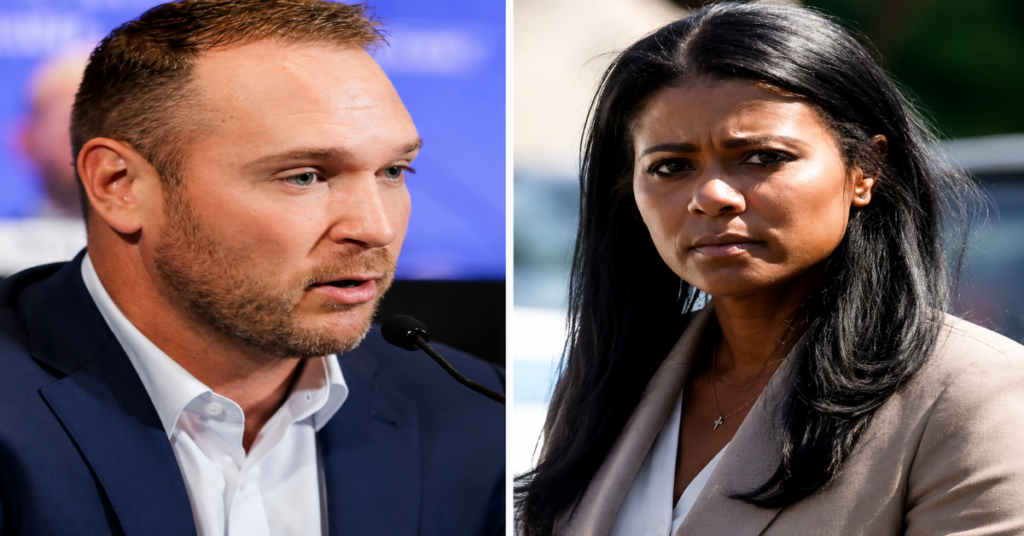
Tyna Robertson is a private figure whose name entered public attention through legal conflict, celebrity proximity and family court coverage. She is often searched because of her connection to former Chicago Bears linebacker Brian Urlacher, with whom she shares a son, Kennedy, and because of later reporting around custody proceedings after the death of her husband Ryan Karageorge.
The verified public story is narrower than many online summaries suggest. Robertson, later identified in court records as Tyna Karageorge, was involved in a long-running custody dispute with Urlacher. In January 2017, Urlacher was granted temporary custody of Kennedy after Ryan Karageorge died from a gunshot wound in December 2016, according to Chicago Sun-Times reporting based on court records.
In January 2018, Karageorge filed a lawsuit alleging that Urlacher and others had tried to portray her in a damaging light during the custody conflict. Local reporting described the suit as seeking $125 million in damages.
This article does not treat allegations as proven facts. It separates verified events, court outcomes, media claims and unresolved areas. That distinction matters because Robertson’s public image has often been shaped by adversarial litigation, headlines and secondary websites repeating one another.
Who Is Tyna Robertson?
Tyna Robertson is best known publicly as the mother of Kennedy Urlacher, the son of Pro Football Hall of Fame linebacker Brian Urlacher. In later court filings, she appears as Tyna Karageorge, formerly known as Tyna Robertson. The federal case record for Karageorge v. Urlacher identifies her that way and describes the lawsuit as involving Urlacher and others connected to child custody proceedings in Cook County, Illinois.
Her public identity is therefore legal and relational rather than professional. Unlike a conventional celebrity profile, there is limited verified information about her education, career history, business activity or current private life. That absence should not be filled with speculation.
The strongest confirmed points are:
| Area | Verified Context |
| Public name | Tyna Robertson, later Tyna Karageorge |
| Known for | Legal disputes and custody litigation involving Brian Urlacher |
| Child | Kennedy Urlacher, born in 2005 |
| Major public dispute | Custody battle after Ryan Karageorge’s death |
| Federal case | Karageorge v. Urlacher et al., Northern District of Illinois |
| Earlier media attention | Civil litigation involving Michael Flatley |
The key editorial challenge is that much of the online coverage around Tyna Robertson is conflict-driven. Readers often arrive expecting a simple biography, but the reliable record is mostly a litigation timeline.
Tyna Robertson and Brian Urlacher: The Custody Dispute
The Brian Urlacher connection is the reason most readers encounter this topic. Robertson and Urlacher were never widely known as a public couple in the celebrity sense. Their public association comes from parenthood and the legal proceedings that followed.
Chicago Sun-Times reporting states that Urlacher and Robertson had a son, Kennedy, in 2005. The same report states that Robertson had custody when she married Ryan Karageorge in 2016.
The custody situation changed after Ryan Karageorge died on December 29, 2016. According to court-record-based reporting, Urlacher filed an emergency petition on January 4, 2017 and was granted temporary custody of Kennedy on January 9, 2017.
That sequence is central to understanding the later lawsuit. It was not simply a celebrity dispute. It involved family court, emergency custody issues, a death investigation context and competing narratives about parental fitness.
The 2018 Defamation Lawsuit
In January 2018, Tyna Karageorge filed a lawsuit against Brian Urlacher, several attorneys and media defendants. Reports at the time said she alleged that Urlacher and others had conspired to portray her as a murderer or person of interest after Ryan Karageorge’s death in order to strengthen Urlacher’s custody position.
The lawsuit reportedly sought $125 million. That figure became the headline detail, but the more important point is legal: a complaint represents allegations, not findings. A plaintiff can claim conspiracy, defamation or false light, but those claims must survive procedural and evidentiary tests.
A later federal opinion in Karageorge v. Urlacher et al. shows that at least some claims did not survive. The Northern District of Illinois opinion dated September 27, 2019 addressed claims against court reporter Jeannine Miyuskovich and imposed Rule 11 sanctions against Karageorge. The court stated that her allegations against that defendant were unsupported and legally deficient.
That does not mean every issue in the broader family dispute can be reduced to that sanctions order. It does mean that responsible coverage must distinguish between what was alleged in 2018 and what a federal court later found regarding specific claims.
Earlier Legal History: Michael Flatley Case
Before the Urlacher-related coverage, Tyna Robertson’s name appeared in reporting connected to Michael Flatley, the performer known for Riverdance and Lord of the Dance.
CBS News reported in 2006 that the California Supreme Court allowed Flatley’s civil extortion and defamation lawsuit against Tyna Marie Robertson and attorney D. Dean Mauro to proceed.
In 2007, multiple outlets reported that Flatley obtained an $11 million judgment in the matter. The Los Angeles Times reported that the award was a default judgment and that Flatley’s attorney said any amount collected would be donated to charity. The Guardian also reported the $11 million judgment in connection with Flatley’s claim that Robertson had falsely accused him and attempted to extort money.
This earlier case is relevant because it shaped later media portrayals of Robertson. However, it should not be used as a shortcut to judge unrelated custody claims years later. Legal history can provide context, but each dispute has its own facts, parties, filings and standards of proof.
Timeline of Verified Events
| Date | Event | Source-Based Context |
| 2002 | Robertson accused Michael Flatley of sexual assault | Later civil litigation followed |
| 2006 | California Supreme Court allowed Flatley’s suit to proceed | CBS News reported the ruling |
| 2007 | Flatley obtained an $11 million judgment | Los Angeles Times and Guardian reported the outcome |
| 2005 | Kennedy Urlacher was born | Reported in Urlacher-Robertson custody coverage |
| September 2016 | Robertson married Ryan Karageorge | Reported in custody case coverage |
| December 29, 2016 | Ryan Karageorge died from a gunshot wound | Reported by Chicago Sun-Times |
| January 9, 2017 | Urlacher received temporary custody of Kennedy | Reported by Chicago Sun-Times |
| January 2018 | Karageorge filed a $125 million lawsuit | Reported by Patch and Chicago Sun-Times |
| September 27, 2019 | Federal court issued Rule 11 sanctions in Karageorge v. Urlacher | Justia federal case record |
Why the Coverage Around Tyna Robertson Is So Complicated
There are three reasons this story is unusually difficult to cover cleanly.
First, the public record comes from adversarial systems. Custody petitions, defamation complaints and sanctions motions are designed around dispute. They do not produce neutral biography.
Second, the story involves private family matters. Kennedy Urlacher was a child during the most public custody reporting. Ethical coverage should avoid unnecessary detail about a child’s private life while still explaining the legal context.
Third, Robertson’s name is often used in search-driven articles that repeat old claims without separating allegation from outcome. That creates a distorted archive. Readers see the same phrases across multiple websites and assume repetition equals verification. It does not.
A careful article should therefore use three labels consistently: reported, alleged and ruled. “Reported” refers to what reputable outlets published. “Alleged” refers to claims made by a party. “Ruled” refers to what a court determined.
Media Impact and Public Perception
Tyna Robertson’s public image has been shaped less by personal interviews and more by legal headlines. That is a major limitation.
When a person becomes known through lawsuits, the public often sees only conflict. The emotional reality of custody disputes, grief after a spouse’s death and adversarial litigation can disappear beneath sensational framing. The 2018 lawsuit’s $125 million demand, for example, was highly clickable. The procedural details of what happened later received far less attention.
The broader cultural lesson is about digital reputation. A private person can become permanently searchable because of one or two court cases. Even when legal claims narrow, fail or become procedurally complex, the search results may keep presenting the person as a controversy rather than a human being.
That is especially relevant to Robertson because her story overlaps with a famous athlete. Brian Urlacher’s celebrity status made the custody dispute more newsworthy than an ordinary family court conflict. His public profile amplified coverage of everyone connected to the case.
Practical Implications for Publishers
Writers covering Tyna Robertson should follow a higher verification standard than normal celebrity blogging.
| Editorial Risk | Better Practice |
| Repeating allegations as facts | Attribute allegations to filings or reports |
| Overusing mugshot-style framing | Focus on verified timeline and court outcomes |
| Treating old lawsuits as current news | Add dates clearly |
| Speculating about current life | State that verified current information is limited |
| Using exact-match keyword stuffing | Use natural variants such as Tyna Karageorge |
| Publishing unsourced family details | Avoid private information not supported by reliable sources |
For Matrics360, internal links should be placed only where they support the reader. Relevant existing examples include profiles that handle private or semi-public figures carefully, such as the site’s coverage of Pamela Hilburger, Meredith Schwarz, Debby Clarke Belichick and Eduardo Tamayo. These are useful internal comparisons because each article deals with a person whose public identity is shaped by famous relationships, limited documentation or online misinformation.
Risks and Trade-Offs in Writing About Tyna Robertson
The biggest risk is defamation by implication. Even when individual facts are technically true, arranging them carelessly can imply guilt, misconduct or intent beyond what the record supports.
A second risk is outdated framing. The Flatley case belongs to the mid-2000s. The Urlacher custody dispute became prominent in 2017 and 2018. A 2026 article should not present old filings as fresh developments.
A third risk is privacy. Robertson is not a current elected official, corporate executive or working entertainer with a public-facing brand. Her continued search visibility comes from past disputes. That makes restraint part of accuracy.
The trade-off is that readers do deserve a clear explanation. Search results around this topic are confusing. A verified account helps readers understand what happened without requiring them to parse scattered reports and court records.
The Future of Tyna Robertson in 2027
The future of public interest in Tyna Robertson will likely depend less on Robertson herself and more on two related factors: Kennedy Urlacher’s football career and the persistence of search-driven celebrity biography sites.
Kennedy Urlacher is now publicly listed by USC as a safety on its football roster. USC’s roster notes that he transferred from Notre Dame and played for the Trojans in 2025. As his athletic profile grows, search interest in his parents may continue. That could bring renewed attention to Robertson, even if she remains personally private.
The second factor is online biography recycling. Websites often update old celebrity-adjacent stories when a related person trends. In 2027, if Kennedy’s college football profile expands further, publishers may revisit the Robertson-Urlacher custody history. The risk is that old allegations will be repackaged without fresh verification.
The responsible path is clear. Future coverage should update only what is new, preserve the historical timeline and avoid implying that past litigation defines Robertson’s entire life.
Key Takeaways
• Tyna Robertson is best understood through verified legal records and reputable reporting, not rumor-driven biography pages.
• Her public connection to Brian Urlacher centers on their son Kennedy and a contentious custody history.
• Ryan Karageorge’s death in December 2016 was a turning point in the custody dispute.
• The 2018 lawsuit made serious allegations, but allegations should not be treated as proven findings.
• The 2019 federal opinion in Karageorge v. Urlacher shows that some claims failed and sanctions were imposed.
• The Michael Flatley case remains part of Robertson’s public record, but it should be dated and contextualized.
• Future search interest may rise because Kennedy Urlacher’s football career has become more visible.
Conclusion
Tyna Robertson’s story is not a simple celebrity biography. It is a public record shaped by custody litigation, civil lawsuits, media attention and the long memory of search engines. The most accurate account is careful, dated and restrained.
What can be verified is that Robertson, later known as Tyna Karageorge, shares a son with Brian Urlacher and became part of public custody reporting after Ryan Karageorge’s death in 2016. She later filed a major lawsuit alleging harmful conduct by Urlacher and others, but federal court records show that at least some claims connected to the litigation failed and resulted in sanctions.
The responsible editorial approach is not to sensationalize her life. It is to explain the record, identify what remains unverified and avoid turning legal allegations into biography. That is the difference between search content and trustworthy reporting.
FAQ
Who is Tyna Robertson?
Tyna Robertson, also known as Tyna Karageorge, is best known publicly as the mother of Kennedy Urlacher and for legal disputes involving former Chicago Bears linebacker Brian Urlacher.
Why is Tyna Robertson known?
She is known mainly because of custody litigation involving Brian Urlacher and their son, along with earlier media coverage connected to civil litigation involving Michael Flatley.
Was Tyna Robertson married to Brian Urlacher?
No widely verified reporting identifies Tyna Robertson and Brian Urlacher as married. Public reporting describes them as parents of a son, Kennedy, born in 2005.
What happened between Tyna Robertson and Brian Urlacher?
They were involved in a contentious custody dispute. In January 2017, Urlacher was granted temporary custody of their son after Robertson’s husband Ryan Karageorge died in December 2016.
What was the $125 million lawsuit?
In January 2018, Tyna Karageorge filed a lawsuit alleging that Urlacher and others tried to portray her negatively during the custody dispute. Reports said she sought $125 million in damages.
What happened in Karageorge v. Urlacher?
A federal court opinion in 2019 addressed claims against one defendant and imposed Rule 11 sanctions against Karageorge, finding that specific allegations lacked evidentiary support.
Is there verified current information about Tyna Robertson?
Verified current information is limited. Most reliable public information concerns past litigation and custody-related reporting rather than her present private life.
Methodology
This article was drafted from the provided Matrics360 production prompt, then checked against available court records and reputable media reporting. The strongest legal source used was the federal court opinion in Karageorge v. Urlacher et al., published through Justia. News context was cross-checked with Chicago Sun-Times, Patch, CBS News, The Guardian and Los Angeles Times reporting.
References
CBS News. (2006). Lord of the Dance can sue accuser.
Chicago Sun-Times. (2017). Urlacher has temporary custody of son after boy’s stepfather dies.
Chicago Sun-Times. (2018). Mother of Brian Urlacher’s son files $125M suit against him.
Justia. (2019). Karageorge v. Urlacher et al., No. 1:2018cv03148, Document 74.
Los Angeles Times. (2007). Dancer Flatley wins judgment.
Patch. (2018). Urlacher’s ex sues for $125M, claims he portrayed her as murderer.
The Guardian. (2007). Flatley gets $11m settlement over sexual assault claims.
USC Athletics. (2026). Kennedy Urlacher, USC Trojans football roster.