
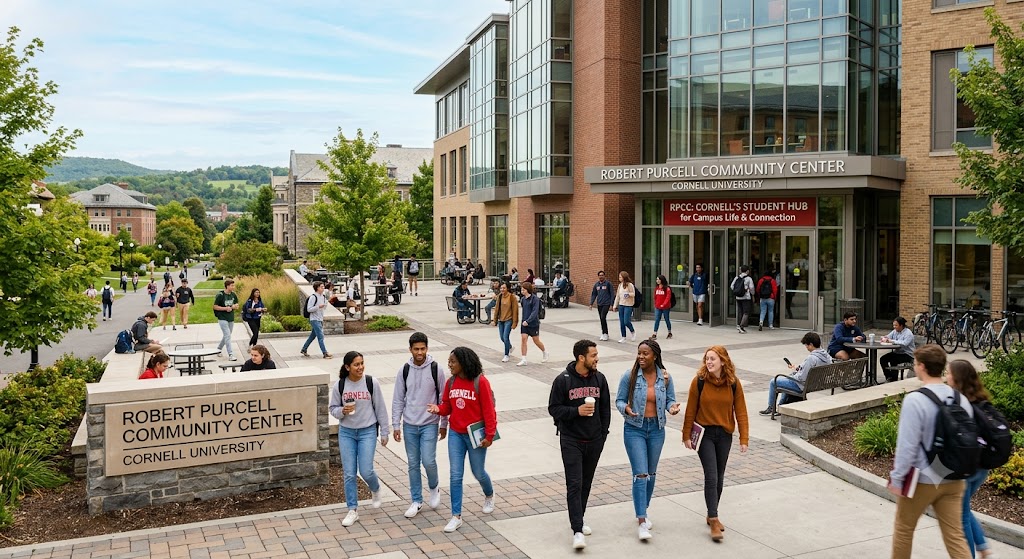
The Robert Purcell Community Center is one of Cornell University’s most important student facilities, serving as a central gathering space for students living and studying on North Campus. Located at 107 Jessup Road in Ithaca, New York, the facility supports everyday student experiences through recreation areas, meeting spaces, dining options, and programs designed to strengthen campus connections.
Unlike academic buildings focused on lectures and research, RPCC functions as a social and community infrastructure point. Its purpose is to help students build relationships, participate in organizations, access services, and create a sense of belonging during their university experience.
Cornell’s North Campus houses many first-year students, making shared spaces especially important. A community center in this environment provides a bridge between residential life and the wider university community.
The facility represents a broader trend in higher education: universities increasingly recognize that student success depends not only on academic resources but also on engagement, wellness, and social support systems.
This article examines the history, purpose, facilities, and future role of Robert Purcell Community Center while explaining why spaces like RPCC remain essential in modern university environments.
The Role of Robert Purcell Community Center at Cornell
Cornell University has long emphasized residential education, where learning extends beyond classrooms. Community centers support this model by creating environments where students can interact informally.
RPCC serves as a North Campus anchor, particularly for students who may be adjusting to university life for the first time.
The center supports several aspects of campus life:
- Student organization activities
- Community meetings
- Recreational opportunities
- Dining and social spaces
- Residential programming
For first-year students, these functions can reduce isolation and encourage participation in campus culture.
Location and Campus Context
The Robert Purcell Community Center is positioned within Cornell’s North Campus residential area.
| Detail | Information |
| Location | North Campus, Cornell University |
| Address | 107 Jessup Rd, Ithaca, NY 14850, United States |
| Primary Users | Cornell students and campus communities |
| Main Purpose | Student services, activities, recreation, and community engagement |
| University | Cornell University |
Its location makes it particularly accessible for students living in nearby residence halls.
Facilities and Services
RPCC is designed as a multi-purpose student facility rather than a single-use building.
Typical community center functions include:
| Area | Student Benefit |
| Meeting rooms | Support clubs, organizations, and campus events |
| Recreation spaces | Encourage wellness and social interaction |
| Dining facilities | Provide convenient food access |
| Lounge areas | Create informal gathering environments |
| Program spaces | Support student activities and events |
The combination of practical services and social areas makes RPCC different from traditional campus buildings.
Why Student Community Spaces Matter
Research in higher education has consistently linked student engagement with academic persistence and overall university satisfaction.
A community center provides opportunities for:
- Peer networking
- Cultural exchange
- Leadership development
- Informal learning
- Campus involvement
These experiences are especially valuable during the transition from high school to university.
For residential campuses, physical spaces influence how students interact. A well-designed community center can encourage spontaneous conversations and create stronger connections among students from different backgrounds.
Robert Purcell Community Center Compared With Traditional Campus Facilities
| Facility Type | Primary Purpose | Student Experience |
| Classroom Building | Academic instruction | Scheduled learning |
| Library | Research and study | Individual academic support |
| Residence Hall | Housing | Residential experience |
| Community Center | Social engagement | Connection and participation |
The key difference is that community centers focus on interaction. They provide the informal spaces where campus culture develops.
Cultural and Real-World Impact
University communities are shaped not only by their academic reputation but also by student experiences outside classrooms.
Facilities such as RPCC influence:
- Student belonging
- Campus traditions
- Organization growth
- Peer relationships
- Residential satisfaction
At Cornell, where students come from diverse geographic and cultural backgrounds, shared spaces help create common experiences.
A student attending an event, meeting a club member, or spending time in a shared lounge may form relationships that influence their entire university journey.
Challenges and Trade-Offs
Although community centers provide significant benefits, they also face practical challenges.
Maintenance and Modernization
Large campus facilities require continuous investment. Technology upgrades, accessibility improvements, and changing student expectations create ongoing demands.
Balancing Multiple Uses
A community center must serve different groups simultaneously. Students seeking quiet study areas, social activities, dining access, and organized events may have competing needs.
Changing Student Behavior
Digital communication has changed how students interact. Universities must design physical spaces that remain valuable in an era where many activities can happen online.
Three Key Insights About University Community Centers
1. Social infrastructure affects student success
Academic resources alone do not define a university experience. Spaces that encourage connection can influence student satisfaction and engagement.
2. Location shapes participation
A centrally positioned facility near residential areas lowers barriers for students who might otherwise avoid campus activities.
3. Flexible spaces have long-term value
Buildings designed for multiple purposes can adapt as student needs change over time.
The Future of Robert Purcell Community Center in 2027
By 2027, university community centers are expected to continue evolving around student wellness, flexible learning, and hybrid campus experiences.
Higher education institutions are increasingly focusing on:
- Collaborative spaces
- Student mental health support environments
- Inclusive design
- Technology-enabled learning areas
The future of facilities like RPCC will likely involve adapting existing spaces rather than simply expanding physical size. Universities face financial and sustainability pressures, making efficient renovation and flexible design important considerations.
Cornell’s continued focus on residential education suggests that community spaces will remain an important part of the student experience.
However, the exact future changes to RPCC depend on university planning decisions, funding priorities, and student needs.
Key Takeaways
- Robert Purcell Community Center is a major student-life facility on Cornell’s North Campus.
- The building supports recreation, activities, dining, and social interaction.
- Community centers play an important role in student belonging and engagement.
- Physical campus spaces remain valuable despite increased digital communication.
- Flexible design helps university facilities adapt to changing student expectations.
- RPCC represents Cornell’s broader approach to residential education.
Conclusion
The Robert Purcell Community Center represents more than a campus building. It serves as a social foundation where students can meet, participate, and create connections outside academic settings.
For Cornell students, especially those living on North Campus, RPCC provides an accessible environment for community involvement and daily interaction. Its importance reflects a larger understanding within higher education: student success depends on experiences that support connection, inclusion, and engagement.
As universities continue adapting to changing student expectations, community centers will remain important spaces. Their value comes not only from the services they provide but from the relationships and experiences they help create.
Frequently Asked Questions
Where is Robert Purcell Community Center located?
Robert Purcell Community Center is located on Cornell University’s North Campus at 107 Jessup Road, Ithaca, New York.
What is Robert Purcell Community Center used for?
The facility supports student activities, meetings, recreation, dining, and community-building programs.
Who can use Robert Purcell Community Center?
The center primarily serves Cornell students and members of the university community.
Why are campus community centers important?
They provide spaces where students can socialize, join organizations, develop relationships, and participate in campus life.
Is Robert Purcell Community Center only for residential students?
While it is especially important for North Campus residents, the facility serves the broader Cornell student community.
Methodology
This article was prepared using publicly available information about Cornell University facilities, campus planning resources, and established research on student engagement and residential education.
The analysis focuses on the role of community centers in higher education rather than providing an operational review of the facility. Specific amenities and schedules may change over time and should be confirmed through Cornell University’s official resources before publication.
References (APA)
Cornell University. (2025). Student life and campus facilities resources. Cornell University.
National Association of Student Personnel Administrators. (2023). Student engagement and campus environments in higher education. NASPA.
Tinto, V. (2022). Student success and the building of educational communities. Higher Education Research resources.
This article was drafted with AI assistance and should be reviewed and verified by the Matrics360.com editorial team before publication. All facility details, references, and claims should be independently confirmed before publishing.