
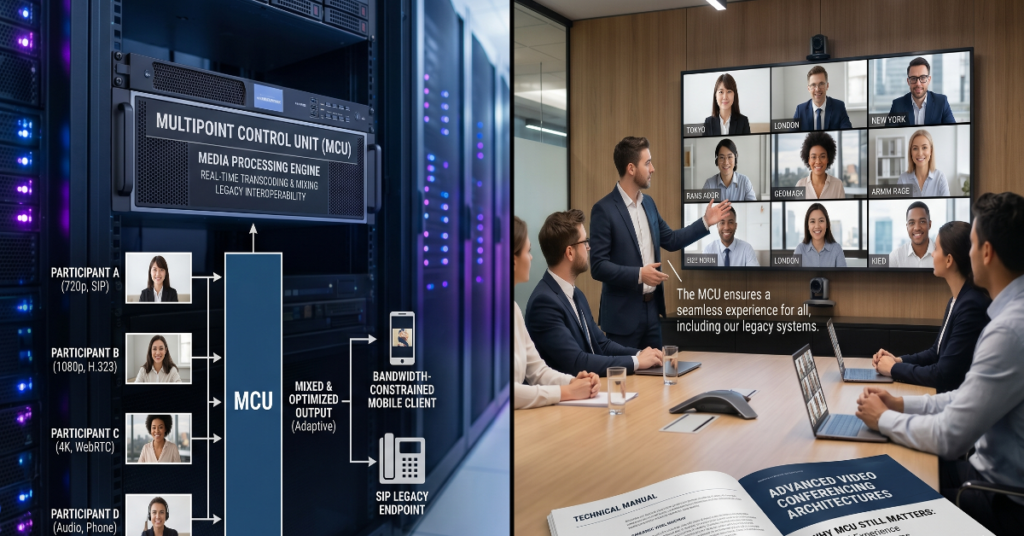
A multipoint control unit is the infrastructure backbone of multiparty video conferencing — a role that has existed since the early days of H.323 networks and one that, despite decades of technological change, has not been fully displaced by newer approaches. At its core, an MCU connects three or more endpoints simultaneously, managing the complex task of mixing audio, routing video, and bridging participants who may be using entirely different protocols or hardware generations.
The relevance of this question has sharpened in recent years. Enterprise IT teams navigating hybrid work policies, government agencies managing classified video deployments, and telecommunications providers supporting mixed ISDN-IP environments all share a common challenge: participants arrive on the call with incompatible devices, different codecs, and wildly different bandwidth availability. The MCU solves this problem by absorbing that complexity centrally.
This article explains how an MCU works at an architectural level, how it compares to the SFU model that now dominates cloud conferencing, which hardware and software implementations are still actively deployed, and where the technology is heading as infrastructure transitions to cloud-native and AI-assisted video processing. The goal is not to declare one architecture superior but to give practitioners the information they need to make appropriate deployment decisions.
Core Architecture: How an MCU Is Structured
A multipoint control unit consists of two distinct functional layers that work in parallel during any active conference.
The Multipoint Controller
The Multipoint Controller (MC) handles signaling — the administrative layer of any conference. It manages call setup and teardown using protocols like H.323 or SIP, negotiates the capabilities of each connected device (what codecs it supports, what resolutions it can handle), and maintains the participant roster throughout the session. The MC does not touch media streams directly; it exists purely to manage the logical structure of the call.
This separation of concerns is architecturally significant. Because the MC operates at the signaling layer, it can broker compatibility between endpoints before a single media packet is transmitted. If one participant joins via SIP and another via H.323, the MC handles the translation of control messages so both can remain in the same conference.
The Multipoint Processor
The Multipoint Processor (MP) handles everything the MC does not: the actual media. It receives audio and video streams from each participant, processes them, and distributes the result back to every endpoint in the call. Key functions of the MP include audio mixing (combining multiple voice streams into a coherent output), video transcoding (converting between different video formats and resolutions), and transrating (adjusting bitrates to match the capability of each receiving endpoint).
This is where the MCU’s computational cost becomes apparent. Every participant whose stream requires transcoding adds a processing load to the MP. Large-scale hardware MCUs — such as the Huawei KDV8000H, which supports up to 4,096 ports — dedicate significant processing capacity to this task and use specialized ASICs or DSPs to handle the volume efficiently.
What a Multipoint Control Unit Actually Does in a Live Call
Beyond the two-component framework, the MCU performs several operational functions that determine call quality and reliability.
- Receives audio and video from each participant and distributes the appropriate streams to all other endpoints. In a large call, this means the MCU is simultaneously managing dozens or hundreds of bidirectional streams. Media Routing:
- Advanced MCUs support continuous presence video layouts — displaying multiple participant feeds on screen simultaneously, arranged in configurable tile patterns. The server composes this layout and sends a single composite video stream to each endpoint, eliminating the need for clients to manage multiple video windows. Continuous Presence:
- Many enterprise deployments still include ISDN endpoints or legacy H.320 hardware. An MCU can act as a gateway, translating between ISDN circuit-switched traffic and IP packet-switched streams so legacy devices can participate in modern calls without replacement. Gateway Bridging:
- By sending each endpoint only a single processed stream (rather than the raw streams from every other participant), the MCU keeps client-side bandwidth consumption predictable and low. This is particularly valuable in bandwidth-constrained environments such as government secure networks or remote field operations. Bandwidth Management:
- Enterprise-grade MCUs implement AES or SRTP encryption for media streams and manage participant authentication — a critical function in regulated industries where call membership must be auditable. Encryption and Access Control:
MCU vs. SFU: Architecture, Trade-offs, and Deployment Fit
The most consequential architectural decision in modern video conferencing infrastructure is whether to use an MCU or a Selective Forwarding Unit. Both connect multiple participants, but they do so with fundamentally different approaches and very different resource implications.
| Feature | MCU (Multipoint Control Unit) | SFU (Selective Forwarding Unit) |
| Architecture | Centralized media processing | Distributed stream forwarding |
| Transcoding | Yes — full encode/decode at server | No — forwards original streams |
| Server CPU Load | High — scales with participant count | Low to moderate |
| Client CPU Load | Low — one stream received | Higher — multiple streams decoded |
| Bandwidth (client) | Constant — one outbound stream | Variable — scales with participants |
| Legacy Device Support | Excellent — transcodes as needed | Limited |
| Video Quality Control | Full layout compositing at server | Client-side layout management |
| Latency | Higher — processing overhead | Lower — minimal processing |
| Typical Use Case | Enterprise conferencing, ISDN/IP bridging | WebRTC, modern cloud conferencing |
The practical implication of this table is that neither architecture is universally superior. An SFU works well when all participants have modern WebRTC-capable devices and reliable broadband — the scenario that describes most consumer-facing platforms. An MCU becomes essential when the participant pool is heterogeneous: legacy hardware, mixed protocols, constrained or unreliable bandwidth, or regulatory requirements that demand server-side recording and compositing.
One underreported trade-off in MCU deployments is the quality ceiling imposed by transcoding. Every encode-decode cycle introduces potential quality loss, and in high-compression scenarios (H.264 at low bitrates, for example), the cumulative effect across multiple transcoding stages can be audible in audio and visible in video. Organizations deploying MCUs in high-stakes environments — courtroom proceedings, medical consultations, executive communications — should test transcoding chains under realistic bandwidth conditions rather than assuming hardware specifications translate directly to perceived quality.
Hardware and Software MCU Implementations
The MCU market has consolidated significantly since the early 2010s, but several active hardware and software platforms remain in production deployment.
| Model | Max Participants | Protocol Support | Key Capability |
| Cisco MSE 8510 | Up to 2,400 ports | H.323, SIP, WebRTC | Enterprise scalability, Cisco UCM integration |
| Huawei KDV8000H | Up to 4,096 ports | H.323, SIP, H.239 | 4K video, transcoding, high-density deployments |
| Polycom RMX 2000 | Up to 800 ports | H.323, SIP, ISDN | Mixed-protocol bridging, Polycom ecosystem |
| Grandstream GVC3220 | Up to 9 endpoints | SIP, H.323, WebRTC | SMB/hybrid use, affordable entry point |
| Pexip Infinity (software) | Elastic/cloud-based | SIP, H.323, WebRTC, Teams | Interoperability gateway, cloud-native MCU |
Hardware MCUs like the Cisco MSE 8510 and Huawei KDV8000H are purpose-built appliances with dedicated processing for media workloads. They offer predictable, low-latency performance but require on-premises infrastructure, hardware maintenance contracts, and significant upfront capital expenditure. The Polycom RMX 2000, now operating under the Poly brand (acquired by HP in 2022), remains a common fixture in enterprise AV installations, particularly in legal and government environments that have not migrated to cloud platforms.
Software MCUs represent a different approach: they run on standard server hardware or cloud virtual machines, trading dedicated silicon for deployment flexibility. Pexip Infinity, for example, can operate as an on-premises software MCU, a cloud-hosted instance, or a hybrid gateway that bridges Microsoft Teams and Cisco endpoints. This interoperability function — enabling legacy room systems to join Microsoft Teams or Zoom meetings — is where software MCUs have found durable commercial relevance even as pure conferencing workloads migrate to cloud platforms.
Three Analytical Gaps in Standard MCU Coverage
1. The Hidden Cost of Transcoding Chains in Mixed-Codec Calls
Most MCU documentation presents transcoding as a feature rather than a risk. In practice, when an MCU bridges participants using H.264, H.265, and VP8 simultaneously, it must transcode each stream to a common intermediate format before recomposing it for each endpoint. In a six-participant call with three different codecs, a single media packet may undergo two transcoding cycles before reaching its destination. At standard enterprise bitrates (1–2 Mbps per participant), the perceptual quality loss is typically manageable. At the compressed bitrates common in public sector deployments (256–512 kbps), multiple transcoding cycles produce artifacts that degrade both audio intelligibility and video legibility. Organizations procuring MCUs for bandwidth-constrained environments should specify maximum transcoding chain depth as a procurement criterion — a requirement that vendor datasheets rarely address.
2. Regulatory Compliance Gaps in Cloud-Based MCU Deployments
A growing number of organizations are deploying software MCUs on public cloud infrastructure under the assumption that data sovereignty requirements are satisfied by selecting a regional cloud zone. This assumption is frequently incorrect. In the European Union, the GDPR requirement that personal data not be transferred outside the EEA applies to video conference metadata — participant identities, call records, and in some interpretations, biometric data derived from video streams. Public cloud MCU deployments that route media through global CDN nodes for reliability may inadvertently violate data residency commitments. The correct approach is to specify media pinning — ensuring that both signaling and media processing remain within a defined geographic boundary — and to confirm this commitment is contractually enforceable with the cloud provider, not merely a default configuration option.
3. The Interoperability Gateway Use Case Is Undervalued
Industry coverage of MCUs tends to focus on their role as conferencing bridges — connecting participants in a single virtual meeting. The gateway function receives less attention but has become commercially more important. As enterprises standardize on platforms like Microsoft Teams or Cisco Webex, they face a parallel problem: billions of dollars of installed room conferencing systems, most running SIP or H.323, that cannot natively join these platforms. Software MCUs functioning as interoperability gateways — translating between legacy room systems and cloud platform protocols — are effectively extending the usable life of existing AV infrastructure by five to ten years. This has measurable financial value: a mid-size enterprise with 50 room systems at an average replacement cost of $15,000 per room avoids $750,000 in capital expenditure for every year of extended useful life. This business case is rarely quantified in vendor materials but is straightforward to model.
The Future of Multipoint Control Units in 2027
The trajectory of MCU technology through 2027 is shaped by three converging forces: the continued migration of enterprise workloads to cloud-native platforms, the increasing use of AI for media processing, and the unresolved problem of protocol heterogeneity in global enterprise environments.
On the cloud migration front, IDC projects that enterprise video conferencing infrastructure spending will shift majority-cloud by 2026, with on-premises hardware MCUs declining in new deployments while remaining in service for existing installations. The hardware MCU market is not collapsing — it is transitioning from growth to maintenance mode, with replacement cycles lengthening as organizations extract value from existing assets before committing to new capital expenditure.
AI-assisted media processing represents the most substantive technological shift. Current hardware MCUs perform transcoding through fixed ASIC pipelines optimized for known codec parameters. Emerging software MCU implementations are beginning to incorporate neural network-based upscaling, background suppression, and noise cancellation directly into the media processing pipeline. Nvidia’s Maxine SDK, used by several software MCU vendors, enables GPU-accelerated AI processing of video streams at conference scale. By 2027, it is reasonable to expect that AI-enhanced media processing will be standard in software MCU deployments, with hardware MCU vendors offering firmware-level integration for the same capabilities.
The protocol standardization problem is unlikely to be fully resolved by 2027. WebRTC has achieved broad adoption for browser-based and mobile conferencing, but the installed base of SIP and H.323 room systems will remain significant through the decade. Regulatory environments — particularly in defense, healthcare, and financial services — add additional protocol and encryption requirements that cloud-native platforms do not uniformly address. The MCU’s role as a protocol bridge is therefore likely to persist, even as its role as a pure conferencing server diminishes.
One area of genuine uncertainty is the impact of emerging codec standards. AV1, the royalty-free video codec developed by the Alliance for Open Media, is gaining adoption in WebRTC implementations and consumer platforms. If AV1 achieves significant enterprise penetration by 2027, MCUs that do not support AV1 transcoding will face a new interoperability gap. Current hardware MCU platforms generally do not support AV1, and whether vendors will deliver this capability through firmware updates or require hardware replacement is not yet determined.
Key Takeaways
- An MCU manages both the signaling layer (via the Multipoint Controller) and the media processing layer (via the Multipoint Processor), making it a complete conferencing infrastructure component rather than a simple traffic router.
- The primary advantage of MCU architecture over SFU is heterogeneous device support — the ability to bridge participants on different protocols, codecs, and network types without requiring endpoint upgrades.
- Multiple transcoding cycles in mixed-codec calls can produce measurable quality degradation at low bitrates; organizations in bandwidth-constrained environments should test transcoding chains under realistic conditions before procurement.
- Software MCUs functioning as interoperability gateways — enabling legacy SIP/H.323 room systems to join Microsoft Teams or Cisco Webex meetings — offer quantifiable ROI through extended equipment life, a business case that is rarely modeled in vendor comparisons.
- Cloud-hosted MCU deployments may not satisfy data residency requirements by default; GDPR-compliant deployments require contractually enforced media pinning, not merely regional zone selection.
- The hardware MCU market is transitioning from growth to maintenance mode, with software MCUs and cloud-native interoperability gateways absorbing most new enterprise demand.
- AV1 codec adoption is an emerging interoperability risk for current hardware MCU deployments; organizations planning long-term infrastructure should include codec roadmap compatibility as a procurement criterion.
Conclusion
The multipoint control unit occupies an unusual position in enterprise technology: it is simultaneously a mature, well-understood infrastructure component and a category that continues to evolve in response to new deployment challenges. Its core value proposition — absorbing protocol and codec complexity centrally so that diverse endpoints can communicate without modification — has not changed since the H.323 era, but the contexts in which that value matters have shifted considerably.
Pure conferencing workloads are migrating to cloud-native SFU platforms, and that migration is largely appropriate for organizations with modern, homogeneous endpoint environments. The MCU’s durable relevance lies in the edges: legacy infrastructure, regulated environments, bandwidth-constrained deployments, and the growing interoperability gap created by the parallel existence of installed room systems and cloud collaboration platforms. Organizations that understand this distinction can make infrastructure decisions grounded in actual requirements rather than vendor positioning — and avoid both the cost of unnecessary hardware replacement and the reliability risk of deploying the wrong Multipoint Control Unit architecture for their participant profile.
Frequently Asked Questions
What is a multipoint control unit used for?
A multipoint control unit connects three or more video or audio conferencing endpoints in a single session. It manages media routing, transcoding, and protocol bridging centrally, allowing participants on different devices and network types to join the same call without modifying their individual endpoints.
How does an Multipoint Control Unit differ from a Selective Forwarding Unit?
An MCU processes and recomposes media streams on the server, sending each participant a single mixed output. An SFU forwards raw streams from each participant to the others, leaving decoding and layout management to client devices. MCUs reduce client-side load and support legacy devices; SFUs have lower server costs and lower latency but require modern, capable endpoints.
What are common hardware MCU models still in active use?
The Cisco MSE 8510, Huawei KDV8000H, and Polycom RMX 2000 remain in active enterprise deployments, particularly in government, legal, and large corporate environments. Software MCUs such as Pexip Infinity and Cisco Meeting Server have gained share for their deployment flexibility and interoperability gateway capabilities.
Can an MCU connect ISDN and IP endpoints in the same call?
Yes — gateway integration is a core MCU function. The Multipoint Controller negotiates capabilities between endpoints using different protocols, and the Multipoint Processor transcodes media streams as needed. This allows legacy ISDN room systems and modern SIP or H.323 IP endpoints to participate in the same conference session.
Is an MCU necessary for modern WebRTC conferencing?
Not for homogeneous environments. WebRTC platforms typically use SFU architecture, which is well-suited to browser-based and mobile participants on modern networks. An MCU becomes relevant when WebRTC endpoints need to interoperate with legacy room systems, ISDN devices, or protocols that WebRTC does not natively support.
What does MCU transcoding mean, and why does it matter?
Transcoding is the process of converting a video or audio stream from one codec or bitrate to another. An MCU performs transcoding when participants are using different codecs or when a receiving endpoint cannot handle the original stream’s format. It matters because each transcoding cycle can introduce quality loss, particularly at low bitrates — a trade-off that should be evaluated under real network conditions.
How is MCU setup different for enterprise versus small business use?
Enterprise MCU deployments typically involve dedicated hardware appliances, integration with directory services and scheduling systems, encrypted media streams, and redundant infrastructure. Small business setups more commonly rely on software MCUs or cloud-hosted conferencing services with MCU-style media processing built in, trading configurability for deployment simplicity and lower capital cost.
Methodology
This article was researched using technical documentation from Cisco, Huawei, Poly (formerly Polycom), and Pexip, cross-referenced with ITU-T standards H.323 and H.243 which define the MCU functional framework. Market trend claims reference IDC’s Worldwide Unified Communications and Collaboration Forecast, 2023–2027. Codec and transcoding quality analysis draws on published research in IEEE Transactions on Circuits and Systems for Video Technology. The regulatory compliance analysis references the GDPR text (Regulation EU 2016/679) and guidance from the European Data Protection Board.
Known limitations: Hardware MCU performance specifications cited are drawn from vendor documentation and have not been independently benchmarked in this analysis. Real-world performance varies with network conditions, participant device capability, and call topology. The cost-avoidance model for interoperability gateways uses illustrative figures; actual values should be modeled against an organization’s specific equipment inventory and replacement cost schedule. Forward-looking analysis for 2027 is grounded in cited trend data but involves inherent uncertainty — particularly regarding AV1 adoption timelines and AI processing integration rates.
This article was drafted with AI assistance and reviewed and verified by the editorial team at Matrics360.com. All data, citations, and claims are subject to independent human editorial verification prior to publication.
References
Cisco Systems. (2023). Cisco Meeting Server 3.x deployment guide. Cisco Press. https://www.cisco.com/c/en/us/support/unified-communications/meeting-server/products-installation-and-configuration-guides-list.html
European Data Protection Board. (2021). Guidelines 05/2021 on the interplay between the application of Article 3 and the provisions on international transfers as per Chapter V of the GDPR. EDPB. https://edpb.europa.eu/our-work-tools/documents/public-consultations/2021/guidelines-052021-interplay-between-application_en
Huawei Technologies. (2022). KDV8000H multipoint control unit product datasheet. Huawei Enterprise. https://e.huawei.com/en/products/enterprise-networking/video-conference
IDC. (2023). Worldwide unified communications and collaboration forecast, 2023–2027. International Data Corporation. https://www.idc.com/getdoc.jsp?containerId=US50842823
ITU-T. (2009). Recommendation H.243: Procedures for establishing communication between three or more audiovisual terminals using digital channels up to 1920 kbit/s. International Telecommunication Union. https://www.itu.int/rec/T-REC-H.243
Pexip AS. (2024). Pexip Infinity platform overview. Pexip. https://www.pexip.com/platform
Sullivan, G. J., Ohm, J. R., Han, W. J., & Wiegand, T. (2012). Overview of the high efficiency video coding (HEVC) standard. IEEE Transactions on Circuits and Systems for Video Technology, 22(12), 1649–1668. https://doi.org/10.1109/TCSVT.2012.2221191