
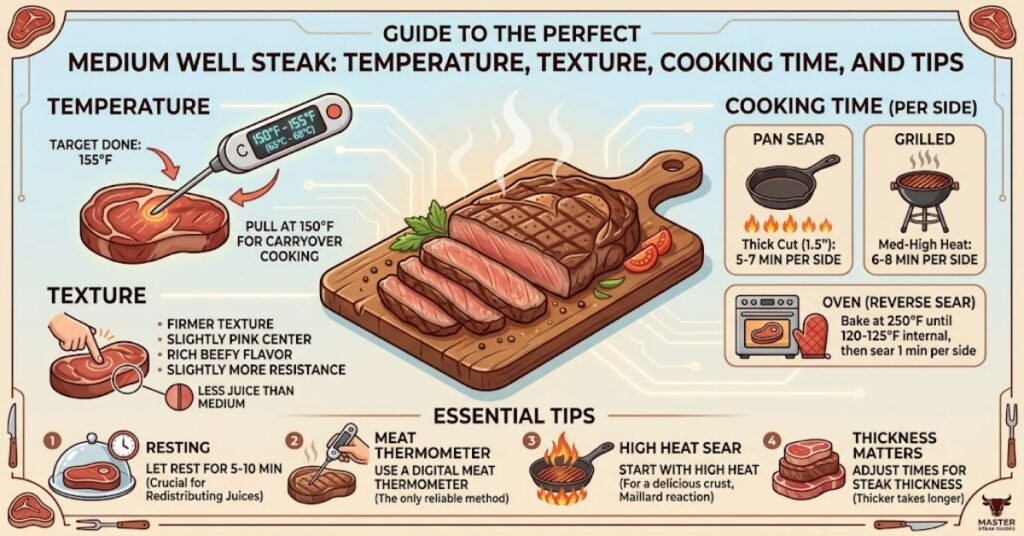
A medium well steak is cooked almost entirely through, with a mostly brown or grey-brown centre and a faint hint of pink. It suits people who prefer less redness than medium steak but still want a satisfying texture and rich beef flavour. The usual culinary temperature range is around 150°F to 155°F (66°C to 68°C), although exact definitions vary between cooking guides.
Achieving this result involves more than leaving meat in a hot pan for a set number of minutes. Steak thickness, fat content, starting temperature, and cooking equipment all affect how quickly heat reaches the centre. A well-marbled ribeye may remain juicy at this level of doneness, while a lean sirloin can become dry if cooked for too long.
Temperature control also matters for food safety. In the United States, the Department of Agriculture recommends cooking whole beef steaks to a minimum internal temperature of 145°F (62.8°C), followed by a three-minute rest. This is a safety recommendation rather than a universal definition of medium-well doneness.
Understanding the difference helps home cooks balance personal preference with safe preparation. A thermometer can confirm the internal temperature, while proper searing creates a browned surface and develops savoury flavours through the Maillard reaction.
This guide explains the temperature range, cooking methods, best cuts, common mistakes, and practical safety considerations for preparing steak with a nearly fully cooked centre.
What Temperature Is Medium-Well Steak?
Medium-well steak generally reaches an internal temperature of 150°F to 155°F (66°C to 68°C). At this point, the centre is mostly brown, with a small amount of pale pink sometimes remaining.
Culinary temperature ranges are not completely standardised. Some guides use slightly different boundaries, so it is helpful to treat them as practical estimates rather than exact rules.
| Doneness level | Approximate temperature | Typical centre |
| Rare | 120–129°F (49–54°C) | Red |
| Medium-rare | 130–134°F (54–57°C) | Warm red |
| Medium | 135–144°F (57–62°C) | Pink |
| Medium-well | 150–155°F (66–68°C) | Mostly brown, faint pink |
| Well-done | 160°F (71°C) and above | Brown throughout |
These ranges describe culinary preferences and may vary between sources. They should not replace official food-safety recommendations.
The USDA advises that whole beef steaks reach at least 145°F (62.8°C), followed by a minimum three-minute rest. Colour alone cannot reliably establish whether meat is safe to eat. A properly used food thermometer is the better choice.
How to Cook a Medium-Well Steak
Pan-searing and grilling are both suitable methods. The aim is to brown the outside while allowing the centre to reach the preferred temperature without excessive cooking.
- Prepare the meat. Pat the steak dry with paper towels. Season it with salt and pepper before cooking.
- Heat the cooking surface. Preheat a heavy pan or grill. Medium-high to high heat can help create a browned crust.
- Sear both sides. For a boneless steak around one inch thick, start with approximately four to six minutes per side, depending on the heat and cut.
- Measure the centre. Insert an instant-read thermometer into the thickest part of the steak, avoiding bone and large pockets of fat.
- Adjust the heat. If the outside is browning too quickly before the centre reaches the target, lower the heat or finish cooking in a moderate oven.
- Rest before serving. Allow the steak to rest for at least three minutes to meet the USDA recommendation for whole beef steaks. A longer rest may suit larger cuts.
Cooking times are estimates, not guarantees. A thin steak can become overcooked quickly, while a thick cut may require more time at a lower temperature.
An important practical point is that a hot pan alone does not ensure a good result. Strong heat helps brown the surface, but keeping it high throughout cooking can leave the outside too dark before the centre is ready.
Choosing the Best Cut for Medium-Well Doneness
The cut of beef affects how a steak tastes and feels after cooking. Fat marbling, muscle structure, and thickness all influence the final result.
| Steak cut | Main characteristics | Cooking advice |
| Ribeye | Rich marbling and strong beef flavour | A good option for retaining moisture |
| New York strip | Firm texture and balanced fat | Monitor the temperature to avoid toughness |
| Sirloin | Leaner, beefy flavour | Avoid unnecessary extra cooking |
| Tenderloin | Very tender with relatively little fat | Use controlled heat to protect its texture |
| T-bone | Combines strip steak and tenderloin | Check the thicker sections carefully |
Ribeye is often a suitable choice because its intramuscular fat helps maintain flavour during cooking. However, fat cannot prevent every steak from becoming dry. Thickness, muscle structure, and the amount of time spent at high temperatures also matter.
For leaner cuts, careful temperature control becomes more important. Cooking beyond the preferred endpoint can cause muscle proteins to contract and release moisture, leaving the meat firmer and less juicy.
Medium-Well vs Medium vs Well-Done Steak
The main differences between these levels are centre colour, texture, and internal temperature.
- Medium: Usually has a noticeable pink centre and a softer texture.
- Medium-well: Has a mostly brown centre with a small amount of pink sometimes remaining.
- Well-done: Is cooked through with little or no pink and usually has a firmer texture.
The choice is largely a matter of preference, but it also affects how the steak should be cooked. A medium steak generally needs less cooking, while a well-done steak requires more time for the centre to heat through.
A useful distinction is that colour and tenderness are not identical measures. Two steaks cooked to the same temperature can have different textures because one contains more marbling or has a different muscle structure.
Common Mistakes When Cooking Steak
Even a good cut can turn out dry or unevenly cooked if a few basic details are overlooked.
Relying only on cooking time: Timings vary with steak thickness, pan temperature, and the cooking method. Use a thermometer to check the centre.
Judging doneness by colour: Lighting, meat pigments, and preparation methods affect appearance. A brown centre does not prove that the meat has reached a safe temperature.
Using excessive heat throughout: A very hot pan can burn the crust before the centre reaches the intended temperature. Reduce the heat when necessary.
Skipping the resting period: Resting allows the temperature to stabilise and gives juices time to redistribute. It also forms part of the USDA’s recommended safety guidance for whole beef steaks.
Choosing a very lean cut without adjusting the method: Lean steak has less fat to contribute to its rich texture. Monitor the temperature closely and avoid unnecessary cooking.
Ignoring mechanical tenderisation: Some steaks are tenderised using blades or needles that can carry surface bacteria into the meat. Check packaging instructions and follow the applicable food-safety guidance.
These points show why a consistent method matters more than a rigid cooking-time formula. Small adjustments based on the steak itself can improve the result without requiring specialised equipment.
Food Safety and Temperature Control
Food safety deserves as much attention as flavour. Raw beef can contain harmful bacteria, and careful handling helps reduce the risk of foodborne illness.
The USDA recommends cooking whole beef steaks to at least 145°F (62.8°C), then resting them for at least three minutes. This advice applies to whole cuts and should not automatically be applied to ground beef or every mechanically tenderised product.
Ground beef requires a higher minimum internal temperature under USDA guidance: 160°F (71°C). Grinding can distribute bacteria from the surface throughout the meat, which changes the safety considerations.
Keep raw meat separate from ready-to-eat foods, wash hands and utensils after contact with raw beef, and refrigerate leftovers promptly. Clean preparation surfaces before using them for other ingredients.
A further consideration is carryover cooking. The internal temperature can continue to rise after the steak leaves the heat, depending on its size and cooking method. If you are aiming for a specific endpoint, account for this rise and check the temperature rather than assuming the pan time will produce an exact result.
The Future of Medium-Well Steak in 2027
Cooking technology is making temperature control more accessible to home cooks. Digital thermometers, induction cooktops, and temperature-controlled appliances can help people monitor cooking more consistently. These tools are useful, but their performance still depends on correct use and reliable temperature readings.
In 2027, connected kitchen devices may offer more convenient monitoring and cooking guidance. However, it would be premature to assume that every smart appliance will produce better steak. Sensor placement, steak thickness, and uneven heat distribution will continue to affect results.
Food-safety guidance will remain important regardless of the equipment used. Official recommendations from bodies such as the US Department of Agriculture provide a more dependable foundation than appliance presets or colour-based cooking advice.
The practical direction is clear: technology can make temperature control easier, but understanding the cut, managing heat, and handling food safely will remain essential skills.
Key Takeaways
- Choose the right cut: Ribeye is a useful option for its marbling, while leaner cuts need closer temperature control.
- Measure rather than guess: A food thermometer is more reliable than colour or cooking time alone.
- Control surface heat: Sear the steak for flavour, but lower the heat if the outside browns too quickly.
- Allow adequate rest: Follow the recommended resting period and account for carryover cooking.
- Understand safety differences: Whole steaks, ground beef, and mechanically tenderised beef may require different precautions.
- Avoid unnecessary cooking: Extra time at high temperatures can make steak firmer and drier without improving its flavour.
Conclusion
Medium-well steak offers a balance for people who prefer beef that is mostly cooked through but may retain a faint hint of pink in the centre. Getting the result right depends on the cut, thickness, cooking method, and internal temperature rather than a single cooking-time formula.
Ribeye can be a good choice because its marbling contributes flavour and moisture, while sirloin and other lean cuts benefit from closer temperature control. A hot pan helps develop a savoury crust, but excessive heat can burn the surface before the centre is ready.
Food safety should guide the process. The USDA recommends a minimum internal temperature of 145°F (62.8°C) for whole beef steaks, followed by a three-minute rest. Ground beef has a different recommendation because grinding can spread bacteria throughout the meat.
A thermometer, sensible heat control, and proper handling provide a reliable foundation for preparing steak. With these basics in place, home cooks can achieve a consistent result while balancing personal preference, texture, and safety.
Frequently Asked Questions
What temperature should medium-well steak reach?
A common culinary target is 150°F to 155°F (66°C to 68°C). Exact definitions vary, and official food-safety guidance should take priority over a preferred doneness label.
How long does it take to cook medium-well steak?
A one-inch boneless steak may take around four to six minutes per side over medium-high to high heat. Actual cooking time depends on thickness, equipment, and the cut.
Is medium-well steak pink inside?
It can have a faint amount of pale pink in the centre, although much of the interior is usually brown or grey-brown. Appearance varies with the cut and cooking method.
Is medium-well steak safe to eat?
It can be safe when handled and cooked properly. The USDA recommends that whole beef steaks reach at least 145°F (62.8°C), followed by a three-minute rest.
Which steak is best for medium-well cooking?
Ribeye is a popular choice because its marbling contributes flavour and moisture. Sirloin and tenderloin can also work, but leaner cuts require careful temperature control.
How can I stop medium-well steak from becoming dry?
Choose a suitable cut, avoid excessive heat throughout cooking, monitor the internal temperature, and allow the steak to rest. Do not rely on cooking time alone.
Is medium-well the same as well-done?
No. Medium-well steak may retain a faint hint of pink, while well-done steak is generally cooked through with no visible pink. The precise temperature boundaries vary between cooking guides.
Methodology
This article draws on food-safety guidance from the US Department of Agriculture’s Food Safety and Inspection Service, alongside established culinary principles concerning heat transfer, browning, and meat texture. Temperature ranges and cooking times are presented as approximate guidance because steak thickness, equipment, and preparation conditions vary.
No independent cooking tests or firsthand experiments were conducted for this article. The temperature recommendations and reference details should be checked against the original publications before the article is published. Culinary preferences also differ, so the suggested doneness range should not be treated as a universal standard.
Editorial disclosure: This article was drafted with AI assistance and requires human editorial review and verification before publication.
References
- U.S. Department of Agriculture, Food Safety and Inspection Service. (n.d.). Safe minimum internal temperature chart.
- U.S. Department of Agriculture, Food Safety and Inspection Service. (n.d.). Food thermometers.
- U.S. Department of Agriculture, Food Safety and Inspection Service. (2022). Mechanically tenderized beef.