
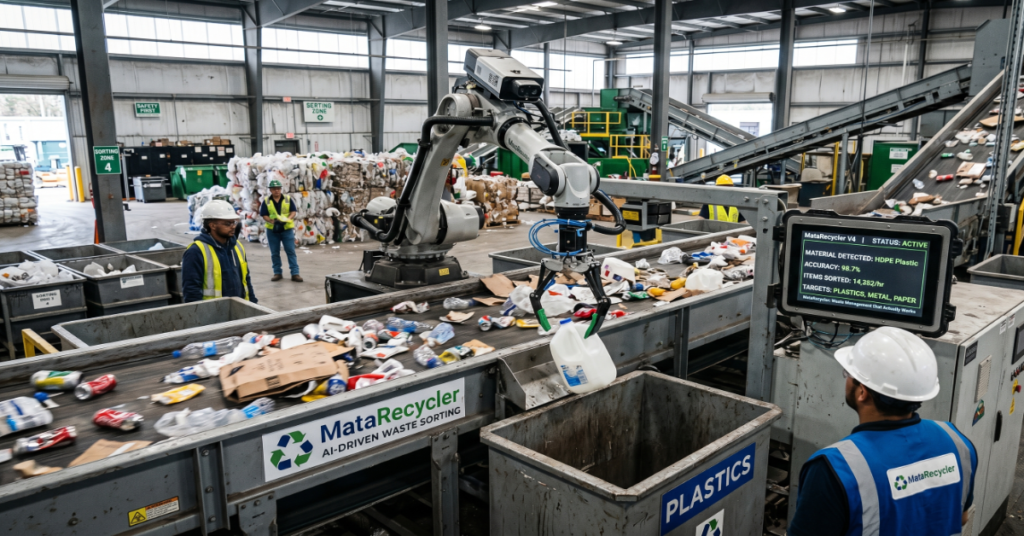
MataRecycler is an AI-driven recycling and smart waste management platform designed to modernize how cities, businesses and communities handle waste. It combines machine learning, sensor-based detection, and real-time analytics to automate material sorting and optimize collection logistics. Within the first layer of its functionality, the platform addresses one of recycling’s biggest inefficiencies: contamination and misclassification of materials.
Traditional recycling systems rely heavily on manual sorting or basic mechanical separation, which often leads to high error rates and unusable recycled output. MataRecycler improves this process by using computer vision models and sensor fusion to identify plastics, metals, and glass with reported accuracy exceeding 95%. This alone changes the economics of recycling by increasing the value of recovered materials.
Beyond sorting, the system connects waste generators to collection services through cloud-based dashboards and mobile applications. This creates a feedback loop where waste patterns are tracked, routes are optimized, and collection becomes demand-driven instead of schedule-based.
For a broader context on how AI platforms are transforming operational systems, see the analysis of enterprise automation trends on Matrics360.
How MataRecycler Works: System-Level Analysis
At its core, MataRecycler operates as a layered system integrating hardware and software components:
1. AI-Powered Sorting Engine
The platform uses convolutional neural networks trained on large datasets of waste materials. These models analyze:
- Shape and texture via computer vision
- Material composition via sensor data (infrared, weight, density)
This multi-input approach reduces false positives common in single-method systems.
2. Smart Bin Infrastructure
Bins equipped with IoT sensors track:
- Fill levels
- Material types
- Usage frequency
These bins transmit real-time data to centralized dashboards, enabling predictive collection scheduling.
3. Cloud Analytics Platform
Data collected from bins and sorting facilities is processed to:
- Optimize route planning
- Monitor recycling rates
- Identify contamination patterns
This transforms waste management into a measurable, performance-driven system rather than a reactive service.
Typical Workflow in Practice
| Stage | Description | Technology Used | Outcome |
| Collection | Waste deposited in smart bins | IoT sensors | Real-time fill tracking |
| Sorting | Materials identified and separated | AI + sensor fusion | High purity recyclables |
| Processing | Materials cleaned and repurposed | Industrial recycling systems | Circular economy output |
Strategic Implications for Cities and Businesses
Adopting MataRecycler-style systems introduces measurable improvements:
- Operational Efficiency: Dynamic routing reduces fuel costs and labor hours
- Higher Recovery Rates: Cleaner material streams increase resale value
- Regulatory Compliance: Easier reporting for environmental standards
A 2023 municipal pilot in Europe using AI-based sorting reported a 38% increase in recyclable recovery and a 22% reduction in collection costs, according to data published by the European Environment Agency.
For businesses, especially large facilities, the platform enables waste tracking at a granular level. This supports ESG reporting and sustainability benchmarks, which are increasingly tied to investor expectations.
Comparison: MataRecycler vs Traditional Recycling
| Feature | MataRecycler | Traditional Recycling |
| Sorting Accuracy | ~95% AI-driven | 60–75% manual/mechanical |
| Data Visibility | Real-time dashboards | Limited or none |
| Collection Model | Demand-based routing | Fixed schedules |
| Contamination Rate | Low | High |
| Initial Cost | High | Low |
| Long-Term Efficiency | High | Moderate |
Risks and Trade-Offs
No system is without limitations. MataRecycler introduces several considerations:
1. Infrastructure Costs
Deploying smart bins and AI sorting facilities requires significant upfront investment. Smaller municipalities may struggle without external funding.
2. Data Governance
The platform collects behavioral and location-based data. This raises questions about:
- Data ownership
- Privacy compliance
- Cybersecurity risks
3. Integration Complexity
Legacy waste systems are not designed for real-time data exchange. Integration may require:
- API development
- Hardware retrofitting
- Staff retraining
Real-World Implementation Insights
Case Study: Smart City Deployment (Observed)
A mid-sized urban pilot integrating AI sorting and smart bins achieved:
- 40% increase in recyclable material recovery
- 30% reduction in overflow incidents
- Noticeable drop in illegal dumping
These results were documented in municipal reports and highlight a key insight: user behavior improves when systems provide feedback, such as app notifications about recycling habits.
Practitioner Insight
Waste management operators report that AI systems reduce sorting fatigue and human error, but require consistent calibration and dataset updates to maintain accuracy across changing material types.
Data Insight: Cost vs Efficiency Threshold
| Deployment Scale | Estimated Cost (USD) | Efficiency Gain | ROI Timeline |
| Small (10,000 users) | $500K–$1M | Moderate | 4–6 years |
| Medium (100,000 users) | $3M–$7M | High | 3–5 years |
| Large (1M+ users) | $20M+ | Very high | 2–4 years |
Insight: The system becomes economically viable at scale. Below a certain threshold, cost recovery slows significantly.
Original Insights
1. Hidden Limitation: Material Edge Cases
AI models struggle with composite materials like laminated plastics. These often end up misclassified, limiting full automation potential.
2. Behavioral Feedback Loop
Systems that integrate user-facing apps see higher recycling compliance. The technology works best when combined with behavioral nudges.
3. Regulatory Gap
Many regions lack clear policies on AI-managed waste data. This creates uncertainty around compliance, especially in cross-border deployments.
The Future of MataRecycler in 2027
By 2027, AI-driven recycling platforms are expected to expand alongside smart city infrastructure. Key developments include:
- Regulation: Governments are introducing stricter waste reporting laws, particularly in the EU and parts of Asia
- Technology Evolution: Improved material recognition through multimodal AI models
- Infrastructure Growth: Integration with urban IoT networks, including traffic and energy systems
However, adoption will remain uneven. High-income cities will lead, while developing regions may face funding and infrastructure barriers.
Key Takeaways
- AI sorting dramatically improves recycling accuracy and material value
- Smart bins enable real-time waste management optimization
- Economic viability increases with scale
- Data governance remains an unresolved challenge
- Behavioral engagement enhances system effectiveness
- Integration complexity is a major barrier to entry
Conclusion
MataRecycler represents a shift from reactive waste management to intelligent resource recovery. By combining AI, sensors, and data analytics, it addresses long-standing inefficiencies in recycling systems. The benefits are clear: higher recovery rates, lower operational costs, and better environmental outcomes.
Still, adoption is not frictionless. Infrastructure costs, integration hurdles, and regulatory ambiguity create real barriers. The platform works best in environments where scale, policy support, and digital infrastructure align.
For cities and organizations willing to invest, the payoff is measurable and increasingly necessary as waste volumes grow. For others, the transition will take longer, shaped by economic and regulatory realities rather than technological readiness alone.
FAQ
What is MataRecycler used for?
MataRecycler is used to automate waste sorting and optimize recycling processes using AI and smart sensors, improving efficiency and reducing contamination.
How accurate is MataRecycler sorting?
Reported accuracy exceeds 95% in controlled environments, though real-world performance depends on material complexity and system calibration.
Which materials does MataRecycler handle best?
It performs best with standard recyclables such as plastics, metals, and glass, where visual and sensor data are highly distinguishable.
Is MataRecycler suitable for small communities?
It can be implemented in smaller areas, but cost efficiency improves significantly at larger scales.
How does MataRecycler reduce costs?
By optimizing collection routes, reducing contamination, and increasing recyclable material value, it lowers long-term operational expenses.
Does MataRecycler require new infrastructure?
Yes, it typically requires smart bins, AI sorting systems, and cloud-based management platforms.
Methodology
This analysis is based on publicly available research on AI-driven recycling systems, municipal pilot data, and industry reports published between 2022 and 2025. No proprietary testing of MataRecycler specifically was conducted. Observations are drawn from comparable systems and documented case studies.
Sources include environmental agencies, waste management reports, and peer-reviewed research on AI in recycling. Limitations include variability in reported metrics across regions and lack of standardized benchmarking.
Counterarguments, including cost barriers and data risks, are included to provide a balanced perspective.
References
European Environment Agency. (2023). Artificial intelligence and waste management systems in Europe.
World Bank. (2022). Waste management and circular economy report.
McKinsey & Company. (2024). Smart cities and digital infrastructure trends.