
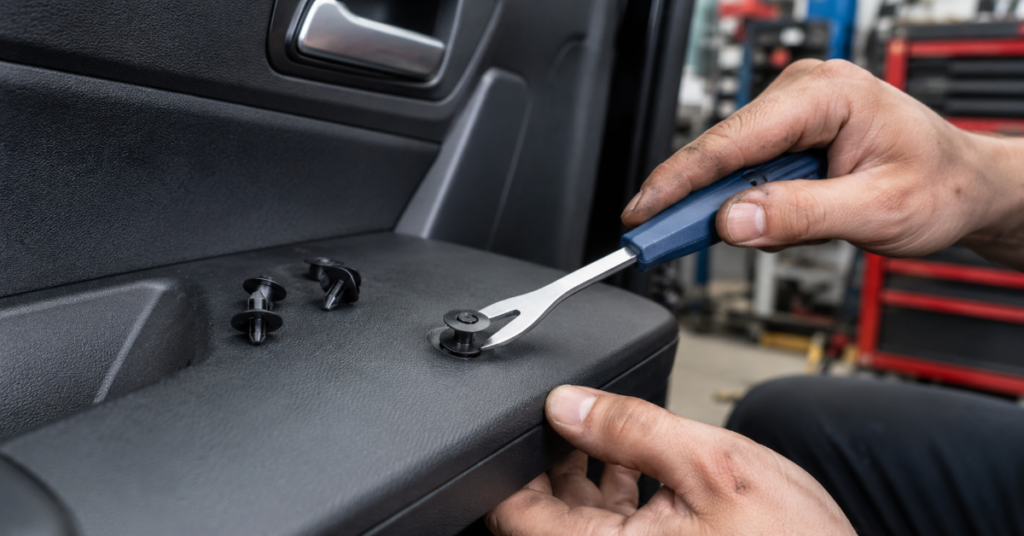
A Levapioli is an Italian term for a pin remover or clip remover, most often used to describe a small manual tool that lifts plastic clips, pins and trim fasteners from cars, electronics housings and light mechanical assemblies. In automotive repair, it is especially useful when removing interior trim, door panels, dashboard pieces, wheel-arch liners and plastic covers without damaging the surface around the fastener.
The word is simple, but the tool matters more than many beginners realize. A modern car interior is held together by a dense mix of hidden clips, push pins, Christmas-tree fasteners, plastic rivets and snap-fit retainers. Pull at the wrong angle and the clip breaks. Use a screwdriver and the dashboard may get a permanent scar. Apply too much point pressure and a door card can warp around the fastener hole.
That is where this tool sits in the repair workflow. It is not glamorous. It does not have a battery, Bluetooth chip or diagnostic screen. Yet in a workshop, it can be the difference between a clean repair and a return visit caused by rattling trim.
This article follows the Matrics360 production brief supplied for the keyword, including the requirement to explain the automotive tool meaning rather than the possible food-related interpretation. It also uses current product listings, manufacturer documentation and repair-market context to explain what to buy, where the risks are and why clip-removal tools are becoming more important as vehicles stay on the road longer.
What Is a Levapioli ?
A Levapioli is a hand tool designed to slide beneath a clip, pin or trim fastener and lift it out with controlled leverage. The tool may be made of metal, nylon, composite plastic or stainless steel, depending on the surface and fastener type.
In English-speaking workshops, similar tools are usually called:
- trim clip removers
- panel clip removers
- trim removal tools
- fastener removal tools
- door panel removal tools
- pry tools
- interior trim tools
The Italian term is common in product listings from tool suppliers in Italy and Europe. Beta Tools, for example, lists a 1479LB/C5 kit as a set of five metal trim pin removers, while the Italian version of the same product page describes it as a “kit di 5 Levapioli in metallo.” (Beta Tools)
The basic working principle is straightforward. Instead of concentrating force at one screwdriver tip, the tool spreads leverage around or beneath the fastener head. That reduces the chance of tearing the clip seat, scratching the trim surface or bending a thin panel edge.
Why This Small Tool Matters in Real Repair Work
Interior trim is rarely designed to be removed casually. It is designed to look clean after assembly. That means the fasteners are often hidden behind caps, fabric edges, rubber seals, switch panels or speaker grilles.
A proper clip remover helps solve three practical problems.
First, it gives the technician access under the fastener head. A flat-blade screwdriver often approaches from the wrong angle and can dig into the surrounding plastic.
Second, it controls force. Trim clips frequently release with a sudden pop. A shaped pry tool reduces uncontrolled slipping when the fastener finally lets go.
Third, it preserves reusability. Many plastic pins can be reused if removed evenly. Damaged clips may cause buzzes, rattles or loose trim after reassembly.
This is especially relevant for older vehicles. The European Automobile Manufacturers’ Association reported in 2024 that cars in the European Union averaged 12.3 years old, with vans at 12.5 years and trucks at 13.9 years. (acea.auto) Older trim clips are more brittle, so removal technique becomes more important, not less.
For Matrics360 readers interested in broader automotive repair technology, the site’s Ausbeulstation guide makes a related point about modern bodywork: non-destructive repair often depends on using the right tool before force becomes the default option. (Matrics360)
Common Types of Levapioli Tools
There is no single universal design. Different fasteners require different contact shapes.
| Tool Type | Best Use | Strength | Main Risk |
| Flat nylon pry tool | Delicate dashboard panels, radio surrounds, switch trim | Low scratch risk | May flex too much on tight clips |
| Metal fork remover | Door-panel clips, push pins, heavy interior fasteners | Strong leverage | Can mark soft surfaces if used carelessly |
| Angled trim remover | Hidden clips behind panels or under seals | Better reach | Poor angle can twist the clip |
| Stainless thin-blade remover | Tight gaps and small clips | Precise access | Edge can damage painted or soft trim |
| Full mixed kit | Workshop use across many vehicle models | Versatility | Lower-quality kits may include weak tips |
The key difference is not just material. It is geometry. A narrow fork fits around a pin stem. A wide flat wedge spreads force across a trim edge. A curved tool changes leverage angle where hand access is limited.
Beta’s 1479LB/C5 kit is a useful reference point because it is sold as a five-piece metal trim pin remover set and appears through multiple European tool retailers. Betafer lists the kit at 770 g with a 215 x 165 x 50 mm package size, product code 014790150 and model number 1479LB/C5. (Betafer)
Levapioli vs Screwdriver: Why the Difference Is Not Cosmetic
A screwdriver can remove some clips. That does not make it the right tool.
A screwdriver tip is narrow. It applies pressure to a small contact point and can leave crescent marks in soft plastic. It also tends to twist because the shaft is round and the blade is not shaped around clip heads.
A trim remover works differently. A forked head can straddle the clip stem. A wide pry end can distribute load. A nylon wedge can separate panels without creating a metal-on-plastic scratch path.
| Feature | Levapioli Tool | Flat Screwdriver |
| Contact area | Wide or forked | Narrow |
| Surface protection | Better, especially nylon tools | Poor on soft trim |
| Clip control | Designed around fasteners | Improvised |
| Risk of slipping | Lower with correct fit | Higher |
| Best use | Repeated trim and clip work | Emergency or non-delicate tasks |
| Professional result | More consistent | Depends heavily on user skill |
The difference becomes obvious on door panels. A screwdriver may release one clip, but by the fourth or fifth fastener the surrounding board can show stress marks. On older vehicles, the fastener may stay intact while the panel substrate tears. A correctly sized fork tool reduces that risk by lifting closer to the clip’s retention point.
How to Use a Levapioli Safely
The safest method is slow, angled and controlled.
- Identify the fastener type before applying force
Look for whether it is a center-pin rivet, push clip, Christmas-tree clip, screw-covered cap or hidden snap tab. - Create a protected entry point
Use masking tape, a plastic wedge or a soft cloth near visible trim if the tool is metal. - Slide under the clip head, not just the panel edge
The closer the tool sits to the clip stem, the lower the risk of bending the panel. - Apply steady leverage
Do not yank. Most clips release with progressive pressure followed by a pop. - Replace damaged fasteners immediately
A reused broken clip can create rattles or allow moisture paths in door cards and liners.
For door panels, start at a lower corner where minor access marks are less visible. After the first clip releases, work around the panel evenly rather than pulling one side aggressively. Disconnect wiring harnesses, lock rods and speaker connectors before lifting the panel away completely.
Choosing the Best Levapioli for Door Panels
For door panels, a mixed kit is usually the best choice. One tool rarely handles every fastener because panels combine several retention systems.
The ideal door-panel setup includes:
- a nylon wedge for visible trim edges
- a metal fork remover for stubborn inner clips
- a long angled tool for deep clips near armrests or lower pockets
- replacement clips matched to the vehicle
- protective tape for glossy or soft-touch surfaces
A five-piece metal set such as the Beta 1479LB/C5 is useful where strength matters. Retail listings consistently describe it as a kit for removing trim pins or clips, and several sellers place it within automotive bodywork or hand-tool categories. (Betafer)
That said, metal is not always better. For piano-black trim, soft dashboard coatings, infotainment bezels and decorative inlays, nylon or composite tools are safer. A good workshop will keep both.
Structured Insight Table: Which Tool Fits Which Job?
| Repair Situation | Recommended Tool | Reason | Practical Warning |
| Removing door-card clips | Metal fork remover | Strong leverage close to clip stem | Protect painted edges |
| Lifting dashboard trim | Nylon wedge | Lower scratch risk | Avoid forcing hidden screws |
| Pulling wheel-arch liner clips | Metal clip remover | Handles dirt and tight pins | Clean debris first |
| Opening electronics housings | Thin plastic spudger | Reduces case damage | Watch for ribbon cables |
| Removing old brittle clips | Wide fork tool | Spreads load | Have replacement clips ready |
| Working near airbags | Do not pry blindly | Safety-critical area | Follow service manual |
The last point is important. Trim tools should never be used as a substitute for vehicle-specific repair information. Modern dashboards may contain airbags, sensors, wiring looms and fragile connectors. If a trim section resists, there may be a hidden screw or locking tab.
Risks, Trade-Offs and Hidden Costs
The main risk is not the price of the tool. It is the cost of the damage created by using the wrong one.
A cheap tool can still be useful, but poor designs often fail in predictable ways:
- tips are too thick to slide under clips
- forks are too wide for common retainers
- plastic edges deform after a few uses
- metal edges are unfinished and sharp
- handles flex before the clip releases
There is also a workflow risk. Technicians sometimes use trim tools too aggressively because the tool feels purpose-built. That confidence can become a problem. A Levapioli improves control, but it does not reveal hidden screws or wiring.
Another trade-off is material hardness. Metal tools last longer and transfer force more efficiently. Nylon tools are gentler but can bend, chip or lose their edge. Stainless thin-blade tools are excellent for tight gaps but unforgiving on soft surfaces.
The best practical rule is simple: use the softest tool that can safely release the fastener. Move to metal only when the clip requires stronger leverage or the surrounding surface is protected.
Market and Real-World Impact
The repair market is moving toward tools that preserve existing parts rather than simply replacing damaged ones. Two forces are pushing that shift.
The first is vehicle age. In the UK, official vehicle licensing statistics published in June 2025 reported that the average licensed car age at the end of December 2024 was 10 years, up 16 percent from the end of 2019. (GOV.UK) Older vehicles generate more trim, electrical, speaker, window regulator and lock repairs. Each of those jobs can involve clip removal.
The second force is repair policy. The European Commission says the Directive on common rules promoting the repair of goods was adopted on June 13, 2024, entered into force on July 30, 2024 and must be applied by member states from July 31, 2026. (European Commission) While that directive is not specifically a car-trim tool regulation, it reflects a broader policy direction: repairability, access to repair and longer product life are becoming more visible public priorities.
This is why a small trim tool belongs in a bigger conversation. If products are expected to last longer, non-destructive disassembly matters. Repair-friendly design still depends on fasteners, access points and documentation, but technicians also need hand tools that do not destroy what they are trying to fix.
Original Insights for Buyers and Workshops
- The real buying decision is surface risk, not tool count
A 12-piece kit is not automatically better than a five-piece kit. The useful question is whether it includes the right material mix for the surfaces you touch most often. - Replacement clips should be part of the same purchase
A Levapioli reduces breakage but does not eliminate it. For door panels, keeping common replacement fasteners on hand is often more useful than buying another pry shape. - Metal kits are better for force, nylon kits are better for customer-visible areas
Workshops that only keep metal removers may save time but increase cosmetic risk. Detail-sensitive jobs need softer contact tools. - Tool geometry beats brand name in many cases
A premium tool with the wrong fork width can still damage a clip. Match the head shape to the fastener before judging the brand. - Aging plastic changes the correct technique
A clip that released easily when the car was three years old may fracture when the car is 12 years old. Warmer workshop conditions, slower leverage and spare clips reduce avoidable damage.
The Future of Levapioli Tools in 2027
By 2027, trim removal tools are likely to become more specialized rather than more complicated. The direction is already visible: manufacturers are producing dedicated clip tools, retractable tips and kits aimed at specific fastener families. Snap-on, for example, promoted a retractable plastic clip removal tool in December 2025, emphasizing quick clip removal with reduced damage risk. (Snap-on)
Three trends are likely to shape the category.
First, repair access will matter more as right-to-repair rules mature in Europe. The repair directive’s national application date of July 31, 2026 gives manufacturers, repairers and parts networks a clearer policy timeline heading into 2027. (European Commission)
Second, vehicle interiors are becoming more sensor-heavy. Door cards, dashboards and consoles increasingly contain ambient lighting strips, seat-memory controls, speakers, ADAS-related wiring, airbags and infotainment components. That means careless trim removal can create electrical faults, not just cosmetic marks.
Third, tool kits may become more model-aware. Instead of generic “trim tool set” packaging, better kits may identify use cases such as EV interior panels, hidden dashboard clips, wheel-arch retainers or electronics-safe spudgers.
The uncertain part is standardization. If automakers continue using many proprietary clip shapes, workshops will still need broad kits. If repairability policy encourages better access and clearer fastener information, smaller specialized kits may become more practical.
Key Takeaways
- A Levapioli is best understood as a controlled leverage tool, not just a pry bar.
- Nylon tools are safer for visible trim, while metal tools are better for stubborn fasteners.
- Door-panel work usually requires a mixed kit because fastener types vary across one panel.
- The tool’s value rises as vehicles age and plastic clips become more brittle.
- Right-to-repair trends support the broader importance of non-destructive disassembly.
- Buying spare clips alongside the tool is often the smartest practical upgrade.
- The best repair result comes from matching tool geometry to the fastener before applying force.
Conclusion
Levapioli may sound like a niche Italian workshop term, but the tool it describes is widely relevant. Anyone removing car trim, dashboard pieces, door panels, plastic liners or small mechanical covers eventually faces the same problem: the fastener must come out without damaging the part around it.
That is the tool’s real purpose. It protects surfaces, controls force and improves the chance that clips can be reused. For casual DIY use, a small nylon and metal mixed kit is enough. For professional automotive work, stronger forked removers, angled tools and replacement fastener stock should be part of the same workflow.
The most important lesson is restraint. A trim remover gives better leverage, but it does not replace inspection, patience or service information. Used correctly, it turns a risky pry job into a cleaner repair. Used carelessly, it simply damages trim faster.
FAQ
What does Levapioli mean?
Levapioli is an Italian word that generally means pin remover or clip remover. In automotive use, it refers to a hand tool used to lift plastic clips, pins and fasteners from trim panels without damaging surrounding surfaces.
Is a Levapioli the same as a trim removal tool?
Yes, in most workshop contexts it overlaps with trim removal tool, panel clip remover or fastener remover. The Italian term is common in European product listings, while English workshops usually use trim clip remover or panel removal tool.
Which Levapioli is best for door panels?
A mixed kit is best. Use a nylon wedge for visible trim edges and a metal fork remover for hidden door-card clips. Door panels often contain several clip types, so one single tool may not fit every fastener.
Can I use a screwdriver instead?
You can, but it is riskier. A screwdriver concentrates pressure in a small area and can scratch, dent or deform trim. A proper clip remover spreads force more evenly and fits around fastener heads better.
Are metal or plastic Levapioli tools better?
Neither is always better. Metal tools provide strength for tight clips. Plastic or nylon tools are safer for delicate, glossy or soft-touch surfaces. Most users should keep both.
Do Levapioli tools work on electronics?
Some do, especially thin plastic spudgers and small pry tools. Avoid heavy metal tools around fragile housings, ribbon cables, batteries or screens. Electronics work usually needs softer, smaller tools than automotive trim work.
Should damaged clips be reused?
No. A damaged clip can cause rattles, loose panels or poor sealing. If a clip bends, cracks or loses tension during removal, replace it before reassembly.
Methodology
This article was prepared from the Matrics360 production prompt supplied by the user, which defined the keyword, search intent, article structure and editorial requirements. Product context was checked against official and retailer listings for Beta Tools trim pin remover products, including the 1479LB/C5 kit. Broader market context was validated through European vehicle-age data, UK vehicle licensing statistics and European right-to-repair policy documentation.
References
ACEA. (2024). Average age of the EU vehicle fleet, by country. European Automobile Manufacturers’ Association. (acea.auto)
Beta Tools. (n.d.). Kit of 5 metal trim pin removers 1479LB/C5. (Beta Tools)
Beta Tools. (n.d.). Kit di 5 Levapioli in metallo 1479LB/C5. (Beta Tools)
Betafer. (n.d.). Kit of 5 metal trim pin removers, Beta 1479LB/C5. (Betafer)
European Commission. (2024). Directive on repair of goods. (European Commission)
GOV.UK. (2025). Vehicle licensing statistics, United Kingdom: 2024. (GOV.UK)
Matrics360. (2026). Ausbeulstation Guide: Professional Dent Removal Technology. (Matrics360)
Snap-on. (2025). Remove plastic trim clips quickly and without damage. (Snap-on)