
Software teams once deployed applications manually to individual servers. Scaling required purchasing additional hardware, configuring load balancers, and coordinating deployments across environments. That process was slow, error-prone, and difficult to maintain.
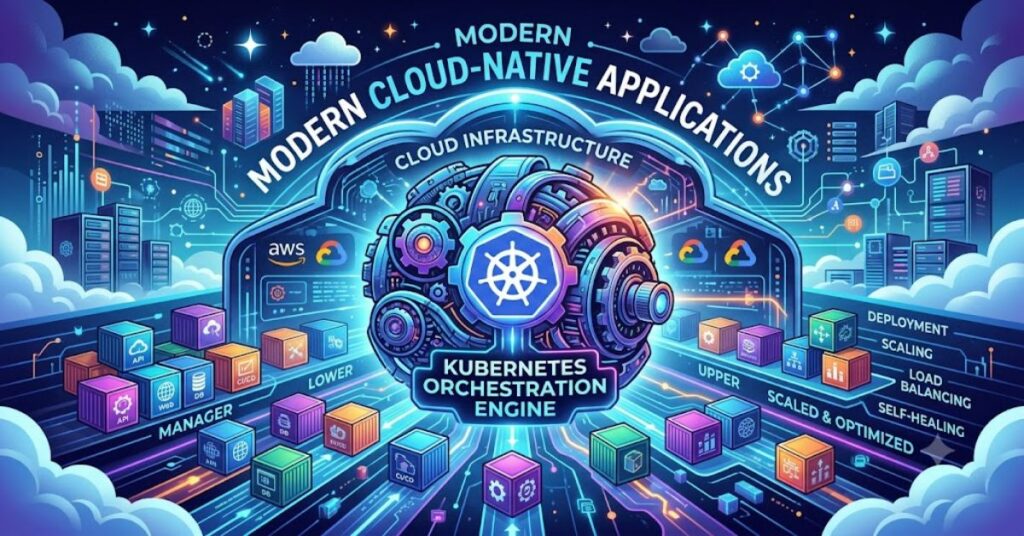
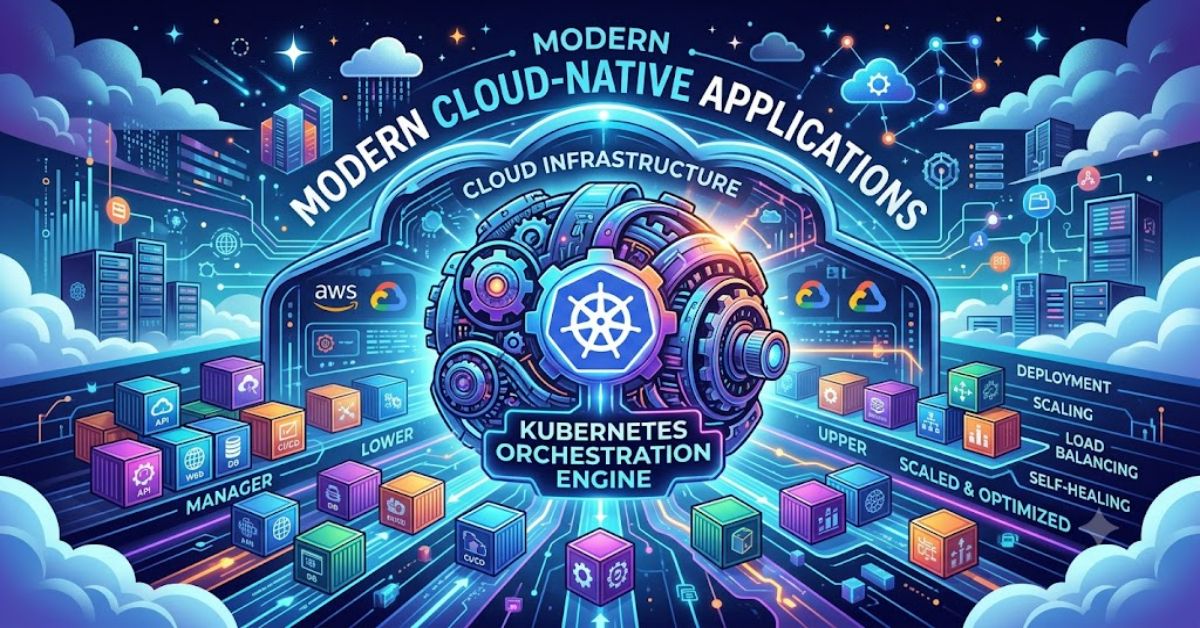
Today, kubernetes orchestration solves many of those challenges by automating how containerized applications are deployed, scaled, updated, and maintained. Kubernetes (often abbreviated as K8s) acts as an orchestration layer that continuously manages infrastructure resources and application workloads. Instead of operators manually managing every change, Kubernetes works toward a declared “desired state” and automatically reconciles the environment when conditions drift.
The result is a platform capable of maintaining high availability, improving resource utilization, and simplifying operations across public clouds, private data centers, and hybrid environments.
What began as an open-source project inspired by Google’s internal infrastructure practices has become one of the most influential technologies in modern computing. Organizations ranging from startups to Fortune 500 enterprises rely on Kubernetes to run customer-facing applications, data platforms, AI workloads, and internal business systems.
This article examines how Kubernetes orchestration works, where it delivers value, what risks it introduces, and why it remains central to cloud-native computing in 2026.
What Is Kubernetes Orchestration?
Kubernetes orchestration is the automated coordination of containerized workloads across a cluster of machines.
Rather than managing individual containers manually, operators define desired outcomes such as:
- Number of application replicas
- Resource allocations
- Networking rules
- Storage requirements
- Security policies
- Upgrade strategies
Kubernetes continuously monitors the cluster and takes corrective actions when actual conditions diverge from those desired outcomes.
How Kubernetes Orchestration Works
At a high level, Kubernetes consists of a control plane and worker nodes.
Control Plane Responsibilities
The control plane acts as the cluster’s decision-making layer.
Key components include:
| Component | Primary Function |
| API Server | Receives commands and cluster requests |
| Scheduler | Places workloads on appropriate nodes |
| Controller Manager | Maintains desired state |
| etcd | Stores cluster configuration data |
Worker Node Responsibilities
Worker nodes execute application workloads.
Each node contains:
- Container runtime
- Kubelet agent
- Networking components
- Monitoring interfaces
When an application deployment is submitted, the scheduler determines where workloads should run based on available resources and policies. The system then continuously monitors application health and infrastructure status.
Why Organizations Adopt Kubernetes
Several business and technical drivers explain Kubernetes’ widespread adoption.
1. Automated Scaling
Traffic rarely remains constant.
Applications may experience:
- Seasonal spikes
- Marketing-driven surges
- Global demand fluctuations
- AI workload bursts
Kubernetes can automatically add or remove application instances based on resource consumption and workload requirements.
2. High Availability
Failures are inevitable.
Servers fail.
Containers crash.
Networks experience interruptions.
Kubernetes automatically replaces failed workloads and redistributes applications across available resources to minimize downtime.
3. Infrastructure Portability
Applications can run across:
- On-premises environments
- Public cloud platforms
- Multi-cloud deployments
- Edge infrastructure
This portability reduces dependence on any single provider.
4. Operational Consistency
Development, testing, staging, and production environments can operate under the same orchestration model.
Consistency reduces deployment surprises and accelerates software delivery.
Kubernetes Versus Traditional Deployment Models
| Capability | Traditional Infrastructure | Kubernetes |
| Manual deployment effort | High | Low |
| Automatic scaling | Limited | Native |
| Self-healing | Rare | Built-in |
| Resource utilization | Often inefficient | Optimized |
| Multi-cloud support | Complex | Strong |
| Rolling updates | Manual | Automated |
| Service discovery | Custom implementation | Native |
The Business Impact of Kubernetes Orchestration
The importance of Kubernetes extends beyond engineering teams.
The Cloud Native Computing Foundation (CNCF) reports that cloud-native adoption continues to expand globally, with Kubernetes serving as the foundation for modern application infrastructure. Production Kubernetes usage increased significantly between 2023 and 2025, reflecting its transition from experimental technology to enterprise standard.
Real-World Benefits
Organizations commonly report:
- Faster software releases
- Improved reliability
- Reduced deployment errors
- Better infrastructure utilization
- Enhanced disaster recovery readiness
These outcomes directly influence revenue generation, customer experience, and operational efficiency.
Kubernetes and AI Workloads
A major shift has emerged over the last two years.
Kubernetes is increasingly becoming the infrastructure layer for artificial intelligence applications.
According to CNCF survey data, 66% of organizations hosting generative AI models use Kubernetes for at least some inference workloads, while 82% of container users now operate Kubernetes in production.
Why AI Teams Use Kubernetes
AI systems require:
- GPU scheduling
- Elastic scaling
- Resource isolation
- Automated deployment pipelines
- High availability
Kubernetes provides a common operational framework capable of supporting these requirements.
Original Insight #1
Many discussions focus on Kubernetes as an AI deployment platform, but the larger advantage is operational standardization. Organizations can use the same governance, monitoring, security, and deployment practices across both traditional software and AI services, reducing platform fragmentation.
Risks and Trade-Offs
No technology solves every problem.
Kubernetes introduces complexity that organizations must manage carefully.
Complexity Overhead
Small teams may find Kubernetes excessive for simple applications.
Operating clusters requires expertise in:
- Networking
- Security
- Observability
- Resource management
- Platform engineering
Cost Management Challenges
Resource overprovisioning remains common.
Organizations frequently allocate more CPU and memory than workloads actually consume, increasing cloud spending. Community discussions and industry reports continue to identify resource inefficiency as a major challenge.
Cultural Challenges
The 2025 CNCF survey identified organizational change as the leading obstacle to cloud-native adoption, surpassing technical barriers. Teams often struggle more with operational transformation than with the software itself.
Original Insight #2
Many Kubernetes projects fail not because the technology is inadequate, but because organizations underestimate the need for platform ownership. Successful deployments typically establish dedicated platform engineering practices rather than distributing responsibility across unrelated teams.
Kubernetes Resource Optimization
One of the most valuable orchestration capabilities is efficient resource allocation.
Common Optimization Techniques
| Technique | Benefit |
| Horizontal Pod Autoscaling | Adds replicas during demand spikes |
| Vertical Pod Autoscaling | Adjusts container resource requests |
| Cluster Autoscaling | Expands or shrinks node pools |
| Resource Quotas | Prevents runaway consumption |
| Node Affinity | Optimizes workload placement |
Research continues to explore more advanced autoscaling approaches that combine performance objectives with cost-awareness. Recent studies suggest significant improvements in both reliability and infrastructure efficiency through intelligent scaling strategies.
Original Insight #3
The next competitive advantage in Kubernetes will likely come less from orchestration itself and more from intelligent resource optimization. As cloud costs increase, organizations that master workload efficiency will gain stronger economic advantages than those merely operating larger clusters.
Observability and Reliability
Modern Kubernetes environments require deep visibility.
Organizations increasingly rely on:
- Metrics collection
- Distributed tracing
- Log aggregation
- Profiling systems
The growing adoption of OpenTelemetry and related observability projects highlights the industry’s focus on operational transparency.
Without observability, teams may struggle to:
- Diagnose failures
- Understand latency issues
- Track resource consumption
- Identify bottlenecks
Structured Insight Table: Kubernetes Adoption Trends
| Trend | Industry Direction |
| Production adoption | Continues expanding globally |
| AI deployment | Increasing reliance on Kubernetes |
| Platform engineering | Becoming a strategic discipline |
| GitOps adoption | Growing among mature organizations |
| Observability investment | Rising rapidly |
| Multi-cloud usage | Increasing operational importance |
| Cost optimization | Emerging executive priority |
Sources: CNCF Annual Surveys 2024–2025.
The Future of Kubernetes Orchestration in 2027
Several trends are likely to shape Kubernetes through 2027.
AI-Native Infrastructure
AI deployment requirements will continue driving innovation around:
- GPU scheduling
- Distributed training
- Inference optimization
- Resource-aware orchestration
Platform Engineering Growth
Organizations increasingly treat internal platforms as products rather than infrastructure projects.
Smarter Automation
Machine-learning-assisted operations may improve:
- Incident response
- Capacity planning
- Root-cause analysis
- Cost optimization
Research into AI-assisted Kubernetes operations already demonstrates promising results for diagnosing cluster failures and operational incidents.
Reality Check
While adoption will likely grow, Kubernetes will not replace every infrastructure model. Simpler deployment platforms remain attractive for smaller applications where operational overhead outweighs orchestration benefits.
Key Takeaways
- Kubernetes automates deployment, scaling, networking, and recovery for containerized applications.
- Desired-state reconciliation remains the foundation of Kubernetes architecture.
- Enterprise adoption continues to grow, particularly for AI workloads.
- Organizational transformation is often harder than technical implementation.
- Cost optimization remains a major operational challenge.
- Platform engineering is becoming a strategic business capability.
- Future innovation will focus on automation, efficiency, and AI-native operations.
Conclusion
Kubernetes orchestration has matured into one of the most important infrastructure technologies of the modern software era. Its ability to automate deployment, scaling, self-healing, and resource management has fundamentally changed how organizations build and operate applications.
The platform’s success stems from a simple but powerful principle: operators declare what they want, and the system continuously works to make reality match that intent. That approach enables resilience, consistency, and operational efficiency at scales that would be difficult to achieve manually.
Yet Kubernetes is not a universal solution. The platform introduces complexity, operational responsibilities, and cultural changes that organizations must address deliberately. Teams that invest in platform engineering, observability, and cost management tend to realize the greatest benefits.
As AI, cloud-native architectures, and distributed systems continue to expand, Kubernetes appears positioned to remain a central orchestration layer for the next generation of digital infrastructure.
FAQ
What is Kubernetes orchestration?
Kubernetes orchestration automates the deployment, scaling, networking, and management of containerized applications across a cluster of machines.
How does Kubernetes maintain desired state?
Kubernetes controllers continuously compare actual cluster conditions with declared configurations and make adjustments to reconcile differences.
Is Kubernetes only for large enterprises?
No. Small organizations can use Kubernetes, although simpler deployment platforms may be more practical for smaller workloads.
Why is Kubernetes popular for AI applications?
It provides scalable infrastructure, resource management, automation, and operational consistency needed for AI deployment and inference workloads.
What are the biggest Kubernetes challenges?
Complexity, cost optimization, security management, observability requirements, and organizational adoption are common challenges.
Does Kubernetes reduce cloud costs?
It can improve efficiency, but poorly configured clusters may increase spending through overprovisioning and unused resources.
What is Kubernetes reconciliation?
Reconciliation is the continuous process of aligning the actual cluster state with the desired state defined by users and applications.
Methodology
This analysis was developed using official Kubernetes documentation, CNCF annual survey findings, industry reports, peer-reviewed research, and community discussions. Priority was given to recent sources published between 2024 and 2026. Survey findings were cross-referenced with independent research and practitioner commentary to identify both benefits and operational challenges.
Limitations include variation in adoption metrics across surveys and differences in organizational maturity among respondents. Future projections are based on documented industry trends rather than speculative forecasts.
Editorial Disclosure: This article was drafted with AI assistance and should be reviewed and verified by the editorial team before publication. All statistics, references, and claims should be independently confirmed before publishing.
References (APA)
Cloud Native Computing Foundation. (2025). Cloud Native 2024: Approaching a decade of code, cloud, and change. CNCF. https://www.cncf.io/reports/cncf-annual-survey-2024/
Cloud Native Computing Foundation. (2026). The infrastructure of AI’s future: CNCF annual cloud native survey. CNCF. https://www.cncf.io/reports/the-cncf-annual-cloud-native-survey/
Cloud Native Computing Foundation. (2026). Kubernetes established as the de facto operating system for AI. CNCF. https://www.cncf.io
Kubernetes Documentation. (2025). Objects in Kubernetes. Kubernetes Project. https://kubernetes.io/docs/concepts/abstractions/overview/
Punniyamoorthy, V., Kumar, B., Saha, S., Butra, L., Palanigounder, M., Agarwal, A., & Kannan, K. (2025). An SLO driven and cost-aware autoscaling framework for Kubernetes. arXiv.
Roberts, J., Archibald, B., & Trinder, P. (2025). Signalling health for improved Kubernetes microservice availability. arXiv.
Xiang, Y., Chen, C. P., Zeng, L., Yin, W., Liu, X., Li, H., & Xu, W. (2025). Simplifying root cause analysis in Kubernetes with StateGraph and LLM. arXiv.