
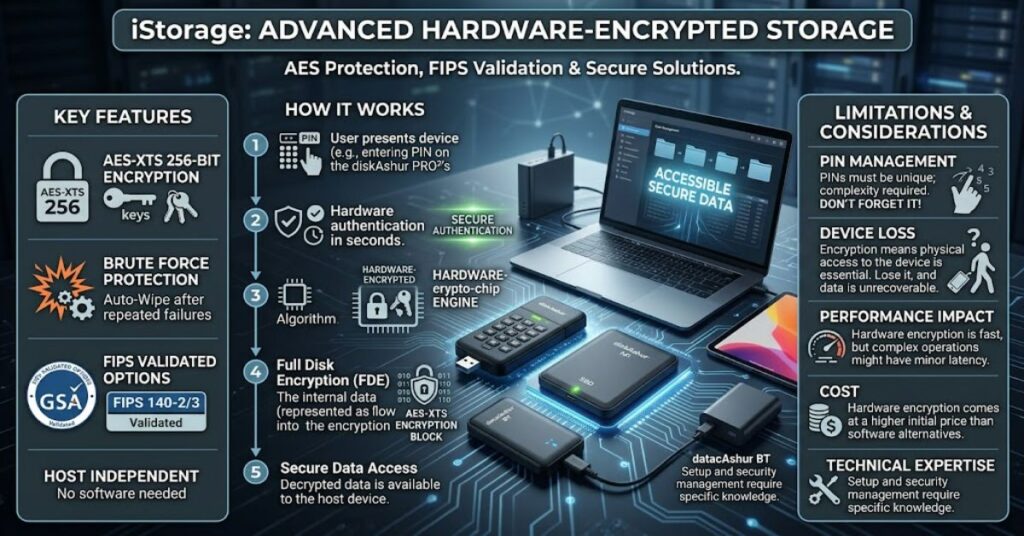
iStorage is a technology company focused on secure data-storage devices. Its product range includes hardware-encrypted USB flash drives, external HDDs and SSDs designed to protect sensitive information while it is stored or transported.
The main difference between these devices and a standard USB drive is that security is built into the hardware. Instead of depending entirely on software installed on a computer, supported iStorage products use integrated encryption and authentication mechanisms.
This matters when a storage device contains confidential documents, financial records, customer information, intellectual property or other sensitive files. If an ordinary unencrypted drive is lost, whoever finds it may be able to access the contents. A hardware-encrypted drive is designed to keep those files inaccessible until the correct authentication method is provided.
The company has developed several product families, including datAshur and diskAshur devices. Smaller USB drives are intended for portable storage, while external HDD and SSD products provide greater capacity.
However, encrypted storage should not be treated as a complete cybersecurity system. It solves one particular problem: protecting information stored on the device when it is locked.
How iStorage Hardware Encryption Works
Hardware encryption places important cryptographic operations inside the storage device itself. Supported products use AES encryption, while authentication can involve a physical PIN keypad or other supported mechanisms depending on the model.
The basic process is simple:
- The user authenticates the device.
- The drive unlocks and provides access to its stored information.
- Files can be transferred through the supported connection.
- The device can lock again according to its security configuration.
This approach can be useful in environments where employees need to use protected storage across multiple computers. Because the security functionality is integrated into the device, dependence on a particular host operating system or separate encryption application can be reduced.
| Security feature | iStorage approach | Practical importance |
| Encryption | Hardware-based AES encryption on supported models | Protects stored information |
| Authentication | PIN-based or supported authentication | Restricts device access |
| Processing | Integrated into device hardware | Reduces dependence on host software |
| Physical protection | Available on selected models | Helps protect the device from environmental damage |
| Certification | FIPS-validated options available | Useful for certain compliance requirements |
| Connectivity | USB interfaces across product families | Supports portable workflows |
| Automatic locking | Available on supported products | Reduces exposure when the device is unattended |
Specifications differ between models, so buyers should always check the documentation for the exact product being considered.
iStorage and FIPS 140-3 Level 3
One of the most important independently verifiable aspects of the iStorage range is its FIPS validation.
The National Institute of Standards and Technology lists certificate #4918 for the datAshur PRO as a FIPS 140-3 Level 3 hardware cryptographic module. The certificate is identified as active through December 15, 2029.
This distinction matters because FIPS validation is different from a manufacturer’s general claim that a product is highly secure. The certification applies to a defined cryptographic module and its implementation against established security requirements.
iStorage has also announced FIPS 140-3 Level 3 validation for its datAshur PRO+C and PRO+A products.
Buyers should still verify the specific certification associated with the model they intend to purchase. A certification attached to one product or cryptographic module should not automatically be assumed to apply to every device sold under the same brand.
Main iStorage Product Types
Secure USB Flash Drives
The datAshur range is designed for portable encrypted storage. Devices such as the datAshur PRO combine hardware encryption with authentication and physical protection features.
These drives are particularly useful for people who regularly transport confidential files between locations or computer systems.
External HDDs and SSDs
The diskAshur range targets users who need more storage capacity than a conventional encrypted flash drive provides.
This can make encrypted external storage relevant for larger business datasets, backups, media projects and other workloads where portable capacity is important.
Removable Storage
Some products take a removable-media approach, allowing users to change storage cards while retaining the secure hardware platform.
This can be useful when organisations need to keep different datasets physically separated.
iStorage vs an Ordinary USB Drive
The most important difference is the location of the security controls.
A standard USB drive generally provides storage but does not automatically provide device-level encryption or authentication. Security may instead depend on software encryption, operating-system features or the way individual files are protected.
| Factor | Ordinary USB drive | Hardware-encrypted iStorage device |
| Basic storage | Yes | Yes |
| Hardware encryption | Usually unavailable | Core feature on supported models |
| Device authentication | Usually unavailable | Available on supported models |
| FIPS-validated options | Uncommon | Available for selected products |
| Portable security | Often software-dependent | Integrated into device |
| Physical protection | Model dependent | Enhanced on selected products |
| Enterprise use | Depends on security controls | Useful for specific secure-storage requirements |
This does not mean an encrypted drive is automatically the best option for every organisation. A business with centrally managed laptops, strong endpoint encryption and cloud-based document management may have limited need for large amounts of removable storage.
The technology becomes more valuable when sensitive information must physically leave a controlled environment.
Practical Uses for iStorage
Hardware-encrypted storage can serve several practical purposes.
Sensitive business documents: Contracts, financial records, customer exports and proprietary files can benefit from protection when transported on removable media.
Professional services: Firms handling confidential client information can use encrypted devices as part of their data-protection controls.
Government-related work: Organisations subject to specific procurement or cryptographic requirements may benefit from products with appropriate certification.
Remote work: Employees moving sensitive files between offices, worksites or home offices face a physical-loss risk that cloud security alone may not address.
Protected backups: An encrypted external drive can provide an additional protected copy of important information. However, it should be part of a wider backup strategy rather than the only copy.
Cybersecurity guidance from CISA has highlighted the risks associated with portable devices and recommends encryption for sensitive information stored on removable media.
Important Limitations
The biggest mistake is assuming that encryption solves every security problem.
Encryption protects stored information when the device is locked. It does not necessarily protect a computer that has already been compromised.
For example, if a user unlocks an encrypted drive and connects it to malware-infected equipment, malicious software may potentially interact with accessible files. The encryption itself has not failed; the threat has moved to another layer of the environment.
There are other limitations too.
A secure PIN still needs to be managed properly. Lost credentials can create operational problems, while weak authentication practices can reduce security.
Encryption also does not create redundancy. If a company stores its only copy of an important project on an encrypted SSD and that drive fails, the information may be lost.
The distinction is therefore simple: protecting storage is different from protecting the entire computing environment.
Three Key Insights for Buyers
Certification should be checked by model.
FIPS validation applies to particular cryptographic modules. Buyers should confirm the exact certificate and product configuration instead of assuming that every iStorage device has identical certification.
Physical protection and encryption address different risks.
A rugged enclosure can help protect hardware from impact, water or dust. Encryption protects the information from unauthorised access. Strong physical construction does not replace encryption, and encryption does not prevent physical damage.
Encrypted storage is not a backup strategy by itself.
A secure drive can protect files from unauthorised access after theft, but it cannot recover data after hardware failure. Important information needs appropriately protected backup copies.
The Future of iStorage in 2027
Portable encrypted storage is likely to remain relevant even as cloud services become more common.
Not every environment can depend entirely on cloud connectivity. Field workers, government contractors, media professionals and organisations operating within restricted networks may still need physical storage.
The bigger change is likely to involve management rather than basic encryption. Organisations increasingly expect security products to fit into wider identity management, auditing, data classification and compliance programmes.
Certification will also remain important. FIPS 140-3 has become the current framework for new cryptographic module validations, making it increasingly important for buyers to distinguish formal validation from general security marketing.
By 2027, the strongest role for products such as iStorage will likely be controlled portable data handling. The device can provide an important security layer, but its effectiveness will depend on how it fits into the organisation’s wider security architecture.
Key Takeaways
- iStorage focuses on hardware-encrypted storage for portable and external data.
- Supported products use hardware-based AES encryption and device-level authentication.
- Selected models have FIPS 140-3 Level 3 validation.
- Certification should always be checked against the specific product and cryptographic module.
- Hardware encryption is particularly useful when sensitive data must be transported physically.
- Encryption does not replace endpoint security, backups or access-management controls.
- The technology is best understood as one layer within a broader data-security strategy.
Conclusion
iStorage occupies a specialised position in the storage market by combining conventional data storage with hardware-based encryption and authentication. Its products are particularly relevant when sensitive information needs to be transported or stored outside centrally managed systems.
The strongest differentiator is the availability of independently validated cryptographic modules on selected products. FIPS 140-3 Level 3 validation can be especially relevant for organisations with defined security or procurement requirements.
At the same time, encrypted hardware should not be evaluated as a standalone cybersecurity solution. Effective protection also depends on strong authentication, secure computers, backup procedures, access controls and appropriate data-handling policies.
For consumers, freelancers and businesses, the right question is therefore not simply whether an encrypted drive is secure. It is whether the device’s encryption method, authentication system, capacity, certification and physical protections match the specific risks involved.
Frequently Asked Questions
What is iStorage used for?
iStorage products are designed to securely store and transport digital information. Its portfolio includes encrypted USB flash drives, external HDDs and SSDs intended for personal, professional and organisational use.
Is iStorage hardware encrypted?
Yes. Supported iStorage products use hardware-based encryption. The company’s encrypted storage devices are designed to protect stored information without relying entirely on software encryption installed on a host computer.
Is iStorage FIPS certified?
Selected iStorage products have FIPS validation. NIST lists a FIPS 140-3 Level 3 validation for the datAshur PRO cryptographic module. Certification should be confirmed for the exact model being purchased.
Is iStorage better than a normal USB drive?
For sensitive information, a hardware-encrypted device can offer security controls that an ordinary USB drive may not provide. Whether it is better depends on the user’s security requirements, capacity needs and existing infrastructure.
Can iStorage replace cloud backup?
No. Encrypted physical storage and backup serve different purposes. An encrypted drive can protect stored information, while a backup strategy provides additional copies that can help with recovery after data loss.
Does hardware encryption protect against malware?
Not completely. Encryption protects information while the device is locked. Once an authorised user unlocks the device, malware on the connected computer can potentially interact with accessible files.
Methodology
This article was prepared using publicly available information from iStorage, the National Institute of Standards and Technology and the Cybersecurity and Infrastructure Security Agency. Primary documentation was prioritised when discussing product features and certification.
No physical iStorage product was independently tested for this article. Therefore, no claims are made about independent performance, transfer speeds, durability or real-world benchmark results.
The strongest independent evidence concerns FIPS validation recorded by NIST for specific iStorage cryptographic modules. Cybersecurity guidance regarding portable-device risks was also considered when assessing the wider role of encrypted removable storage.
Product specifications and certification status can change between models and over time. Readers should verify current documentation before making procurement or compliance decisions.
Editorial disclosure: This article was drafted with AI assistance and should be reviewed and independently verified by the Matrics360.com editorial team before publication.
References
- Cybersecurity and Infrastructure Security Agency. (2024). The risks of using portable devices. U.S. Department of Homeland Security.
- National Institute of Standards and Technology. (2024). Security guidelines for storage infrastructure (NIST Special Publication 800-209). U.S. Department of Commerce.
- National Institute of Standards and Technology. (2024). Cryptographic Module Validation Program: Certificate #4918. U.S. Department of Commerce.
- iStorage. (2024). FIPS 140-3 Level 3 validated: datAshur PRO+C and PRO+A. iStorage Ltd.
- iStorage. (2026). Secure data storage solutions and product information. iStorage Ltd.
Human verification note: Product specifications, certification status and reference details should be manually checked against the original sources before publication. No firsthand product testing is claimed.