
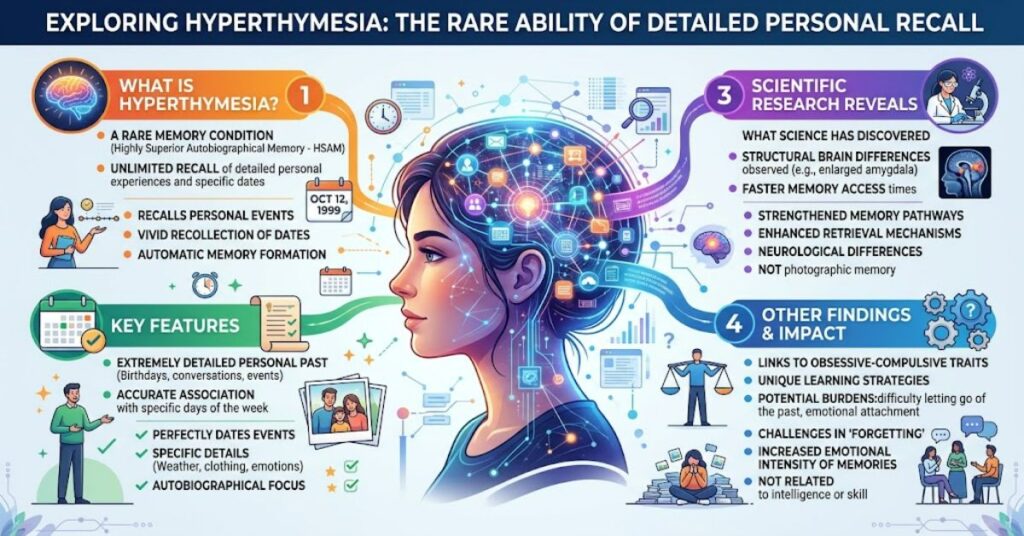
Hyperthymesia is a rare neurological phenomenon in which a person can recall an unusually large number of personal experiences, often identifying the exact dates when events occurred. Also called highly superior autobiographical memory (HSAM), it has attracted scientific interest because it challenges conventional ideas about how people store and retrieve memories.
Most people rely on photographs, diaries or reminders to reconstruct events from years earlier. Someone with this ability may remember what they did on a particular date, where they went and what happened around them. These recollections can feel vivid and immediate, even when the events occurred long ago.
However, hyperthymesia is not the same as having a photographic memory. It does not mean someone remembers every fact, learns new information instantly or possesses flawless recall. Its defining feature is exceptional autobiographical memory: remembering experiences from one’s own life.
Scientific research into the phenomenon gained attention in 2006, when researchers documented a woman who could recall extensive details about her personal history. Later studies examined memory performance, brain activity and the possible role of repeated recollection.
Understanding this rare ability requires distinguishing established evidence from popular assumptions. Although it may provide valuable insights into human cognition, many questions remain about why it develops, how it affects everyday life and whether its advantages come with particular challenges.
What Causes Hyperthymesia?
Scientists have not established one definitive cause. Research suggests that differences in autobiographical memory retrieval, mental habits and the brain networks involved in recalling personal experiences may contribute.
Memory generally involves several connected processes:
- Encoding: The brain processes information from an experience.
- Consolidation: Memories become more stable over time.
- Retrieval: Stored information is accessed when a person remembers an event.
Researchers are investigating whether people with HSAM differ in how they retrieve and organise personal memories. Repeatedly revisiting past experiences may also help make certain memories more accessible, although this does not fully explain the phenomenon.
A systematic review by Talbot and colleagues examined experimental research on highly superior autobiographical memory. Its findings suggested differences in activity within the brain’s autobiographical memory network, but the available evidence did not establish a single structural or neurological explanation that accounts for every case.
Hyperthymesia therefore remains an active research topic rather than a condition with a fully understood biological mechanism.
How It Differs from Other Memory Abilities
Memory is not one single skill. People may excel at remembering numbers, visual details or learned facts without having unusually strong autobiographical recall.
| Memory type | Main characteristic |
| Hyperthymesia | Exceptional recall of personal experiences and dates |
| Eidetic imagery | Brief retention of detailed visual images |
| Mnemonic memory | Recall supported by deliberate memorisation techniques |
| Semantic memory | Knowledge of facts, meanings and concepts |
| Working memory | Temporarily holding and manipulating information |
A 2012 study by LePort and colleagues investigated 11 people with HSAM. Participants demonstrated exceptional autobiographical recall, but their performance was broadly comparable to control participants on most standard laboratory memory tests.
This finding is important because it challenges the assumption that exceptional personal memory automatically produces superior general intelligence or learning ability.
What Is It Like to Have Highly Superior Autobiographical Memory?
One of the best-known cases was reported by Elizabeth Parker, Larry Cahill and James McGaugh in 2006. Their research described a woman identified as AJ who could recall numerous personal events and connect them to particular calendar dates.
Her recollections appeared frequently and sometimes felt difficult to control. This account showed that exceptional memory is not necessarily a simple advantage.
Other research participants have demonstrated similarly unusual abilities to retrieve personal experiences when given date-based cues. However, experiences vary, and scientists cannot assume that everyone with HSAM remembers events in precisely the same way.
Does exceptional recall guarantee accuracy?
No. A memory can feel vivid and convincing without preserving every detail correctly. People reconstruct experiences using available information, personal interpretations and later knowledge.
Researchers can sometimes check recalled dates against diaries, public records or other evidence. Such verification is more reliable than treating confidence alone as proof.
This distinction is especially important when considering eyewitness testimony. Even someone with extraordinary autobiographical recall should not automatically be considered an infallible witness.
Benefits and Possible Challenges
Exceptional recall may help people revisit personal experiences and remember details that others have forgotten. Nevertheless, the ability can also create difficulties.
Unwanted memories: Some documented individuals have described frequent recollections that feel automatic or exhausting.
Emotional persistence: Distressing experiences may remain easy to access, although HSAM does not automatically imply trauma or a mental health disorder.
Attention demands: Frequently recalling past events may compete with attention needed for present activities. The extent of this effect varies between individuals.
Social misunderstandings: People with unusually strong autobiographical memory may remember dates and interactions that others cannot. Ordinary forgetting, however, is common and does not necessarily indicate that someone considers an event unimportant.
The evidence remains limited because the condition is rare and research groups are relatively small. It would therefore be misleading to claim that all people with HSAM experience emotional difficulties or that the condition inevitably disrupts daily life.
What Hyperthymesia Reveals About the Brain
Research into HSAM has broader implications for understanding personal identity and human memory.
First, exceptional recall appears to be domain-specific. Strong autobiographical performance does not necessarily translate into superior working memory, general knowledge or learning ability.
Second, the process of retrieving memories may deserve as much attention as the process of storing them. Studies of brain activity suggest that established autobiographical memory networks are involved, but further research is needed to understand the precise mechanisms.
Third, remembering more does not automatically mean understanding the past better. Personal memories help shape identity, yet people interpret their experiences through changing beliefs, emotions and circumstances.
These findings suggest that memory should not be viewed as a perfect recording system. It is a complex process that combines retained information with reconstruction and interpretation.
The Future of Hyperthymesia in 2027
Research into hyperthymesia may progress through larger studies, more consistent assessment methods and improved brain-imaging techniques. These are potential research directions, not guaranteed discoveries.
Researchers need clearer criteria for identifying HSAM and distinguishing it from ordinary strong autobiographical memory or deliberate memorisation. Longitudinal studies could also help explain how the ability changes over time.
Brain-imaging research may clarify how memory-related regions coordinate during recall. However, imaging alone cannot establish the cause of the condition or explain every person’s subjective experience.
By 2027, the most useful progress will likely depend on reproducible evidence rather than dramatic claims about perfect memory. Any proposed applications in healthcare or legal settings would require careful testing before being adopted.
Key Takeaways
- Hyperthymesia concerns unusually strong autobiographical recall.
- The phenomenon was documented in a widely discussed research report published in 2006.
- Exceptional personal memory does not guarantee superior performance across all cognitive tasks.
- Scientists have identified possible differences in memory networks, but the precise cause remains uncertain.
- Vivid recollections can still contain inaccuracies.
- The condition may be helpful for some individuals while making unwanted memories difficult for others.
- Larger, carefully designed studies are needed to understand its long-term effects.
Frequently Asked Questions
1. What is hyperthymesia?
It is a rare memory phenomenon involving unusually detailed recall of personal experiences and associated dates. It is also known as highly superior autobiographical memory.
2. Is hyperthymesia the same as photographic memory?
No. Hyperthymesia concerns personal experiences, while photographic memory usually refers to supposedly exact visual recall. The terms describe different abilities.
3. Can people with hyperthymesia remember everything?
No. Their exceptional ability centres on autobiographical memory. They do not necessarily remember every fact or outperform others in every type of memory test.
4. What causes hyperthymesia?
The precise cause remains unknown. Research suggests that differences in autobiographical memory retrieval and brain-network activity may contribute.
5. Is hyperthymesia a disorder?
Not automatically. Some people report distress associated with frequent recollections, but the experience varies. Persistent or disruptive memory concerns should be discussed with a qualified health professional.
6. Can hyperthymesia improve eyewitness reliability?
Not necessarily. Detailed recall does not guarantee complete accuracy. Eyewitness accounts must still be assessed alongside independent evidence.
References
LePort, A. K. R., Mattfeld, A. T., Dickinson-Anson, H., Fallon, J. H., Stark, C. E. L., Kruggel, F., Cahill, L., & McGaugh, J. L. (2012). Behavioral and neuroanatomical investigation of highly superior autobiographical memory (HSAM). Neurobiology of Learning and Memory, 98(1), 78–92.
Parker, E. S., Cahill, L., & McGaugh, J. L. (2006). A case of unusual autobiographical remembering. Neurocase, 12(1), 35–49.
Talbot, J., et al. (2025). Highly superior autobiographical memory (HSAM): A systematic review. Neuropsychology Review, 35, 54–76.
Methodology
This article draws on peer-reviewed research into highly superior autobiographical memory, including a widely discussed case report, a behavioural and neuroanatomical study, and a systematic review. The evidence has been presented cautiously because studies use different methods and involve relatively small groups. Findings about brain activity do not establish a definitive cause, and vivid memories cannot be assumed to be perfectly accurate.
Editorial disclosure: This article was drafted with AI assistance. A human editor should verify scientific claims and bibliographic details against the original publications before publication.