
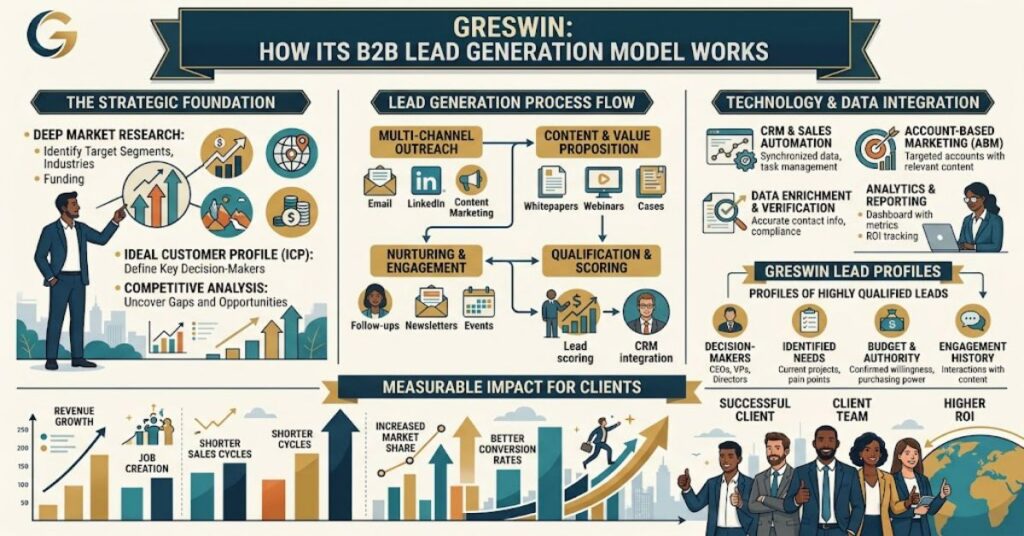
Greswin is a specialised outbound sales and lead generation agency that helps B2B manufacturers and exporters find international buyers and build sales pipelines. The company describes its work as combining global trade data, lead research, contact verification and personalised outbound sales. Its LinkedIn company profile identifies manufacturing, textiles, plastics, packaging, food ingredients and logistics among the sectors it supports.
That positioning matters because selling manufactured goods internationally is different from generating ordinary consumer leads. A factory may have excellent production capacity and competitive pricing but still struggle to identify the right importer, distributor, procurement manager or sourcing company.
Greswin’s model attempts to address that gap by moving prospecting closer to the actual buying activity of international businesses.
Instead of treating every company in an industry as an equally valuable prospect, the process is built around an Ideal Customer Profile, commonly abbreviated as ICP. The goal is to identify organisations whose geography, product requirements, company profile and purchasing activity make them commercially relevant.
How Greswin’s Lead Generation Model Works
The company’s publicly described process has several connected stages. First comes ICP definition, followed by multi-source research, contact enrichment and verification. Outreach then uses personalised, multi-touch communication before qualified conversations are passed to the client’s sales team.
This creates an important distinction between lead volume and lead quality.
A database containing thousands of companies may look impressive, but it has limited commercial value if the contacts are outdated, unrelated to the product or unable to influence purchasing decisions. Greswin instead presents its service around verified buyers and decision-makers.
| Area | Greswin approach | Traditional list building |
| Targeting | ICP-based | Broad industry filters |
| Research | Multi-source | Often database-led |
| Contact selection | Decision-maker focused | General contacts |
| Verification | Manual verification stated | Varies by provider |
| Outreach | Personalised, multi-touch | Often standardised |
| Handover | Qualified conversations and meetings | Contact list |
The practical advantage is obvious for an export sales team: research can consume substantial amounts of time before a salesperson has even spoken to a potential buyer.
Why Trade Data Matters for Export Sales
One of Greswin’s more distinctive areas is trade intelligence. The company says it uses import and export information to identify businesses demonstrating actual trading activity.
This is strategically different from relying only on company directories.
A directory can tell a manufacturer that a company exists. Trade information can provide additional signals about whether that company is actually buying, selling or moving particular categories of goods.
Greswin’s public material refers to shipment volumes, trade routes, HS codes and supplier changes as useful signals for identifying commercial opportunities.
That leads to a useful insight: the best export prospect is not necessarily the largest company in a target market. It may be the company showing recent and relevant purchasing behaviour.
For manufacturers, this can make market research more actionable.
Industries and Buyer Profiles
Greswin’s public company profile lists several export-oriented industries, including manufacturing, textiles, plastics, packaging, food ingredients and logistics.
Potential buyer profiles can differ significantly between these sectors.
A textile manufacturer may need clothing brands, wholesalers or sourcing companies. A packaging producer may target food manufacturers, retailers or distributors. An industrial supplier may need procurement teams, engineering companies or specialised distributors.
That is why a single generic outreach message rarely works across an entire export market.
| Buyer signal | Why it matters |
| Relevant industry | Establishes basic product fit |
| Import activity | Indicates potential purchasing behaviour |
| Geography | Determines market suitability |
| Company size | Helps assess commercial capacity |
| Decision-maker role | Determines influence over purchasing |
| Recent activity | Helps prioritise active prospects |
The deeper value of this framework is prioritisation. A sales team can spend its limited follow-up capacity on prospects with stronger evidence of fit instead of treating every contact equally.
Greswin Compared With In-House Prospecting
Outsourcing lead generation does not automatically make a sales operation better. The real question is where the internal team creates the most value.
| Factor | Greswin-style outsourcing | Internal prospecting |
| Research workload | Externalised | Internal |
| ICP development | Collaborative | Internal |
| Data sourcing | Multi-source | Depends on company resources |
| Outreach | Agency-supported | Sales team owned |
| Product expertise | Client supplies context | Usually stronger internally |
| Closing | Client sales team | Client sales team |
This suggests a hybrid model can make sense for manufacturers. An external team can handle repetitive research and first-touch activity while internal salespeople retain control over technical discussions, pricing, quotations and negotiation.
That division is especially useful for complex products where a salesperson needs engineering or production knowledge before a buyer can be properly qualified.
Risks and Trade-Offs
The model also has limitations.
First, data quality is never permanent. Decision-makers change jobs, companies restructure and purchasing patterns move between suppliers. Even a carefully verified database requires maintenance.
Second, a technically accurate contact is not necessarily a commercially interested buyer. Verification can confirm identity without proving purchase intent.
Third, outbound sales has reputational risk. Poorly targeted campaigns can damage a manufacturer’s brand, particularly in specialised industries where procurement networks are relatively small.
Greswin’s public profile says its campaigns use messaging approved by clients and provide handover of qualified conversations, RFQs and meetings to the client’s sales pipeline. This client-side control is important because the manufacturer ultimately owns the product claims and commercial relationship.
What Public Evidence Says About Greswin
Independent directories provide some additional context, although they should not be treated as customer-performance audits.
GoodFirms lists Greswin as a lead-generation provider and reports a company size of 10–49 employees, with manufacturing and transportation/logistics among its industry areas. It also states that no customer reviews had been submitted to that profile at the time it was crawled.
Krowdbase similarly describes Greswin as a provider of verified outbound lead generation for global B2B exporters.
These independent listings support the broad description of its service, but they do not independently verify performance claims such as conversion rates, contact accuracy or return on investment. That distinction should remain clear when evaluating the agency.
The Future of Greswin in 2027
The future of export lead generation is likely to involve more integration between trade intelligence, CRM systems and automated sales workflows.
However, automation alone will not solve the core problem. Manufacturers still need accurate product positioning, credible buyer qualification and human follow-up.
The most useful direction for agencies such as Greswin may therefore be the combination of structured trade data with human verification. Automated systems can identify patterns and prioritise accounts, while researchers and salespeople can determine whether those signals actually make commercial sense.
By 2027, the strongest providers are likely to be judged less by the number of contacts they deliver and more by measurable pipeline outcomes: qualified conversations, RFQs, opportunities and ultimately revenue.
Key Takeaways
- Greswin specialises in outbound B2B sales and international lead generation.
- Its stated focus is manufacturers and exporters seeking overseas buyers.
- Trade intelligence can provide stronger prospecting signals than generic business directories.
- ICP definition is central to avoiding irrelevant leads.
- Manual verification can improve data quality but cannot guarantee purchase intent.
- Internal sales teams remain important for technical qualification and closing.
- Independent listings support Greswin’s service description but do not independently establish its claimed performance metrics.
Frequently Asked Questions
What does Greswin do?
Greswin provides outbound sales and B2B lead generation services for manufacturers and exporters. Its stated services include trade-data research, lead enrichment, decision-maker identification, contact verification and outbound campaigns.
Is Greswin a B2B lead generation agency?
Yes. Greswin describes itself as an outbound sales and lead generation agency focused on international B2B manufacturers and exporters.
How does Greswin find international buyers?
Its publicly described approach combines global trade data, business research, industry sources and decision-maker verification to identify potential buyers aligned with a client’s ICP.
Does Greswin work with manufacturers?
Yes. Manufacturing is specifically identified among the sectors Greswin supports, alongside areas such as textiles, plastics, packaging, food ingredients and logistics.
What is trade-data lead generation?
Trade-data lead generation uses import, export and shipment information to identify companies that may demonstrate relevant commercial purchasing or sourcing activity.
Can outsourced lead generation replace a sales team?
Usually, it should complement rather than completely replace one. An agency can handle research and initial outreach, while the manufacturer’s team manages technical qualification, pricing, negotiation and closing.
Methodology
This article was developed from publicly available information about Greswin, including its LinkedIn company profile and independent business-directory listings. The company’s stated service model was compared across sources to identify consistent descriptions of its activities.
No independent performance audit, customer interview or hands-on test of Greswin’s services was conducted. Accordingly, the article does not present the company’s promotional performance figures as independently verified results. Public directory information can also become outdated, so company size, location and service details should be rechecked before publication.
Editorial disclosure: This article was drafted with AI assistance and should be independently reviewed and verified by a human editor before publication. All data, citations and named claims should be checked against the original sources.
Conclusion
Greswin occupies a specialised position within B2B sales by focusing on manufacturers and exporters that need international buyers rather than broad consumer audiences. Its stated approach combines ICP development, trade intelligence, lead research, decision-maker verification and outbound communication.
The strongest part of this model is its emphasis on relevance. For an exporter, a smaller group of companies demonstrating meaningful purchasing signals can be more useful than a large database of loosely related contacts.
There are limits, however. Verified contact information does not guarantee buying intent, and outsourced outreach still depends on accurate product positioning, suitable markets and effective sales follow-up. Independent listings also provide useful context but do not constitute a full performance audit.
For manufacturers evaluating an agency in this category, the most meaningful measures should therefore extend beyond lead counts. Qualified conversations, RFQs, sales opportunities and closed business provide a clearer picture of whether prospecting activity is contributing to sustainable international growth.
References
GoodFirms. (2026). Greswin reviews & ratings. GoodFirms.
Greswin. (2026). Greswin: Outbound sales & lead generation. LinkedIn.
Krowdbase. (2026). Greswin: Verified outbound lead generation for global B2B exporters. Krowdbase.