
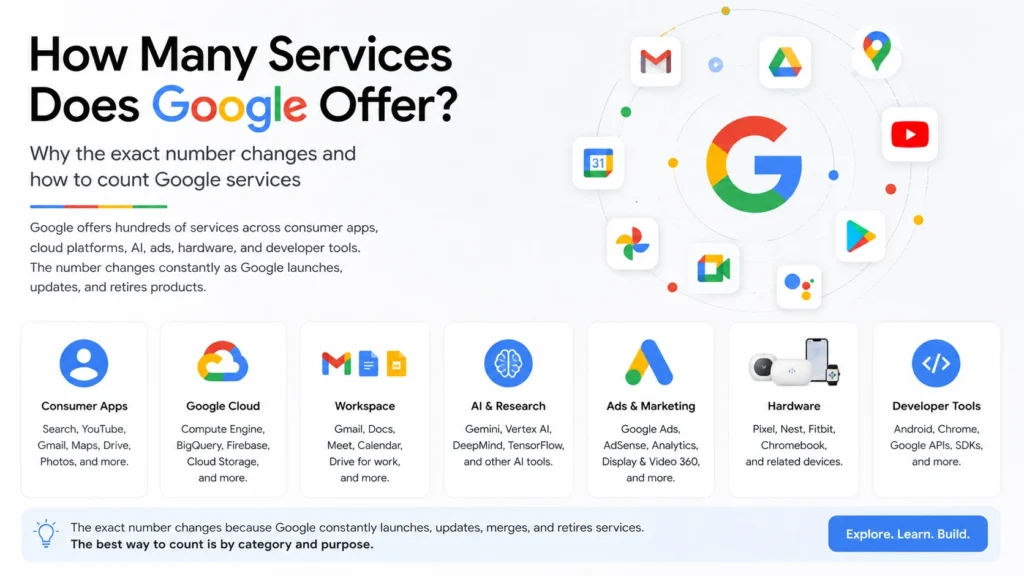
I often see people ask how many services does Google offer because the company feels almost impossible to count from the outside. Google is not just Search anymore. It includes Gmail, Maps, YouTube, Android, Gemini, Chrome, Workspace, advertising tools, developer APIs, Pixel devices, Nest products, Google Cloud, experimental AI tools, and many smaller services that most users never notice. In my view, the most honest answer is this: Google offers at least 119 general services on its official service-specific terms list, more than 150 Google Cloud products, and well over 250 services or products if we count consumer apps, business tools, Cloud products, developer platforms, hardware-related services, and experimental AI products together. Google itself does not publish one single all-inclusive public number for everything it operates, and its own terms page says some major services, fee-based enterprise products, and developer API products are handled separately.
Key Takeaways
- The narrowest official count I would use is 119 services from Google’s service-specific Terms page.
- Google Cloud alone lists over 150 products, which means the broader ecosystem is much larger.
- The real answer depends on whether we count only consumer services or include enterprise tools, Cloud services, developer APIs, hardware, AI labs, and platforms.
- Google’s official terms describe services broadly, including apps, sites, platforms, integrated services, and devices.
- A practical SEO answer should say Google offers “more than 100 core services and more than 250 products and services across its full ecosystem.”
What Counts as a Google Service?
I believe the confusion starts with the word “service.” A regular user may think of a service as Gmail, Google Maps, Google Search, or Google Photos. A business owner may think of Google Ads, Google Analytics, Google Business Profile, Merchant Center, or Workspace. A developer may think of Google Cloud APIs, Firebase, BigQuery, Compute Engine, Maps Platform, or Workspace APIs. Google’s own Terms of Service uses a broad definition and says its services include apps and sites like Search and Maps, platforms like Google Shopping, integrated services like Maps embedded in other companies’ apps, and devices like Google Nest and Pixel.
This is why I do not think one flat number gives readers enough context. If we count only everyday apps, the number looks manageable. If we count Cloud, APIs, AI tools, advertising systems, enterprise products, hardware ecosystems, developer consoles, and region-specific services, the number becomes much larger. We can reasonably conclude that Google operates one of the broadest service ecosystems in the technology industry, but the exact total changes as products launch, merge, rebrand, or shut down.
How Many Services Does Google Offer by the Narrow Official Count?
By the narrow official count, Google lists 119 services on its service-specific additional terms page. This is the cleanest count because it comes from Google’s own legal service list, and it includes services such as Search, Maps, Gmail, Drive, Docs, Sheets, Slides, Google Photos, Google Play, Google Wallet, Gemini Apps, NotebookLM, Google Meet, Google Classroom, Google Trends, and many others.
However, I would not present 119 as the complete global total. Google states that the list only includes services governed by Google’s general Terms of Service. The same page also says a limited number of popular services, including YouTube, have their own terms, and that most fee-based enterprise products and developer API products also have separate terms. That means 119 is a defensible minimum, not a full ecosystem count.
Why the Total Number Changes So Often
Google’s service count changes because the company constantly launches, tests, combines, renames, and discontinues products. Google says on its service-specific terms page that it often launches new services and sometimes updates its terms and policies.
“We often launch new services and sometimes update our terms and policies.”
Google Privacy & Terms
I read that quote as a direct warning against treating any single number as permanent. For example, Google may launch an AI tool through Google Labs, later move it into Gemini, then integrate parts of it into Gmail, Docs, Search, or Android. From a user’s perspective, it may feel like one feature. From a product perspective, it may involve multiple services, APIs, models, and platform layers.
How Many Services Does Google Offer Across the Full Ecosystem?
Across the full ecosystem, I would estimate that Google offers well over 250 services, products, platforms, and tools. This broader count includes the 119 general services listed under Google’s general Terms of Service, more than 150 Google Cloud products, plus major separately governed services such as YouTube and many developer tools. Google Cloud’s official catalog says users can explore over 150 Google Cloud products, including Compute Engine, BigQuery, Cloud Run, Cloud SQL, Cloud Storage, and AI products.
That does not mean we should simply add 119 and 150 and call the answer 269. Some categories overlap, some names represent platforms rather than single end-user services, and some services sit inside larger products. Still, the evidence supports a clear statement: Google has more than 100 core services and more than 250 products or service offerings when Cloud and developer tools are included.
Google Services by Category
The easiest way to understand Google’s scale is to separate services into categories. I find this more useful than arguing over one exact number because readers usually want to know what Google actually offers, not just a headline figure.
| Category | Examples | How I Would Count It |
|---|---|---|
| Search and discovery | Google Search, Images, News, Trends, Scholar, Alerts | Core consumer services |
| Communication | Gmail, Meet, Chat, Voice, Messages, Contacts | Consumer and Workspace services |
| Productivity | Drive, Docs, Sheets, Slides, Forms, Calendar, Keep, Tasks | Consumer and business tools |
| AI and experiments | Gemini Apps, NotebookLM, Labs.google, Illuminate, Jules | Fast-changing AI services |
| Maps and local | Maps, Earth, Street View, Business Profile, Local Guides | Consumer and local business services |
| Entertainment and media | YouTube, Google TV, Play Books, Play Games | Some services have separate terms |
| Commerce and payments | Shopping, Merchant Center, Pay, Wallet, Store | Consumer and business commerce tools |
| Advertising and marketing | Google Ads, AdSense, Ad Manager, Tag Manager, Looker Studio | Business and analytics tools |
| Developer and Cloud | Google Cloud, Firebase, BigQuery, Compute Engine, Cloud Run | Enterprise and developer products |
| Hardware ecosystems | Pixel, Nest, Fitbit, Wear OS, Android Auto | Devices plus connected services |
The most important takeaway from this table is that Google is not one product line. It is a layered ecosystem. We can use Search without realizing it connects to Maps, Ads, Business Profile, Shopping, News, Images, Lens, or Gemini-powered experiences.
Consumer Services Most People Recognize
When most people ask how many services does Google offer, they usually mean the services they can use directly. That includes Search, Gmail, Maps, Drive, Docs, Sheets, Slides, Calendar, Photos, Translate, Chrome, Android, Google Play, Google Wallet, Google Meet, Google Chat, Google News, Google Trends, Google Lens, Google Earth, Google Keep, Google Tasks, Google Forms, and Gemini.
Google’s public products page highlights familiar areas such as Gemini, Android, Pixel, AI products and experiments, NotebookLM, Google Labs, Google Workspace with Gemini, Chrome, and Google Maps.
In my view, the everyday consumer layer alone is already larger than many full technology companies. A student may use Google Search for research, Google Docs for assignments, Google Drive for storage, Gmail for communication, Google Meet for classes, and Google Calendar for deadlines. That one realistic scenario touches at least six Google services without even counting Android, Chrome, YouTube, Maps, or Gemini.
Business and Workspace Services
Google Workspace adds another layer. It includes communication, collaboration, storage, administration, security, and developer integration tools. Google’s Workspace developer products page lists apps and resources such as Admin console, Gmail, Calendar, Chat, Classroom, Docs, Drive, Forms, Keep, Meet, Sheets, Sites, Slides, Tasks, Vault, Apps Script, add-ons, Chat apps, Drive apps, and Marketplace.
From my perspective, Workspace shows why counting Google services is difficult. Gmail is one consumer app, but inside a business environment it can also involve Gmail API, email routing, admin controls, Vault retention, security policies, marketplace add-ons, and Gemini features. A small company might think it uses “Google Workspace,” but in practice it uses a bundle of many services.
Google Cloud Products and Developer Services
Google Cloud is the biggest reason the count expands beyond a normal consumer list. Google Cloud officially says its catalog includes over 150 products. Those products include AI and machine learning, infrastructure, databases and analytics, developer tools, app development, integration services, management tools, security and identity, hosting, productivity, collaboration, and industry-specific solutions.
For example, a developer building a mobile app might use Firebase Authentication, Firestore, Cloud Storage, Cloud Functions, Cloud Run, BigQuery, Google Maps Platform, and Google Analytics. A data team might use BigQuery, Looker, Vertex AI, Cloud SQL, Pub/Sub, Dataflow, and Cloud Storage. None of these examples feels like a simple consumer app, but each one is part of the broader Google service ecosystem.
AI Services Are Changing the Count Faster
AI has made Google’s service count even harder to freeze. Gemini appears as a standalone app, a model family, a Workspace assistant, a Chrome feature, a Search experience, a developer tool, and an enterprise offering. Google’s products page highlights Gemini Live, Canvas, image generation, video generation, NotebookLM, Flow, Google Labs, and Gemini in Workspace or Chrome.
In my analysis, AI is not only adding new Google services. It is also changing old services from the inside. Search becomes more AI-assisted. Gmail can include AI writing help. Docs can include AI drafting. Photos can include AI editing. Android and Pixel can include AI features at the device level. This means the service count becomes less about separate icons and more about connected capabilities.
Google’s Mission Explains Why the Ecosystem Is So Large
Google’s growth makes more sense when we look at its mission. Google Search explains the company’s mission in a short sentence that still shapes how many of its services work.
“Google’s mission is to organize the world’s information and make it universally accessible and useful.”
Google Search, How Search Works
I believe this mission explains why Google did not stop at web search. Maps organizes places. Gmail organizes communication. Photos organizes memories. YouTube organizes video. Scholar organizes academic information. Shopping organizes product listings. Cloud organizes computing resources for companies. Gemini tries to organize and generate answers across text, images, code, and workflows.
Practical Examples of Google Services in Daily Life
Let us consider a normal weekday. A person wakes up and checks Gmail. They open Google Calendar to confirm a meeting. They use Google Maps to estimate the commute. They search for a news topic on Google Search. At work, they edit a Google Doc, join a Google Meet call, review a Google Sheet, and save files in Drive. Later, they watch YouTube, use Google Photos, pay through Google Wallet, and ask Gemini for help summarizing notes.
That example is hypothetical, but it is realistic. One person can touch more than a dozen Google services in a single day without thinking of them as separate services. This is why the question how many services does Google offer is not just a trivia question. It reveals how deeply Google’s ecosystem can sit inside modern digital routines.
How to Count Google Services Step by Step
If I were building a clean count for research, SEO, or a business article, I would use a method instead of guessing.
Step 1: Choose the Definition
First, decide whether “service” means consumer app, legal service, business tool, developer product, API, platform, or hardware-related experience. Without this definition, the number becomes misleading.
Step 2: Start With Google’s Official Terms List
Next, use Google’s service-specific Terms page as the narrow baseline. This gives a grounded count of 119 services governed by Google’s general Terms. It is not complete, but it is official and useful.
Step 3: Add Separately Governed Major Services
Then, add major services with their own terms, such as YouTube. Google’s own service-specific page says some popular services have their own terms because of unique features.
Step 4: Add Google Cloud Products Separately
After that, count Google Cloud products separately because the Cloud catalog alone contains over 150 products.
Step 5: Avoid Double Counting
Finally, remove obvious duplicates and overlaps. For example, Google Workspace is a suite, while Docs, Sheets, Slides, Gmail, Drive, and Meet are individual services inside or alongside that suite. Counting both the suite and all included services may be useful for category analysis, but it can inflate a single headline number.
Count Comparison for Different Search Intents
Readers may need different answers depending on why they ask the question. This table gives a practical way to choose the right number.
| Search Intent | Best Answer | Why This Answer Works |
| Quick factual answer | At least 119 | Based on Google’s official service-specific Terms list |
| Consumer-focused article | More than 100 | Covers widely recognized Google apps and services |
| Business and productivity angle | More than 100, plus Workspace tools | Workspace adds admin, collaboration, security, and developer layers |
| Cloud and developer angle | Over 150 Google Cloud products alone | Google Cloud publishes this broad catalog count |
| Full ecosystem answer | Well over 250 | Includes core services, Cloud products, APIs, platforms, AI tools, and hardware-related services |
| Strict legal answer | 119 under Google’s general Terms list | Excludes services with separate terms and many enterprise or API products |
The best takeaway is that 119 is the safest narrow count, while “well over 250” is the better ecosystem-level answer. I would use both numbers in an article because they answer different reader intentions.
Common Mistakes When Counting Google Services
One common mistake is counting only the apps shown in a Google account menu. That menu does not include everything Google operates. It may leave out Cloud tools, developer APIs, advertising products, enterprise products, experimental AI tools, and region-specific services.
Another mistake is counting every feature as a separate service. For example, Magic Eraser, Gemini side panels, AI Overviews, and smart replies may be important features, but they are not always independent services. I would count them only when the research goal is to measure capabilities rather than formal products.
A third mistake is ignoring discontinued or renamed products. Google has retired, merged, or replaced many services over time. If an article includes old names, it should clearly separate active services from discontinued ones.
Why Google Services Are So Interconnected
Google’s services are interconnected because they often share accounts, data controls, infrastructure, security systems, and user identity. Google’s Privacy Policy explains that it uses information across services to provide, maintain, improve, and develop services. It also gives examples involving Search, Drive, Photos, YouTube, Google Play, Translate, Gemini Apps, and Cloud AI capabilities.
This interconnected design can make Google services convenient. A file in Drive can attach to Gmail. A Meet link can appear in Calendar. A Google Doc can be shared through Chat. A YouTube video can appear in Search. A Maps listing can connect to Business Profile. But it also means users should understand privacy settings, account controls, and data sharing choices.
Google’s Privacy Policy frames this responsibility directly.
“When you use our services, you’re trusting us with your information.”
Google Privacy Policy
In my view, that quote matters because a large service ecosystem creates both convenience and responsibility. The more services a person uses under one account, the more important it becomes to review privacy controls, account security, connected apps, location settings, and data retention choices.
Expert Recommendations for Readers
If you are writing an article, I recommend avoiding a single unsupported claim like “Google has 271 services.” That kind of number sounds precise but can become outdated quickly. A better sentence would be: “Google lists 119 services under its general Terms of Service, while Google Cloud alone includes over 150 products, so the full Google ecosystem exceeds 250 products and services depending on how the count is defined.” This wording is accurate, cautious, and useful.
If you are a normal user, I recommend reviewing the Google services you actually use rather than trying to understand every product Google offers. Check your Google Account dashboard, privacy settings, security settings, payment methods, YouTube settings, location history, app permissions, and connected third-party apps. The practical question is not only how many services Google offers, but which services have access to your data and daily habits.
If you are a business owner, I would separate Google tools into customer acquisition, productivity, analytics, cloud infrastructure, and security. For example, Google Business Profile helps local visibility, Google Ads supports paid traffic, Google Analytics and Tag Manager support measurement, Workspace supports collaboration, and Google Cloud supports infrastructure. Counting them by purpose is more useful than memorizing a total number.
The Best Answer for SEO Content
For SEO purposes, I would answer the primary keyword directly in the first few sentences, then explain the nuance. The best answer is: Google offers at least 119 officially listed general services, more than 150 Google Cloud products, and well over 250 products and services across its broader ecosystem.
This satisfies the searcher who wants a number, but it also prevents the article from becoming misleading. Google is too large and too dynamic for one permanent total. The company’s service count depends on what we include, and Google itself separates general services, separately governed popular services, enterprise products, and developer API products.
Conclusion
The most practical answer to how many services does Google offer is not one fixed number, but a range based on the counting method. I would use 119 as the narrow official baseline because that is the number of services I counted from Google’s service-specific Terms list. I would then explain that Google Cloud alone includes more than 150 products, while YouTube, many enterprise products, and developer API products may sit outside the general Terms list. That makes “well over 250” the stronger full-ecosystem answer.
From my perspective, the useful lesson is simple: Google is not just a search engine or a group of popular apps. It is a connected ecosystem of consumer services, business tools, developer platforms, AI products, cloud infrastructure, hardware experiences, and advertising systems. Readers should define what they mean by “service” before accepting any exact count. For the next step, I would review Google services by category, then focus on the tools that matter most for personal use, business growth, privacy, or technical development.
Frequently Asked Questions
How Many Services Does Google Offer in 2026?
Google offers at least 119 general services on its official service-specific Terms list, but the broader ecosystem is much larger. Google Cloud alone lists over 150 products, and Google says some popular services, fee-based enterprise products, and developer API products have separate terms. That is why I would say Google offers more than 100 core services and well over 250 total products and services across its full ecosystem.
Why Is It Hard to Count Google Services Exactly?
It is hard to count Google services exactly because Google has consumer apps, business suites, developer APIs, Cloud products, AI tools, hardware services, and separately governed platforms. Some tools are standalone products, while others are features inside larger products. Google also launches, updates, merges, and retires services over time. In my view, a range is more honest than a single permanent total.
Does YouTube Count as a Google Service?
Yes, YouTube should count as part of Google’s broader ecosystem, but it is not included in Google’s general service-specific Terms list in the same way as many other services. Google’s Terms page says YouTube has its own terms because of its unique features. That means YouTube belongs in the full ecosystem count, but it should be handled separately when using the narrow official Terms list.
How Many Services Does Google Offer for Businesses?
Google offers many business services across Workspace, advertising, analytics, local business tools, commerce, Cloud, and developer platforms. Business users may use Gmail, Meet, Drive, Docs, Sheets, Calendar, Google Ads, Google Business Profile, Merchant Center, Tag Manager, Looker Studio, and Google Cloud products. Because Google Cloud alone has over 150 products, the business-focused count depends heavily on whether Cloud and APIs are included.
What Are the Most Popular Google Services?
The most recognizable Google services include Search, Gmail, Maps, YouTube, Chrome, Android, Google Drive, Docs, Sheets, Slides, Calendar, Photos, Translate, Google Play, Google Meet, Google Wallet, and Gemini. I would call these the public-facing core services because many people use them directly. Other services, such as Google Cloud, Ads, Merchant Center, and Workspace admin tools, are more common in business or developer environments.
Is Google Still Mainly a Search Company?
Google is still strongly associated with Search, but it is no longer only a search company. Search remains central to its identity, and Google’s mission is still connected to organizing information. However, the company now operates across AI, productivity, mobile operating systems, video, cloud computing, advertising, payments, hardware, maps, education, and enterprise software. The service count proves how much Google has expanded beyond its original search engine.
Sources and References
- Google Privacy & Terms, “List of services & service-specific additional terms.”
- Google Terms of Service, definition and examples of Google services.
- Google Cloud, “Products and Services.”
- About Google, “Google’s products and services.”
- Google Workspace Developer Products.
- Google Search, “How Search Works.”
- Google Privacy Policy.
Disclaimer
I based this article on publicly available Google pages and official Google documentation accessed in July 2026. Google may add, rename, merge, discontinue, or reclassify services at any time. The counts in this article should be treated as a practical editorial estimate, not as a permanent legal or financial statement.