
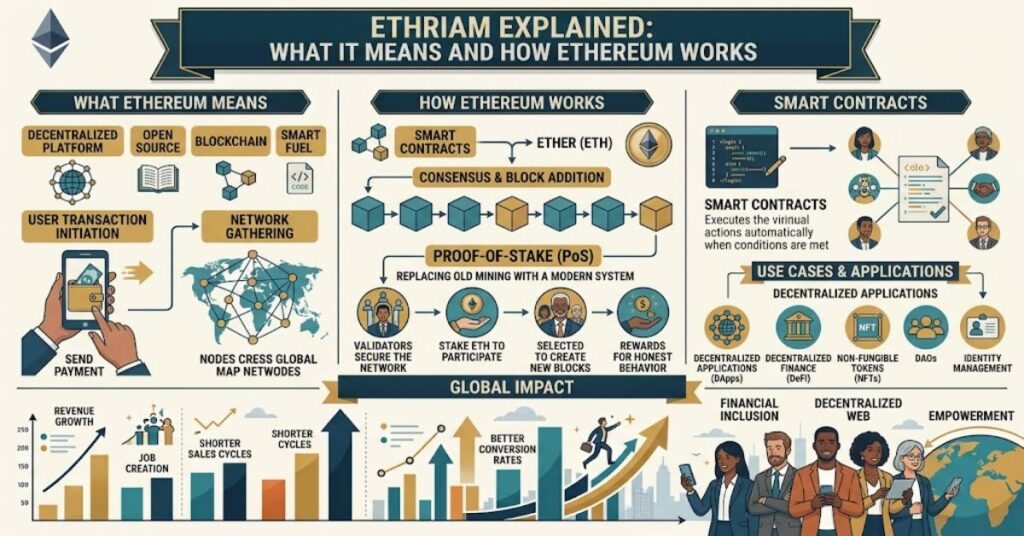
If you searched for ethriam, you are most likely looking for Ethereum. The two terms are not separate blockchain technologies. “Ethriam” is commonly used as a misspelling or phonetic spelling of Ethereum, the decentralised blockchain network that supports ETH, smart contracts and thousands of applications.
Ethereum officially launched on July 30, 2015. Its purpose went beyond simply transferring digital money. Ethereum introduced a programmable blockchain where developers could deploy software called smart contracts and build decentralised applications, or dapps.
That distinction remains important today. ETH is Ethereum’s native cryptocurrency, used for transaction fees, staking and other functions within the network. Ethereum itself is the underlying infrastructure.
The platform has changed substantially since its launch. Ethereum originally relied on proof-of-work mining. On September 15, 2022, The Merge moved the network to proof-of-stake, replacing mining with validator-based consensus.
Since then, major upgrades have focused increasingly on scaling and user experience. Dencun introduced cheaper blob-based data for Layer 2 networks in March 2024. Pectra followed in May 2025, while Fusaka went live in December 2025 with further improvements to data availability and scaling.
Understanding Ethereum therefore requires looking beyond its token price. The more useful question is what the network does, how its components work together and what its roadmap means for users and developers.
What Is “Ethriam”?
“Ethriam” is not the official name of a major blockchain protocol. In most searches, the intended term is Ethereum.
Ethereum is a decentralised blockchain network and software platform powered by its native cryptocurrency, ETH. It provides a shared environment where transactions and computer programs can be executed without depending on one central operator.
The distinction between Ethereum and ETH is straightforward:
| Term | Meaning | Main role |
| Ethereum | Decentralised blockchain and computing platform | Runs transactions and smart contracts |
| ETH | Native cryptocurrency of Ethereum | Pays gas, supports staking and transfers value |
| Smart contract | Program deployed on Ethereum | Automates rules and application logic |
| EVM | Ethereum Virtual Machine | Executes smart-contract code |
| Layer 2 | Scaling network connected to Ethereum | Processes transactions more efficiently |
This distinction prevents one of the most common beginner mistakes: treating Ethereum and ETH as interchangeable terms.
ETH is an asset. Ethereum is the network and programmable infrastructure on which applications operate. Ethereum.org describes ETH as the cryptocurrency that powers the network, including transaction fees and staking.
How Ethereum Works
Ethereum combines several technical components rather than relying on one mechanism.
At the base is the blockchain, a distributed database replicated and maintained by network participants. Transactions change the network’s state, while blocks provide an ordered record of those changes. Ethereum currently creates blocks at roughly 12-second intervals.
Above this sits the Ethereum Virtual Machine, or EVM.
The EVM is a decentralised execution environment that allows Ethereum nodes to execute smart-contract code consistently. Gas measures the computational resources required to perform operations, helping prevent unrestricted or abusive computation.
Then there is the consensus layer.
Ethereum now uses proof-of-stake. Validators commit ETH as collateral and participate in confirming the network’s state. A validator can receive rewards for performing its duties, while dishonest behaviour can result in penalties or destruction of part of its stake.
This architecture separates an important function from the cryptocurrency itself. ETH has monetary value, but it also serves as an economic security mechanism for the blockchain.
Ethereum vs. Bitcoin
Ethereum and Bitcoin are often grouped together because both use blockchain technology, but their design goals differ.
Bitcoin’s original whitepaper described a peer-to-peer electronic cash system. Ethereum was designed as a more programmable platform capable of running smart contracts and applications.
| Feature | Ethereum | Bitcoin |
| Primary purpose | Programmable blockchain and application platform | Peer-to-peer digital money |
| Native asset | ETH | BTC |
| Smart contracts | Core feature | More limited scripting model |
| Current consensus | Proof-of-stake | Proof-of-work |
| Application ecosystem | DeFi, NFTs, games, stablecoins and dapps | Primarily monetary and settlement use cases |
| Scaling strategy | Layer 2 rollups and protocol upgrades | Layered approaches including Lightning |
| Block production | Validator-based | Miner-based |
Neither model is automatically superior. They optimise for different priorities.
Ethereum’s programmability creates more possibilities, but it also creates a larger attack surface. Smart-contract bugs, bridge vulnerabilities, compromised private keys and poorly designed applications can expose users to losses even when the underlying blockchain continues operating correctly.
What Are Ethereum Smart Contracts?
Smart contracts are programs stored and executed on Ethereum.
A conventional contract depends heavily on legal enforcement and trusted parties. A smart contract instead encodes rules into software. When the required conditions are met, the program executes according to its programmed logic.
This enables applications such as:
- Decentralised exchanges
- Lending protocols
- Stablecoin systems
- NFT marketplaces
- On-chain games
- Tokenised assets
- Decentralised organisations
- Automated financial products
The important point is that Ethereum does not itself guarantee that every application built on it is safe.
A smart contract can contain a programming error. A user can approve a malicious transaction. A wallet can be compromised. A bridge can fail. These risks exist at the application layer even when Ethereum’s underlying consensus remains intact.
That distinction is one of the most important practical lessons for anyone researching “ethriam” or Ethereum.
Why ETH Matters
ETH performs several functions inside the Ethereum ecosystem.
First, it is used to pay transaction fees. Every transaction or smart-contract operation consumes computational resources, and users pay for that resource through gas fees.
Second, ETH secures the proof-of-stake system. Validators stake ETH and participate in consensus.
Third, ETH can function as a transferable digital asset. It can be held, transferred or used within decentralised applications.
The economic design has also changed significantly since 2022. The Merge eliminated execution-layer issuance associated with proof-of-work mining, while the network continued issuing ETH through the consensus layer to validators. ETH can also be burned through the fee mechanism introduced by EIP-1559.
Key Ethereum milestones
| Date | Development | Why it mattered |
| July 30, 2015 | Ethereum mainnet launches | Established the public network |
| December 1, 2020 | Beacon Chain launches | Introduced proof-of-stake infrastructure |
| September 15, 2022 | The Merge | Replaced proof-of-work with proof-of-stake |
| April 12, 2023 | Shapella | Enabled staking withdrawals |
| March 13, 2024 | Dencun | Introduced EIP-4844 blobs for cheaper rollup data |
| May 7, 2025 | Pectra | Improved accounts, validators and scaling |
| December 3, 2025 | Fusaka | Expanded blob capacity and introduced PeerDAS |
The dates above show that Ethereum is better understood as an evolving protocol than as a finished product.
How Ethereum Scaling Has Changed
One of Ethereum’s biggest challenges has been balancing decentralisation, security and transaction capacity.
The original assumption that Ethereum could simply increase activity on its main chain has increasingly given way to a rollup-centric model.
Layer 2 networks process transactions away from Ethereum’s main execution layer and publish relevant information back to Ethereum. Optimistic rollups and zero-knowledge rollups are two important approaches.
Dencun was particularly important.
Activated on March 13, 2024, Dencun introduced EIP-4844, commonly called proto-danksharding. It added temporary data blobs designed to make publishing rollup data cheaper.
This produced an important structural insight: Ethereum’s scaling strategy is increasingly about making the base layer a secure settlement and data-availability layer while pushing much of the transaction execution elsewhere.
That changes how users should think about Ethereum. The Ethereum ecosystem is no longer simply one blockchain competing on raw transactions per second. It increasingly functions as a layered network.
Risks and Trade-Offs
Ethereum’s strengths create corresponding weaknesses.
Smart-contract risk
Code is powerful but unforgiving. A faulty contract can behave exactly as programmed while still producing a harmful outcome.
Validator concentration
Proof-of-stake removes energy-intensive mining, but staking introduces its own concentration concerns. Ethereum’s documentation specifically identifies liquid-staking providers as a potential centralisation risk when large organisations control substantial amounts of staked ETH.
Layer 2 complexity
Rollups can reduce transaction costs, but they introduce another layer of infrastructure. Users may have to understand networks, bridges, sequencers and withdrawal procedures.
User responsibility
Ethereum removes some intermediaries but transfers more responsibility to users. Private-key security, transaction signing and contract permissions become critical.
This is a genuine trade-off rather than a simple benefit. Less dependence on a central intermediary can mean more control, but it can also mean fewer recovery mechanisms when something goes wrong.
What Pectra Changed
Pectra went live on May 7, 2025.
One of its most significant changes was EIP-7702, which allows externally owned accounts to temporarily adopt smart-contract functionality. This moves Ethereum closer to account abstraction, where wallets can support more sophisticated transaction and recovery behaviour.
The practical significance is larger than the technical description suggests.
Traditional Ethereum wallets often require users to manage ETH for gas and approve transactions individually. Account abstraction can support features such as transaction batching and more flexible account controls. Ethereum.org reports that ERC-4337 adoption had already reached more than 26 million smart accounts and over 170 million UserOperations by June 2026.
That creates a potentially important shift: Ethereum’s next usability gains may come less from changing the blockchain itself and more from changing how people interact with it.
What Fusaka Added
Fusaka followed Pectra and activated on December 3, 2025.
A major focus was scaling blob data. Fusaka introduced PeerDAS, which distributes data-availability responsibilities across the network and increases the capacity available to rollups.
This is another useful example of Ethereum’s current direction.
Rather than simply making every node process every piece of application activity at maximum volume, the protocol is being designed to distribute responsibilities while retaining the security properties of the base layer.
The trade-off is technical complexity. More sophisticated data-availability mechanisms must be implemented correctly across multiple clients and infrastructure providers.
The Future of Ethereum in 2027
Ethereum’s 2027 outlook is best understood through its published protocol roadmap rather than price predictions.
As of August 2026, Ethereum’s roadmap lists Glamsterdam as a development target for Q4 2026 and Hegotá for 2027. The roadmap identifies work around block production, censorship resistance, gas efficiency, data availability and protocol simplification. However, Ethereum explicitly states that roadmap timelines are estimates and can change.
The most important trend is likely to remain L1 security combined with L2 execution.
Ethereum’s 2026 protocol priorities identify three broad tracks: scaling, improving user experience and hardening Layer 1. The Ethereum Foundation has also described a future in which independent Layer 2 networks compete and cooperate while relying on Ethereum as a security and settlement foundation.

Account abstraction is another area to watch. If programmable accounts become easier and safer to use, many users may eventually interact with blockchain applications without thinking about gas, networks or wallet mechanics in the way they do today.
There are limits, however. Ethereum’s own roadmap continues to acknowledge unresolved research, decentralisation challenges and changing implementation timelines. The 2027 picture should therefore be treated as a development direction, not a guaranteed product schedule.
Takeaways
- “Ethriam” generally refers to Ethereum rather than a separate cryptocurrency.
- ethriam is a programmable blockchain, while ETH is its native cryptocurrency.
- Smart contracts make Ethereum useful for applications rather than only payments.
- The September 2022 Merge fundamentally changed Ethereum’s consensus mechanism.
- Dencun, Pectra and Fusaka show a clear emphasis on scaling, Layer 2 infrastructure and usability.
- Proof-of-stake reduces energy requirements but introduces staking concentration considerations.
- Ethereum’s 2027 direction centres on scaling, security, data availability and easier user interaction.
Conclusion
For anyone searching for “ethriam”, the key clarification is simple: the term generally points to Ethereum. But understanding the network requires going beyond a spelling correction.
ethriam is a programmable blockchain platform with ETH at its centre. Its smart-contract system allows developers to build financial applications, digital assets, games and other decentralised services. Its proof-of-stake consensus secures the network, while Layer 2 systems increasingly handle transaction execution at lower cost.
The network’s history also shows why current Ethereum cannot be judged by its 2015 design. The Merge changed consensus in 2022. Dencun changed the economics of rollup data in 2024. Pectra and Fusaka continued the push towards better accounts and greater scaling in 2025.
The main challenge now is balancing usability, scalability, security and decentralisation. Ethriam roadmap suggests that this balancing act will continue through 2027. Its future therefore depends less on one feature and more on whether the entire layered system can become easier to use without weakening the properties that make the network valuable.
FAQ
Is ethriam the same as Ethereum?
In most searches, yes. “Ethriam” is generally a misspelling or phonetic variation of Ethereum. Ethereum is the blockchain platform, while ETH is its native cryptocurrency.
What is Ethereum used for?
Ethereum is used to run smart contracts and decentralised applications. Its ecosystem includes decentralised finance, stablecoins, NFTs, gaming, tokenisation and other blockchain-based applications.
Is Ethereum a cryptocurrency?
Ethereum itself is the blockchain network and software platform. ETH, or ether, is the cryptocurrency native to that network. ETH is used for gas fees, staking and transferring value.
How does Ethereum differ from Bitcoin?
Bitcoin was originally designed as peer-to-peer electronic cash, while Ethereum was designed as a programmable blockchain capable of running smart contracts and applications.
Does Ethereum still use mining?
No. Ethereum stopped using proof-of-work mining when The Merge occurred on September 15, 2022. It now uses proof-of-stake, in which validators stake ETH to participate in network consensus.
What are Ethereum Layer 2 networks?
Layer 2 networks process transactions away from Ethereum’s main execution layer and use Ethereum for security, settlement or data availability. Rollups are the main scaling approach promoted by Ethereum’s current roadmap.
What could happen to Ethereum by 2027?
Ethereum is expected to continue working on scaling, data availability, account abstraction, security and protocol simplification. Specific upgrade dates can change, so roadmap targets should not be treated as guarantees.
Methodology
This article treats “ethriam” as a search term referring to Ethereum and validates the explanation against primary Ethereum Foundation and ethereum.org documentation. Historical dates were checked against Ethereum’s official launch and upgrade records, while technical descriptions of proof-of-stake, the EVM, smart contracts, rollups, Dencun, Pectra and Fusaka were checked against official technical documentation.
Two documented real-world protocol milestones provide experience-based evidence without claiming personal testing: Dencun’s mainnet activation on March 13, 2024, and Pectra’s mainnet activation on May 7, 2025. Both were publicly documented network upgrades with specified protocol changes.
The analysis does not claim to have independently operated an Ethereum validator, deployed a smart contract or conducted transaction-cost benchmarks. That limitation matters because network fees, application security and Layer 2 performance can vary substantially over time.
The future section uses Ethereum’s published roadmap and 2026 protocol priorities. Roadmap dates are treated as targets rather than certain outcomes because Ethereum’s own documentation states that development timelines can change.
Editorial disclosure: This article was drafted with AI assistance and should be reviewed and verified by the Matrics360.com editorial team before publication. All data, citations and named claims should be independently confirmed against the original sources.
References
Ethereum Foundation. (2015, July 30). Ethereum launches.
Ethereum Foundation. (2024, February 27). Dencun mainnet announcement.
Ethereum Foundation. (2025, April 23). Pectra mainnet announcement.
Ethereum Foundation. (2026, February 18). Protocol priorities update for 2026.
Ethereum.org. (2026). What is Ethereum?
Ethereum.org. (2026). What is Ether (ETH)?
Ethereum.org. (2026). Proof-of-stake (PoS).
Ethereum.org. (2026). Ethereum Virtual Machine (EVM).
Ethereum.org. (2026). Introduction to smart contracts.
Ethereum.org. (2026). Scaling Ethereum.
Ethereum.org. (2026). Ethereum roadmap.
Ethereum.org. (2026). Fusaka.
Ethereum.org. (2026). Pectra.
Ethereum.org. (2026). Account abstraction.
Nakamoto, S. (2008). Bitcoin: A peer-to-peer electronic cash system. Bitcoin.org.