
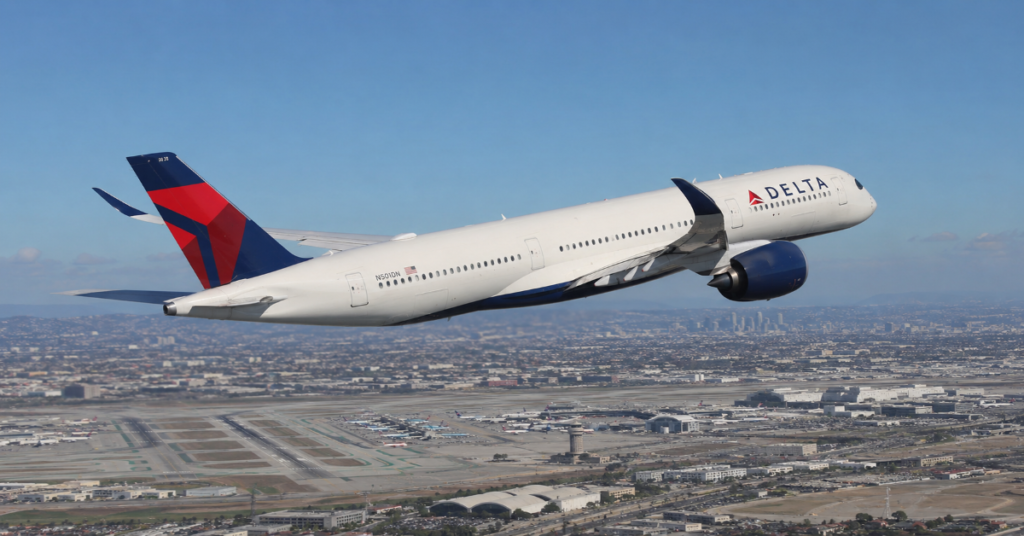
Delta flight DL275 diverted LAX after departing Detroit for Tokyo Haneda on a long-haul Airbus A350-900 service, a route that normally sends passengers deep across the North Pacific. Instead, after several hours airborne, the aircraft turned toward Los Angeles and landed safely. Reports from aviation tracking sources and incident coverage described the trigger as an engine anti-ice system fault, with no emergency declaration, no reported injuries and a normal landing at LAX.
The event mattered because the aircraft was not simply minutes from departure. It had already crossed into the operational logic of a transpacific flight, where diversion choices become more complex with every mile. A cockpit indication that may be manageable near land becomes more serious when the next safe airport could be hours away.
That is why this case should not be framed as a near-disaster. It is better understood as a study in aviation risk management. The crew had to balance the condition of the aircraft, the weather environment, fuel planning, passenger welfare, maintenance access and the realities of continuing toward oceanic airspace.
Matrics360 has covered similar safety-first diversion logic in its analysis of Delta DL139’s Amsterdam diversion and United Flight 1270’s emergency response timeline, both of which show that modern aviation systems are designed to intervene early rather than wait for failure to become visible to passengers.
Delta Flight DL275 Diverted LAX: The Basic Timeline
The available reporting indicates that Delta Flight DL275 was operating from Detroit Metropolitan Wayne County Airport to Tokyo Haneda on an Airbus A350-900. The flight turned back after several hours in the air and landed safely at Los Angeles International Airport. Aviation Herald reported the aircraft landed on LAX runway 06R about 5.5 hours after the diversion decision sequence became visible, with passengers later describing an engine anti-ice issue.
| Item | Reported Detail |
| Flight | Delta Air Lines DL275 |
| Planned route | Detroit to Tokyo Haneda |
| Aircraft type | Airbus A350-900 |
| Diversion airport | Los Angeles International Airport |
| Reported issue | Engine anti-ice system fault |
| Emergency status | No emergency widely reported |
| Outcome | Safe landing, passenger reaccommodation reported |
The important point is that the aircraft remained controllable and the landing was routine. A diversion does not automatically mean an aircraft is in immediate danger. In many long-haul cases, it means the crew has identified a system condition that should not be carried into a more remote part of the route.
Why an Engine Anti-Ice Fault Matters
Engine anti-ice systems protect parts of the engine and inlet area from ice accumulation in cold, moisture-rich atmospheric conditions. The FAA’s aircraft icing guidance explains that icing can affect safe flight and that pilots must understand how to avoid or exit icing conditions when required.
On a short domestic flight in clear weather, an anti-ice system indication may lead to a different decision than on a long overwater route. The aircraft’s immediate condition is only one part of the calculation. The larger question is what conditions the aircraft could encounter later.
For a Detroit to Tokyo flight, the route can involve high-latitude airspace, cold temperatures and long periods without a nearby diversion field. If the system warning suggested reduced anti-ice capability, continuing west could have narrowed the crew’s options.
That is the core safety logic. The issue was not necessarily that the engine was failing. The issue was that one protective layer may not have been fully available for the rest of the mission.
Why LAX Made Operational Sense
Some observers asked why the aircraft went to Los Angeles instead of Anchorage, Seattle, Portland or San Francisco. The answer is likely a mix of geography, weather, aircraft support, passenger handling and maintenance capability.
Los Angeles is a major Delta station and one of the most capable widebody airports in the United States. It has long runways, large international terminal infrastructure, maintenance support, hotel capacity and onward options to Asia. For an Airbus A350 with a reported engine-related system fault, those details matter.
The FAA’s ETOPS guidance defines extended operations as routes where a twin-engine aircraft may be more than one hour from an adequate airport at one-engine cruise speed. That regulatory structure is built around planning, alternate airport suitability and operational control.
| Diversion Factor | Why It Mattered for DL275 |
| Maintenance support | A350 technical support is easier at a major hub than a smaller station |
| Passenger handling | Hotels, meals, rebooking and customs handling are more scalable at LAX |
| Weather avoidance | A warmer coastal airport may reduce icing-related uncertainty |
| Network recovery | Delta can reroute passengers through LAX and partner networks |
| Runway capability | LAX can comfortably handle long-haul widebody arrivals |
The hidden insight is that the closest airport is not always the best airport. Crews and dispatchers look for the best safe airport, not simply the nearest dot on the map.
The Passenger Experience: Calm Cabin, Long Night
Passenger disruption was real, even if the landing itself was uneventful. A flight that was supposed to reach Tokyo instead ended in Los Angeles after many hours in the air. Reports and passenger comments described frustration, confusion and a long recovery process, but not panic in the cabin.
That distinction matters. Aviation safety decisions can feel severe to passengers because the personal cost is immediate. Missed connections, hotel delays, meal vouchers and rebooking uncertainty become the visible part of the story. But from the crew’s perspective, a calm diversion is the system working correctly.
The passenger care element also shows why a large airport can be preferable. A remote diversion may be geographically closer but operationally worse. If hundreds of passengers need immigration processing, hotel rooms, replacement crew, baggage support and new long-haul seats, the airport’s ground ecosystem becomes part of the safety decision.
Systems Analysis: What the A350 Tells the Crew
The Airbus A350 is a highly automated, sensor-rich long-haul aircraft. Delta’s public fleet materials identify the A350 as a widebody aircraft used for premium international operations, while Rolls-Royce identifies the Trent XWB as the engine family designed and optimized for the A350.
Modern cockpits are built around layered alerts. A system fault does not leave the crew guessing from sound or vibration alone. Instead, onboard monitoring systems detect abnormal conditions, classify them and guide checklist action.
That creates a subtle but important change in aviation culture. A flight can divert before passengers notice anything. The absence of visible drama does not mean the diversion was excessive. It often means the alerting architecture worked early enough to keep the event routine.
Strategic Implications for Delta and Long-Haul Airlines
For Delta, the DL275 diversion highlights three operational truths.
First, premium long-haul flying depends on maintenance resilience. A carrier can sell a nonstop route, but it also needs a recovery plan when a widebody aircraft cannot continue.
Second, A350 reliability is not judged by whether technical issues ever occur. Every aircraft type has faults. Reliability is judged by detection, crew response, dispatch support and repair turnaround.
Third, passenger communications now matter almost as much as the technical event itself. Flight-tracking apps make diversions public in real time. Travelers may know a flight is turning before the airline has completed its internal communications chain.
That creates a reputation problem for airlines. The safest decision can still look chaotic if passengers receive little explanation.
Risks and Trade-Offs
The main operational trade-off was schedule reliability versus safety margin. Continuing toward Tokyo might have reduced disruption if the fault remained benign, but it would also have increased exposure to remote airspace and possible weather constraints.
Diverting to LAX created immediate passenger inconvenience and cost. It likely required hotel accommodation, meals, crew reassignment, maintenance inspection and rebooking. But it preserved options.
| Decision Path | Benefit | Risk |
| Continue to Tokyo | Keeps schedule intact if fault remains stable | Fewer diversion options over the Pacific |
| Divert to nearest suitable airport | Reduces flight time after fault detection | May lack A350 support or passenger capacity |
| Divert to LAX | Strong support network and maintenance capability | Longer diversion flight and passenger delay |
The less obvious point is that diversions are expensive precisely because safety is not treated as a narrow cockpit issue. A modern diversion activates maintenance, operations control, customer service, crew scheduling, airport services and network planning at once.
Real-World Impact: Why This Story Spread
The phrase delta flight dl275 diverted lax spread because it combined three elements that attract search interest: a major airline, an international route and an unusual flight path. But the public discussion often missed the technical nuance.
Many readers see a U-turn and assume danger. Aviation professionals see a decision tree. The aircraft’s position, the nature of the fault, icing forecasts, ETOPS alternates and maintenance access all shape the final choice.
Matrics360’s earlier coverage of aviation diversions shows the same pattern: incidents that look alarming to the public are often routine examples of conservative system design. In the Delta DL139 case, Amsterdam was not just a landing point. It was a maintenance and network recovery choice.
The Future of Delta Flight DL275-Type Diversions in 2027
By 2027, long-haul diversions may become more visible, not necessarily more dangerous. Aircraft health monitoring is improving, airlines are investing in predictive maintenance and regulators continue to focus on safe operation in icing and extended-range environments.
Airbus received EASA certification in 2025 for the A350-900 with the Trent XWB-84 Enhanced Performance engine, showing that the A350 platform continues to evolve technically. Rolls-Royce also announced in 2026 that Delta ordered additional Trent XWB-84 EP engines as part of future widebody fleet planning.
The likely trend is not fewer cockpit alerts. It is better interpretation of alerts. Airlines will increasingly use live aircraft data to decide whether a fault can be monitored, deferred, isolated or requires diversion. That may reduce unnecessary diversions over time, but it may also make crews even more conservative when the aircraft is approaching remote oceanic segments.
The uncertainty is cost. Better predictive maintenance requires data infrastructure, parts availability, trained engineers and aircraft downtime. Not every airline will move at the same pace.
Key Takeaways
- Delta Flight DL275’s diversion was a precautionary safety decision, not evidence of a failed flight.
- An engine anti-ice fault matters more on a transpacific route than it might on a short flight near multiple alternates.
- LAX likely offered the strongest combination of runway capability, weather suitability, Delta support and A350 maintenance access.
- Passenger inconvenience was significant, but it was the trade-off for keeping the aircraft within safer operational margins.
- The case shows why the nearest airport is not always the best diversion airport.
- Real-time flight tracking has changed public perception, making routine operational decisions look dramatic.
- By 2027, predictive maintenance may improve decisions, but early diversions will remain part of safe long-haul flying.
Conclusion
Delta flight DL275 diverted LAX because modern aviation rewards caution before crisis. The reported engine anti-ice issue did not have to become visible, violent or frightening to justify a change of plan. On a long-haul route toward Tokyo, the risk calculation changes once the aircraft is approaching more remote airspace.
The crew’s decision preserved options. LAX offered maintenance depth, passenger handling capacity and operational support that smaller alternates may not have matched. For passengers, the result was delay and frustration. For aviation safety, it was a controlled outcome.
The lasting lesson is simple: diversions are not failures when they prevent uncertainty from becoming danger. DL275 became a story because the flight path looked unusual. In practice, it was a reminder that the safest flights are often the ones where conservative decisions happen long before passengers understand why.
Frequently Asked Questions
Why was Delta Flight DL275 diverted to LAX?
Delta Flight DL275 was reportedly diverted after an engine anti-ice system fault was detected during cruise. Because the aircraft was operating a long transpacific route, continuing toward remote oceanic airspace would have reduced safe options if weather or system conditions worsened.
Was Delta Flight DL275 Diverted LAX an emergency?
Available reports do not indicate a declared emergency. The aircraft landed safely at Los Angeles and there were no widely reported injuries. A precautionary diversion can be serious without being an emergency.
Why did DL275 choose LAX instead of Anchorage or Seattle?
LAX likely offered a stronger combination of A350 maintenance capability, Delta operational support, passenger reaccommodation resources, long runways and favorable weather. The best diversion airport is not always the closest airport.
How does an engine anti-ice fault affect flight safety?
Engine anti-ice systems help protect engine and inlet components from ice accumulation. If that protection is uncertain, crews may avoid routes where icing conditions or remote airspace would reduce safety margins. FAA guidance treats icing as a major operational hazard requiring clear procedures.
What happened after the plane landed at LAX?
Reports indicate passengers were handled on the ground through rebooking and support arrangements. The aircraft required inspection before returning to service. Specific airline compensation details depend on Delta’s policies, passenger itinerary and applicable regulations.
Is the Airbus A350 safe for long-haul flights?
Yes. The A350 is a modern long-haul widebody used by major international airlines. Technical faults can occur on any aircraft type, but the safety question is how quickly they are detected and managed.
Methodology
This article was prepared using the supplied Matrics360 production brief, aviation incident reporting, public FAA guidance on icing and ETOPS, aircraft and engine manufacturer information and Matrics360’s related internal aviation coverage. The incident details are treated as reported, not as final investigative findings, because no full official investigative report was located in the available public record. Aviation Herald, Simple Flying and AIRLIVE-style incident reporting were used for timeline context, while FAA advisory circulars were used for technical grounding. All claims involving passenger experience, maintenance duration or airline support should be manually checked against Delta statements, flight records or passenger documentation before publication.
References
Federal Aviation Administration. (2006). Aircraft ice protection: Advisory Circular AC 20-73A. U.S. Department of Transportation.
Federal Aviation Administration. (2008). Extended operations: ETOPS and polar operations, AC 120-42B. U.S. Department of Transportation.
Federal Aviation Administration. (2015). Pilot guide: Flight in icing conditions, AC 91-74B. U.S. Department of Transportation.
Rolls-Royce. (n.d.). Trent XWB.
Airbus. (2025). A350-900 with Trent XWB-84 Enhanced Performance engine receives EASA certification.
Delta Air Lines. (2026). Airbus A350 media kit.