
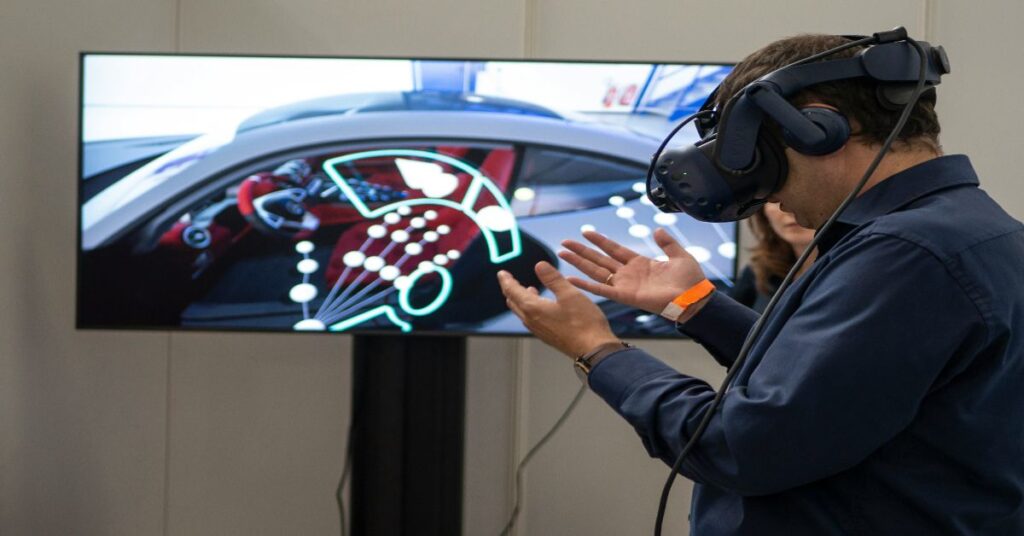
I often think about augmented reality as a promise that took longer than expected to mature. Early AR experiences were visually impressive but operationally fragile. Most systems depended on controlled lighting, fixed markers, or highly scripted interactions that struggled in unpredictable real-world environments. That limitation shaped public perception for years. Today, Ark Augmented Reality represents something more substantial. Instead of treating AR as a layer floating above reality, newer systems increasingly interpret and respond to the environment around them. Computer vision, spatial mapping, edge AI inference, and real-time scene understanding now allow AR systems to adapt dynamically rather than replay pre-programmed interactions.
This matters because the competitive advantage of modern AR is no longer visual novelty. It is operational intelligence.
The evolution became visible after 2020, when improvements in smartphone LiDAR sensors, mixed-reality headsets, and cloud-rendering infrastructure reduced latency and improved spatial stability. Research into AI-enhanced AR environments accelerated across sectors including retail, industrial maintenance, healthcare, and logistics.
Ark AR sits inside that broader movement. Whether discussed as a platform category, design philosophy, or emerging ecosystem, it reflects a practical reality: successful augmented reality systems must understand environments, not merely decorate them.
That distinction changes how businesses deploy AR, how consumers interact with digital environments, and how regulators may eventually govern persistent spatial data.
A related discussion on intelligent human-machine interaction can also be seen in broader AI infrastructure analysis published by Matrics360 Technology coverage.
Why Traditional Augmented Reality Struggled
The first wave of consumer AR suffered from three recurring problems:
| Problem | Impact on Adoption |
| Weak environmental understanding | Objects drifted or failed to anchor accurately |
| High processing demands | Devices overheated or drained battery quickly |
| Limited practical utility | Experiences felt promotional rather than useful |
Most early applications focused on filters, gaming gimmicks, or product previews. While visually appealing, they rarely solved meaningful workflow problems.
Research published by Harvard Business Review described early AR systems as dependent on digital twins and object recognition frameworks that were computationally expensive and difficult to scale reliably.
The hardware ecosystem also slowed progress. Smart glasses remained expensive, bulky, and socially awkward for mainstream users. Mobile AR succeeded faster because smartphones already had cameras, GPS, gyroscopes, and AI acceleration chips.
That hardware reality shaped the market for nearly a decade.
How Ark Augmented Reality Differs From Earlier AR Models
Modern intelligent AR systems operate differently from legacy overlay-based experiences.
Core Architectural Shift
Traditional AR systems:
- Displayed fixed information
- Relied heavily on markers or QR triggers
- Performed limited contextual reasoning
Ark-style intelligent AR systems increasingly:
- Interpret environmental depth in real time
- Predict user intent
- Adapt interfaces dynamically
- Combine cloud AI with on-device inference
- Maintain persistent spatial memory
This shift is largely enabled by advances in computer vision and machine learning.
Research analyzing AI-powered AR environments notes that artificial intelligence significantly improves object recognition accuracy, environmental tracking, gesture interpretation, and personalization.
Comparison Table: Traditional AR vs Intelligent AR
| Feature | Traditional AR | Ark Augmented Reality Model |
| Spatial awareness | Limited | Persistent and adaptive |
| Environmental mapping | Static | Dynamic real-time mapping |
| User interaction | Gesture or tap-based | Context-aware multimodal input |
| AI integration | Minimal | Central operational layer |
| Latency handling | Cloud dependent | Hybrid edge/cloud architecture |
| Commercial use cases | Marketing-heavy | Workflow and operational systems |
| Data interpretation | Reactive | Predictive |
One overlooked improvement is environmental persistence. Earlier AR systems often “forgot” physical space once sessions ended. Intelligent AR increasingly stores spatial anchors, enabling continuity between sessions and users.
That capability is essential for enterprise deployment.
The Technologies Powering Intelligent AR
Ark Augmented Reality depends on multiple technical layers working simultaneously.
Spatial Computing
Spatial computing allows digital systems to understand depth, geometry, movement, and object relationships inside physical environments.
Without accurate spatial mapping, AR experiences collapse.
Modern devices use:
- Simultaneous Localization and Mapping (SLAM)
- LiDAR depth sensing
- Visual inertial odometry
- Semantic scene segmentation
These systems continuously rebuild 3D representations of the surrounding environment.
Edge AI Processing
One major limitation of earlier AR was cloud dependency. High latency created motion instability and synchronization failures.
Edge AI changes this.
By processing computer vision tasks directly on-device, systems reduce:
- Motion lag
- Bandwidth dependency
- Cloud rendering delays
This becomes especially important in healthcare and manufacturing environments where response timing affects safety.
AI Scene Understanding
Intelligent AR systems increasingly recognize:
- Human gestures
- Surface materials
- Object categories
- Behavioral patterns
- Navigation pathways
According to enterprise AI analysts at TechTarget, AI-enhanced AR systems perform significantly better when environmental interpretation occurs continuously rather than through isolated frame analysis.
That sounds technical, but the real-world implication is simple: the software behaves less like a filter and more like a situational assistant.
Real-World Industries Already Using Advanced AR
The strongest evidence for intelligent AR maturity comes from enterprise deployment rather than consumer entertainment.
Manufacturing and Maintenance
Industrial AR adoption accelerated after remote operations became essential during the pandemic years.
Technicians now use AR headsets for:
- Guided equipment repair
- Real-time diagnostics
- Digital twin visualization
- Remote expert collaboration
The measurable advantage is reduced downtime.
Several aerospace and automotive manufacturers reported shorter maintenance cycles after integrating mixed-reality diagnostic overlays into field operations between 2022 and 2025.
Retail and Commerce
Retail adoption moved beyond virtual try-ons.
AI-enhanced AR systems increasingly:
- Predict sizing preferences
- Recommend complementary products
- Simulate lighting conditions
- Map consumer attention behavior
Research into AR retail systems found increased purchase confidence among users interacting with immersive visualization tools.
One practical insight rarely discussed: retailers care less about “immersion” than about lowering product return rates. Accurate spatial visualization reduces uncertainty, especially for furniture and home décor purchases.
That operational metric matters more than novelty.
Healthcare and Medical Training
Healthcare adoption remains cautious but meaningful.
AR-assisted systems are being explored for:
- Surgical navigation
- Anatomy visualization
- Rehabilitation support
- Medical simulation training
Latency stability and calibration accuracy remain major barriers. Even slight visual drift can create clinical risk.
That is why healthcare AR adoption progresses more slowly than consumer marketing deployments.
The Hidden Risks Behind Ark Augmented Reality
The public discussion around AR often focuses on excitement. The operational risks receive far less attention.
Privacy and Spatial Surveillance
Persistent AR systems collect environmental data continuously.
That includes:
- Interior room layouts
- Facial movement patterns
- Behavioral tracking
- Eye movement analytics
- Location persistence
Unlike traditional browsing data, spatial data can reconstruct physical environments with alarming precision.
This creates regulatory exposure.
The European Union’s AI regulatory discussions increasingly examine biometric and environmental mapping concerns tied to immersive technologies. Similar scrutiny is emerging in U.S. and Asian regulatory conversations.
Hardware Fragmentation
AR development still suffers from ecosystem fragmentation.
Developers must optimize for:
- Smartphones
- Smart glasses
- Enterprise headsets
- Proprietary operating systems
- Varying sensor capabilities
This dramatically increases deployment complexity.
One of the biggest hidden costs in AR is not hardware procurement. It is cross-platform maintenance.
Cognitive Overload
There is also a usability issue rarely acknowledged in marketing materials.
Too much contextual information becomes distracting.
Poorly designed AR interfaces increase:
- Cognitive fatigue
- Decision paralysis
- Visual clutter
- User frustration
The most effective intelligent AR systems minimize visible augmentation rather than maximize it.
That design principle separates functional systems from technological demonstrations.
Market Impact and Competitive Pressure
The AR industry changed after major technology companies shifted from metaverse branding toward practical spatial computing.
The market increasingly rewards:
- Operational utility
- Enterprise productivity
- AI integration
- Low-latency infrastructure
- Persistent spatial ecosystems
This transition matters financially.
Companies deploying intelligent AR successfully are usually solving workflow inefficiencies rather than building entertainment experiences.
Structured Insight Table: Commercial Drivers of Intelligent AR
| Market Driver | Why It Matters | Current Constraint |
| Industrial training | Reduces onboarding time | Hardware costs |
| Retail visualization | Lowers product returns | Consumer device inconsistency |
| Remote collaboration | Improves distributed operations | Bandwidth limitations |
| Healthcare simulation | Enhances procedural training | Regulatory approval |
| Logistics optimization | Faster warehouse navigation | Spatial accuracy reliability |
Another emerging factor is AI cost efficiency.
Running multimodal AI inference inside AR environments requires substantial compute resources. Companies that control optimized chip architectures may dominate future AR ecosystems.
This is increasingly becoming an infrastructure competition, not merely a software competition.
The Future of Ark Augmented Reality in 2027
The Future of Ark Augmented Reality in 2027 will likely depend less on visual breakthroughs and more on infrastructure maturity.
Three trends appear realistic.
1. AI-Native Spatial Interfaces
By 2027, AR interfaces will increasingly behave like adaptive operating systems rather than visual applications.
Users may interact through:
- Eye tracking
- Voice intent prediction
- Gesture interpretation
- Contextual automation
The interface itself may become largely invisible.
2. Enterprise Adoption Will Outpace Consumer Adoption
Consumer AR still faces:
- Social acceptance problems
- Battery constraints
- Device pricing barriers
Enterprise deployments face fewer cultural obstacles because operational ROI is easier to measure.
Manufacturing, logistics, field repair, and healthcare will likely remain the strongest growth sectors.
3. Regulation Will Expand
Persistent spatial mapping creates significant privacy implications.
Governments are expected to introduce:
- Spatial data retention limits
- Biometric consent rules
- AI transparency requirements
- Environmental capture restrictions
Any company building large-scale AR ecosystems will eventually operate under stricter compliance obligations.
One uncertainty remains important: consumer appetite for wearable AR hardware is still unclear. Technical progress alone does not guarantee behavioral adoption.
Key Takeaways
- Intelligent AR systems succeed when they solve operational problems instead of showcasing visual effects.
- Spatial computing and edge AI are now more important than graphical realism alone.
- Privacy concerns around environmental mapping may become one of the industry’s biggest regulatory challenges.
- Retail and manufacturing currently show stronger commercial AR adoption than entertainment sectors.
- Persistent spatial memory is emerging as a defining feature of next-generation AR ecosystems.
- Hardware fragmentation continues to slow broader developer standardization.
- The long-term success of AR depends as much on interface design discipline as technical innovation.
Conclusion
Ark Augmented Reality represents a meaningful evolution in how digital systems interact with physical space. Earlier generations of AR struggled because they treated augmentation as decoration rather than intelligence. Modern systems are beginning to understand environments, user behavior, and contextual relationships in ways that make augmented interfaces operationally useful.
That transition changes the economics of the industry.
The companies likely to succeed in AR over the next several years will not necessarily be those producing the most visually impressive demonstrations. They will be the organizations building reliable spatial infrastructure, efficient AI processing pipelines, and low-friction user experiences that function consistently in unpredictable real-world environments.
The technology still faces real constraints. Hardware comfort, privacy regulation, computational costs, and interface fatigue remain unresolved. But the direction is increasingly clear: AR is moving away from novelty and toward persistent intelligent computing layered directly into physical environments.
Whether mainstream consumers fully embrace that future is still uncertain. Enterprise systems already have.
FAQ
What is Ark Augmented Reality?
Ark Augmented Reality refers to a newer generation of AR systems that combine spatial computing, AI, and contextual awareness to create adaptive digital experiences rather than static overlays.
How is intelligent AR different from traditional augmented reality?
Traditional AR mainly displayed fixed digital content. Intelligent AR continuously interprets environments, predicts user intent, and adapts interactions in real time using AI models and spatial mapping.
Which industries benefit most from Ark AR systems?
Manufacturing, logistics, retail, healthcare, and field maintenance currently show the strongest adoption because AR improves workflow efficiency and reduces operational errors.
Does Ark Augmented Reality require special hardware?
Not always. Many systems run on smartphones and tablets, although advanced enterprise deployments often use smart glasses or mixed-reality headsets with depth sensors and AI acceleration.
What are the biggest risks associated with intelligent AR?
Major concerns include spatial privacy, biometric data collection, hardware fragmentation, environmental surveillance, and interface overload from excessive visual information.
Will augmented reality replace smartphones?
Most analysts do not expect full replacement by 2027. AR devices may complement smartphones first, especially in enterprise and industrial settings where hands-free interaction has practical value.
How does AI improve augmented reality systems?
AI enables scene recognition, gesture interpretation, predictive interaction, object tracking, environmental understanding, and personalized user experiences inside AR environments.
Methodology
This analysis was developed using a combination of recent academic papers, enterprise technology reporting, AR industry research, and operational case studies published between 2022 and 2026. Sources included peer-reviewed research repositories, enterprise AI publications, retail AR implementation studies, and technology infrastructure reporting.
The article focuses on observable deployment trends rather than speculative metaverse narratives. Where direct commercial performance data was unavailable, conclusions were limited to documented infrastructure developments and publicly reported enterprise use cases.
Limitations remain important. Many AR companies publish selective performance metrics, and long-term consumer adoption data for wearable AR devices is still incomplete. Hardware ecosystems also change rapidly, making some infrastructure assumptions time-sensitive.
References
Porter, M. E., & Heppelmann, J. E. (2017). How does augmented reality work? Harvard Business Review. https://hbr.org/2017/11/how-does-augmented-reality-work
Minaee, S., Liang, X., & Yan, S. (2022). Modern augmented reality: Applications, trends, and future directions. arXiv. https://arxiv.org/abs/2202.09450
Suzuki, R., Karim, A., Xia, T., Hedayati, H., & Marquardt, N. (2022). Augmented reality and robotics: A survey and taxonomy for AR-enhanced human-robot interaction and robotic interfaces. arXiv. https://arxiv.org/abs/2203.03254
Murali, S. (2024). Smart retail evolution: Integration of augmented reality and artificial intelligence for enhanced consumer shopping experience with biometric security. International Journal of Research in Computer Applications and Information Technology. https://ijrcait.com/index.php/home/article/view/IJRCAIT_08_01_137
Schmelzer, R. (2020). AI and augmented reality blur lines between virtual and reality. TechTarget. https://www.techtarget.com/searchenterpriseai/feature/AI-and-augmented-reality-blur-lines-between-virtual-and-reality
Pattnayak, A. (2023). Unleashing the power of AI in augmented reality. AZoAI. https://www.azoai.com/article/Unleashing-the-Power-of-AI-in-Augmented-Reality.aspx
Tang, B. (2026). AI in AR marketing: Delivering immersive, interactive experiences. Forbes. https://www.forbes.com/councils/forbesagencycouncil/2026/02/11/ai-in-ar-marketing-delivering-immersive-interactive-experiences/
Sohn, S. M. (2026). The AR-MR-DR-VR framework: The artificial environment matrix and the augmented, mixed, digital and virtual reality AI adoption Turing test. SSRN. https://papers.ssrn.com/sol3/papers.cfm?abstract_id=6192198